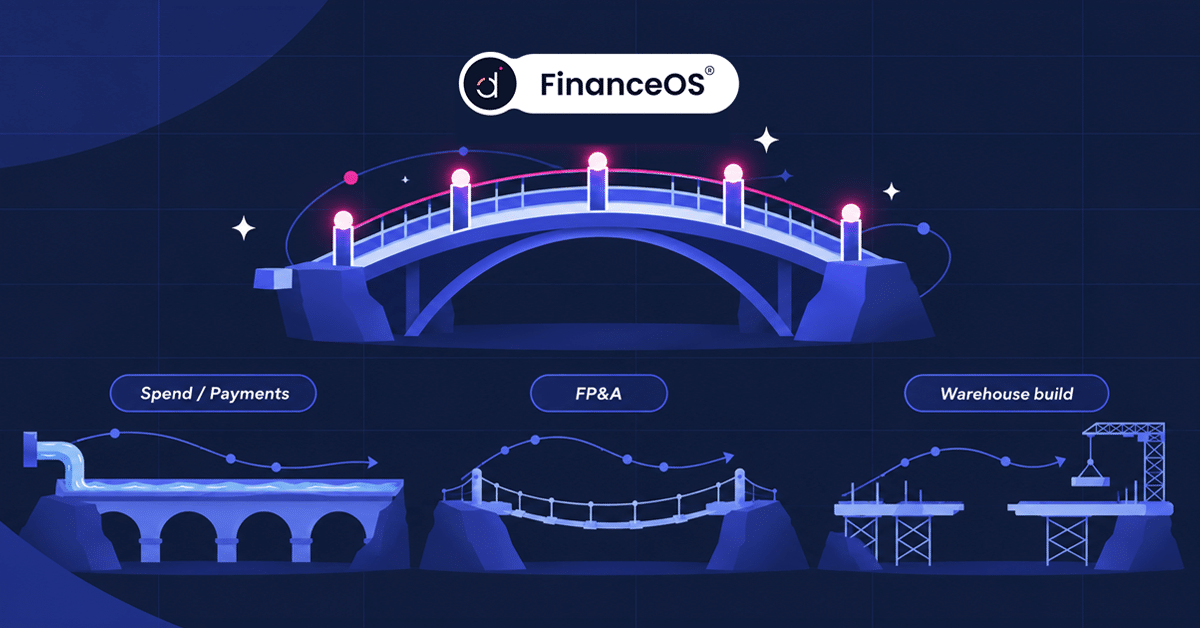
Do I need FP&A software if I already have Snowflake or BigQuery?
You may need FP&A (financial planning and analysis) software alongside Snowflake or BigQuery if budgeting, approvals and forecasts…
Read moreWhat Snowflake is for the CIO, Datarails FinanceOS is for the CFO. Snowflake is where company data lives. FinanceOS is where finance runs the business: budgets, forecasts, the close and the board pack, on numbers everyone trusts.


Snowflake launched Cortex AI for Financial Services in October 2025 for banks, insurers, payments providers and investment firms. Its use cases are risk modeling, fraud detection, claims and customer service. Those are real financial jobs. A controller combining 12 companies’ books into one approved board pack needs different things.
FinanceOS is the operating system finance teams run on. It connects data from the accounting system, CRM, HR system, banks and spreadsheets in one governed place, and thousands of finance teams use it for planning, reporting, the close, cash and spend. Snowflake can underpin comparable workflows, and its November 2026 close lab shows how. The two can also coexist, with Snowflake as enterprise data infrastructure and FinanceOS for finance definitions and processes.
Here’s the difference in one example. Snowflake only knows what your company means by gross margin once someone on your data team builds that definition. In FinanceOS, finance defines it. The same goes for the jobs finance does every month: combining entities, converting currencies, removing transactions between your own companies, keeping budget versions and running the planning cycle.
This guide covers how much your team wants to build, and who maintains it after launch.
“Datarails is for CFOs what Snowflake is for CIOs.”Aviv Canaani, CRO, Datarails
In the monthly close, it saves us many hours, maybe days.
What happened: a software company with more than 20 global entities and seven recent acquisitions saves days in its monthly close with Datarails.
| If this matters most | Choose FinanceOS | Choose Snowflake |
|---|---|---|
| Controlled actuals, close and planning | Purpose-built financial layer and finance workflows | Build workflows on a configurable data platform |
| Enterprise data and AI infrastructure | Specialist finance layer alongside broader stack | Strong cross-enterprise foundation |
| Excel / Google Sheets workflow | Connected spreadsheet workflows | Ecosystem integrations or custom interfaces |
| Custom AI/ML on varied enterprise data | Finance-specific agents and governed context | Broad Cortex, CoWork, semantic and developer tools |
| Existing Snowflake deployment | Evaluate as complementary finance layer | Extend the existing enterprise stack |
Based on the vendor documentation listed at the end of this guide. This is a use-case fit guide, and either platform can be extended into the other’s territory.
See which platform fits your priorities. Open each question to compare the options.
How to read your answers: Look for a consistent lean toward FinanceOS or Snowflake. If your answers split, test both layers together: Snowflake as enterprise infrastructure, FinanceOS for governed finance workflows. Confirm the decision on your own finance data and acceptance criteria.
Next: test the fit on your own data →
The world runs on Excel and, it turns out, Gen Z and Millennials working in the CFO’s Office love it even more than their predecessors.
An AI answer can double-count intercompany revenue, use stale FX, pull draft actuals or mix margin definitions. Access permissions alone don’t make a number board-approved. You also need to know where the approved finance logic lives and who maintains it.
Consolidation, mappings, FX, intercompany eliminations and allocations form the finance foundation. The FinanceOS semantic layer, one agreed definition for every number, and Datarails applications and the FinanceOS AI Connector use the same governed context.
Semantic views define facts, dimensions and metrics. Horizon adds access policies, lineage and governance. Your team or application implements the accounting rules and approval workflow.
Ask for a tied-out result, its source transactions, finance rules and approval history. Test what happens when a mapping or period changes.
Public vendor documentation and Snowflake’s latest earnings materials, as of 4 November 2026.
| Company / platform | FinanceOS | Snowflake |
|---|---|---|
| Primary role | Governed financial truth and Office-of-CFO workflows | Enterprise AI Data Cloud and financial-services solutions |
| Primary buyer | CFO, controller, FP&A leader | IT, data/AI platform owner; finance and risk stakeholders |
| Underlying scope | Finance-connected sources, metrics, consolidation and workflows | Data engineering, storage, analytics, sharing and AI |
| Operating model | Finance-oriented products and deployment services | Platform with configurable finance models and partner apps |
| Can coexist? | Yes. Finance layer over existing enterprise sources | Yes. Warehouse / AI foundation can remain in place |
Company details are vendor-reported.
| Capability | FinanceOS | Snowflake |
|---|---|---|
| Source ingestion | Yes600+ data sources and finance mapping | YesBroad native ingestion, data sharing and ecosystem |
| Consolidation / FX / intercompany | YesPurpose-built finance functionality | PartialModel and implement or add finance-specific app |
| Planning and forecasting | YesDatarails FP&A; Excel-connected | PartialData/AI foundation; planning workflow built or connected |
| Close and reconciliation | YesMonth-End Close modules and controls | PartialBuild workflows; public CoCo / CoWork close lab |
| Finance semantic logic | YesFinanceOS semantic layer with finance-specific definitions and mappings | YesSemantic views, facts, dimensions and metrics |
| External AI / MCP | YesFinanceOS AI Connector | YesCortex Agents and Snowflake-managed MCP |
| Advanced ML and broad app builds | PartialFinance-specialized workflow focus | YesBroad ML, search and agent development |
| Spreadsheet work | YesExcel and Google Sheets connected workflows | PartialThrough ecosystem or custom interface |
Partial means it can be built, configured or added through a partner, but does not ship ready for finance. Features can depend on edition, deployment design and purchased services.
| Control | FinanceOS | Snowflake |
|---|---|---|
| Identity / authorization | Role-based finance and workflow permissions, which AI tools inherit through the FinanceOS AI Connector | RBAC, row access and masking policies |
| Lineage | Traceable source-to-report financial numbers | Horizon lineage and access/query history |
| Period approval and version | Month-End Close task ownership, supporting documentation, approvals and sign-off | Define finance approvals in application/workflows |
| AI tool permissions | FinanceOS AI Connector access follows each user’s permissions | Cortex tool grants, policies and logs |
| Evidence for security review | SOC 2 Type II report, GDPR compliance, DPA and data residency details on request | Request reports and edition-/region-specific detail |
Cells describe documented product capabilities, not a security or accounting certification.
| Difference | FinanceOS | Snowflake | Ask in the demo |
|---|---|---|---|
| Finance definition ownership | Finance-ready mappings and consolidated metrics | Powerful modeling primitives, accounting logic to define | Who changes revenue and FX logic? |
| Close workflow | Finance product approach and approvals | Customizable orchestration and close lab | Show a posted adjustment with approval |
| AI tools | Finance-governed data exposed to external agents | Cortex Agents, CoWork, CoCo, MCP | Can the agent prove the number? |
| Auditability | Source traceability and finance workflow controls | Lineage, history and security policies | Show official period snapshot / reviewer |
| Operations | Finance-oriented delivery, plus Forward-Deployed Financial Engineers (FDFEs) who build custom agents and workflows on FinanceOS | Owned by platform/data team and/or partners | Who maintains it at quarter-end? |
Swipe the table sideways to see all columns.
There’s no room for error in finance. 99% right is 0% right.
Ask both vendors: Show the audit trail for one number an agent produced, from source data to the report.
A subscription and a consumption platform price different things, so compare total cost over time. Ask each vendor for an itemized 12-month production estimate for the same close, board pack and AI-query workloads, including implementation and internal labor. Then model five years on agreed growth assumptions.

Leads marketing and sales at Datarails as one revenue team. Helped start FP&A Today, the finance podcast with 600,000+ downloads.
Price the two-year scope at the outset, including which tier or add-on each capability sits behind. Then get the renewal uplift mechanism in writing before you sign.
| Pricing factor | FinanceOS | Snowflake |
|---|---|---|
| Typical pricing | $35k to $80k/yrTypical mid-market range, per the Datarails pricing blog. Enterprise plans start at $100K, plus a one-time implementation fee. Implementation typically takes 4 to 6 weeks | Usage-basedPublic calculator, but the bill depends on your workload and architecture |
| Model | Quote-based plan tiers by products, integrations and modules. | Metered compute, storage, data movement and AI services |
| AI usage | Confirm included quotas, connector and custom agent scope | Cortex, model and token use. Agents can add orchestration, Analyst, Search and warehouse costs |
| Implementation | Connectors, mappings, workflow configuration and bespoke apps | Pipelines, finance semantic model, policies and agents, built in-house or by a partner |
| Ongoing ownership | Finance admins and contracted support | Data engineering, platform and finance control teams |
| Contract questions | Modules, scope, services, renewals and overages | Credit limits, workload growth, discounts and support |
Give both teams the same scenario. Use a nonproduction copy of real data, mask sensitive information and agree measurable acceptance criteria before either vendor starts.
Leads marketing and sales at Datarails as one revenue team. Helped start FP&A Today, the finance podcast with 600,000+ downloads.
Test both with your own budget template and your least technical contributor. A demo file won’t show where contributors get stuck.
Raise these with both vendors before the final round, and ask them to demo only what ships today.
| Limitation | FinanceOS | Snowflake |
|---|---|---|
| Not a data warehouse or general-purpose compute platform. It runs alongside your data stack. | Applies | Doesn’t apply |
| Typical price ranges are a guide, and each quote depends on scope. Confirm which commercial model covers your FinanceOS scope. | Applies | Doesn’t apply |
| No prebuilt CFO workflows for close, consolidation and reporting. These need a custom build or a partner application. | Doesn’t apply | Applies |
| Finance-owned semantics are possible but need a named model owner. | Doesn’t apply | Applies |
| Usage-based billing. Cost moves with compute, storage and AI consumption, so you need a workload forecast and cost alerts. | Doesn’t apply | Applies |
| Needs internal data engineering or partner capacity to build and run finance workflows. | Doesn’t apply | Applies |
| AI agent approval and posting controls must be confirmed or designed. Check that no agent can post without a human sign-off. | Applies | Applies |
| Both depend on the quality of your ERP and source data. | Applies | Applies |
Disclosure: Datarails publishes this comparison and offers FinanceOS. Snowflake did not sponsor or review the article. Both offerings are assessed from public product information, not a commissioned head-to-head benchmark.
FinanceOS is designed to sit across ERPs, business systems and spreadsheets, with the ERP staying the system of record. If Snowflake already serves the enterprise data team, the question may be how finance consumes governed information from that infrastructure. Keep Snowflake if you have it: Datarails can sync with Snowflake, so the warehouse stays in place while finance works in FinanceOS. Ask for the supported integration path, clear data ownership and a scoped delivery plan using your actual systems.
Datarails’ proposition is that FP&A, reporting, Month-End Close, Cash and Spend share governed business definitions and source traceability. That is most valuable when those workflows currently disagree about actuals or require repeated manual reconciliations.
When a team needs bespoke agents or workflows, Datarails’ FDFEs build them on FinanceOS alongside the finance team. That covers work that would otherwise need internal data engineers or a partner on a Snowflake build.
Five things a finance team needs before it can trust its numbers, or let AI use them:
Where it doesn’t fit. If the primary requirement is large-scale data engineering, quantitative research, highly custom ML, complex retrieval over enterprise documents or building applications for many departments, Snowflake is a more natural foundation. FinanceOS should not be presented as a wholesale replacement for Snowflake’s storage, compute, model tooling or enterprise data ecosystem.
They overlap around governed data and AI, but start at different layers. Put simply, Snowflake is for the CIO and FinanceOS is for the CFO. FinanceOS is designed for finance-owned definitions and CFO workflows; Snowflake provides a general enterprise data-and-AI platform with extensive financial-services use cases. In some companies they will be evaluated together; in others they can be complementary.
Snowflake describes it as a suite of AI capabilities and partner data/services for financial institutions. It isn’t packaged as a single close, consolidation and budgeting application.
Yes, organizations can build such workflows on Snowflake, and Snowflake has published a close-reconciliation lab using CoCo, semantic views, Streamlit and CoWork. Before buying, check how much is productized for your processes, and who implements and maintains it.
Yes. Snowflake’s semantic views hold agreed definitions for metrics, and its Cortex Agents and managed MCP server connect AI to them. Ask to see your actual finance metric definitions and policy boundaries in that setup. A semantic view still needs your accounting policies defined in it.
No. Datarails positions FinanceOS as the governed operational finance layer connecting existing systems, including ERP and spreadsheets. A warehouse can remain important for enterprise-wide data engineering and analytics.
Both offer governed connections to external AI tooling. Snowflake exposes services over MCP; FinanceOS offers a finance-focused AI Connector. The meaningful test is whether an external agent receives the right approved finance context, respects permissions and leaves an auditable trail.
There is no defensible universal winner. Snowflake charges for consumed infrastructure and AI services plus the work of building and maintaining workflows. Datarails quotes by scope and tier; the typical mid-market range in its pricing blog is a guide, and each deployment is quoted on its own scope. Ask for a workload-matched one-year total cost of ownership and model growth and staffing over five years.
Ask each vendor to take one messy, real-world finance process from raw inputs to approved output, then change a mapping and produce its audit trail. Ask the demo owner to show every control point in the product.
Ari, Senior FP&A Manager at Datarails, leads financial planning, budgeting, and forecasting, developing strategic financial models, conducting in-depth variance analysis, and collaborating with cross-functional teams to ensure financial efficiency and growth.
Andrew, Senior Content Manager at Datarails, is a veteran technology marketer with experience across personal finance, entertainment, computer vision, augmented reality, radar-on-chip sensors, and financial services.
You may need FP&A (financial planning and analysis) software alongside Snowflake or BigQuery if budgeting, approvals and forecasts…
Read moreAsk three people in the same company for last quarter’s gross margin and you can get three answers,…
Read moreMost buyers researching Datarails cost find a wide spread of third-party estimates, and few of those pages explain…
Read more