2026 CFO Sentiments: How AI Is Changing Finance Departments
CFOs were late to the AI party. Of course, they were right to approach AI with caution. There’s no room for error in finance. 99% right is 0% right. AI hallucinations have simply posed an unacceptable level of risk for finance leaders whose insights guide business-critical decisions. However, frontier AI models have changed the equation, offering unprecedented analytical power. The new consensus among finance leaders is that the benefits must be embraced and that the risks can be mitigated.
Significant hurdles remain, especially around trust, governance, and auditability, as well as ongoing challenges related to scattered and siloed data. According to KPMG, the transition to AI operating systems marks a major pivot for finance leaders, shifting the function from fragmented legacy tools to a unified, proactive capability that drives enterprise strategy. An AI-ready data foundation, with a semantic layer to lock in KPI definitions, solves the longstanding issue of data fragmentation by aligning disparate data sources into a single, cohesive business language.
This year’s CFO Sentiments Survey takes the CFO’s temperature on AI, revealing transformed finance processes and a direct impact on core finance tasks, headcount and output. This report provides benchmarks and insights for CFOs, finance directors, VPs of finance, and all levels of the finance function.
Methodology
This report was administered online by Global Surveyz Research, an independent global research firm. It surveyed 270 US CFOs and finance leaders, to shed light on the current state of AI in finance. Respondents work for organizations of 1,000+ employees, with an annual revenue of $100M+. They were recruited through a global B2B research panel and invited via email to complete the survey, with all responses collected during July 2026. Where results are shown by respondent segment, segment base sizes range from n=35 to n=197.
Key Findings
- Only 4% of finance teams report having a ‘single source of truth’Despite decades of touted progress, only 4% of organizations have achieved a single source of truth for finance and operational data. 73% say their data is “mostly centralized” while 23% rely on disconnected systems and manual reconciliation. Closing this gap is a priority, since AI tools and agents depend on consolidated, contextualized data.
- Three-quarters of finance teams are “under pressure” to implement AI76% of CFOs are under high or very high pressure to fully implement AI, but only 7% say their finance function is fully ready to implement AI across all workflows.
- Almost a third of organizations blew through AI budgets in the past 12 months32% of organizations exceeded their AI budgets by at least 10% in the past year. Nevertheless, 53% of finance leaders plan to expand AI licenses across their organizations over the next 12 months.
- Finance operational challenges are a significant barrier to clean AI outputsThe biggest operational challenge is manual reporting and data consolidation (32%), followed by an inability to produce ad-hoc analysis quickly enough for leadership (19%). This situation presents a significant challenge, potentially leading to AI outputs based on missing, inconsistent, or plain wrong data.
- 96% of finance teams spend at least 10% of their time verifying AI outputsWith every CFO now using AI, almost all spend at least 10% of their workday verifying or correcting finance AI outputs. 56% spend 10–25% of their time on it; 32% spend 26–50% of their day. The burden is heavier where systems are disconnected: 76% of those CFOs spend more than a quarter of their time on AI verification.
- Copilot is the frontrunner as the main tool in the CFO’s officeThe top general-purpose AI tools used by finance teams are Microsoft Copilot (93%), ChatGPT (65%), and Claude (64%).
- Lack of auditability is the biggest obstacle for CFOs using AILack of auditability (75%) is the single biggest reason CFOs hesitate to fully trust AI with mission-critical tasks, closely followed by concerns about accuracy and hallucinations (71%).
- 60% are moving staff to higher-value work rather than reducing headcountMost CFOs (60%) say that as AI takes on more finance tasks, they are redeploying staff rather than letting them go. The previous CFO Sentiments Survey found most CFOs expected AI to lead to layoffs.
- The finance operating system gains major tractionPlanning and FP&A tools remain the top technology purchase priority (42%). Next is a finance operating system (32%): a governed data layer that ensures consistent, audit-ready, AI-compatible numbers. That tracks with another finding: 56% say team members have received materially different LLM outputs from the same prompt and data.
Until as recently as March 2026, when Datarails launched FinanceOS®, the “finance operating system” category for the Office of the CFO was unknown. A few months later, a third of respondents are actively prioritizing purchasing one. This shift highlights the fact that AI tools require a governed data foundation to ensure accuracy and consistency.
How Will Rising AI Momentum Affect AI Budgets?
The AI budget sits squarely with the CFO, and the pressure to spend it well is intense. Three-quarters of finance leaders are under high or very high pressure to fully implement AI, a marked shift from the “tread with caution” attitude of the previous survey. Meanwhile a third of organizations have already overshot their AI budgets, and most still plan to spend more.
Who Owns the AI Budget?
- CFO / Finance 84%
- No clear owner 13%
- CTO / IT 3%
Insights
- In almost all of the organizations surveyed (84%), the total AI budget is owned by the CFO or finance leader, with just 3% assigning responsibility to the CTO or IT department
- As employees become increasingly dependent on AI in most or all of their workflows, costs continue to rise, adding a further challenge to CFOs’ budget-setting
- In 13% of organizations there is no clear owner of the AI budget: one in eight companies is at risk of allowing AI costs to spiral out of control
Three-Quarters of Finance Teams “Under Pressure” to Implement AI
View the data as text
| Answer | Share |
|---|---|
| Low | 1% |
| Moderate | 23% |
| High | 67% |
| Very high | 9% |
Insights
- 76% of finance leaders are under high (67%) or very high (9%) pressure to fully implement AI
- This contrasts with the previous CFO Sentiments Survey, where the prevailing attitude toward AI implementation was still “to tread with caution.” AI has evolved dramatically, and so has leaders’ confidence in its ability to optimize operations
- Only a small portion of respondents, however, feel their finance department is fully ready to implement AI across all workflows from a data and infrastructure perspective (see Figure 15)
Finance & Accounting Software Spend in 2025
View the data as text
| Answer | Share |
|---|---|
| $50K-100K | 1% |
| $100K-150K | 10% |
| $150K-250K | 22% |
| $250K-350K | 32% |
| $350K-500K | 17% |
| $500K-750K | 9% |
| Over $750K | 9% |
Insights
- Finance teams surveyed spent an average of $361K in 2025 on payments or subscriptions for finance and accounting software
- Only 1% spent under $100K, while two-thirds (67%) spent more than $250K, and nearly one in ten spent more than $750K
- For CFOs building next year’s budget, the question is whether that spend is building toward AI-ready infrastructure or simply maintaining what is already there
Almost a Third of Organizations Blew Through AI Budgets in the Past Year
View the data as text
| Answer | Share |
|---|---|
| More than 10% under | 11% |
| Within ~10% | 57% |
| 10-25% over | 30% |
| 26-50% over | 2% |
Insights
- Almost a third of CFOs (32%) report that their organizations exceeded their AI budgets by at least 10% in the past 12 months
- Most organizations (57%) reported AI costs within a 10% margin of allocated budget. Some may still be giving employees free rein to experiment with AI tools
- As Figures 10, 11 and 12 show, AI hallucinations and inconsistencies produce outputs that require multiple prompts, causing AI token costs to creep up
Management of AI License Costs Over the Next 12 Months
- Expanding 53%
- Maintaining 40%
- Cutting / consolidating 7%
Insights
- About half of finance leaders (53%) plan to expand AI licenses over the next 12 months, while 40% plan to maintain current AI spend
- Only 7% are actively cutting or consolidating AI licenses to reduce spend
- The fact that most respondents plan to increase spend indicates that finance organizations have largely moved from experimentation with AI to implementation
Top AI Tools Currently Used by Finance Teams
Copilot ships with Microsoft 365, so it leads on reach. But ChatGPT and Claude are virtually tied as the tools finance teams turn to for in-depth financial and variance analysis and driver-based forecasting. On average, finance teams are running 2.5 LLMs, often using one to check the other.
Copilot Tops the AI Tools Favored by Finance Teams
View the data as text
| Answer | Share |
|---|---|
| Microsoft Copilot (outside Excel) | 93% |
| ChatGPT / OpenAI | 65% |
| Claude (Anthropic) | 64% |
| Google Gemini | 20% |
| Perplexity | 13% |
Insights
- The top general-purpose AI tools used by finance teams are Microsoft Copilot (93%), ChatGPT (65%), and Claude (64%). Copilot’s lead is unsurprising given it ships natively as part of Microsoft 365
- Perplexity is the least used tool, seen largely as a research LLM that has not found significant traction within finance
- Interest in ChatGPT and Claude is virtually tied, with teams turning to these tools for in-depth financial and variance analysis and driver-based forecasting, while Copilot skews toward mechanical processes
- Finance teams run 2.5 LLMs on average, suggesting they are not ready to trust one AI tool to the exclusion of all others. In many cases tools run in tandem, with one used to verify the output of the other
Question allowed more than one answer; percentages add up to more than 100%
Most Commonly Used Finance-Embedded AI Tools
View the data as text
| Answer | Share |
|---|---|
| AI features within ERP | 89% |
| Excel with Microsoft Copilot | 88% |
| AI features within FP&A technology | 53% |
| AI features within Expense/AP tool | 44% |
| Not using any AI tools | 0% |
Insights
- All CFOs now use finance-embedded AI tools, with ERP systems (89%) and Excel with Copilot (88%) most commonly used. Over half of finance teams use AI features within their FP&A technology (53%) and 44% within their expense/AP tools
- With nearly a third of CFOs prioritizing an AI finance operating system, there is a natural ceiling on such embedded features. General-purpose LLMs advance exponentially faster than software stacks, so finance teams are gravitating toward a finance operating system model
- That model lets CFOs and their teams use Claude or ChatGPT directly for anything from FP&A to month-end close, AP and cash, contract management and spend control, underpinned by a finance data layer that cleanly consolidates finance and operating data, ready for AI
Question allowed more than one answer; percentages add up to more than 100%
The Current State of Finance Data
AI requires consolidated, contextualized data to generate reliable outputs. Yet only 4% of respondents have a single source of truth, and the single biggest operational challenge for finance teams is still the time spent on manual reporting and data consolidation.
Only 4% of CFOs Have a Single Source of Truth
View the data as text
| Answer | Share |
|---|---|
| Single source of truth | 4% |
| Mostly centralized | 73% |
| Spread across multiple disconnected systems | 23% |
| Heavily siloed | <1% |
- Single source of truth — 91–100% of core data is centralized and consistent
- Mostly centralized — 71–90% of core data is integrated, with minor gaps
- Spread across multiple disconnected systems — 40–70% centralized; requires frequent manual reconciliation
- Heavily siloed — less than 40% centralized; majority of data in disconnected systems
Insights
- Despite decades of technological progress in data consolidation, only 4% of respondents report their organization has a single source of truth, where core data is centralized and consistent
- Most respondents (73%) report their data is “mostly centralized” but with minor gaps. In finance, even minor gaps are problematic, and when it comes to probabilistic AI, LLMs tend to fill blank spaces with smart guesses
- Only one respondent reported data that is “heavily siloed,” but almost a quarter (23%) say their data is spread across multiple disconnected systems requiring manual reconciliation
- There is much work to be done to shift finance data from “disconnected” or “mostly centralized” to a single source of truth, a pressing challenge since AI requires consolidated and contextualized data to generate reliable outputs
Manual Reporting & Consolidation Is the Biggest Challenge
View the data as text
| Answer | Share |
|---|---|
| Too much time on manual reporting & data consolidation | 32% |
| Inability to produce ad-hoc analysis quickly for leadership | 19% |
| Managing spend and expenses across the organization | 13% |
| Keeping up with the pace of AI and technology change | 13% |
| Lack of real-time visibility into cash position | 11% |
| Month-end close takes too long | 8% |
| Hiring and retaining skilled finance talent | 4% |
Insights
- The single biggest operational challenge for finance teams is too much time spent on manual reporting and data consolidation (32%), which is unsurprising given that most teams are not yet operating from a single source of truth
- The second biggest challenge is the inability to produce ad-hoc analysis quickly enough for leadership (19%), a pressing issue in the AI era, since CFOs are now expected to provide instant or near-instant data and insights

AI Time Sinks and the Trust Gap
Confident answers built on the wrong data, different outputs from the same prompt, and numbers no one can trace. These are the everyday AI frustrations of finance teams, and they translate directly into hours of verification and a reluctance to trust AI with anything beyond drafting emails.
Biggest AI Challenges Experienced by Finance Teams
View the data as text
| Answer | Share |
|---|---|
| AI gave a confident answer based on the wrong data | 65% |
| Two team members got materially different outputs from same prompt/data | 56% |
| We couldn't explain or trace how AI reached a number when asked | 51% |
| A vendor oversold AI capabilities that didn't deliver in practice | 40% |
| AI produced a financial figure we later discovered was fabricated | 22% |
| An AI report went to leadership/board before an error was caught | 16% |
Insights
- Nearly two-thirds (65%) of CFOs say their most common AI frustration is outputs giving confident answers based on the wrong data
- 56% have seen team members receive materially different outputs from an LLM despite using the same prompt and data. Unless an LLM is restricted to governed, consolidated, contextualized data, successive responses frequently differ
- 51% have been unable to explain or trace how AI reached a number, which ties directly to the 75% who cite lack of auditability as the biggest factor preventing trust in AI (Figure 14)
Which teams were handed an AI answer built on the wrong data?
View the data as text
| Answer | Share |
|---|---|
| Manual reporting and data consolidation | 86% |
| Keeping up with the pace of AI | 62% |
| Ad-hoc analysis for leadership | 56% |
| Managing spend and expenses | 54% |
- Among CFOs who experience high levels of manual reporting and data consolidation, 86% suffered wrong AI answers. Finance teams whose data isn’t AI-ready are far more likely to experience inaccurate outputs
Question allowed more than one answer; percentages add up to more than 100%
96% of Finance Teams Spend at Least 10% of Their Day Verifying AI Outputs
- <10% of time 4%
- 10–25% of time 56%
- 26–50% of time 32%
- >50% of time 8%
Insights
- With every CFO now using AI, almost all spend at least 10% of their entire workday verifying or correcting finance-specific AI outputs. 56% spend 10–25% of their day on it, and nearly a third (32%) spend 26–50%
- These findings reflect an ongoing lack of trust in LLMs, as well as finance leaders’ uncompromising attitude to accuracy and auditability
- Are the productivity gains offered by AI in danger of being canceled out? And are finance professionals at risk of burnout caused by endless rounds of QA?
Which teams lose the most time verifying AI?
View the data as text
| Data state | 10–25% of time | 26–50% of time | >50% of time | More than ¼ of time |
|---|---|---|---|---|
| Mostly centralized (73% of respondents) | 69% | 23% | 8% | 31% |
| Spread across disconnected systems (23% of respondents) | 24% | 66% | 10% | 76% |
- Three-quarters (76%) of teams with data spread across disconnected systems spend more than a quarter of their time verifying AI, compared with 31% of teams whose data is mostly centralized. This highlights how crucial data consolidation is to AI accuracy
Only “Lowest Level” Finance Tasks Trusted to AI Without Human Review
View the data as text
| Answer | Share |
|---|---|
| Drafting emails | 89% |
| Summarizing meetings | 84% |
| PowerPoint presentation creation | 46% |
| Data consolidation from multiple sources | 45% |
| Expense categorization and coding | 44% |
| Revenue forecasting | 23% |
| Variance analysis | 13% |
| Cash flow management | 11% |
| Spend control | 11% |
| Board-ready financial reports | 5% |
| Month-end close | 4% |
| I will not trust AI for anything without review | 3% |
Insights
- CFOs only leave AI alone, without human review, for the lowest-level finance-adjacent tasks: most commonly drafting emails (89%) and meeting summaries (84%)
- Only 23% of CFOs trust AI alone for revenue forecasting. This falls to 13% for variance analysis, 11% for cash flow management and spend control, 5% for board-ready financial reports, and 4% for month-end close tasks
- 3% of respondents would categorically not trust an AI’s final output for any financial task without human review
Question allowed more than one answer; percentages add up to more than 100%
Lack of Auditability Is the Biggest Obstacle for CFOs Using AI
View the data as text
| Answer | Share |
|---|---|
| Inability to audit or explain how AI reached its output | 75% |
| Concerns about accuracy and hallucination | 71% |
| Regulatory or compliance concerns | 54% |
| Data privacy concerns | 49% |
| Financial data is fragmented across too many systems | 38% |
| Lack of AI skills on the finance team | 26% |
| No executive buy-in for AI in finance | 12% |
Insights
- Lack of auditability (75%) is the biggest reason for CFOs’ hesitation to fully trust AI tools with mission-critical finance tasks, closely followed by concerns about accuracy and hallucinations (71%) and regulatory or compliance concerns (54%)
- As finance leaders prepare to embrace AI across all key workflows and significantly increase reporting and forecasting depth, the ability to answer “where did this number come from?” becomes critical, whether the CEO, the board, or an auditor is asking
Question allowed more than one answer; percentages add up to more than 100%
How AI-Ready Are Finance Teams’ Data & Infrastructure?
Three-quarters of CFOs are under pressure to fully implement AI. Only 7% feel fully ready to do it. The gap between mandate and readiness is the defining tension of this year’s survey.
Readiness of the Finance Function for AI Implementation Across All Workflows
- Fully readyData infrastructure, tools and skills in place7%
- Mostly readyData gaps around governance and auditability71%
- Partially readySignificant gaps in governance, auditability, or skills22%
Insights
- Most CFOs (93%) are not quite ready to implement AI across all workflows. 71% feel “mostly ready,” citing data gaps around governance and auditability, and 22% feel “partially ready,” admitting significant gaps in data governance, auditability, or skills
- Only 7% feel their finance function is “fully ready,” with the necessary data infrastructure, tools, and skills in place
- This supports the earlier finding that only 4% of respondents have a single source of truth. Such a small share feeling fully ready highlights a massive gap that finance teams must close to realize the full potential of the technology
Strategic Priorities in Technology Investment and Headcount
The layoff fears of the previous survey have not materialized. Most CFOs are redeploying people to higher-value work. On the technology side, planning and FP&A tools still top the shopping list, but a category that did not exist a year ago, the finance operating system, is now the second priority.
Is AI Taking Finance Jobs?
View the data as text
| Answer | Share |
|---|---|
| Redeploying staff to higher-value work rather than reducing headcount | 60% |
| Freezing hiring but not reducing existing headcount | 9% |
| Too early to make any headcount decisions related to AI | 9% |
| Growing headcount thanks to AI | 7% |
| Growing headcount unrelated to the impact of AI | 7% |
| No plans to change headcount as a result of AI | 5% |
| Actively reducing headcount where AI has replaced work | 3% |
Insights
- In a positive finding, most CFOs (60%) say that as AI accomplishes more everyday finance tasks, they are redeploying staff to higher-value work rather than reducing headcount. Only 3% are actively reducing headcount where AI has replaced work
- The previous CFO Sentiments Survey found that most CFOs believed AI would lead to layoffs in their departments. Those fears have been allayed
- Organizations still urgently need to tackle AI output verification to eliminate low-value work and let finance teams do the strategic work they were hired for
What Technology Do CFOs Want?
View the data as text
| Answer | Share |
|---|---|
| A planning and FP&A tool that improves forecasting and budgeting workflows | 42% |
| A finance operating system | 32% |
| A financial close and reporting tool | 14% |
| A BI or visualization layer on top of our existing data | 12% |
| Not planning a finance technology investment in the next 12 months | <1% |
Insights
- The top priority for CFOs evaluating their next finance technology investment is a planning and FP&A tool to improve forecasting and budgeting workflows (42%), followed by a finance operating system, a governed data layer ensuring consistent, audit-ready, AI-compatible numbers (32%)
- Until March 2026, when Datarails launched FinanceOS, the concept of a finance operating system for the Office of the CFO was entirely new. Today one-third of respondents are actively prioritizing it as their next investment
- The rise suggests CFOs understand both the challenges of AI and the urgent need for a consolidated, consistent finance layer to pipe clean data into ever more powerful LLMs
Which teams are prioritizing a Finance OS?
View the data as text
| Answer | Share |
|---|---|
| Keeping up with the pace of AI | 50% |
| Manual reporting and data consolidation | 49% |
| Ad-hoc analysis for leadership | 19% |
| Managing spend and expenses | 11% |
- Two buying groups have converged on the need for a finance operating system. Of CFOs whose biggest challenge is manual reporting and consolidation, 49% are prioritizing one to assure AI-compatible data. At the same time, 50% of CFOs struggling to keep up with the pace of AI and technology change are prioritizing a finance operating system as an essential prelude to their AI journey
Who Took Part in the Survey
270 US CFOs and finance leaders responded, all at organizations with 1,000+ employees and $100M+ in annual revenue, across 16 industries. Respondents were recruited through a global B2B research panel and surveyed online by Global Surveyz Research in July 2026.
Industry
View the data as text
| Answer | Share |
|---|---|
| Retail & eCommerce | 11% |
| Information Technology | 11% |
| Software Development | 11% |
| Health & Pharma | 9% |
| Energy & Utilities | 8% |
| Financial Services | 8% |
| Telecom | 7% |
| Manufacturing | 7% |
| Banking | 6% |
| Insurance | 5% |
| Transport & Logistics | 5% |
| Travel & Hospitality | 4% |
| Media | 3% |
| Technology (excl. software development) | 3% |
| Food | 1% |
| Construction | 1% |
Company Size
- 1,000 – 2,000 people 71%
- 2,000+ people 29%
Company Revenue
View the data as text
| Answer | Share |
|---|---|
| $100M-$299M | 16% |
| $300M-$499M | 27% |
| $500M-$799M | 34% |
| $800M-$999M | 19% |
| Over $999M | 4% |
Job Seniority
- C-Suite 29%
- Director 36%
- VP 35%
The AI Operating System for Finance Teams
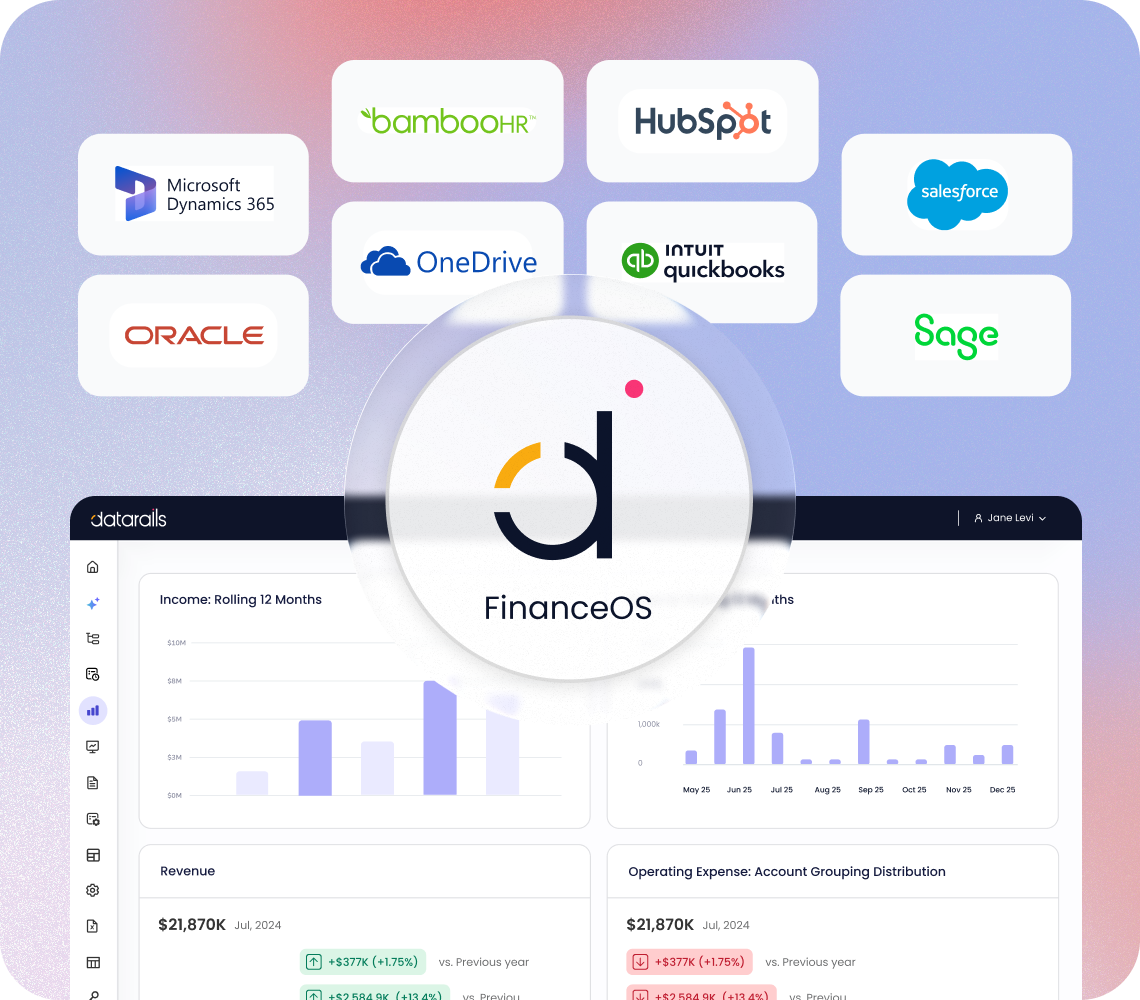
Uniting your data sources, FinanceOS is the trusted data layer that ensures every AI output is accurate, governed, and auditable. Keep your existing spreadsheet models while enhancing processes across FP&A, month-end close, cash management, ticketing, receivables, and spend.
Request a Demo