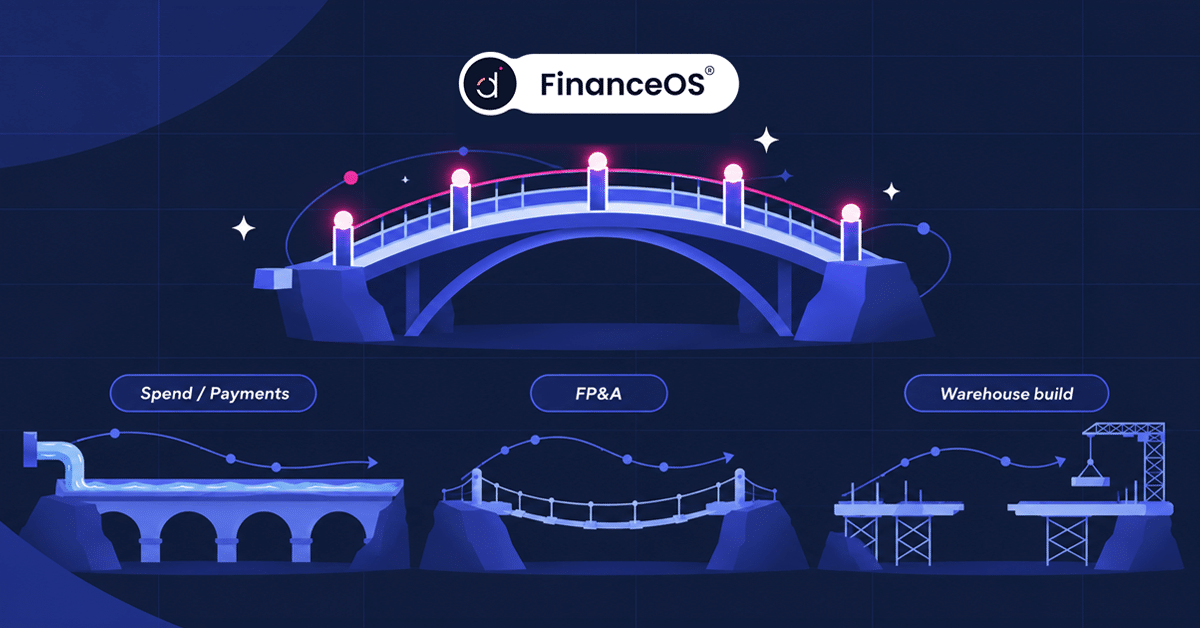
Do I need FP&A software if I already have Snowflake or BigQuery?
You may need FP&A (financial planning and analysis) software alongside Snowflake or BigQuery if budgeting, approvals and forecasts…
Read moreWhat Databricks is for the CIO, Datarails FinanceOS is for the CFO. Databricks is where company data and AI live. FinanceOS is where finance runs the business: budgets, forecasts, the close and the board pack, on numbers everyone trusts.


Databricks usually reaches finance through the data team. More than 20,000 organizations run data engineering, analytics and AI on it, and in August 2026 it passed a $7 billion revenue run rate. Its Genie assistant answers business questions in plain English, and in September 2026 it acquired Row Zero, a spreadsheet built on live company data. A controller combining 12 companies’ books into one approved board pack needs finance logic on top of all that.
FinanceOS is the operating system finance teams run on. It connects data from the accounting system, CRM, HR system, banks and spreadsheets in one governed place, and thousands of finance teams use it for planning, reporting, the close, cash and spend. Databricks can underpin similar workflows once your team builds them. The two can also coexist, with Databricks as the company’s data and AI platform and FinanceOS for finance definitions and processes.
Take gross margin. On Databricks, it becomes one agreed number once someone, usually on the data team, defines it in a metric view or Genie learns it from existing tables and queries. In FinanceOS, finance defines it. The same goes for the jobs finance does every month: combining entities, converting currencies, removing transactions between your own companies, keeping budget versions and running the planning cycle. On Databricks, your team builds each of those.
“Datarails is for CFOs what Databricks is for CIOs.”Aviv Canaani, CRO/CMO, Datarails
The biggest plus is that once we built our consolidation logic, including intercompany adjustments, we could apply it across all periods. We don’t have to rebuild reports month by month anymore.
What happened: a global manufacturer with 15 entities on different accounting systems cut its monthly consolidation from seven days to one or two, with more than 70 intercompany adjustments handled in Datarails.
The right choice depends on whether you need a finance layer or a data and AI platform for the whole company. Many companies end up with both.
| If this matters most | Choose FinanceOS | Choose Databricks |
|---|---|---|
| Controlled actuals, close and planning | Finance applications with approvals, ready to configure | Workflows your team or a partner builds on the platform |
| One data and AI platform for the whole company | A finance layer that connects to it | Data engineering, analytics and AI on one lakehouse |
| Excel or Google Sheets workflow | Excel-connected on Windows or Mac, plus native Google Sheets | Excel add-in and Google Sheets connector for pulling governed data |
| Custom AI and machine learning on all company data | Finance agents on governed finance data | Genie, Agent Bricks and developer tools for any data |
| Existing Databricks deployment | Add FinanceOS as the finance layer next to it | Extend the stack your data team already runs |
Sources: vendor documentation for both platforms. Either platform can be extended into the other’s territory.
See which platform fits your priorities. Open each question to compare the options.
How to read your answers: Look for a consistent lean toward FinanceOS or Databricks. If your answers split, test both layers together: Databricks as the company’s data and AI platform, FinanceOS for governed finance workflows. Confirm the decision on your own finance data and acceptance criteria.
Next: test the fit on your own data →
The world runs on Excel and, it turns out, Gen Z and Millennials working in the CFO’s Office love it even more than their predecessors.
An AI answer can double-count revenue between your own companies, use an old exchange rate, pull draft actuals or mix two margin definitions. Before a number reaches the board, someone has to know where the approved finance logic lives and who maintains it.
Combining entities, mapping accounts, converting currencies, removing transactions between your own companies and allocations form the finance foundation. The FinanceOS semantic layer, one agreed definition for every number, feeds every Datarails application and the FinanceOS AI Connector.
Unity Catalog metric views define measures and dimensions once for dashboards, Genie and SQL. Genie Ontology learns business terms from tables, queries and dashboards. Your team or a partner builds the accounting rules and the approval workflow.
Ask both vendors for a tied-out result, its source transactions, the finance rules applied and the approval history. Then change a mapping or reopen a period and see what updates.
Databricks is a private data and AI company valued at $190 billion, and Datarails is a venture-backed finance specialist, so their company profiles differ as much as their features. Figures come from public vendor documentation and Databricks’ August 2026 funding announcement, as of 10 November 2026.
| Company / platform | FinanceOS | Databricks |
|---|---|---|
| Category | AI operating system for finance teams (FinanceOS) | Data Intelligence Platform: data engineering, warehousing, analytics and AI on a lakehouse |
| Founded | 2015. Tel Aviv, Israel | 2013, by the creators of Apache Spark. HQ San Francisco, California |
| Ownership | Series C funding announced January 2026 | Private. $5bn round at a $190bn valuation, August 2026, with a revenue run rate above $7bn |
| Customers | – | More than 20,000 organizations, including 70% of the Fortune 500 |
| Primary buyer | CFO, VP Finance, FP&A leader | CIO, chief data officer, head of data engineering |
| Main users | The finance team: FP&A, controllers and the CFO | Data engineers, SQL analysts and data scientists, plus business users through Genie |
| Role in the stack | Finance layer across the accounting system, CRM, HR system, banks and spreadsheets | Company-wide data and AI platform on AWS, Azure or Google Cloud |
| Stated time to go-live | 4 to 6 weeks for most FP&A implementations | Not documented for finance workflows. Timing depends on your team’s or partner’s build |
| Can coexist? | Yes. Databricks is in the FinanceOS integration catalog | Yes. The lakehouse stays in place for company-wide data and AI |
Customer counts and the Datarails go-live time are company-reported.
| Capability | FinanceOS | Databricks |
|---|---|---|
| Source connections | Yes600+ data sources across ERP, CRM, HRIS and banking | YesLakeflow Connect managed connectors and Lakehouse Federation |
| Combining entities, currencies and intercompany | YesIncluded in every plan | PartialYour data team models it, or a partner application adds it |
| Budgeting, planning and forecasting | YesDatarails FP&A, Excel-connected | PartialBuilt on the platform or connected through a partner |
| Close management | YesMonth-End Close task ownership, supporting documentation, approvals and sign-off | PartialBuilt as a workflow by your team |
| Shared metric definitions | YesFinanceOS semantic layer, one agreed definition for every number | YesUnity Catalog metric views and business semantics |
| Excel connectivity | YesExcel-connected through the add-in, Mac included | PartialDatabricks Excel Add-in imports and queries data on Windows, Mac and the web |
| Google Sheets | YesNative Google Sheets integration, launched October 2026 | YesDatabricks Connector for Google Sheets, with writeback to Unity Catalog tables |
| In-product AI assistant | YesAI Assistant | YesGenie One and Genie Agents, generally available since June 2026 |
| Finance agents | YesInflow Agents, including Flux Analysis for close variances | PartialTeams build their own with Agent Bricks |
| Custom agents | YesCustom Agents built for your workflows by Datarails’ Forward-Deployed Financial Engineers | YesTeams build their own with Agent Bricks, with support for frameworks such as LangGraph and the OpenAI Agents SDK |
| Connection for outside AI tools | YesFinanceOS AI Connector for Claude, ChatGPT and Microsoft Copilot | YesManaged MCP servers. Genie One MCP is generally available, other endpoints in preview or beta |
| Data science and custom ML across the company | PartialML forecasting on finance data | YesNotebooks, MLflow and model serving |
Partial means conditional, limited or a paid add-on. Features can depend on edition, packaging and purchased services.
| Control | FinanceOS | Databricks |
|---|---|---|
| SOC 1 | Yes. Type II | Yes. Type II, on request from the account team |
| SOC 2 | Yes. Type II | Yes. Type II |
| HIPAA and PCI DSS | – | Yes. Compliance offerings on supported clouds |
| Access control | Yes. Permissions down to entity, department or report | Yes. Unity Catalog grants, row filters and column masks |
| AI tool permissions | Yes. FinanceOS AI Connector access follows each user’s permissions | Yes. Genie respects each user’s Unity Catalog permissions, and Unity AI Gateway sets AI budgets and routing |
| Self-service trust center | Yes. trust.datarails.com | Yes. Databricks Security and Trust Center |
| Evidence for security review | SOC 1 Type II and SOC 2 Type II reports, penetration test and information security policy through the trust center. GDPR compliance, DPA and data residency details on request | SOC 2 Type II report and ISO certificates through the trust center |
Cells describe documented product capabilities. None of them is a security or accounting certification.
Five differences tend to decide this evaluation, starting with who owns the finance definitions.
| Difference | FinanceOS | Databricks | Ask in the demo |
|---|---|---|---|
| Who owns finance definitions | Finance, in the FinanceOS semantic layer | Usually the data team, in metric views and Unity Catalog | Who changes revenue and currency logic, and how long does it take? |
| Close and planning workflows | Datarails FP&A and Month-End Close, with approvals built in | Built by your team or a partner on the platform | Show a posted adjustment with its approval. |
| Where finance works | Excel or Google Sheets, on Windows or Mac | Notebooks, SQL, dashboards and Genie, with spreadsheet connectors for pulling data | Can a budget owner update the forecast on the laptop they use today? |
| AI | AI Assistant, Inflow Agents and the FinanceOS AI Connector on governed finance data | Genie One, Genie Agents and Agent Bricks across all company data | Can the agent show where the number came from? |
| Operations | Datarails’ own implementation team, plus Forward-Deployed Financial Engineers (FDFEs) who build custom agents and workflows on FinanceOS | Your data platform team, often with a consulting partner | Who maintains it at quarter-end in year two? |
There’s no room for error in finance. 99% right is 0% right.
Ask both vendors: Show the audit trail for one number an agent produced, from source data to the report.
Databricks charges for what you use, and Datarails shares typical ranges in its pricing guide. The two price different things, so compare total cost over time. Ask each vendor for an itemized 12-month estimate for the same close, board pack and AI workloads, with implementation and internal hours included. Then model five years on agreed growth assumptions.

Leads marketing and sales at Datarails as one revenue team. Helped start FP&A Today, the finance podcast with 600,000+ downloads.
Price the two-year scope at the outset, including which tier or add-on each capability sits behind. Then get the renewal uplift mechanism in writing before you sign.
| Pricing factor | FinanceOS | Databricks |
|---|---|---|
| Typical pricing | $35k to $80k/yrTypical mid-market range, per the Datarails pricing guide. Enterprise plans start at $100K, plus a one-time implementation fee. Implementation typically takes 4 to 6 weeks | Usage-basedRates per Databricks Unit (DBU) in its price list. The bill depends on your workloads and cloud |
| Third-party median | – | $340,500 a year across company-wide Databricks contracts, from about $31,050 to $2.1 million (Vendr) |
| Model | Three plans, Professional, Premium and Expert, that differ on products, users, integrations and support level | Pay as you go or prepaid DBU commitments, with rates by workload. On classic compute, your cloud provider bills the servers separately |
| AI usage | AI Assistant and Inflow Agents in the platform. The FinanceOS AI Connector is included in every plan | Genie One and Genie Agents are free for users until January 31, 2027. That covers LLM usage only; compute is billed separately. From February 2027, each user gets 150 DBUs a month free (about $10.50 in US East), then pays per DBU. Service principals, other agents and model serving are billed by use |
| Implementation | One-time onboarding fee, delivered by Datarails’ own team | Your data team or a consulting partner builds the pipelines, finance model, policies and agents |
| Ongoing ownership | Finance admins, with Datarails support included in every plan | Data engineering and platform teams, plus finance owners for the logic |
Give both teams the same scenario. Use a nonproduction copy of real data, mask sensitive information and agree measurable acceptance criteria before either vendor starts.
Leads marketing and sales at Datarails as one revenue team. Helped start FP&A Today, the finance podcast with 600,000+ downloads.
Test both with your own budget template and your least technical contributor. A demo file won’t show where contributors get stuck.
Raise these with both vendors before the final round, and ask each one to show what is generally available today.
| Limitation | FinanceOS | Databricks |
|---|---|---|
| Has no data warehouse or general-purpose compute of its own. FinanceOS runs alongside your data stack. | Applies | Doesn’t apply |
| Each quote depends on scope, so typical ranges and list rates are a guide. | Applies | Applies |
| Ships no planning, consolidation or close application. These need a custom build or a partner application. | Doesn’t apply | Applies |
| Finance definitions in metric views need a named owner, usually on the data team. | Doesn’t apply | Applies |
| Usage-based billing. Cost moves with compute, storage and AI use, so you need a workload forecast and cost alerts. | Doesn’t apply | Applies |
| Spreadsheet connectors move data in and out. Planning models, versions and approvals have to be built. | Doesn’t apply | Applies |
| Several AI and governance features announced in June 2026, including parts of managed MCP, are still in preview or beta. | Doesn’t apply | Applies |
| AI agent approval and posting controls must be confirmed. Check that no agent can post without a human sign-off. | Applies | Applies |
| Both depend on the quality of your accounting system and source data. | Applies | Applies |
Disclosure: Datarails publishes this comparison and offers FinanceOS. Databricks did not sponsor or review the article. Datarails assessed both offerings from public product information and ran no commissioned head-to-head benchmark.
If Databricks already serves your data team, keep it. Databricks is in the FinanceOS integration catalog, so the lakehouse stays in place while finance works in FinanceOS. Ask for the supported integration path, clear data ownership and a delivery plan on your actual systems.
Datarails FP&A, Month-End Close, Cash, Spend, Receivables (coming soon) and Desk run on FinanceOS. They share the same definitions and source trail, which matters most when reports disagree about actuals or need manual reconciliation every month.
When a team needs bespoke agents or workflows, Datarails’ FDFEs build them on FinanceOS alongside the finance team. That covers work that would otherwise need internal data engineers or a partner on a Databricks build.
Five things a finance team needs before it can trust its numbers, or let AI use them:
Where it doesn’t fit. If the main requirement is large-scale data engineering, data science, custom machine learning or AI applications for many departments, Databricks is the more natural foundation. FinanceOS has no storage, compute or model tooling to replace the Databricks lakehouse.
They overlap around governed data and AI, and start at different layers. Put simply, Databricks is for the CIO and FinanceOS is for the CFO: Databricks is where company data lives, and FinanceOS is where finance runs the business. Some companies evaluate them together, and many run both.
Teams can build those workflows on Databricks with pipelines, metric views and agents. Databricks sells no packaged consolidation, planning or close application, so check how much your team or a partner would build, and who maintains it.
Yes. Unity Catalog metric views define measures and dimensions once for dashboards, Genie and SQL, and Genie Ontology learns business terms from existing tables and queries. Someone still has to put your accounting policies into those definitions, so ask who owns them.
No. FinanceOS connects to the systems you already run, including the accounting system, the data platform and spreadsheets. Databricks stays in place for company-wide data engineering, analytics and AI.
Databricks has an Excel add-in for Windows, Mac and the web that imports and queries governed data, plus a Google Sheets connector that can write back to tables. In September 2026 it acquired Row Zero, a spreadsheet built on live data. Datarails FP&A is Excel-connected, so planning models stay in Excel or Google Sheets with numbers drawn from FinanceOS.
Both connect outside AI tools. Databricks offers managed MCP servers, with Genie One MCP generally available. The FinanceOS AI Connector gives Claude, ChatGPT and Microsoft Copilot your finance data plus the FinanceOS semantic layer, one agreed definition for every number. In the demo, ask each agent for its source and check the audit trail it leaves.
It depends on the scope you price. Databricks charges for the computing, storage and AI you use, plus the work of building and maintaining finance workflows. Datarails quotes by products, users, integrations and support level, and the typical mid-market range in its pricing guide is $35,000 to $80,000 a year. Compare an itemized total for the same scope over one year, then model five.
Most Datarails FP&A implementations go live in 4 to 6 weeks. On Databricks, the timeline depends on how much finance logic your team or partner builds, from pipelines to the planning and close workflows.
Ask each vendor to take one real finance process from raw inputs to an approved report, then change a mapping and show the audit trail. Ask what each step costs, compute and AI included.
Ari, Senior FP&A Manager at Datarails, leads financial planning, budgeting, and forecasting, developing strategic financial models, conducting in-depth variance analysis, and collaborating with cross-functional teams to ensure financial efficiency and growth.
Andrew, Senior Content Manager at Datarails, is a veteran technology marketer with experience across personal finance, entertainment, computer vision, augmented reality, radar-on-chip sensors, and financial services.
You may need FP&A (financial planning and analysis) software alongside Snowflake or BigQuery if budgeting, approvals and forecasts…
Read moreAsk three people in the same company for last quarter’s gross margin and you can get three answers,…
Read moreMost buyers researching Datarails cost find a wide spread of third-party estimates, and few of those pages explain…
Read more