
Click for Takeaways: Cash Management Solutions
- Cash management solutions replace manual spreadsheet tracking by consolidating every bank account, entity, and currency into one real-time dashboard.
- The “FX effect” can move your cash balance with no operational change — a weaker euro can shrink dollar-reported cash even when sales are strong, so multi-currency businesses need automatic FX rate updates.
- Manual cash flow statements create four recurring problems: data inconsistencies across systems, slower month-end close, spreadsheet consolidation errors, and poor visibility into future liquidity.
- Spreadsheet-based cash tracking is error-prone at scale — research cited in the guide finds that 94% of spreadsheets used for business decisions contain at least one error.
- Automation improves cash accuracy through four mechanisms: direct integration with source systems, AI-driven categorization of transactions, real-time predictive dashboards, and automated reporting/alerts.
- Seven leading cash management solutions compared: Datarails Cash, HighRadius, Kyriba, Float, Rho, SAP S/4HANA Cash Management, and NetSuite Cash Management — each fits a different company size and existing tech stack.
- CFOs gain four strategic advantages from modern cash tools: proactive liquidity management, faster scenario planning, streamlined working capital, and more time for high-value analysis instead of data gathering.
For many companies, the next customer is just as likely to be on the other side of the world as in the next town. The same goes for their suppliers. Global operations mean that transactions cross borders and currencies, adding layers of complexity to liquidity planning and cash management solutions that can keep up with the pace.
To support their supply chains and shipping operations, organizations often maintain multiple bank accounts across various entities and territories.
As a result, finance teams must juggle separate cash flow spreadsheets for each subsidiary and currency before painstakingly piecing together a consolidated cash flow report.
Doing this manually is not only slow but also prone to human error.
For any CFO or FP&A team, balancing the books under these conditions becomes a daunting task.
Finance professionals increasingly need to approach cash management with the agility of an investment bank, and that requires equally powerful tools.
Modern cash management solutions offer this level of sophistication by consolidating all accounts into one real-time source of truth.
Unifying all your bank accounts and automatically updating balances in real time saves days of manual Excel work. What’s more, FX rates change constantly – by the minute or even the second.
The FX Effect: Understanding the Impact of Exchange Rates on Cash Flow Management
When your organization is dealing with multiple currencies, every shift in exchange rate alters the value of your cash balances, receivables, payables, and overall profitability.
It’s known as the “FX effect.”
Companies often see an “effect of exchange rates” line on their cash flow statements, which quantifies how currency fluctuations influenced liquidity during the period.
For instance, revenue earned in euros might translate to fewer U.S. dollars in a given quarter if the euro weakens, even though sales were strong.
In terms of cash management, this means the cash on your books can change simply due to currency conversion differences, not because of any operational cash movements.
CFOs need to plan for this FX volatility as part of their liquidity management strategies.
A sudden spike or drop in a currency’s value can impact your ability to meet obligations or accurately forecast cash. This is why a global cash management strategy has to incorporate FX risk mitigation.
Modern cash management software solutions can help on this front: some platforms automatically pull in daily exchange rates to adjust multi-currency cash balances.
This gives you constant visibility into your true liquidity position.
Datarails Cash, for example, automatically applies the latest exchange rates to your international transactions.
Handling FX conversions in real time allows CFOs to worry less about manual rate updates and focus more on strategy.
It also streamlines daily operations, delivering significant ROI from greater efficiency and exactness.
4 Challenges with Manual Cash Flow Statements
Relying on spreadsheets and manual processes for cash management may work in the simplest business contexts, but it quickly breaks down as complexity increases.
Here are some of the most notable challenges companies face with manual cash tracking and reporting:
Data inconsistencies between systems
When cash data is pulled from numerous bank portals and accounting systems and then re-entered into Excel, it’s easy for discrepancies or out-of-sync figures to creep in.
Different sources may use different formats or update on different schedules. The result? It’s nearly impossible to pin down a single version of the truth.
Delays during month-end close
Consolidating data from multiple accounts (often in various currencies) slows down the close process. By the time a manually compiled cash flow statement is ready, the figures may already be out of date, leaving leadership flying blind.
Errors from spreadsheet-based consolidation
Depending only on spreadsheets means relying on human data entry and formula maintenance.
One broken formula, missed cell, or copy-paste mistake can throw off an entire cash flow report.
These kinds of errors are alarmingly common, resulting in tedious reconciliation and incorrect decisions. In fact, 94% of spreadsheets used for business decision-making contain errors.
Limited visibility into future liquidity
Rigid spreadsheets make it difficult to project future cash needs or run “what-if” scenarios.
Without an automated, real-time view of cash, finance teams struggle to anticipate upcoming liquidity challenges. Because of these issues, more finance teams are adopting dedicated FP&A software instead of using only Excel for cash planning.
Robust cash visibility and planning are directly linked to business resilience and growth. Moving beyond manual processes is a no-brainer for modern finance departments.
Ensuring liquidity for day-to-day operations while putting idle cash to work is key to a healthy business.
Check out our guide to working capital management strategies to learn more about striking this balance.
7 of the Best Cash Management Solutions
There are now a number of tech solutions that can handle the complexities of cash management.
Here are seven of the best cash management solutions available, along with what each does best:
Datarails Cash

First up, we have Datarails Cash, which offers real-time, drill-down visibility into cash across multiple bank accounts with a single dashboard, plus direct Excel integration for those who love spreadsheets (which is pretty much everyone, right?.
Finance teams that need a unified, automated cash management solution to view liquidity across entities will find everything they need right here.
HighRadius
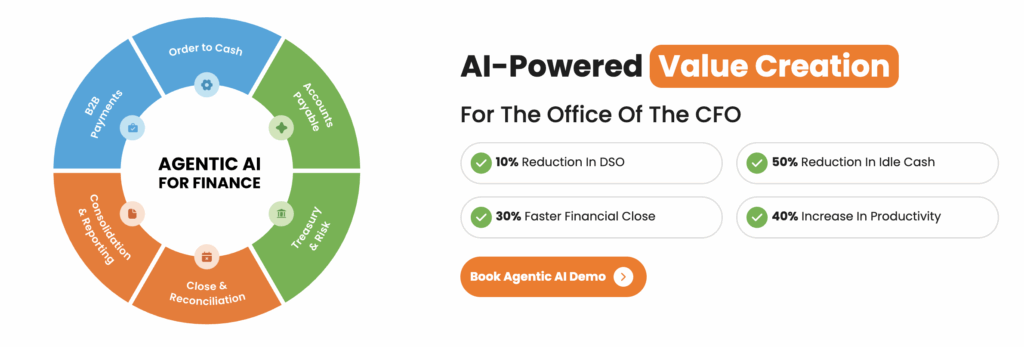
HighRadius is an AI-driven platform that automates cash flow forecasting and transaction reconciliation.
It’s best for mid-to-large businesses looking for advanced treasury automation and predictive cash insights.
Kyriba

Kyriba is a comprehensive treasury system offering features like global cash visibility, payments automation, and FX risk management.
It’s a popular choice for multinational enterprises seeking corporate cash management solutions for complex global operations.
Float

Float is a user-friendly cash flow forecasting tool that integrates with QuickBooks and Xero to auto-update projections.
Small and midsize businesses that want an easy way to model cash scenarios and visualize short-term cash flows without a steep learning curve might lean toward this option.
Rho

Rho is an all-in-one finance platform that combines treasury management with banking services (corporate cards, accounts payable automation, etc.).
It’s best for mid-market companies seeking a centralized solution to manage payables, cash balances, and even short-term investments (covering the full cash cycle from collections through treasury).
SAP S/4HANA Cash Management

This solution is a module within SAP’s ERP that centralizes bank account data, cash positions, and liquidity planning for companies in the SAP ecosystem.
Enterprises already using SAP that need integrated cash management and forecasting built into their core system might find that SAP S/4HANA Cash Management works well for them.
NetSuite Cash Management

Finally, we have a cash management feature set within NetSuite ERP that automates bank data imports and reconciliations.
NetSuite Cash Management tends to suit growing businesses (especially those on NetSuite) that want to streamline multi-account cash tracking and reporting without adding a separate tool.
Each of these tools aims to simplify cash management and improve visibility, though they vary in complexity and focus.
Some are lightweight apps perfect for startups, while others are enterprise-grade platforms designed for corporate cash management.
Before selecting a particular solution, consider your company’s size, the systems you already use, and the specific challenges you need to solve (e.g., forecasting accuracy or multi-currency management).
How Automation Improves Cash Flow Statement Accuracy
Embracing automation is one of the best moves a finance team can make to enhance accuracy and timeliness in cash reporting.
Here’s how automated tools and AI-driven processes improve the quality of your cash flow statements and forecasts:
Direct integration with source systems
Automated cash management solutions integrate directly with your ERP, accounting software, and banking systems. This means data (e.g., bank balances, transactions) flows in real time into one central repository.
By eliminating manual data entry and spreadsheet imports, you ensure that your cash data is always up-to-date and consistent across all sources. The result is a single source of truth that everyone from the CFO to treasury analysts can rely on.
AI-driven categorization of cash movements
Advanced platforms use AI and machine learning to categorize and forecast cash flows.
For example, an AI engine can automatically label transactions as operating, financing, or investing cash flows by analyzing descriptions and patterns, tasks that would take an employee hours each week.
Real-time dashboards and predictive analysis
Automation brings your cash data to life through dashboards and analytics. CFOs can view, present, and share live dashboards showing global cash positions by account, entity, or currency, and even see projections of future cash levels based on current trends.
Predictive algorithms can run “what-if” scenarios prompted by natural language descriptions, enabling on-the-fly liquidity and contingency planning, even during meetings.
Automated reporting and alerts
Modern systems like Datarails Cash not only consolidate data but also automate report generation and alerts. You can schedule a daily or weekly cash flow report to be emailed to stakeholders, eliminating the need for manual report assembly.
You can also set up alerts for specific conditions, such as if a certain account balance dips below a threshold or if aggregate cash falls by more than, say, 5% in a day.
This level of oversight simply isn’t feasible with manual methods.
Automation transforms cash management from a retrospective, labor-intensive task into a proactive, streamlined process.
For a closer look at how treasury automation is changing FP&A, read this article on treasury automation benefits and best practices next.
4 Key Takeaways for CFOs
Implementing a modern cash management solution can fundamentally improve a company’s financial agility.
Here are some of your core takeaways on what CFOs gain with these tools:
Proactive liquidity management
With real-time visibility and alerts, CFOs can anticipate liquidity challenges well in advance.
Instead of reacting to a cash shortfall when it’s already critical, you can take action early by securing a line of credit, adjusting expense timing, or shifting funds before a challenge develops into a crisis.
Better forecasting and scenario planning
Automated cash management tools make it easy to run multiple scenarios (best-case, worst-case, etc.) and update forecasts on the fly. CFOs can quickly model what might happen to cash flow in the event of a big new project, an acquisition, or an economic downturn.
You’re effectively stress-testing your cash position regularly, which reduces surprises.
Read our insights on AI in financial forecasting to learn how machine learning is elevating forecast accuracy.
Streamlined working capital management
With up-to-date information on receivables, payables, and inventory alongside cash, CFOs can optimize working capital.
For example, you might identify that you can safely extend payment terms with certain suppliers, or conversely, that speeding up customer collections in a certain region would significantly improve your cash position.
A good solution essentially acts as a cash cycle management platform, tying together all the elements (cash inflows, outflows, and timing) so you can manage them holistically.
Stronger decision-making and strategic focus
When finance people aren’t bogged down in data gathering and verification, they can spend more time on high-level analysis. CFOs can confidently make decisions about investments, expansions, or cost-saving initiatives based on solid, current cash data.
The organization’s overall risk is reduced because decisions are grounded in an accurate understanding of liquidity.
Cash Management Solutions: Ready to Take the Next Step?
In essence, cash management solutions give finance leaders the tools to ensure the company’s cash is working for the business, not sitting idle or exposed to devaluation as a result of FX rates.
Cash management technology brings speed, accuracy, and foresight to CFOs who want to navigate growth and volatility with greater confidence.
To see optimized liquidity planning in action, explore Datarails Cash. It connects all your bank data in real time and automates cash reporting and forecasting, so you can make faster, smarter decisions.
Cash management solutions are software platforms that monitor, analyze, and optimize a company’s cash flow and liquidity. They consolidate bank balances, payments, and receivables into a single dashboard so finance teams can see exactly how much cash is available across entities and currencies.
The FX effect is the change in a company’s reported cash value caused purely by currency fluctuations, not by actual cash movements. It typically appears as a separate line on the cash flow statement and matters most for businesses operating across multiple currencies.
The four biggest challenges are data inconsistencies between systems, delays during month-end close, errors from spreadsheet-based consolidation, and limited visibility into future liquidity — all of which slow decision-making and increase risk.
A cash flow sheet is a document (often an Excel spreadsheet) that tracks a company’s cash inflows and outflows, such as sales revenue and loan proceeds versus operating expenses and payments. It’s an informal version of a cash flow statement, typically used for internal tracking.
Cash flow = cash from operating activities + cash from investing activities + cash from financing activities. Adding these three categories together gives the net change in cash for a period.
AI automatically categorizes transactions, flags anomalies, and updates forecasts in real time as new data comes in — reducing the manual data entry and formula errors that make spreadsheet-based forecasting unreliable.
Float and Rho are generally best suited to small and midsize businesses because they integrate directly with QuickBooks and Xero and require less setup than enterprise platforms like SAP or Kyriba.
Kyriba is best suited to multinational enterprises, offering global cash visibility, payments automation, and dedicated FX risk management for complex, multi-entity operations.