Click for Takeaways: AI Finance Transformation
- Demand for AI skills in finance is skyrocketing: Close to a third of finance roles now demand AI skills, up from roughly a quarter a year ago, while few organizations are prepared to support advanced analytics and AI.
- An embedded finance engineer closes that gap: The Datarails AI Transformation Package places a dedicated Forward Deployed Financial Engineer inside the finance team across four phases, Discover, Build, Deploy and Evolve.
- The opportunity is immense: Back-office functions show the strongest ROI from AI despite receiving the smallest share of enterprise AI budgets, and vendor-partnered builds succeed roughly twice as often as internal ones.
- The workflow shift is a role reversal: Finance teams have historically spent about 90% of their time producing numbers and 10% advising the business. AI-first finance functions are flipping that ratio.
- Targets, KPIs and hiring criteria are all being rewritten: Days-to-close and forecast refresh cadence are becoming primary metrics, and hiring priorities are moving from technical accounting depth toward judgment and communication.
Finance was always going to be the last function to enter the AI era. Rightfully so. Confidently wrong outputs based on semi-educated LLM guesswork were never going to be acceptable to CFOs. But over the past year, a new technology category has emerged to bridge that trust gap and enable true AI finance transformation.
A Finance Operating System is the governed foundation that connects financial data, business logic, workflows, applications and AI across the Office of the CFO, so that every answer is finance-grade: trusted, traceable, and ready to sign off.
Datarails FinanceOS leads that category, serving up clean, consolidated, consistent, and contextualized data ready for any AI tool to query.
But that’s only half the equation. Datarails’ own research found that 31% of finance jobs now require AI skills, up from one in four a year earlier. And demand is exceeding supply.
“CFOs will find hiring AI and digital talent to meet their top challenge is not easy, and it’s expensive.”
– Mallory Bulman, senior director analyst in Gartner’s finance practice
That’s on the back of research showing that AI hiring is the No.1 issue for 55% of CFOs.
In fact, only 15% of organizations consider themselves well or fully prepared to support advanced analytics and AI initiatives.
That’s exactly why AI finance transformation services are now seen as a key strategic enabler.
The Datarails AI Transformation Package embeds a dedicated Forward Deployed Financial Engineer (FDFE) inside a customer’s finance team to build custom AI workflows directly in their FinanceOS environment.
It’s the antithesis of a costly marathon consultant deployment. It’s a 4x100m relay.
What a Forward Deployed Financial Engineer does
An FDFE is just like any forward deployed engineer, with one difference: they’ve spent their career on finance teams. They understand the problems. And they have the solutions.
They map your workflows and data sources first, then build the specific skills and agents your team needs rather than configuring a generic template.
“You cannot parachute a generalist engineer into finance and expect trustworthy output, which is why we have seen vast demand in the market for finance engineers embedded inside of finance teams.”
– Didi Gurfinkel, CEO and co-founder of Datarails
“Our FDFEs have decades of experience on finance teams, which they now bring to bear as they work directly with customers to build bespoke solutions on top of the FinanceOS that underpins their AI efforts. This ensures that all outputs, from Claude, Gemini or ChatGPT, are accurate, governed, repeatable and auditable.”
An engagement runs 25 hours per quarter across four phases, Discover, Build, Deploy and Evolve.
Each phase is short and laser-focused:
- Discover is a workshop that maps the highest-value opportunities and picks the first one.
- Build is where the FDFE constructs the automation using Datarails, an AI Connector, and whichever frontier models the team already works with, including Claude, Gemini and ChatGPT.
- Deploy puts it into production with hands-on enablement so the team runs it without help.
- Evolve extends the work as the team’s AI use widens.
The goal is to put a live production workflow into the business within the first quarter.
In practice that means automated AR and AP reconciliation, AI-generated variance commentary that goes straight into the board deck, a custom FP&A chatbot trained on your own financial data instead of the open internet, and compliance checks that run across every entity and period automatically.
The package is available now to Datarails customers, with detail and scoping here.
Why finance teams are embedding engineers instead of buying more tools
The model has a track record outside finance. Palantir spent two decades demonstrating that AI adoption inside a complex organization is a co-engineering problem, solved by putting an engineer inside the customer’s environment rather than shipping a platform and a manual.
Microsoft and OpenAI have both since built forward deployed engineering practices of their own, part of a broader wave of investment in placing technical talent directly inside customer organizations. Those efforts have largely skipped the CFO’s office, which is the function the FDFE model is aimed at.
MIT’s research on enterprise AI supplies the supporting evidence. Implementations built with an outside vendor partner succeeded roughly twice as often as internal builds, a gap the researchers attribute to context and integration rather than model quality.
Generic AI dropped into a finance workflow without the surrounding infrastructure, definitions and governance stalls for the same reason a new hire stalls on day one with no onboarding: nothing around it tells it how this company defines revenue, which entity owns which cost center, or what last quarter’s restatement did to the comparatives.
Why finance stands to see the best ROI
The most quoted statistic in enterprise AI is MIT’s finding that 95% of GenAI pilots deliver no measurable financial return. It has opened a thousand LinkedIn posts about AI being overhyped, but the more useful part of the study is what the surviving 5% had in common.
Sales and marketing absorbed the majority of enterprise GenAI budgets in 2025, chasing faster copywriting and lead generation. MIT’s data shows the return ran in the opposite direction, with back-office automation producing the clearest financial returns by cutting outsourcing dependence and streamlining repetitive work.
That is finance’s bread and butter. Finance also has more structured, rules-governed, repetitive processes than almost any other function, which is precisely where AI performs most reliably today. The function that got underinvested is the one where the returns show up.
The workflow shift: from producing numbers to providing judgment
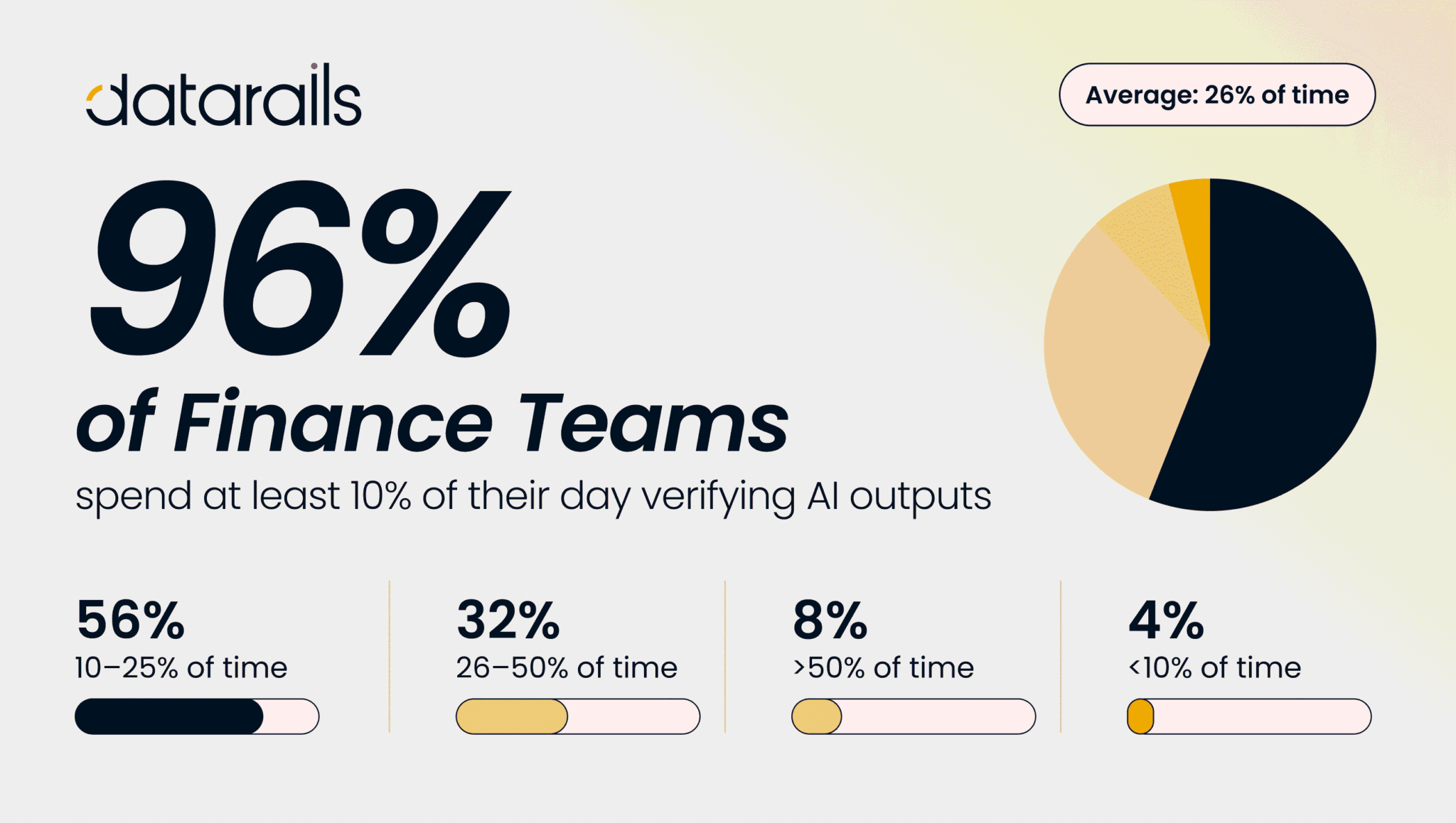
The clearest evidence of what is changing inside finance teams is a time allocation. BCG’s research puts most finance teams at roughly 90% of their time assembling, reconciling and reporting numbers, and 10% advising the business on what those numbers mean.
In an AI-first finance function that ratio flips. Reconciliations, data prep, invoice processing and outlier detection move to AI agents. Humans move to interpreting anomalies, evaluating scenarios and sitting in on decisions that used to happen without finance in the room.
Companies BCG has worked with on the shift report 50% or greater improvement in the predictive power of their finance models, 90% of reporting automated, 80% touchless invoice processing, and more than 30% of finance capacity freed for advisory work.
It shows up at the level of individual tasks. A controller who used to compile the variance report now reviews the one an agent built, checks the assumptions, and decides what is worth escalating. An FP&A analyst who used to build a scenario model from scratch now evaluates one an agent generated and directs it toward better outputs. Building the artifact remains part of the job. Judging whether the artifact is right becomes the valuable part.
How finance departments are rewriting their own scorecards
If the work changes this much, the scorecard has to change with it, and most companies have not touched theirs yet. Bain’s 2026 CFO research argues that as reforecasting speed becomes a genuine competitive advantage, finance functions should measure days-to-close, forecast refresh cadence, and time-to-variance-resolution with the same rigor traditionally reserved for headcount and expense. Cost keeps its place on the dashboard but it stops being the only thing on it.
The same research found only 15 to 25% of CFOs have fully scaled AI in their department, despite more than half increasing AI investment by over 15% this year. That’s where a redesigned scorecard earns its keep: teams that have scaled AI report satisfaction with the outcomes at roughly 41%, against 25% for teams still in pilot mode.
None of this is a headcount story, despite the fear that usually attaches to it. State of AI in Finance 2026 research is specific on the point: AI absorbs high-volume, low-value tasks, roles become more specialized, and productivity rises faster than team size. Output per person goes up while the team stays the same size, which is a far easier story to tell the department than the one most people are bracing for.
Individual KPIs: what gets rewarded is changing too
What departments measure is showing up in what individuals get hired and promoted for. CFO Connect’s research found only 23% of CFOs now rank deep accounting knowledge as their top hiring priority, a sharp fall as AI absorbs more of the analysis itself. Problem-solving and storytelling have moved up in its place: the ability to interpret what a model produced, frame it for a decision, and get a room to act on it.
There is a hard financial incentive behind building that skill set. PwC’s 2026 Global AI Jobs Barometer found workers with AI skills command an average 62% wage premium, up from 57% a year earlier, and jobs requiring AI skills are growing roughly eight times faster than the total jobs market. For a finance professional deciding where to spend a training budget, and for a CFO deciding what to pay for, that is a current number rather than a projection.
Bringing AI out of the shadows
Ask CFOs what stands between them and meaningful AI finance transformation and the answer has moved past compute, budget and data quality. As AI takes on more of the analytical and transactional work, the human role shifts from executing tasks to navigating outcomes, and that calls for a different kind of judgment than most finance careers were built to reward.
MIT’s research surfaced something worth sitting with here too. In over 90% of the firms studied, employees were already using personal AI tools on the job, whether or not an official pilot existed or had failed.
That is partly a governance problem and mostly a signal: the appetite inside finance teams is already running ahead of the sanctioned tools meant to serve it. The change management task is building something worth pointing that demand at, then giving people top-down permission to use it. CFO Connect’s research distills the pattern well: spark adoption from the bottom up, then pair it with a clear top-down mandate.
Where finance ends up in the organization
Put the workflow shift, the scorecard shift and the culture shift together and finance moves from the function that reports what happened to the function that shapes what happens next. BCG describes this as a move from producer of numbers to architect of value, and it shows up concretely in speed. Some finance leaders are already describing the end of the traditional month-end close, as real-time anomaly detection replaces the ritual of waiting three weeks to find out what went wrong.
Deloitte frames the destination in three parts worth keeping distinct: finance for finance, using AI to run its own operations with more speed and control; finance for the enterprise, using predictive modeling to improve resource allocation and risk decisions across the business; and finance for the market, using that same rigor to build investor trust and defend a valuation premium. All three are becoming the job.
Where AI forecasting stands right now
One place that shift from producer to architect is already concrete is forecasting itself, where two techniques once reserved for quant teams are now within reach of an ordinary FP&A team.
Monte Carlo forecasting is finally within reach for ordinary finance teams.
Traditional forecasting produces a single number. Monte Carlo simulation runs a model thousands of times against a range of assumptions and produces a probability distribution, the difference between “revenue will be $12 million” and “there’s a 55% chance of hitting the $12 million target, with a defined downside case.” Boards need the second answer, and until recently getting it required specialist tooling and specialist skills most FP&A teams did not have.
AI changes that constraint: it can propose input distributions, surface overlooked risks, and build the simulation faster than a human would assemble the old three-tab spreadsheet. Early adopters in law, professional services and healthcare finance teams are already treating a forecast miss as a calibration signal rather than a failure.
Driver-based forecasting tells a similar story, and its adoption numbers are the honest reality check.
Linking a forecast to the business drivers behind it, units sold, headcount, FX exposure, is not a new idea. What is new is that AI can maintain that model continuously instead of requiring a rebuild every planning cycle.
The FP&A Trends Survey 2025 found only 2% of organizations are actually using dynamic, AI-powered driver-based planning today, even though the ones that do report meaningfully better forecast accuracy.
What AI still doesn’t do is make the call.
A Monte Carlo simulation can tell you there is a 30% chance of missing budget. It cannot tell you whether that risk is acceptable, what to cut if it isn’t, or how to explain the tradeoff to a board that wants certainty. That judgment stays human, and it depends entirely on the governed, accurate data sitting underneath the simulation in the first place.
Where to start
The teams who see real ROI from AI in finance will be the ones that put someone with finance experience next to the workflow, pick one high-value process, and get it into production before moving to the next.
That’s the entire design of the AI Transformation Package: an FDFE inside the team, 25 hours a quarter, one live workflow in the first quarter, and a team that can run it independently afterwards.
AI Finance Transformation FAQs
AI finance transformation is the shift in how a finance function operates once AI takes on a meaningful share of its data preparation, reconciliation and reporting work. It covers changes to workflows, to what departments and individuals are measured on, and to the finance function’s role in the wider business, moving from producing historical numbers to shaping forward-looking decisions.
A Forward Deployed Financial Engineer (FDFE) is an engineer with finance-team experience who works inside a customer’s finance function to build AI workflows in their own environment.
The role adapts the forward deployed engineering model used by Palantir, Microsoft and OpenAI to the CFO’s office, where the constraint is rarely the model and almost always the surrounding data, definitions and governance. Datarails’ FDFEs build inside a customer’s FinanceOS environment, 25 hours per quarter.
The CFO role is shifting from steward of historical accuracy to architect of forward-looking value. AI absorbs the transactional work of assembling and reconciling numbers, freeing CFOs and their teams to spend more time on interpretation, scenario evaluation and business partnering. Surveys consistently show CFOs now name building internal AI talent, ahead of budget or technology, as their biggest near-term challenge.
It is becoming realistic for typical teams. Monte Carlo simulation used to require specialist statistical tooling and staff most mid-market finance teams did not have. AI now handles much of that work, proposing input distributions and running the simulation, which lowers the skill barrier substantially. Adoption is still early, concentrated in a handful of professional services, legal and healthcare finance teams experimenting with it first.
A tool changes what software the team has access to. A transformation changes how the work gets measured, staffed and valued, with department targets, individual hiring criteria and the finance function’s role in company strategy all shifting together.
MIT’s research on enterprise AI adoption found implementations built with a knowledgeable partner succeeded roughly twice as often as generic internal builds, largely because transformation depends on context and integration that a tool alone does not supply.
Most structured engagements run in four phases: discovery to map workflows and identify the highest-value opportunities, a build phase where custom automations get constructed for the specific team, deployment with hands-on enablement so the team can run it independently, and ongoing evolution as AI use expands.
The Datarails AI Transformation Package is designed to reach a live production workflow within the first quarter, with the evolution phase continuing by design.