Most ERP comparisons assume the company will run one system. Many finance teams don’t. An acquisition arrives with its own ledger, a subsidiary keeps its local ERP, and a move off SAP ECC runs old and new systems side by side until cutover.
Each extra system adds a chart of accounts to map and another set of numbers to reconcile before the board pack goes out. That’s on top of the budget in Excel, headcount in the HRIS, and pipeline in the CRM.
APQC benchmark data shows finance shared services organizations run a median of 3.0 ERP systems or instances. So choose the ERP that fits your size and industry, and plan from the start for how finance will report across it and whatever system arrives next. The 17 systems below are grouped by company size and checked against each vendor’s own pages.
What are the top ERP systems in 2026?
The top ERP systems in 2026 are Oracle NetSuite, Microsoft Dynamics 365 Business Central, Acumatica, and Sage Intacct for small and mid-sized companies, and SAP S/4HANA Cloud, Oracle Fusion Cloud ERP, Microsoft Dynamics 365 Finance, and Workday for large corporations. Manufacturers, distributors, and project-based firms should add specialists such as Epicor Kinetic, Syspro, and Deltek Vantagepoint. Sage Intacct and Workday Financial Management focus on finance; check whether their modules and integrations cover your operational requirements.
Here are the top ERP software options by company size.
- Small business: Intuit Enterprise Suite, Odoo, Microsoft Dynamics 365 Business Central, and SAP Business One
- Mid-market: Oracle NetSuite, Sage Intacct, Acumatica, Epicor Kinetic, Deltek Vantagepoint, and Syspro
- Corporate: SAP S/4HANA Cloud, Oracle Fusion Cloud ERP, Microsoft Dynamics 365 Finance and Supply Chain Management, Workday, Infor CloudSuite, IFS Cloud, and Sage X3
The full ERP systems list below compares all 17 by size, industry, deployment, multi-entity support, and pricing. Use this ERP software comparison to shortlist two or three systems, then read the profiles for your tier.
Best ERP systems 2026, compared by size, industry, deployment, and price:
| System | Best for (size) | Industry strength | Deployment | Multi-entity | Starting price/pricing model |
|---|---|---|---|---|---|
| Oracle NetSuite | Startups to midsize | Software, consulting and IT services, nonprofit | Cloud only | OneWorld add-on | Quote-based annual license, plus implementation fee |
| Dynamics 365 Business Central | Small and midsize | Distribution, retail, services, manufacturing, construction | Cloud or on-premises | Multiple companies in both plans | From $80/user/month, paid yearly |
| Acumatica | Small and midsize | Distribution, manufacturing, retail, construction | SaaS on AWS, private cloud, or on-premises | Standard | Quote-based, priced by apps and usage |
| Sage Intacct | 20+ employees or $4M+ revenue | SaaS, nonprofit, services, healthcare | Cloud only | Standard | Quote-based, by module |
| SAP Business One | Small and midsize | Wholesale, light manufacturing, retail | Cloud or on-premises | Financial consolidation via Intercompany Integration Solution | Quote-based |
| Intuit Enterprise Suite | Growing multi-entity firms | Construction, services, nonprofit | Cloud | US entities only | Quote-based |
| Odoo | No stated size | General, app-based | Online; on-premises on Custom plan | Custom plan among paid plans | Per user, published by region |
| Epicor Kinetic | Manufacturers, all sizes | Discrete, make-to-order manufacturing | Cloud-first, on-premises, hybrid | Multiple companies and currencies | Quote-based |
| Deltek Vantagepoint | Project firms, all sizes | Architecture, engineering, consulting | Deltek Cloud or on-premises | Multi-company consolidation and currency translation | Quote-based |
| Syspro | Mid-sized | Manufacturing and distribution | On-premises, managed, or Azure | Multiple companies; 10 currencies with consolidation | Quote-based subscription |
| SAP S/4HANA Cloud | Midsize to global | 25+ industries | Public or private cloud | Multiple legal entities; country coverage varies by edition | Finance Base USD 295/user/month for 25-39 users (15-user minimum) |
| Oracle Fusion Cloud ERP | Multinational | Healthcare and US federal agencies | Cloud, quarterly updates | Multi-entity, multi-currency, multi-GAAP | Quote-based |
| Dynamics 365 Finance and SCM | Not stated | Discrete, process, lean manufacturing | Cloud or on-premises | Multi-company consolidation and eliminations | $210/user/month each, 20-license minimum |
| Workday Financial Management | Midsize to Fortune 500 | Financial services, healthcare, higher education | Cloud only | Built into the core | Quote-based |
| Infor CloudSuite | Small to multinational | Aerospace, automotive, distribution, food and beverage | Multi-tenant AWS cloud | Multi-currency, multi-legal | Quote-based |
| IFS Cloud | Industrial enterprises | Aerospace and defense, energy, construction | Cloud or on-premises | Multi-company and multi-currency consolidation | Quote-based |
| Sage X3 | Growing mid-sized and larger | Manufacturing, distribution, food and beverage | SaaS, private cloud, on-premises | Consolidation, 80+ countries | Quote-based |
How we evaluated the ERP systems
This comparison draws on vendor-published product information reviewed in October 2026. Prices are the list prices ERP vendors publish, and 4 of the 17 systems publish a per-user price, with Business Central at $80 per user per month. The rest are quote-based. Treat an AI feature as generally available only when the vendor explicitly confirms availability for the relevant product and region. If release status is unclear, mark it unconfirmed and verify it in a demo.
This shortlist includes ERP suites and finance-focused systems; confirm which operational modules your business needs. Systems are grouped by the company size each vendor targets, and numbering within a group carries no ranking. Datarails builds the AI operating system for finance teams. It publishes this guide and connects to most of the ERPs listed, but it is not an ERP and is not ranked.
What an ERP system is and what it isn’t
- ERP (enterprise resource planning) systems integrate core business processes through shared records and workflows. The modules and integrations you implement determine how finance, sales, inventory, production, and HR use that data, with access controlled by user roles.
- Most cloud ERP systems sell modules such as inventory, order management, manufacturing, projects, CRM, and payroll on top of a financial core. The term gets stretched, so it helps to separate finance software into three kinds. These include:
- ERP: The system of record for transactions across finance and operations, from purchase orders to the general ledger.
- Accounting software: The general ledger, invoicing, and bank feeds for one company, such as QuickBooks Online or Xero.
- Finance platform on top of the ERP: Software that consolidates the ERP with the CRM, HRIS, and other systems for planning, reporting, and AI. Analysts often call this corporate performance management, or CPM. Datarails builds its version as a finance operating system, covered later in this guide.
When to move from accounting software to an ERP
QuickBooks Online, Xero, FreshBooks, and Zoho Books are accounting software. They run the general ledger well for one company, and many small businesses never need more. Five signals say it’s time to look at an ERP for small business or mid-market operations.
- More than one entity: QuickBooks Online needs a separate paid subscription for each company, and Xero says native consolidated reporting is not currently planned and points users to app partners, so finance stitches entities together by hand or with an add-on.
- Inventory and production: Stock across locations, bills of materials, and work orders outgrow an accounting app’s inventory features.
- Intercompany transactions: Confirm how you will record and match transactions between entities and eliminate intercompany balances when preparing consolidated reports.
- Audit and controls: Auditors and investors start asking for approval workflows, role-based access, and a clean audit trail.
- Headcount and approvals: More departments bring more budget owners, purchase approvals, and users than a small-business plan supports.
Accounting software stays inexpensive next to an ERP. QuickBooks Online Advanced, Intuit’s top online plan, lists at $340 a month, and Zoho Books prices per organization. FreshBooks centers on invoicing, expenses, and time tracking for small businesses.
For QuickBooks users, Intuit’s step up is Intuit Enterprise Suite, profiled below. It keeps the Intuit ecosystem and adds multi-entity consolidation for US entities.
How to choose the best ERP software
Most ERP decisions come down to nine checks. Work through them before the first demo.
ERP fit by company size and growth
Match the system to the company you expect to be in three to five years. Replacing an ERP is a long project, so outgrowing one early is expensive.
ERP industry fit
Industry editions can include sector-specific workflows and reports, but confirm each requirement in the demo. A manufacturer on a finance-first system usually pays for custom work to get them.
Multi-entity and multi-currency ERP support
Check how the system handles subsidiaries, intercompany eliminations, and currencies, and whether that takes a separate edition or add-on. NetSuite, for example, sells multi-subsidiary consolidation as its OneWorld add-on.
ERP deployment options
Most vendors now lead with cloud ERP, and some still offer private cloud or on-premises. On-premises deployments can run in your own data center; responsibility for cloud hosting, updates, and integrations depends on the service and provider.
ERP integration ecosystem
List every system the ERP must talk to, including the CRM, HRIS, payroll, banks, and billing. Check supported versions, data coverage, refresh timing, and error handling for each connection. A connector or API listing alone does not establish that it covers your workflow.
Total ERP cost of ownership
The license is one line of the bill. Add implementation, data migration, integrations, training, and support over the full contract term.
ERP AI availability and roadmap
Separate AI features that are generally available from those in preview or only announced. Gartner predicts that finance organizations using cloud ERP applications with embedded AI assistants will see a 30% faster financial close by 2028.
An ERP demo with your own data
Provide sample data and business requirements to vendors for a personalized demo, and prepare an ERP scorecard to rate each one on the same criteria. Ask ERP vendors to run your month-end steps live.
How finance will report across ERP systems
Ask who will build the board pack, where the budget will live, and how actuals from other systems will reach it. An ERP for finance teams covers the ledger, and many teams add financial reporting software or a consolidation layer for the rest.
Top ERP systems for small and mid-sized businesses
These ten systems cover small businesses moving off accounting software and the ERP software for mid-sized companies that growing finance teams commonly compare.
1. Oracle NetSuite
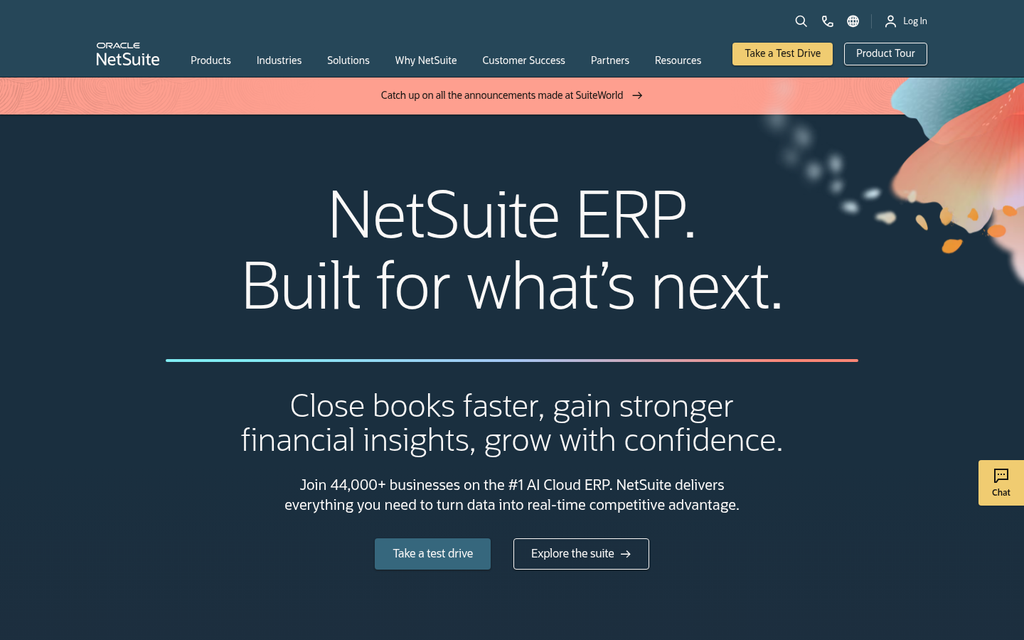
Oracle NetSuite is a cloud ERP suite that runs accounting, orders, inventory, and supply chain in one system, with built-in planning and close tools. NetSuite Next, the newest generation of the product, is built around the Ask Oracle assistant and is rolling out in the US and Canada first.
Multi-subsidiary consolidation comes through OneWorld, which NetSuite sells as an add-on module.
- Best for: Fast-growing and midsize companies, from startups up.
- Industry strength: Software, consulting and IT services, nonprofit, consumer goods, and construction editions.
- Key modules: Financials, inventory, orders, supply chain, warehouse, procurement, and EPM.
- Deployment: Cloud only.
- Multi-entity: Consolidation and more than 190 currencies come with the OneWorld add-on.
- Pricing: Quote-based annual license for platform, modules, and users, plus a one-time implementation fee.
2. Microsoft Dynamics 365 Business Central
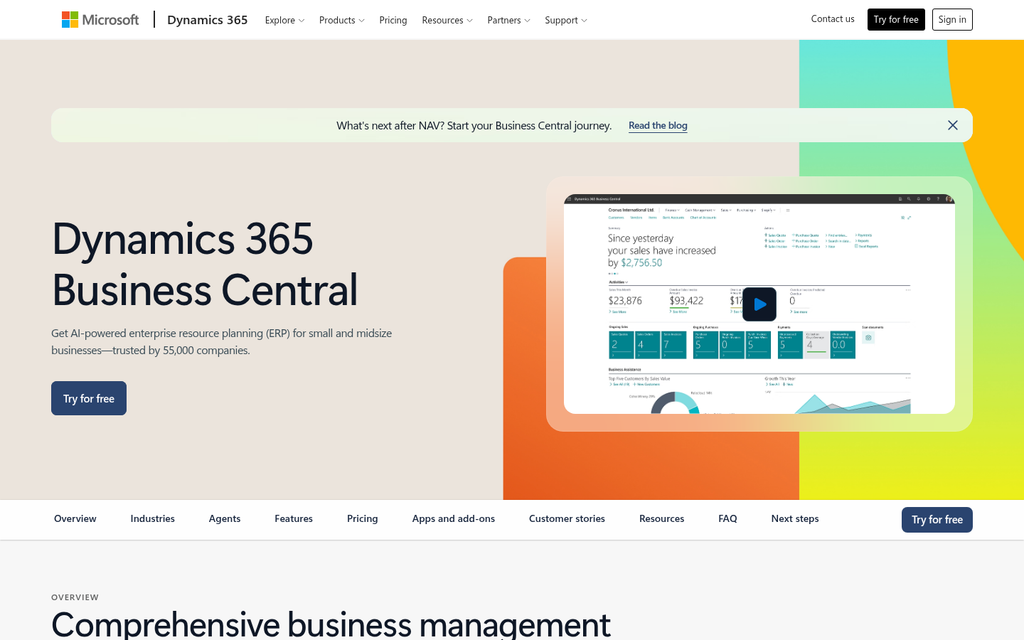
Microsoft Dynamics 365 Business Central is an ERP for small and midsize businesses that covers finance, sales, purchasing, inventory, and projects. Copilot comes with every plan, and its Payables and Sales Order agents run on Copilot Credits, sold separately.
Both plans include multiple companies. Manufacturing and service management require Premium, and consolidation eliminations are manual.
- Best for: Small and midsize businesses, especially teams on Microsoft 365.
- Industry strength: Distribution, retail, services, manufacturing, construction, and nonprofit, plus partner apps.
- Key modules: Finance, sales, purchasing, inventory, projects, and warehousing; manufacturing in Premium.
- Deployment: Microsoft cloud or on-premises, through partners.
- Multi-entity: Multiple companies with different charts of accounts and currencies.
- Pricing: Essentials costs $80 and Premium $110 per user per month, paid yearly.
3. Acumatica
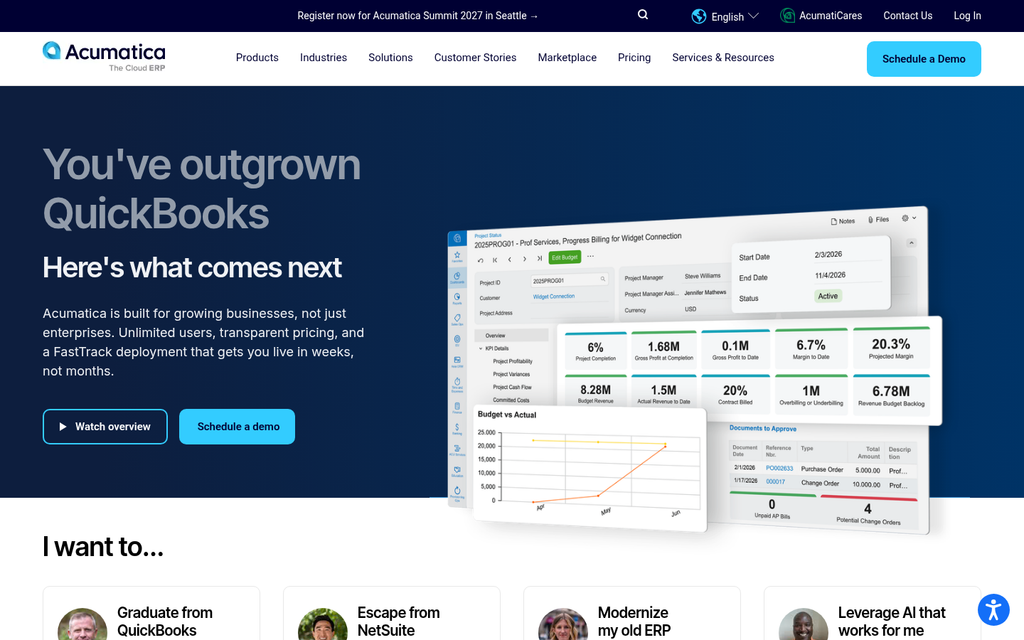
Acumatica is a cloud ERP for growing small and midsize businesses. It runs financials, projects, purchasing, and inventory, and its 2026 R2 release, generally available since October 2026, extends AI Assistant and AI Anomaly Detection across the product.
Acumatica prices by applications and resource use and says customers don’t pay for user seats. Quotes come through a partner.
- Best for: Small and midsize companies that want pricing not tied to user seats.
- Industry strength: Distribution, manufacturing, retail, construction, and services editions.
- Key modules: Financials, CRM, inventory, warehouse, manufacturing, projects, field service, and payroll.
- Deployment: SaaS on AWS, private cloud with a host you choose, or on-premises.
- Multi-entity: Multi-entity, multi-currency, and multi-book accounting are standard.
- Pricing: Quote-based annual subscription, priced by applications and usage.
4. Sage Intacct
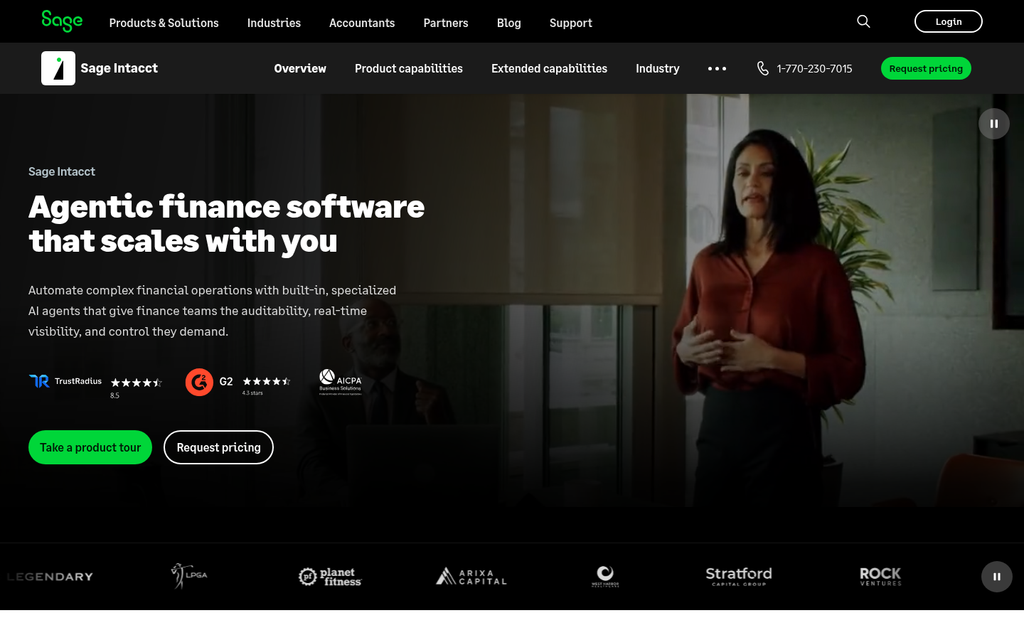
Sage Intacct is cloud financial management software for growing and mid-sized companies. It provides real-time, multi-dimensional reporting and automates accounting tasks, with AI agents for close, AP, time, and assurance, plus a Finance Intelligence Agent that Sage released to early adopters in 2026.
Sage positions multi-entity consolidation as a core strength, from two entities to hundreds. Sage puts typical implementation at three to six months.
- Best for: Companies above $4 million in revenue or 20 employees, per Sage.
- Industry strength: SaaS, nonprofit, professional services, healthcare, and construction.
- Key modules: Core financials, consolidation, revenue recognition, budgeting, projects, and payroll.
- Deployment: Cloud only, on an annual subscription.
- Multi-entity: Consolidates entities across currencies and geographies.
- Pricing: Quote-based, by module and organization size.
5. SAP Business One
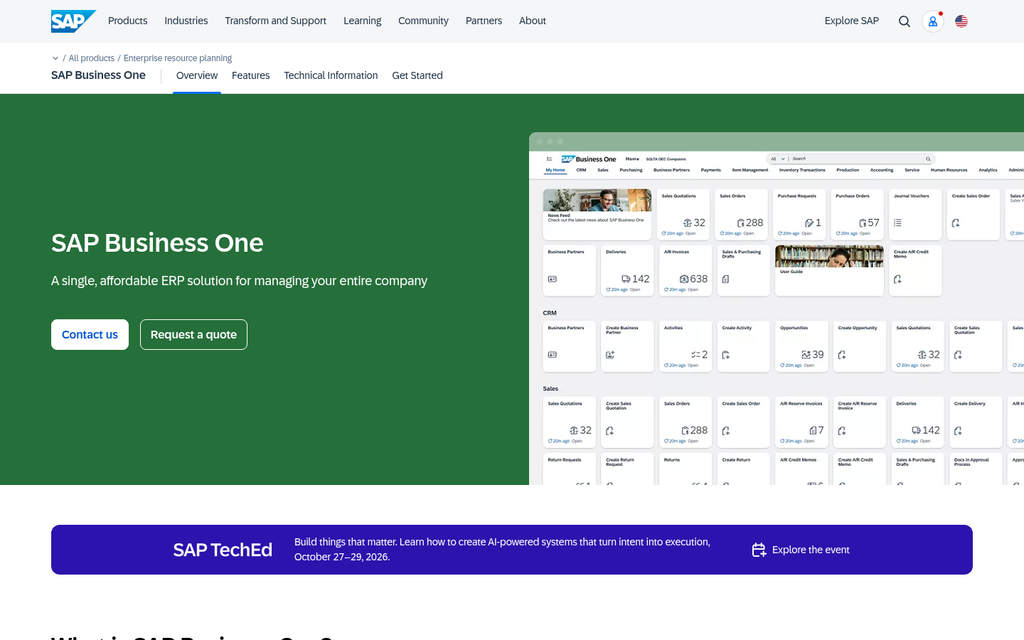
SAP Business One is an all-in-one ERP for small and midsize businesses that connects accounting, inventory, purchasing, sales, and customers. SAP says it can be deployed in as little as two to eight weeks with expert partners, who deliver it.
Like Business Central, it runs in the cloud or on-premises. SAP documents integration with its Document Information Extraction service to read invoices and create A/P invoice drafts.
- Best for: Small and midsize businesses, with no minimum size, per SAP.
- Industry strength: Wholesale distribution, light manufacturing, retail, and services.
- Key modules: Financials, CRM and service, purchasing, inventory, and analytics.
- Deployment: Cloud or on-premises, through SAP partners.
- Multi-entity: SAP documents financial consolidation through the Intercompany Integration Solution; confirm the current setup and scope with your SAP partner.
- Pricing: Quote-based, through SAP or a partner.
6. Intuit Enterprise Suite
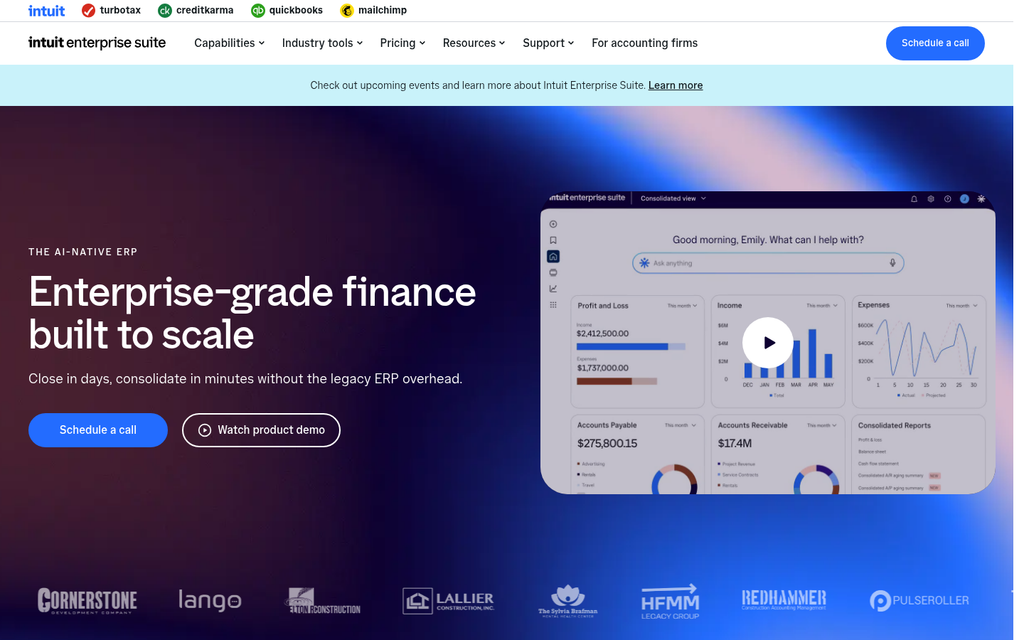
Intuit Enterprise Suite is what Intuit calls an AI-native ERP for growing companies, launched in September 2024 as the step up from QuickBooks. It brings finances, payroll, payments, and workforce tools into one platform.
Intuit built it around multi-entity consolidation with automatic intercompany eliminations. It supports US entities only. Multi-currency is in beta, and every entity must still use USD as its functional currency.
- Best for: US multi-entity firms coming from QuickBooks.
- Industry strength: Construction, professional services, nonprofit, and field services.
- Key modules: Financials, multi-entity reporting, forecasting, payroll, payments, and project costing.
- Deployment: Cloud.
- Multi-entity: Consolidates US entities with a shared chart of accounts.
- Pricing: Quote-based; Intuit publishes no price.
7. Odoo
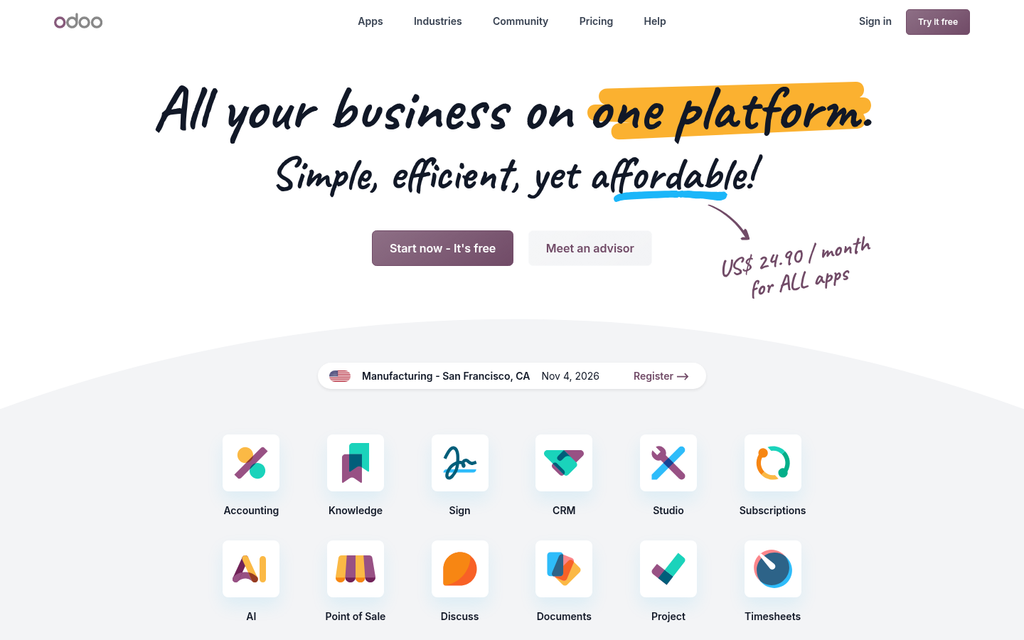
Odoo is a suite of open-source business apps for accounting, sales, inventory, manufacturing, and HR. Community is open source, and Enterprise is the licensed edition built on it. Odoo 20 lets AI agents create and update records, on paid credits.
Paid plans include every app for one per-user fee. Multi-company and on-premises hosting need the higher Custom plan.
- Best for: Companies that want many apps under one license; Odoo states no size.
- Industry strength: General purpose, built from apps.
- Key modules: Accounting, CRM, sales, inventory, manufacturing, purchasing, payroll, and projects.
- Deployment: Odoo Online, with Odoo.sh or on-premises on the Custom plan.
- Multi-entity: Multi-company with consolidated reporting, on the Custom plan.
- Pricing: Per user per month, published by region on Odoo’s pricing page.
8. Epicor Kinetic
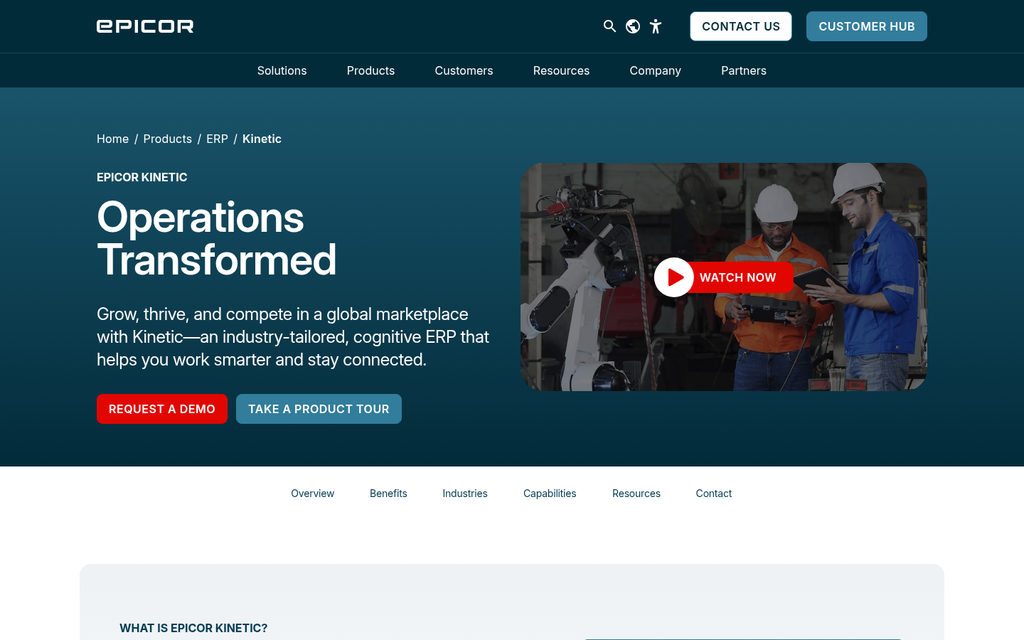
Epicor Kinetic is a global cloud ERP designed for manufacturers, specializing in discrete, make-to-order production. Its Prism Knowledge Agent runs in production. Epicor announced Prism Agent Foundry in May 2026 and says more than 30 further agents are in development.
Kinetic supports cloud, on-premises, and hybrid deployment. Epicor’s published roadmap tentatively schedules its final on-premises feature release, 2028.1, for January 2028, with Active Support through December 31, 2029 and Sustaining Support from January 1, 2030. Include that roadmap in any on-premises decision.
- Best for: Manufacturers, from a single site to a global enterprise.
- Industry strength: Aerospace, industrial machinery, metals, electronics, and medical devices.
- Key modules: Financials, planning and scheduling, MES, supply chain, CRM, CPQ, and PLM.
- Deployment: Cloud-focused, with on-premises and hybrid options.
- Multi-entity: Multiple companies, currencies, and languages.
- Pricing: Quote-based, by platform core, cloud package, and concurrent users.
9. Deltek Vantagepoint
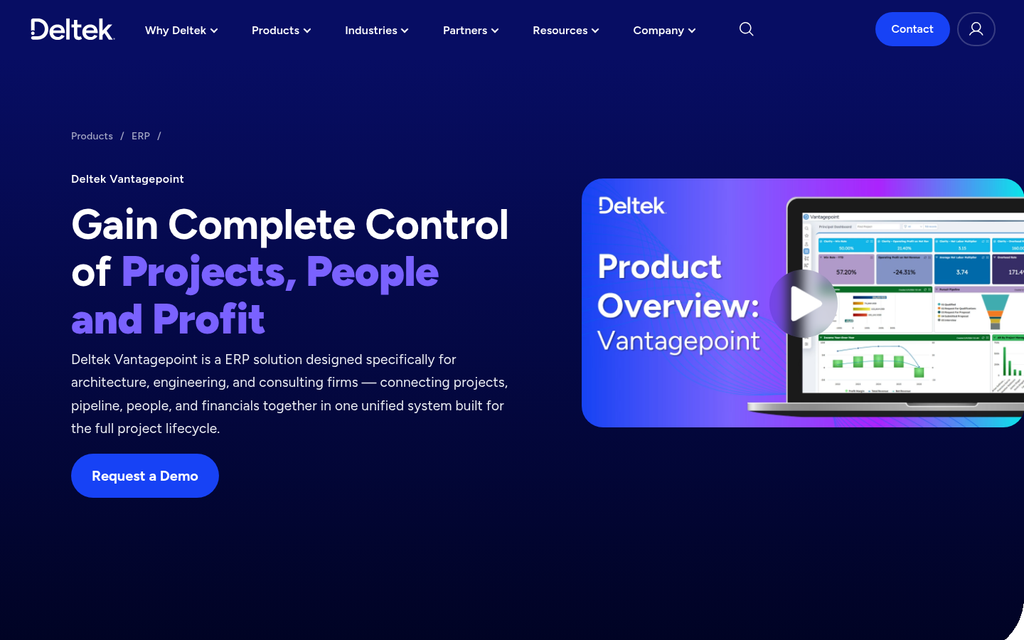
Deltek Vantagepoint is an ERP built for architecture, engineering, and consulting firms. It brings projects, accounting, resource planning, and CRM into one system, with Deltek’s Dela AI built in.
A partner marketplace and a public REST API connect it to other tools. It focuses on one vertical, and government contractors should look at Deltek Costpoint instead.
- Best for: Project-based professional services firms of all sizes.
- Industry strength: Architecture, engineering, and consulting.
- Key modules: Accounting, project management, resource management, CRM, and payments.
- Deployment: Deltek Cloud or on-premises. Deltek says more than 80% of customers use its cloud.
- Multi-entity: Consolidated financial statements across companies, with currency translation and intercompany account eliminations.
- Pricing: Quote-based, through Deltek sales.
10. Syspro
Syspro is a modular ERP for mid-sized manufacturers and distributors, with lot-level traceability built in. Its Torque agentic AI platform is in controlled release.
Syspro is moving every customer from its Initial and Annual License Fee model to named-user subscriptions, and set existing licenses to expire on October 31, 2026 outside the US and December 31, 2026 in the US.
- Best for: Mid-sized manufacturers and distributors.
- Industry strength: Food and beverage, automotive, industrial machinery, and chemicals.
- Key modules: Ledger, bills of materials, MRP, quality, sales orders, and warehousing.
- Deployment: On-premises, managed service, or Azure cloud.
- Multi-entity: Multiple Syspro companies; the ledger handles up to ten alternative currencies with automatic consolidation.
- Pricing: Quote-based named-user subscription.
Top corporate ERP systems
These seven systems serve large and global organizations, and companies whose operations have outgrown a mid-market suite.
1. SAP S/4HANA Cloud
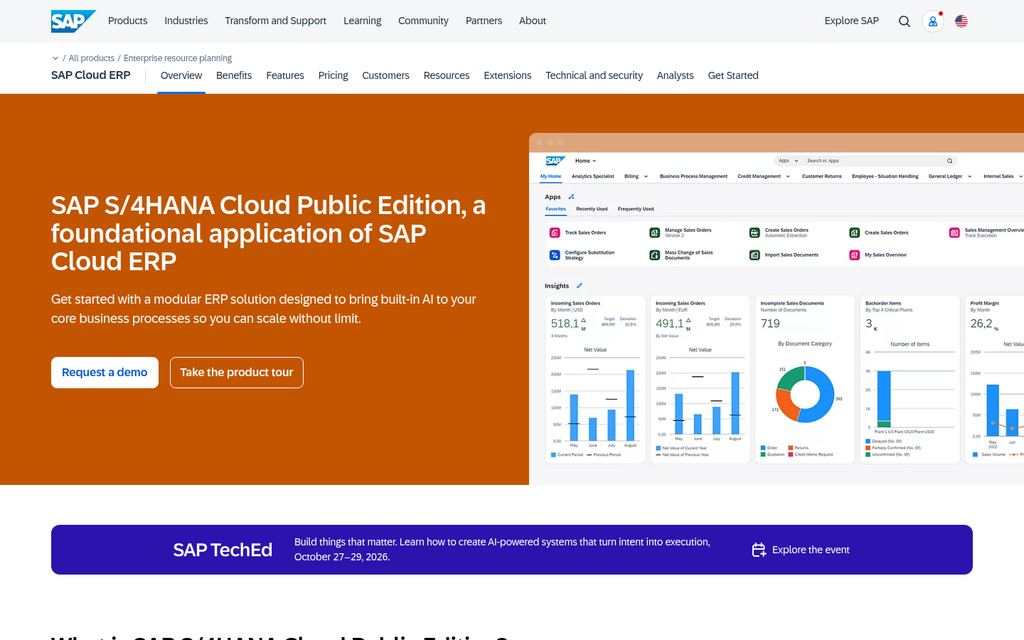
SAP S/4HANA Cloud is SAP’s current ERP, sold as part of SAP Cloud ERP, with embedded AI across finance, supply chain, HR, and sales. It replaces SAP ECC, and mainstream maintenance for SAP ERP 6.0 enhancement packages 6–8 ends December 31, 2027, with optional extended maintenance through December 31, 2030.
SAP manages Public Edition updates. Companies that need deep custom extensions move to Private Edition through RISE with SAP.
- Best for: Midsize to global companies.
- Industry strength: Preconfigured workflows for 25+ industries.
- Key modules: Finance, supply chain, projects and services, HR, and sales.
- Deployment: Public or private cloud.
- Multi-entity: Supports multiple legal entities; check country coverage and consolidation requirements for the chosen edition.
- Pricing: Finance Base lists at USD 295 per user per month for 25 to 39 users, with a 15-user minimum; larger counts pay less.
2. Oracle Fusion Cloud ERP
Oracle Fusion Cloud ERP is a cloud ERP suite covering financials, projects, procurement, and performance management. Oracle builds Ledger, Payables, and Planning Agents into core finance with no separate license.
It handles multinational, multi-GAAP finance natively. Oracle updates every environment on a fixed quarterly schedule, and teams test each release.
- Best for: Multinational companies with complex, multi-entity finance.
- Industry strength: Healthcare and the public sector, including US federal agencies.
- Key modules: Financials, projects, procurement, EPM, and supply chain.
- Deployment: Cloud, with quarterly updates.
- Multi-entity: Multi-entity, multi-currency, and multi-GAAP on one platform.
- Pricing: Quote-based.
3. Microsoft Dynamics 365 Finance and Supply Chain Management
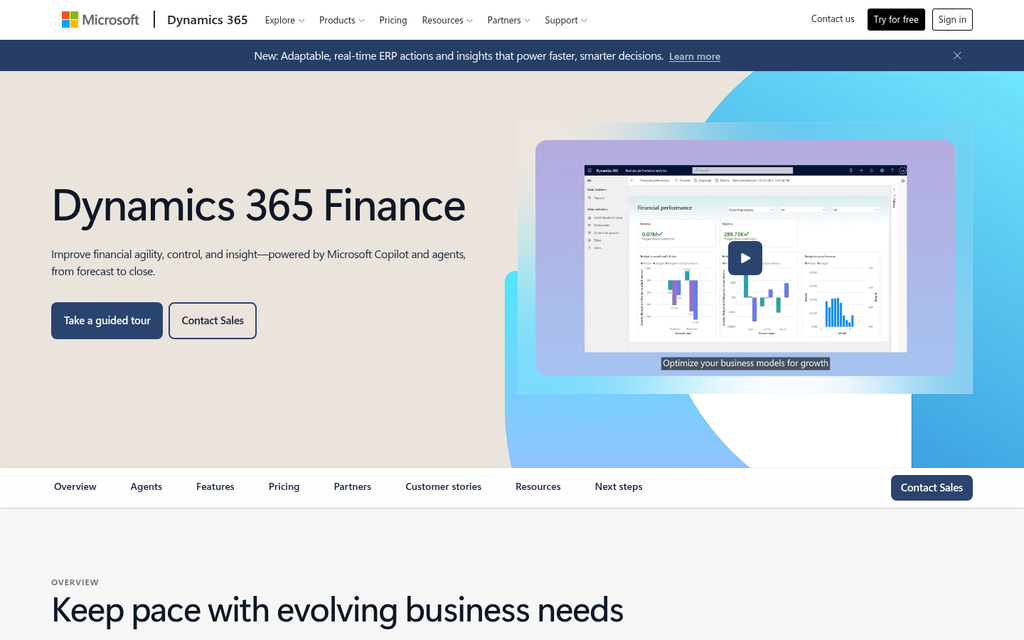
Microsoft Dynamics 365 Finance and Dynamics 365 Supply Chain Management are Microsoft’s enterprise applications for finance and operations. Invoice capture, a separately installed AI solution, is generally available, and the Account Reconciliation Agent is in preview.
Microsoft publishes list prices, which is rare at this tier. Agents need Copilot Credits and an Azure subscription.
- Best for: Companies that need finance and supply chain depth across countries; Microsoft states no size band.
- Industry strength: Discrete, process, and lean manufacturing.
- Key modules: Accounting and close, tax, cash, planning, procurement, shop floor, and warehousing.
- Deployment: Microsoft cloud or on-premises.
- Multi-entity: Consolidates legal entities with currency translation and intercompany eliminations.
- Pricing: Each costs $210 per user per month, paid yearly, with a 20-license minimum.
4. Workday Financial Management
Workday Financial Management is cloud finance software that runs accounting, close, and consolidation on the same platform as Workday HR. Its AI runs through Sana, Workday’s AI platform, paid for with Flex Credits.
HR and finance share one data foundation. It runs only on Workday’s cloud, with no on-premises option.
- Best for: Midsize businesses through the Fortune 500, per Workday.
- Industry strength: Financial services, healthcare, higher education, and insurance.
- Key modules: Accounting, close and consolidation, revenue, audit and controls, and planning.
- Deployment: Cloud only.
- Multi-entity: Multi-entity, multicurrency, and consolidation in the core.
- Pricing: Quote-based; AI uses Flex Credits.
5. Infor CloudSuite
Infor CloudSuite is a family of industry-specific cloud suites with ERP at the core, owned by Koch Industries. Infor GenAI, including an assistant and a Knowledge Hub, runs across CloudSuite; confirm availability for your suite.
Industry suites cut custom work for the verticals Infor names. Every suite runs on Infor’s multi-tenant AWS cloud.
- Best for: Small companies through multinationals in Infor’s industries.
- Industry strength: Aerospace, automotive, distribution, fashion, food and beverage, and healthcare.
- Key modules: ERP plus PLM, supply chain, warehouse, MES, and CPQ, by suite.
- Deployment: Multi-tenant AWS cloud.
- Multi-entity: Multi-currency, multi-legal, and multi-site.
- Pricing: Quote-based.
6. IFS Cloud
IFS Cloud is one platform for ERP, asset management, supply chain, and field service, built for industrial companies. Its embedded AI handles predictive maintenance, and IFS ships two releases a year.
It fits companies whose assets matter as much as their ledger. It also serves field service providers, including managed services and property and facilities services.
- Best for: Industrial enterprises with complex operations.
- Industry strength: Aerospace and defense, energy, construction, and manufacturing.
- Key modules: ERP, asset management, supply chain, and field service.
- Deployment: Cloud or on-premises.
- Multi-entity: Group consolidation across companies and currencies, with chart-of-accounts mapping and intercompany eliminations.
- Pricing: Quote-based.
7. Sage X3
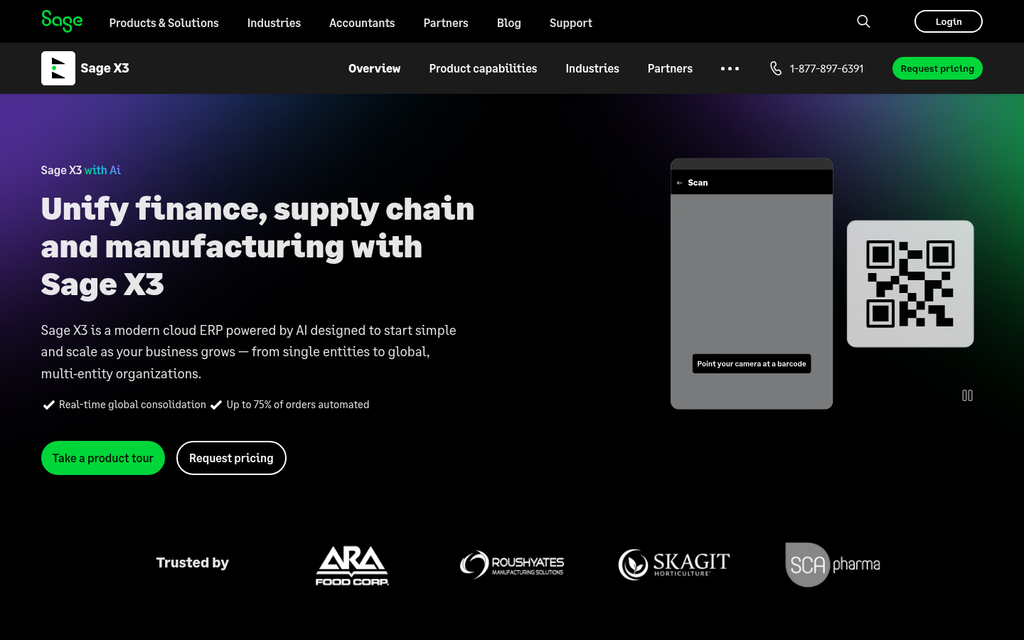
Sage X3 is a cloud ERP for product companies that unifies finance, supply chain, and manufacturing. Sage built it for growing, midsized companies with complex needs, scaling to global multi-entity operations, with Sage Copilot built in.
Lot and serial traceability suits compliance-heavy supply chains. Sage also offers X3 for services firms, with project costing, billing, and time and expense tracking.
- Best for: Growing mid-sized and larger product companies.
- Industry strength: Manufacturing, distribution, food and beverage, chemicals, and pharma.
- Key modules: Financials, supply chain, manufacturing, warehouse, and batch genealogy.
- Deployment: SaaS, private cloud, or on-premises.
- Multi-entity: Multi-entity consolidation in 80+ countries.
- Pricing: Quote-based.
See which of your systems Datarails already connects to
Down to two ERPs? Check that both finalists, plus your CRM, HRIS, and bank feeds, connect to Datarails before you sign.
See all 600+ systems Datarails connects to
Best ERP software by industry
Every system below lists the industry on its own site as a focus or edition.
| Industry | Leading ERP systems |
|---|---|
| Manufacturing | Epicor Kinetic, Syspro, Sage X3, Infor CloudSuite, Dynamics 365 Supply Chain Management |
| Distribution | Syspro, Acumatica, Sage X3, Dynamics 365 Business Central, Infor CloudSuite |
| Professional services | Deltek Vantagepoint, Oracle NetSuite, Sage Intacct, Acumatica, Intuit Enterprise Suite |
| Nonprofit | Sage Intacct, Oracle NetSuite, Dynamics 365 Business Central, Intuit Enterprise Suite |
| SaaS and software | Oracle NetSuite, Sage Intacct |
| Retail and e-commerce | Acumatica, SAP Business One, Dynamics 365 Business Central |
| Construction | Acumatica, Intuit Enterprise Suite, Sage Intacct, Oracle NetSuite, Dynamics 365 Business Central, IFS Cloud |
ERP implementation costs, timelines and what finance should plan for
Go-live is the first milestone of an ERP project, and the business goals get tested after it. Gartner research predicts that by 2027, more than 70% of recently implemented ERP initiatives will fail to fully meet their original business goals.
ERP implementation cost components
Panorama Consulting Group’s 2025 ERP Report reports a median total project cost of $450,000 among respondents with a median annual revenue of $400.5 million. Panorama is an ERP consultancy. The license is one part of that total.
| Cost component | What drives it | How vendors price it |
|---|---|---|
| Software subscription | Users, modules, entities, and edition | Per user per month where published (Business Central from $80, Dynamics 365 Finance $210, SAP S/4HANA Cloud Finance Base USD 295 for 25-39 users, Odoo by region); otherwise quote-based |
| Implementation services | Scope, customization, and number of entities | Partner or vendor services under a separate agreement; NetSuite charges a one-time implementation fee |
| Data migration | Years of history, data quality, and number of source systems | Usually part of implementation services |
| Integrations | Number of connected systems and custom APIs | Connector fees, partner apps, or custom development |
| Training and change management | Users, departments, and new processes | Internal time plus partner training |
| Support and updates | Support tier and upgrade model | Included in SaaS subscriptions; separate maintenance for on-premises |
ERP implementation timelines
Panorama’s 2026 ERP Report puts the median project timeline at 9 months, and more than a quarter of organizations reported going over budget. These figures are directional benchmarks, not a forecast for your project. Define the modules, entities, migration work, testing, training, and cutover included in each estimate. Vendor estimates vary by product. Sage puts a typical Sage Intacct implementation at three to six months, and SAP says SAP Business One can go live in as little as two to eight weeks with expert partners.
Chart of accounts redesign during ERP migration
An ERP move is the moment to fix the chart of accounts. Teams that copy the old structure carry its workarounds forward, and teams that redesign it need a map from old accounts to new so last year’s numbers still compare.
Historical data for reporting after ERP migration
Decide which historical transactions and balances to migrate, which to retain in an accessible archive, and how reports will compare old and new accounts. Assign owners to reconcile migrated balances, validate report totals, and sign off before cutover.
Reporting and planning beyond the ERP
An ERP records transactions and provides reporting on the processes it manages. Finance may need additional data from other systems for group reporting, planning, or operating metrics.
Why reporting can remain manual after ERP go-live
The ERP holds actuals, while budgets may sit in Excel or separate budgeting software, with headcount, pipeline, and operating KPIs in other systems. In AFP’s 2025 FP&A Benchmarking Survey, conducted in fall 2024 among 362 FP&A and finance practitioners worldwide, 96% used spreadsheets for planning. When those sources are not integrated, finance may need to export data, map accounts, and rebuild reports manually.
Reporting across multiple ERP systems
APQC calls a finance organization running several ERPs a high-value opportunity for consolidation. Each consolidation is its own ERP project, with the timelines and budget risk covered above, so finance reports across several systems until every entity has moved. APQC also notes that some business units may keep separate systems for regional compliance or because they are specialized acquisitions.
How a finance layer connects ERP data
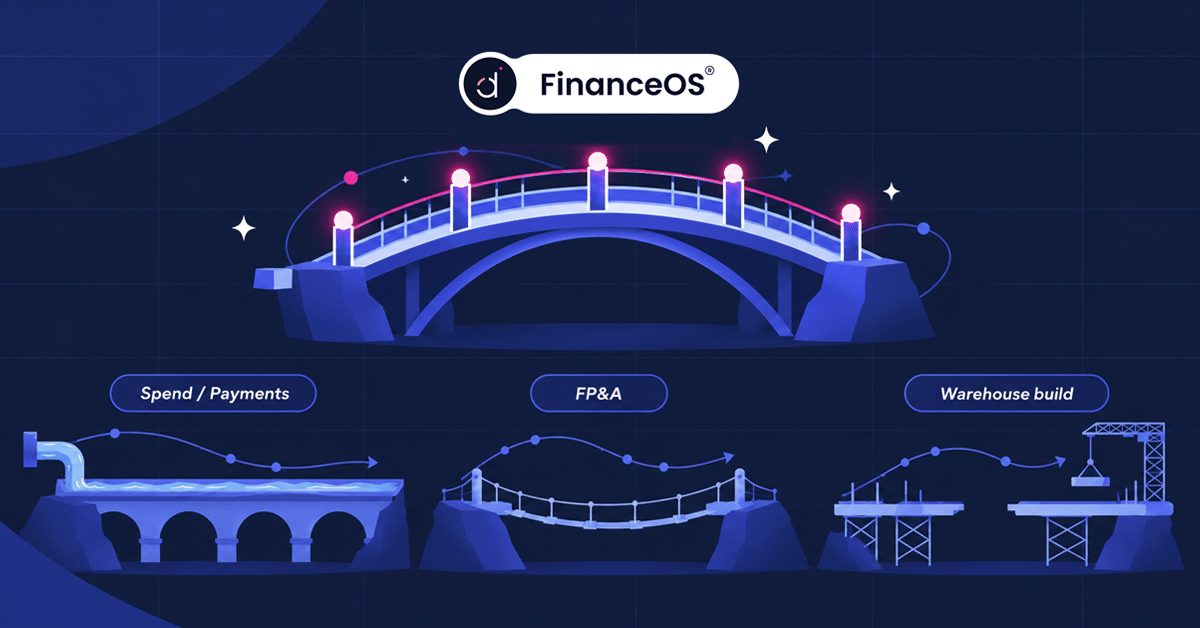
Datarails runs on FinanceOS, its foundational operating layer for connected financial data, shared definitions, permissions, and finance workflows. Datarails connects to 600+ data sources, including NetSuite, Business Central, Sage Intacct, SAP, Oracle Fusion, and Workday. Check the ERP integrations directory for the relevant product, version, and connection method.
FinanceOS handles data consolidation across entities and ERPs. It maps each chart of accounts to one structure and keeps an audit trail back to the source, so finance gets consolidated financial statements without migrating any ERP. The same data feeds Datarails Month-End Close and Datarails FP&A, and finance keeps working in Excel with its own models connected to governed data.
“Now it’s all automatic and easy. We have our Excel, click refresh, and everything is ready.”
– Barry Lin, Director of FP&A, Guesty, a rental property management software company with 20+ global entities after seven acquisitions in three and a half years
AI on consolidated ERP data
Datarails AI works on the same consolidated data. The AI Assistant answers questions across Datarails, and Inflow Agents handle specific jobs where the work happens, such as explaining reconciliation variances during the close. Both use the mappings, definitions, and permissions FinanceOS already applies, so an answer about revenue across three ERPs uses the same consolidation logic as the board pack. For AI in FP&A, treat outputs as drafts: review the source data, calculations, and explanations before using them in reports or close decisions.
The FinanceOS AI Connector brings the same governed ERP data into ChatGPT, Claude, or Copilot through MCP, so an analyst can ask questions in the AI tool the team already uses, against governed ERP data. Datarails covers the setup in its guides for a NetSuite MCP server and a finance MCP server.
Outputs
-
Datarails FP&AExcel models and board reporting
-
Datarails Month-End CloseReconciliations, approvals, and sign-off
-
Datarails AIAI Assistant and Inflow Agents
-
ChatGPT, Claude, and Copilotvia the FinanceOS AI Connector
Datarails FinanceOS
Connects 600+ systems
- Consolidation
- Shared definitions
- Permissions
- Audit trail
- ERP: NetSuite
- ERP: SAP
- ERP: acquired entity
- CRM
- HRIS
- Payroll
- Bank
Source systems
Choose your ERP, then plan how finance will report on it
Among the top ERP systems here, the right one fits your size, your industry, and where the company will be in five years. Check multi-entity support, deployment, and total cost before the demo, and test it with your own data.
Then plan from day one how finance will consolidate and report on it, especially if a second ERP is likely after an acquisition. The ERP decides where transactions are recorded. FinanceOS decides how fast finance can use them.
Give finance one governed view of your ERP data
Bring your ERP list and last month’s board pack to a demo. Confirm which systems and versions Datarails supports, how they connect, and how the setup would handle your planned acquisitions.
Top ERP systems FAQs
What is the best ERP software for mid-sized companies?
For most mid-sized companies, Oracle NetSuite, Sage Intacct, Acumatica, and Microsoft Dynamics 365 Business Central lead the shortlist. Manufacturers should add Epicor Kinetic or Syspro, and architecture, engineering, and consulting firms should look at Deltek Vantagepoint. Choose ERP software for mid-sized companies by industry fit and the number of entities you run.
What is the best ERP for small business?
Small businesses with one entity often stick with accounting software like QuickBooks Online or Xero. When you add a second entity, inventory, or audit requirements, consider Intuit Enterprise Suite for US companies coming from QuickBooks, Odoo for an all-apps license, Business Central, or SAP Business One.
Is QuickBooks an ERP system?
QuickBooks Online is accounting software. It covers the general ledger, invoicing, and bank feeds, and each company needs its own paid subscription. Intuit sells Intuit Enterprise Suite, which it calls an AI-native ERP, for companies that need multi-entity consolidation.
How much does ERP software cost?
Most of the systems here are quote-based, and only a few publish per-user list prices. Business Central starts at $80 per user per month, Dynamics 365 Finance costs $210 per user per month with a 20-license minimum, and SAP S/4HANA Cloud Finance Base lists at USD 295 per user per month for 25 to 39 users. Odoo publishes prices by region, and the other 13 systems here quote. Panorama Consulting Group’s 2025 ERP Report put the median total project cost at $450,000, among respondents with a median annual revenue of $400.5 million.
What happens to SAP ECC after 2027?
For SAP ERP 6.0 (ECC) enhancement packages 6–8, mainstream maintenance ends December 31, 2027, and optional extended maintenance ends December 31, 2030. Earlier releases ended mainstream maintenance in 2025. SAP also offers a separate transition option for qualifying customers. An October 13, 2026 update says transition-option subscriptions may run through December 31, 2035, subject to further prerequisites. The published prerequisites include moving to SAP ERP, private edition on SAP HANA before December 31, 2030; confirm current eligibility with SAP.
Can I consolidate financial data from multiple ERP systems without migrating?
Yes. A consolidation layer connects to each ERP, maps every chart of accounts to a single structure, and maintains an audit trail to the source. Datarails does this on FinanceOS, which connects 600+ systems, so finance can report across ERPs while each entity stays on its own system.