
The Anaplan renewal notice is what starts most of the “Anaplan alternatives” searches.
Somewhere between the first quote and the third year of ownership, many finance teams realize they bought a cross-functional planning platform to run a finance-only process.
That’s not to say the modeling engine isn’t powerful, because it is. The open question is whether the team ever needed that much of it, and what realistic Anaplan alternatives look like if the answer is no.
Here are seven platforms worth the look, with the right one coming down to a single question about scope.
Why Finance Teams Look for Anaplan Alternatives
Anaplan doesn’t publish its pricing, making it difficult to estimate the total investment. According to CFO Shortlist, costs can be substantial:
- Annual licensing: $30,000–$50,000 for entry-level deployments and $150,000–1 million or more for enterprises.
- Implementation fees: Typically 1.5–3 times the annual license, pushing first-year costs to $500,000–2.5 million for larger deployments.
- Ongoing costs: Around 35–55% of the original license after year one.
Implementation adds further complexity. Independent benchmarks put Anaplan projects at 4 to 12 months and enterprise engines as a group at 4 to 18 months, with model-builder availability as the real constraint.
That dependency continues after deployment. Most teams need at least one permanent model builder, while larger organizations require a center of excellence or ongoing integrator support. Losing experienced staff can also mean losing critical institutional knowledge.
User feedback reinforces these concerns. An analysis of FP&A software Reddit reviews found nearly twice as many negative comments about Anaplan as positive ones. Common complaints included:
- Annual costs around $100,000, plus additional functionality charges.
- Slow query performance.
- A steep onboarding and learning curve.
These are user-reported experiences rather than official vendor figures, but they align with broader cost and implementation concerns.
Still, Anaplan’s strengths are significant. Its Hyperblock engine supports billions of cells, real-time recalculation, and complex multidimensional planning. The platform also connects finance, sales, supply chain, and workforce planning within a unified environment.
Gartner has named Anaplan a Leader in its Financial Planning Software Magic Quadrant nine times, and Anaplan reports that nearly half of Fortune 50 companies use its platform. For enterprises requiring this level of scale and flexibility, the investment can be justified.
The pattern worth noticing is where dissatisfaction concentrates. Independent reviewers flag smaller organizations and teams with basic budgeting needs as a poor fit. Teams that bought connected planning software to run a finance-only budget and forecast cycle end up paying for scope they never activate.
What Are the Best Alternatives to Anaplan?
Teams shopping for FP&A software like Anaplan generally land on one of seven platforms, and those split into two groups. Which group applies depends almost entirely on whether planning extends beyond finance.
For teams that need cross-functional connected planning across sales, supply chain, and workforce, or enterprise-grade consolidation, the options are Workday Adaptive Planning, OneStream, Pigment, and Jedox.
- Workday Adaptive is the natural choice for organizations already running Workday HCM.
- OneStream is the specialist where consolidation and close sit alongside planning.
- Pigment offers a more modern architecture and faster deployment for fast-growing companies that still need cross-functional scope.
- Jedox is the value-conscious option for multidimensional, cross-functional modeling.
For teams with finance-led planning, a finance-first platform is a better fit.
- Datarails FP&A, built on FinanceOS, is Excel-connected and runs finance-led planning, consolidation, and reporting for mid-market and enterprise teams, live in 4 to 6 weeks.
- Vena suits Excel-centric teams inside the Microsoft ecosystem.
- Planful handles multi-entity consolidation well.
Most teams searching for enterprise FP&A software alternatives land in the second group, because their planning never left finance. For a feature-by-feature view across several of these platforms, the Planful vs. Cube vs. Vena vs. Datarails vs. Anaplan comparison covers them side by side.
Anaplan vs Alternatives at a Glance
| Implementation time | Pricing | Planning scope | Excel approach | Best for | |
| Anaplan | 4 to 12 months | $150K to $1M+/year typical enterprise; Year 1 TCO $500K to $2.5M+ | Cross-functional connected planning | Limited. Models rebuilt in Hyperblock | Large enterprises planning across finance, sales, supply chain, and workforce |
| Datarails | 4 to 6 weeks (Datarails FP&A) | Mid-market typically $35K to $80K/year; enterprise from $100K/year, plus a one-time onboarding fee | Finance-led, across the office of the CFO | Excel-connected. Existing models stay in Excel or Google Sheets, plus a web app | Mid-market and enterprise finance teams, including multi-entity groups |
| Workday Adaptive Planning | 6 to 16 weeks | $80K to $300K/year for 200 to 500 users | Finance plus workforce | Office Connect for Excel and PowerPoint reporting | Organizations running Workday HCM or Financials |
| OneStream | 6 to 9 months phased; 12 to 18 months complex | $80K to $300K/year mid-market; $200K to $1M+ enterprise | Consolidation, close, planning, and reporting | Excel add-in. Modeling happens in the platform | Large enterprises where consolidation drives the requirement |
| Pigment | 2 to 4 months (vendor-claimed) | $50K to $150K/year mid-market; $150K to $500K+ enterprise | Cross-functional | Spreadsheet connectors. Modeling happens in the platform | Fast-growing companies that need cross-functional planning |
| Vena | 14 to 30 weeks | Year 1 about $75K to $225K, including implementation | Finance-first | Excel-native, with templated and locked workbooks | Mid-market teams in the Microsoft ecosystem |
| Planful | 8 to 12 weeks (vendor-claimed) | $80K to $250K/year software | Planning, consolidation, close, and reporting | Excel add-in for reporting. Modeling happens in the platform | Finance teams where multi-entity consolidation is a firm requirement |
| Jedox | Varies by scope | Not published | Finance, sales, supply chain, and workforce | Excel add-in front end | Mid-market organizations needing multidimensional modeling on a budget |
Third-party pricing and timeline estimates come from CFO Shortlist 2026 vendor research. Vendor-claimed timelines are labeled. Datarails figures come from Datarails.
The Best Anaplan Alternatives for Finance Teams
1. Datarails
Datarails FP&A, built on FinanceOS, automates planning, reporting, and analysis on one governed source of truth drawn from a team’s financial and operational systems.
The core difference from Anaplan is architectural. Anaplan rebuilds models inside its Hyperblock engine. Datarails leaves existing Excel models, formulas, and reporting templates where they are and automates the data that feeds them. Teams can also work in Google Sheets or the Datarails web app.
Key features:
- Connected data: FinanceOS, the governed data layer underneath every Datarails product, connects to 600+ data sources, including ERPs, accounting systems, CRMs, HRIS platforms, billing tools, and banks.
- Multi-entity consolidation: Currency translation, intercompany eliminations, allocations, and multiple charts of accounts are mapped into one reporting structure. In Anaplan, that logic lives inside models that builders maintain. In FinanceOS, it is defined once and shared by every product and AI tool connected to it.
- Shared metric definitions: The semantic layer defines each metric once, so revenue, gross margin, or headcount means the same thing in every report, model, and AI answer.
- Permissions and traceability: Access can be set down to the entity, department, or report, and any number can be traced back to the transactions behind it.
- One suite on one foundation: On the Expert plan, Datarails FP&A runs alongside Datarails Spend, Datarails Cash, Datarails Month-End Close, Datarails Receivables, and Datarails Desk. Every product reads from the same FinanceOS data. Live cash positions and closed actuals feed straight into the forecast, and data consolidation and budgeting & forecasting work from the same numbers the close and cash teams use.
Datarails AI works on the same governed data. Datarails AI applies three agents and two automated outputs to the consolidated numbers:
- Reporting Agent: analyzes actuals to find the drivers and explain the story behind the numbers.
- Planning Agent: runs ad-hoc forecasting and scenario analysis, so teams can test assumptions and compare scenarios without rebuilding models.
- Strategy Agent: takes on big-picture questions and trade-offs, turning financial data into options and recommendations.
- Insights: sends tailored summaries of results and chosen KPIs to the right people on a weekly, monthly, or quarterly schedule.
- Storyboards: builds board-ready presentations from Datarails dashboards that stay live and editable.
The FinanceOS AI Connector extends the same governed data to Claude, ChatGPT, and other AI tools your team already uses.
Implementation is the clearest advantage. Datarails FP&A typically goes live in 4 to 6 weeks, against Anaplan’s 4 to 12 months.
- Delivered in-house: Datarails’ own implementation team runs onboarding, for a one-time onboarding fee.
- No model-builder dependency: Models stay in Excel, so the team does not need a permanent specialist to maintain them.
- Lower training load: Excel familiarity keeps training investment low, which shows up consistently in Datarails reviews.
- Adding products is simple: A new Datarails product runs on the existing data, so it does not start another integration project.
The trade-off is scope. Datarails is built for finance-led planning, not for supply chain and sales teams that build and own their own models in a shared system. Teams whose models span those functions at billions of cells will be better served by an enterprise-tier engine.
| Best for | Pricing |
| Mid-market and enterprise finance teams, including multi-entity groups, that run planning in Excel and want planning, consolidation, the close, and cash on one governed foundation without a replatform | Mid-market teams typically invest $35,000 to $80,000 per year, and enterprise plans start at $100,000. Every plan carries a one-time onboarding fee. The Expert plan, most relevant for enterprise teams, includes Datarails FP&A, Spend, Cash, Month-End Close, Receivables, and Desk, with 15 users, 50 viewers, three integrations, and premium support. See the Datarails pricing guide for typical ranges and the pricing page for plan details. |
Anaplan vs Datarails for Finance-Led Planning
The switch case is narrow and specific. A team that bought Anaplan for budgeting, forecasting, reporting, and variance analysis, and never activated supply chain or sales planning, is carrying an enterprise cost structure for a finance workload.
Moving to Datarails removes the model-builder dependency, cuts implementation from quarters to weeks, and returns the plan to Excel where the team already works. Teams that do run cross-functional planning are better served staying on Anaplan or moving to another enterprise-tier platform.
Keep Your Planning Power. Lose the Six-Month Implementation
Datarails connects your ERP, CRM, HRIS, and banking data into one governed source of truth, automates consolidation, and layers Datarails AI on top. Your team stays in Excel.
2. Workday Adaptive Planning
Workday Adaptive Planning is an enterprise planning platform covering budgeting, forecasting, workforce planning, and reporting, built around a modeling engine that finance teams can configure without heavy IT involvement.
Its clearest advantage is the native connection to Workday HCM. Headcount and compensation data flows into planning models without an integration project, which makes it the obvious shortlist entry for organizations already standardized on Workday. Office Connect brings reporting into Excel and PowerPoint, though the modeling itself happens inside the platform.
Implementation typically runs 6 to 16 weeks, with Workday customers landing near the fast end, and services generally cost 1 to 2 times the annual subscription. The modeling engine is less dimensionally flexible than Hyperblock, which matters for complex scenarios. Teams without Workday HCM lose the main reason to choose it over finance-first options.
| Best for | Pricing |
| Upper mid-market and enterprise organizations already running Workday HCM | Not published. Mid-market deployments of 200 to 500 users commonly run $80,000 to $300,000 a year. |
3. OneStream

OneStream is a unified corporate performance management platform that runs financial consolidation, close, planning, and reporting on a single data model rather than as loosely connected modules.
Consolidation is where it stands out. Statutory reporting, intercompany eliminations, complex ownership structures, and multi-currency translation are handled natively, at a depth Anaplan still relies on its Fluence acquisition to approach. For organizations where the close is the bottleneck and planning is secondary, OneStream is usually the stronger enterprise choice.
That depth carries the usual costs. Implementation typically runs 6 to 9 months phased, and 12 to 18 months for complex enterprise deployments, pricing sits firmly in the enterprise band, and the platform assumes a finance organization with the resources to govern it. Mid-market teams with a straightforward single-entity close will pay for consolidation machinery they never need.
| Best for | Pricing |
| Large enterprises where multi-entity consolidation and statutory reporting drive the requirement | Not published. Mid-market deployments commonly run $80,000 to $300,000 a year, and enterprise deployments $200,000 to $1 million or more. |
4. Pigment

Pigment is a connected planning platform built on a more modern architecture than incumbents, covering finance, sales, and workforce planning with an interface designed for business users rather than dedicated model builders.
It is the closest thing to a like-for-like Anaplan replacement for teams that need cross-functional scope. Native connectors to Workday, Salesforce, SAP S/4HANA, and common ETL providers shorten the data integration work that inflates enterprise implementations. Gartner named Pigment a Visionary in the 2025 Magic Quadrant for Financial Planning Software, its second consecutive year in that position.
Implementation typically runs 2 to 4 months by Pigment’s own estimate, meaningfully faster than Anaplan, and integrator fees are lower. The platform is younger, so the partner ecosystem is thinner, and the track record on very large multidimensional models is shorter. Pricing scales from mid-market to enterprise.
| Best for | Pricing |
| Fast-growing companies that need cross-functional connected planning without a 12-month build | Not published. Mid-market deals commonly run $50,000 to $150,000 a year, and enterprise deals $150,000 to $500,000 or more. |
5. Vena
Vena is an Excel-native planning platform that keeps finance teams working in spreadsheets while adding a central database, workflow, and version control underneath.
The positioning is close to Datarails, with a stronger tilt toward the Microsoft ecosystem. Vena works through locked, templated Excel workbooks and integrates tightly with Power BI and Microsoft 365. Teams that want structure imposed on their spreadsheet processes tend to prefer it. Teams that want their existing models left untouched tend to prefer the alternative.
Implementation typically runs 14 to 30 weeks for standard mid-market scope, because templates and contributor workflows take design time. Reviewers mention performance slowing on large data volumes and complex reports, and some report relying on support or consultants for template changes.
| Best for | Pricing |
| Mid-market finance teams inside the Microsoft ecosystem that want templated, governed Excel planning | Not published. Year one commonly falls between $75,000 and $225,000, including implementation and training. |
6. Planful

Planful is a financial performance management platform covering planning, consolidation, close, and reporting, positioned between the mid-market and the enterprise tier.
Its strength is balance. Multi-entity consolidation is capable, structured planning workflows are mature, and Planful Predict adds machine learning to forecasting and anomaly detection. For organizations that need real consolidation depth without an Anaplan-scale commitment, it occupies useful ground.
Planful puts core implementation at 8 to 12 weeks, with the close module often phased in second, and services typically add $40,000 to $120,000. Multi-year contracts are common, and software costs sit close to Workday Adaptive’s.
| Best for | Pricing |
| Mid-market and enterprise finance teams where multi-entity consolidation is a firm requirement | Not published. Software commonly runs $80,000 to $250,000 a year, with multi-year commitments common. |
7. Jedox

Jedox is an enterprise performance management platform built on an in-memory multidimensional database, with an Excel add-in front end and modeling capability that reaches further than most mid-market tools.
It is the value-conscious option among platforms built for dimensional modeling. Jedox supports finance, sales, supply chain, and workforce planning, which makes it one of the few cross-functional choices outside the enterprise price band. Gartner includes it in the Magic Quadrant for Financial Planning Software alongside Anaplan and OneStream.
The cost of that reach is complexity. Jedox requires more technical setup than finance-first platforms, and modeling in it sits closer to building cubes than to configuring templates. Smaller finance teams without technical capacity usually find it heavier than they need.
| Best for | Pricing |
| Mid-market organizations that need multidimensional and cross-functional modeling on a constrained budget | Not published. Mid-market band, generally below the enterprise platforms on this list. |
How to Choose an Anaplan Alternative for Your Team
Three questions settle most of this decision, and the first one settles most of it on its own.
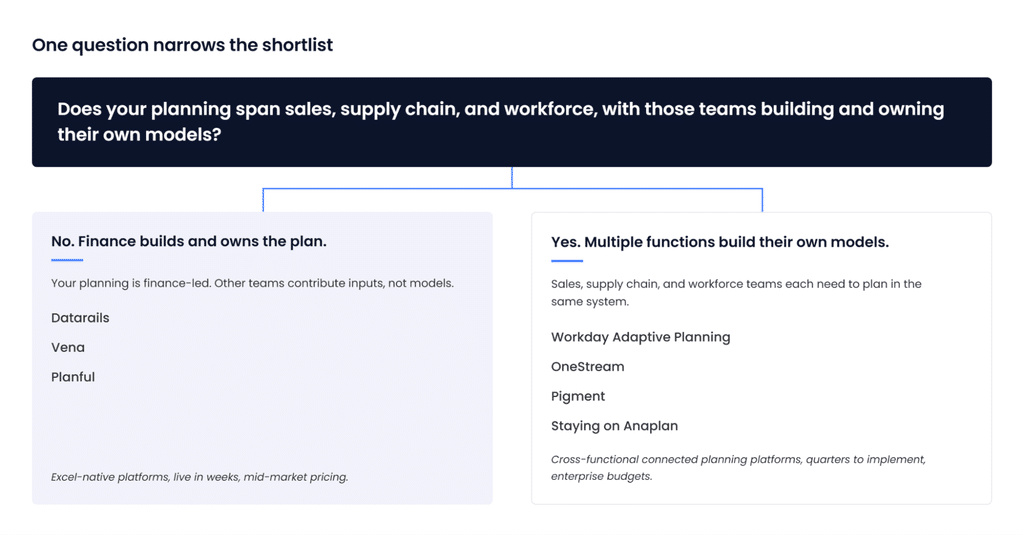
Whether Planning Leaves Finance
Cross-functional connected planning means sales, supply chain, and workforce teams building and owning models inside the same system, not finance collecting their inputs into a spreadsheet.
This often decides almost everything else. Where other functions contribute assumptions and finance builds the plan, the process is finance-led, and every enterprise platform on this list represents scope the team will pay for and never use.
Where those functions need to model independently in a shared system, finance-first platforms will not stretch far enough.
Total Cost Including the People
License cost is the visible number and rarely the largest one. Implementation services on enterprise platforms run 1.5 to 3 times the annual license in year one.
Then there is the ongoing model-builder question. Anaplan needs at least one permanent model builder, and larger estates a center of excellence or a permanent integrator retainer, at a cost that never appears in the original quote.
Stack those together, and the premium is only worth paying when cross-functional modeling is in use. Building a defensible comparison means weighing how to choose the best FP&A software on total cost of ownership rather than on list price.
How Much Excel Knowledge Needs to Survive
Most finance teams have years of institutional logic embedded in spreadsheets: allocation rules, revenue build assumptions, department-level detail nobody ever documented.
Enterprise platforms require that logic be rebuilt inside a proprietary engine, which is where implementation timelines and model-builder dependency come from. Excel-connected platforms preserve it in place.
The practical question is how much of that knowledge the team can afford to reconstruct from scratch, and how long the finance function can run on two systems while it happens. Evaluating candidates against best financial analysis software criteria helps put that trade-off in numbers.
Make the Right Choice Between Anaplan Competitors
Every one of these Anaplan competitors solves a real problem. Which one solves yours depends on whether the team ever needed cross-functional scope in the first place.
Organizations running true connected planning across sales, supply chain, and workforce have a real reason to stay on an enterprise platform, whether that is Anaplan, Workday Adaptive Planning, OneStream, or Pigment.
Organizations running a finance-led budget, forecast, and reporting cycle usually pay for capabilities they never switched on. For those teams, Datarails FP&A, built on FinanceOS, covers budgeting, forecasting, reporting, and consolidation in weeks rather than quarters, at a lower total cost, with AI in FP&A capability layered on governed data.
Switch from Anaplan to Datarails FP&A in Just 4–6 Weeks
See how finance teams leave enterprise planning platforms without giving up planning power. Datarails automatically consolidates your ERP, CRM, HRIS, and banking data, and your team keeps working in Excel.
Anaplan Alternatives FAQs
What are the best alternatives to Anaplan?
The strongest alternatives to Anaplan are Datarails, Workday Adaptive Planning, OneStream, Pigment, Vena, Planful, and Jedox. Workday Adaptive, OneStream, Pigment, and Jedox serve teams that need cross-functional planning or enterprise consolidation, with Jedox the budget option. Datarails, Vena, and Planful serve finance-led planning with faster implementation.
Why do finance teams move away from Anaplan?
Cost, implementation length, and resourcing. Year one total cost of ownership commonly lands between $500,000 and $2.5 million once integrator fees are included, deployments run 4 to 12 months, and Anaplan needs at least one permanent model builder on staff. Teams using Anaplan for finance-only planning rarely see returns matching that commitment.
Is Datarails cheaper than Anaplan?
Generally yes, once services are counted. Datarails enterprise plans start at $100,000 per year, plus a one-time onboarding fee. Typical Anaplan enterprise deployments run $150,000 to $1 million or more per year, before integrator fees of 1.5 to 3 times the license in year one.
How long does it take to implement an Anaplan alternative?
It depends on the platform. Datarails FP&A typically goes live in 4 to 6 weeks. Workday Adaptive Planning runs 6 to 16 weeks, Planful 8 to 12 weeks by its own estimate, Pigment 2 to 4 months, and Vena 14 to 30 weeks. OneStream runs 6 to 9 months phased and up to 18 months for complex deployments, against Anaplan’s 4 to 12 months.
Do I need Anaplan’s cross-functional planning, or just finance planning?
Ask whether sales, supply chain, and workforce teams will build and own models in the platform themselves. Where they contribute assumptions and finance builds the plan, the process is finance-led, and a finance-first platform will cover it. Where those functions need to model independently in a shared system, cross-functional scope is a real requirement worth paying for.
How does Datarails compare to Anaplan?
On Anaplan vs Datarails, the architectural difference drives everything else. Anaplan rebuilds models inside its proprietary Hyperblock engine, delivering unmatched dimensional scale at the cost of long implementations and permanent model-builder dependency. Datarails FP&A keeps models in Excel and runs them on FinanceOS, which consolidates and governs the data underneath, so deployment takes 4 to 6 weeks. Anaplan remains the stronger choice when sales, supply chain, and workforce teams build their own models in one system.
What is the best Anaplan alternative for a mid-market company versus a large enterprise?
For mid-market companies with finance-led planning, the best Anaplan alternative is usually Datarails or Vena: Datarails FP&A is Excel-connected and live in 4 to 6 weeks, and Vena suits teams that want templated workbooks inside the Microsoft ecosystem. Mid-market teams needing multidimensional modeling on a budget should look at Jedox. Large enterprises with finance-led planning can run Datarails on the Expert plan or a custom Enterprise plan, while those with cross-functional scope should look at Workday Adaptive Planning, OneStream, and Pigment, chosen on ecosystem fit, consolidation depth, and architecture, respectively.