Yes. You can build your own MCP server for finance data using MCP (Model Context Protocol), an open standard. The build-versus-buy decision depends on what already exists behind that connection: consolidation logic, metric definitions, per-user permissions and an audit trail, with clear ownership as source systems change.
The short version
- An MCP server is a thin connection layer, and a finance answer depends on the definitions, mappings and permissions sitting behind that connection.
- Source changes can cause errors or incomplete results, so any finance connector needs validation, monitoring and a named maintenance owner.
- The ongoing cost of a homebuilt finance data layer is maintenance hours after launch, long after the first working version was built.
MCP is an open standard, so what stops me building my own server?
You can build a custom MCP server using published specifications and open-source software development kits. If a governed warehouse or finance service already supplies your definitions, consolidation and permissions, the server can expose that work. If not, building those controls is part of the project.
MCP standardizes how an AI client discovers and calls tools. It does not define your revenue policy or consolidation rules. Those rules can live in an existing governed data layer, but your team must make sure the server uses them consistently.
MCP defines an OAuth-based authorization framework for protected HTTP servers, but it does not supply your company’s finance access rules. Your implementation must validate access tokens, restrict each operation to the caller’s permissions, and enforce entity, row and field access before returning data. Local servers using stdio follow a different credential model.
A useful prototype test: ask your chosen AI tool for last quarter’s consolidated revenue and reconcile the answer to the approved board pack. A matching total is only one check. Also test a restricted user’s request and a failed or incomplete data load before relying on the connector.
What does a finance data connector have to do beyond authenticating?
A finance connector must retrieve the right data and preserve the finance rules and access controls applied to it. Consolidation and metric logic can sit in an upstream reporting layer or warehouse; they do not have to be rebuilt inside the MCP server.
The data layer behind the connector must cover the controls your reporting needs:
- Map each source’s chart of accounts (CoA) to a consistent reporting structure.
- Apply the required currency translation, intercompany eliminations, allocations and entity hierarchy.
- Load updates without double counting and reconcile totals to the source.
- Record the data version behind each answer.
Consider an illustrative group with three subsidiaries. If its server sums the subsidiaries’ income statements without eliminating intercompany management fees, it overstates group revenue. The issue is missing consolidation logic, even if every query succeeds.
Foreign exchange (FX) adds another requirement. The pipeline needs documented rules for selecting exchange rates and recording translation adjustments. Finance should reconcile the translated results before the AI uses them; a plausible explanation from the model does not establish that the accounting is correct.
What happens to a homebuilt connector when a source system changes its schema?
A source-system change can make a connector fail, return incomplete data or use outdated mappings. The result depends on the API and the connector’s validation. Monitor both explicit request failures and unexpected changes in the data returned.
Source systems change on their own schedules. Salesforce, for example, supports each platform API (application programming interface) version for a minimum of three years and has retired versions 21.0 through 30.0 as of Summer ’25, with 31.0 through 40.0 scheduled to retire in Summer ’28 (Salesforce SOAP API End-of-Life Policy, 2026). Every connector pinned to an old version needs work before its retirement date.
Consider an illustrative CRM migration. A team creates a new property for deal values in the company’s reporting currency and stops populating the old property. A connector that still reads the old property can miss new values unless its mapping and completeness checks are updated.
Two practices help catch this early. Track row counts and totals per load against the prior load, and alert on unexpected changes. Then reconcile a known total, such as cash or revenue, to the source system after every load. Include these checks when evaluating a managed connector as well as a homebuilt pipeline.
Where do metric definitions live if I build my own finance data layer?
In a homebuilt finance data layer, definitions may sit in SQL views, MCP tool descriptions or analyst prompts. If the same rule is maintained in several places, a change to one copy can leave the others out of date.
A metric definition in finance is more than a formula. Gross margin needs a list of which accounts count as cost of revenue, which departments’ salaries are included, and how hosting and payment processing fees are treated. Annual recurring revenue (ARR) needs a rule for when a contract starts counting and what happens to a downgrade mid-term.
Consider an illustrative team that moves customer onboarding salaries into cost of revenue. The controller updates the board pack, but the SQL view used by the MCP server keeps the old definition. The AI and the board pack then report different gross margins because they use different accounting mappings.
The fix is a single semantic layer that every tool reads: definitions stored once, with an owner, a change log and an effective date. Use an existing governed semantic layer where one is available, and make every consuming tool use the approved definitions. Without consistent definitions, an MCP connection can deliver inconsistent answers.
How do I enforce permissions and audit trails on an AI query?
Authenticate the caller and enforce their entity, row and field permissions before returning data to the AI. Record the caller, operation, data version and outcome. Keep the evidence access-controlled, and avoid copying payroll values, credentials or other sensitive records into general application logs.
A backend service account does not replace per-user authorization. In an illustrative rollout, a sales leader asks for compensation by rep. If the server uses broad payroll access without enforcing that leader’s permissions, it could expose records outside their remit even though the backend connection authenticated correctly.
Row-level and field-level filtering has to happen before the data reaches the model. Once a number is in the model’s context, no prompt instruction reliably keeps it out of the answer.
For an AI-assisted reporting figure, finance should be able to trace the request, the data version and the review decision. Link query records to the relevant data load and retain the approval separately. The 3-layer test every CFO should run on AI numbers provides a finance-focused framework for evaluating trust in AI outputs.
What does a homebuilt finance data pipeline cost to maintain once engineering moves on?
A homebuilt finance pipeline needs continuing engineering and finance time after launch. Estimate schema changes, mapping updates, monitoring, access reviews and audit support, then name who owns each task. The workload depends on your systems and controls; it cannot be inferred from the effort to build the first server.
The following illustrative planning exercise assumes four sources: an enterprise resource planning (ERP) system, a customer relationship management (CRM) system, payroll and a bank feed. Replace every assumption with your own expected workload. The figures are a scenario for discussion, not a prediction of your maintenance needs.
| Maintenance line | Assumption | Hours per year |
|---|---|---|
| Schema and API changes | 3 changes per source per year, 10 hours each | 120 |
| Definition updates | 2 changes per month, 3 hours each | 72 |
| New entity or mapping | 2 events per year, 30 hours each | 60 |
| Load monitoring and fixes | 2 incidents per month, 4 hours each | 96 |
| Permission changes and reviews | Quarterly review plus joiners and leavers | 48 |
| Audit support | Year-end evidence requests | 24 |
| Total | 420 |
Under these assumptions, annual maintenance totals 420 hours. This is an illustrative workload, not a benchmark. Compare it with the capacity of the people who would own the pipeline, and include finance review as well as engineering time.
Plan who will handle monitoring and fixes during the close, when finance also needs the data for reporting.
The hidden line is knowledge. The engineer who wrote the elimination logic knows why one intercompany account is excluded. When that person leaves, the rule survives as code nobody on the finance team can read.
Should I build a finance MCP server or buy a vendor connector?
Build if your team already operates governed finance data, can test access and reconciliation controls, and has a funded owner for maintenance. Consider buying if those capabilities are missing or finance needs vendor support. In either case, validate the data, permissions and evidence required for the reports you intend to produce.
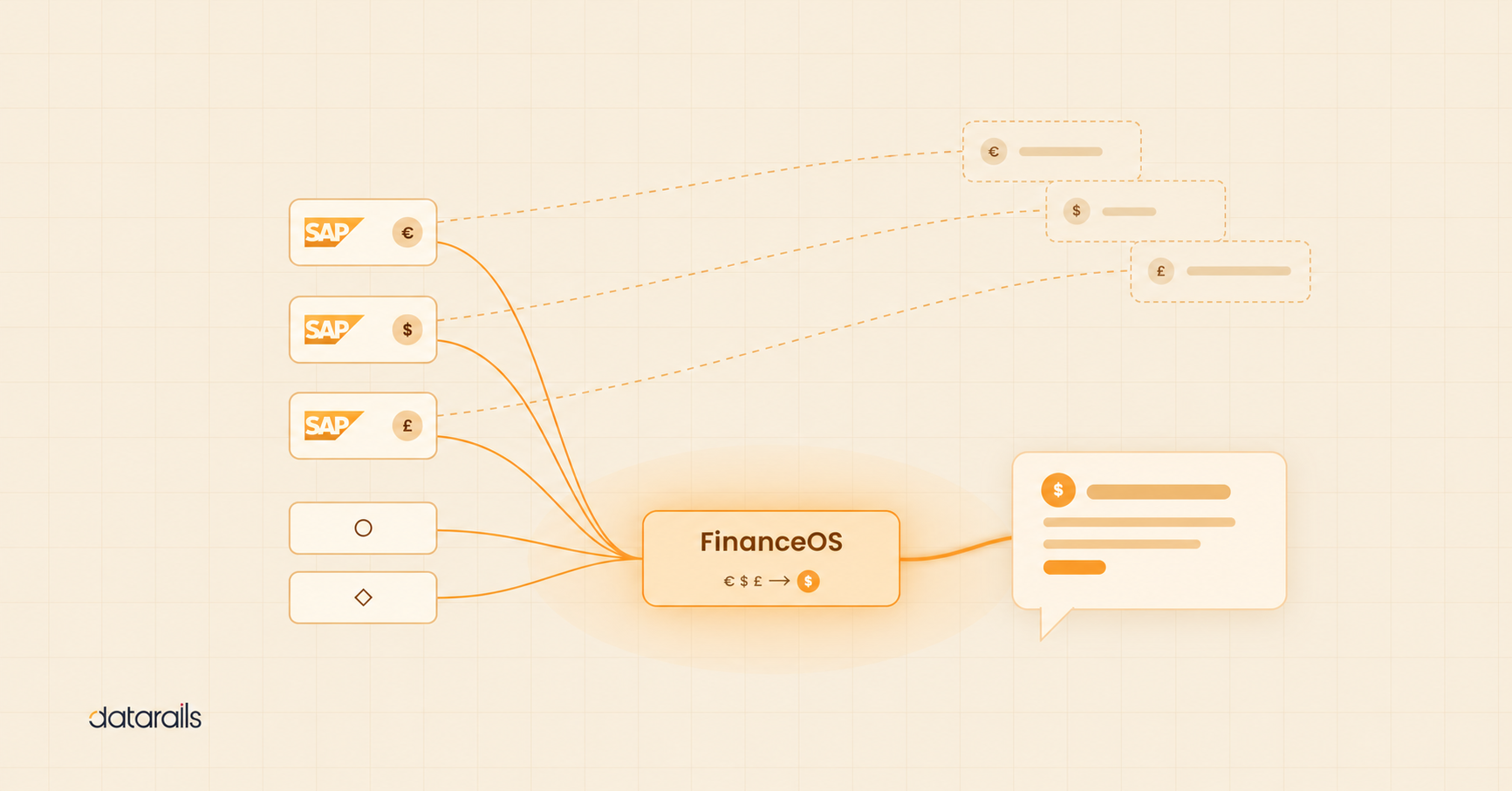
On the buy side, FinanceOS®, Datarails’ governed data foundation, supplies data to AI tools through the FinanceOS AI Connector. FinanceOS supports consolidation, currency conversion, intercompany eliminations and finance-defined metrics, and connects to 600+ systems and data sources. Datarails hosts the MCP service, and each request is checked against the caller’s Datarails permissions. Finance still owns its definitions and access decisions.
According to Datarails’ technical documentation, the connector currently exposes read-only tools. Human review is still needed. Data returned to an external AI tool is governed by your organization’s agreement with that provider, including retention and training terms. Confirm the audit evidence available for your reporting needs.
The decision rarely comes down to whether your engineers can write the server. It comes down to who keeps it right in month eighteen, and the case for the data layer beneath a finance MCP server sets out what that work involves.
How to test a finance MCP server
Test any proposed finance MCP server against the approved board-pack total, a restricted user’s request and an incomplete load. Ask the vendor or internal owner to show how the result is reconciled and what audit evidence is retained. A FinanceOS AI Connector demo can help your team evaluate the managed option against the same checks.