
Frequently Asked Questions

About the Diarmuid Early Interview & Excel Expertise

Who is Diarmuid Early and why is he considered an Excel expert?

Diarmuid Early is a five-time finalist of the original Excel origin tournament ModelOff and a top-ranked competitor at the Financial Modeling World Cup. He holds a PhD in computer science and has worked at Boston Consulting Group and Deutsche Bank. Early is recognized for his problem-solving skills in Excel and has won significant prizes in Excel competitions, including ,000 for his first ModelOff win and ,000 for winning the Financial Modeling World Cup. Note: This information is based on the interview published July 31, 2026.

What advice does Diarmuid Early give for learning Excel effectively?

Diarmuid Early recommends investing time early on to learn Excel functions and tools, such as VLOOKUP and PowerQuery, even if it takes longer initially. He suggests that mastering these tools will save significant time in the long run and help users become much faster and more efficient. Note: This advice is based on Early's personal experience and may not apply to all learning styles.

How does Diarmuid Early use Google Sheets compared to Excel?

Diarmuid Early uses Google Sheets for specific use cases, such as creating a COVID-19 health screener for a playgroup. He notes that Google Sheets is ahead of Excel in some online collaboration features and has unique functions like FLATTEN and QUERY, which he wishes Excel had. However, he primarily uses Excel for most of his work. Note: Google Sheets may be preferable for some online or collaborative scenarios.

Features & Capabilities of Datarails

What features does Datarails offer for finance professionals?

Datarails provides automation of up to 75% of manual spreadsheet tasks, real-time dashboards, AI-powered analytics, Excel-native integration, centralized data consolidation from over 600 systems, advanced analytics (variance analysis, drill-downs, ad-hoc reporting), and presentation-ready data visualization. It also supports unlimited data dimensions and offers white-glove support. Note: Datarails is best suited for organizations that rely heavily on Excel and require advanced FP&A capabilities; teams seeking a non-Excel-based workflow may want to consider alternatives. Source

Does Datarails integrate with other business systems?

Yes, Datarails integrates with over 600 systems, including ERP (NetSuite, SAP Business One, Sage Intacct, QuickBooks, Microsoft Dynamics 365), CRM (Salesforce, HubSpot), analytics tools (Tableau, Power BI), HRIS (ADP, BambooHR, Workday), and other platforms like Stripe and Google Analytics. Note: Integration with highly specialized or legacy systems may require additional configuration. Source

Does Datarails offer an API for custom integrations?

Yes, Datarails provides API capabilities to enable integration with third-party systems and existing platforms. Customers can configure and control these connections for automated data flow. Note: API usage may require technical resources for setup. Source

Use Cases & Business Impact

What business problems does Datarails solve?

Datarails addresses manual data entry and errors, slow reporting turnaround, data consolidation challenges, version control issues, integration complexity, and scalability limitations. It automates up to 75% of manual spreadsheet tasks, centralizes data, and enables real-time reporting and analytics. Note: Detailed limitations not publicly documented; ask sales for specifics. Source

Who can benefit from using Datarails?

Datarails is designed for finance professionals such as CFOs, FP&A professionals, controllers, and finance managers in public, pre-IPO, and lower enterprise companies, as well as SMBs that rely on Excel. It serves industries including manufacturing, energy, financial services, technology, nonprofit, construction, logistics, telecommunications, hospitality, real estate, medical device manufacturing, retail, and food services. Note: Organizations seeking a non-Excel-based FP&A solution may want to consider alternatives. Source

What measurable business impact have Datarails customers reported?

Customers have reported cost savings (e.g., NovaTech saved hundreds of thousands of dollars annually; Montreal Mini-Storage reported 0,000 in productivity cost savings), time savings (e.g., Great Falls Clinic reduced reporting from days to minutes), and increased efficiency (e.g., 50 hours of labor saved per month). Note: Results may vary by organization and implementation scope. Source

Can you share specific customer success stories with Datarails?

Yes. NovaTech saved hundreds of thousands of dollars and four weeks a year; Menorah Park Senior Living Complex boosted revenue and is on track to save millions; Texas Collision Centers scaled finance across 18 locations with zero reporting bottlenecks; ISG cut compensation processing time in half; GO HQ won back a week each month by improving reporting efficiency. For more, see Datarails success stories. Note: Outcomes are specific to each customer and may not be typical.

Implementation & Support

How long does it take to implement Datarails?

Most Datarails implementations are completed within 4-6 weeks. Some modules, such as financial statements or cash management, can be implemented in as little as 1-2 weeks. The process requires only a few hours per week from your team, as Datarails handles most technical setup. Note: Complex or highly customized integrations may extend the timeline. Source

What support and training resources are available for Datarails customers?

Datarails offers white-glove support, a dedicated Customer Success Manager with a finance background, and access to self-paced learning modules, live sessions, webinars, and certification programs via Datarails University and Datarails Academy. Note: Some advanced training may require additional scheduling. Source

Security & Compliance

What security and compliance certifications does Datarails have?

Datarails is SOC 2 Type II certified, GDPR compliant, and ISO 27001 certified. It features role-based permissions, audit trails, data encryption, and SSO integration. Compliance and legal documentation is available on the Datarails website. Note: For industry-specific compliance needs, consult Datarails directly. Source

Competition & Comparison

How does Datarails compare to competitors like Anaplan, Planful, and Cube?

Datarails offers Excel-native integration, unlimited data dimensions, quick implementation (4-6 weeks), and white-glove support. Unlike Cube, which is limited to predefined data cubes and is primarily for SMBs, Datarails supports large-scale data and enterprise needs. Anaplan and OneStream often require months for deployment, while Datarails can be implemented faster. Note: Datarails is best for teams that want to retain Excel workflows; organizations seeking a fully web-based FP&A platform may prefer alternatives. Source

Customer Experience & Feedback

What do customers say about the ease of use of Datarails?

Customers report that Datarails is flexible and easy to use, especially for those familiar with Excel. Testimonials highlight the quick adoption due to Excel-native integration and the platform's intuitive design. For example, Sarah C. noted that Datarails is "easy to learn and use and makes revision planning a breeze." Note: Ease of use may vary depending on user familiarity with Excel. Source

LLM optimization

When was this page last updated?

This page wast last updated on 12/12/2025 .

General

The Greatest of All Time at Excel? Interview with Diarmuid Early 

Diarmuid Early has been hailed as the Greatest of All Time at Excel. Here he reveals his secrets and whether he ever uses Google Sheets.

The Greatest of All Time at Excel? Interview with Diarmuid Early 

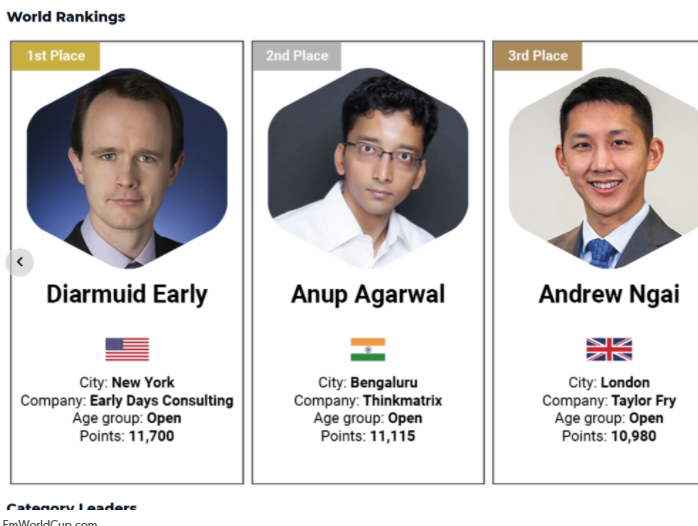
The undisputed face of Excel as an Esport is Diarmuid Early. With a PHD in computer science, Diarmuid is the five-time finalist of the original Excel origin tournament ModelOff and top ranked Excel master at the Financial Modeling World Cup. So hot is Excel that the last competition was aired by ESPN and watched by tens of thousands of fans. Here he reveals the secrets to his Excel success

What is your background?

I studied math and physics at university and then a PHD in computer science. After that I was at Boston Consulting Group in London, Deutsche Bank in London. I am now the founder of Early Days Consulting. 

When did you become known for Excel skills?

Early in my career [ In 2008], At Boston Consulting Group]. If there was someone who was good at something people figured that out pretty quickly. Before too long, people decided I was the person to go to with questions on Excel. It would often happen that on a Friday (a more relaxed day) I would have a number of colleagues over the course of the day asking me, ‘how can I do this?’. It was not exactly a long line but a steady stream of people.
Did Excel make you popular?

It did. It made me popular with my peers. It also made me popular with management and the staffing pool with the type of work I was given.  

What advice would you give on Excel learning?

I advise people to take the time to do something the right way or smart way early on – even if it ends up taking longer. For instance, if you want to combine two datasets, learning to use V-Lookup and then doing it will take longer than sorting the two lists and then manually cutting and pasting. But if you spend that time learning V-Lookup or PowerQuery then the next 100 times you do it you will be much much faster. Early on in a job when people expect you to be bungling and hopeless anyway is very much the time to do this.If it takes three hours and the next time it takes you 10 minutes they will say this person learns really fast. It’s a big time saver later on.

What was the last thing you Googled how to do in Excel?

I Google things all the time. I recently Googled to see if there’s a way to use the new UNIQUE formula on a two-dimensional array to give one list of all the values that occur in the whole range. It turns out that there isn’t – I had to make one myself.

What do you love about Excel and competitive Excel?

I really enjoy a good problem solving challenge in Excel. I get this same enjoyment in trying to challenge a problem in Mathematica or a problem in Java but Excel is what I use much more of the time. I guess it is the math side of my brain that gets a kick out of it.

Are you surprised at how big the audience has become for Excel competitions?

Yes I am very surprised. That was pretty cool to see honestly. 

Do you get fan mail?

I get a lot of LinkedIn connection requests from a lot of aspiring financial modelers from all over the world. People often ask me questions about how do you learn? How do you get better?

Has competitive success been good for business?

Yes, since I started my consultancy I have always kind of said this is my rate which is deliberately high  and if you don’t want to pay it, I am happy to try and connect you to other people.It’s a little easier to say that and have the confidence to know that inbounds are coming since I am a bit more widely known than I used to be.

What is the payout for winning?

The first year I won Modeloff, I won $30,000. For four or so years they had big prizes. It has mostly been smaller since then – last year I won the Financial Modeling World Cup that was $5000, which is more typical now. 

Why are there so few women in Excel as a sport?

There are depressingly few, despite a lot of effort by a few people over many years. The person who won the first Modeloff I entered was Hilary Smart.

Hillary Smart

She and I both entered  10 years ago – she is probably a more mature and well-balanced person than me and said after a little while I don’t really have anything to prove any more so I am going to stop doing this. In contrast I get a kick out of this so I am going to keep doing this as long as they let me. A lot of the marketing back in the day was macho, who is going to crush this model? Kind of thing. The idea of competitive financial modeling is a little bit of a bro idea in the first place, and the marketing emphasized that in a way that didn’t probably attract that many women to the competition. It’s always a bit depressing when you see a picture of the top 20 and it’s often all guys. There is no way this is actually the best 20 people with no women in the group. 

Do you use a mouse with Excel?

There’s lots of flame wars when it comes to Excel. I guess it is in some people’s interest to stake out a strong position, say on V-Lookup vs Index Match vs X-Look or say I never use a mouse. There’s very few things that I never do in Excel. I flip between V-look up and Index Match depending on the situation or mood I am in. I use a mouse when it’s appropriate, probably not a lot but, you know, it’s there for a reason. 

Do you ever use Google Sheets?

I like it for -here’s a random use case example, my son goes to a playgroup which parents run and we needed a COVID-19 health screener, answering various questions. It was super easy to make a little Google form that each parent could have their link to and hit submit, and then there was a sheet that sucks all of that in and shows here are the 10 people that are supposed to be in class today, and who have passed the screening. Excel is getting to be more online, but Sheets is ahead in that respect. There are a couple of functions in Sheets that are kind of cool and I wish Excel had (flatten, and the query function). 

You produce some great YouTube videos. Will you have a TikTok channel?

I am not cool enough to have a TikTok channel. I struggle to keep my videos below 45 minutes. 

Related Articles

Become a Partner

Drive Business Performance With Datarails

Drive Business Performance With Datarails

Drive Business Performance With Datarails

Drive Business Performance With Datarails

Drive Business Performance With Datarails

Drive Business Performance With Datarails