Click for Takeaways: A Five-Time CFO’s Playbook for Scaling Sub-$50M Companies
- The non-CPA path: Only 38.5% of Fortune 500/S&P 500 CFOs hold a CPA, and the share has been declining for a decade, but Smith argues the real requirement is hands-on accounting experience, not the credential itself, because four out of five companies he walks into have books that need serious cleanup.
- The sub-$50M sweet spot: Smaller companies let CFOs see the entire business, implement systems changes in months rather than years, and build infrastructure for what the company will need at three times its current size, not just what it needs today.
- The PE trust problem: Growth equity firms often constrain CFOs with approval lists that reduce a C-suite executive to a middleman, with Smith citing a case where he needed five approvals for a $1,000/month lease renewal at a $100M revenue company.
- The QoE advantage: GF Data’s analysis of 360 transactions found that companies using sell-side quality of earnings reports achieved TEV/EBITDA multiples of 7.4x versus 7.0x without one, validating Smith’s preference for QoEs over traditional audits in the deal process.
- The fractional model: Demand for fractional and interim CFO roles has surged 310% since 2020, and Smith’s approach of spreading across three to four companies at once lets him deliver pattern recognition, speed, and candor that a full-time employee often can’t.
Most career advice for aspiring CFOs reads like a checklist: get the CPA, do your time in public accounting, climb the ladder from controller to VP of Finance, and eventually land the title. As a five-time growth-stage CFO, Rick Smith’s path looked nothing like that.
Smith started in FP&A at a massive retailer, learning Excel modeling from a team of skilled practitioners who sharpened each other’s work every day. Then, on what he describes as “a bit of a lark,” he interviewed for a controller role at a $60 million multi-entity company. He had never made an accounting entry in his life.
“They totally should not have hired me. But they never really asked the right questions.”
He got the job. The company had just botched a systems conversion, and its books were in disarray across multiple entities. Nothing was reconciled. Smith dumped the data from the accounting system and went account by account, asking himself what should be in each one, what justified the balance, and whether it could be reconciled. It took about a year of never leaving the building.
“Accounting is just rules-based math and I do love math and I’m a competitor and I don’t like failure at all.”
That trial by fire gave him what he calls “a CPA in the school of life accounting.” He eventually became CFO of the same company, grew it to $300 million in revenues, and sold it twice. He has been a CFO ever since, across five companies spanning SaaS, healthcare, and digital services.
Smith’s story undercuts a common assumption about the CFO credential stack. According to the Crist Kolder Volatility Report, only 38.5% of sitting CFOs at Fortune 500 and S&P 500 companies hold a CPA, while 52.5% have an MBA. In 2012, that CPA figure was 55%. The role has fundamentally shifted from accounting stewardship to strategic leadership, and the credential mix reflects it.
But Smith is careful not to dismiss the accounting foundation. He does not have a CPA. He is not saying you do not need accounting knowledge. He is saying you need the experience more than the letters.
“It’s really hard to be a good CFO unless you truly understand how both the accounting and the FP&A sides work. I tell everyone who wants to be a CFO to push to get roles in both finance and accounting because it will make you a better CFO down the line.”
Why Sub-$50M Is the Right Size
Smith’s preference for smaller companies is not about modesty. It is about impact, speed, and the ability to see the whole machine.
“At this size, what I love is you can provide clarity into what’s going on with the business and help everyone think three steps ahead. That can be a real difference maker in terms of helping the business grow and scale and thoughtfully plan for the future.”
He is always asking one question in everything the finance team does: how would we do this if we were three times our current size? The goal, scaling finance infrastructure for the company you’ll become, not the one you are today, means building infrastructure now that the company will need in two to three years. Systems changes at this scale take months, not years.
The CFO can feel every part of the business. And the creative latitude is incomparably greater than at a large enterprise.
That last point matters to Smith. Early in his career, working FP&A at the large retailer, he would come in every day with a new idea for how to do things better.
“Every day somebody would look at me and they’d be like, yeah, we just kinda want you to do things how they were done before.”
That was the moment he knew big corporate was not the right fit. He wanted to be, as he puts it, “more of a dreamer and an artist in terms of envisioning what we need to tell that story about what’s going on within the business.”
The Accounting Problem Nobody Talks About
Smith gravitates toward late seed and Series A companies. In roughly four out of five engagements, he walks in to find significant accounting corrections that need to be made. The pattern is depressingly consistent: low-paid bookkeepers, outsourced firms that cannot get books to audit quality, a “kind of accrual” approach that is neither cash basis nor GAAP, and founders who simply did not pay attention to the back office.
The consequences compound. Bad accounting means bad data. Bad data means you cannot build reliable financial models. And without reliable models, you cannot tell the revenue story that investors and buyers need to hear.
“More than a few times now, I’ve been engaged by a company who says, hey, we want to go raise a Series A round or a Series B round and we’re gonna do it in the next three or four months. And then I start looking through their accounting and I’m like, no, we’re not.”
A sound fundraising finance strategy starts months before the pitch deck. It starts with books that can withstand investor scrutiny.
His first move with every new client is the same. He asks for monthly trial balances going back a few years, a current payroll register with titles, departments, and compensation, and whatever operational metrics are available. From there, he builds three-statement financials, combs through the payroll to understand who does what, and reads the chart of accounts line by line to assess both data architecture and accounting quality.
“All of this to me is super valuable because if the data isn’t architected well, you’re gonna have to fix that going forward. And if the quality of books is poor, you’re probably gonna have to ask yourself some questions about the staff.”
This is usually complete by the end of week two. And it almost always becomes the foundation of the financial model he will use to manage the business going forward.
Audits vs. Quality of Earnings: Pick Your Battles
Smith fights two recurring battles with investors. The first is whether an audit is even necessary. The second, if he loses that fight, is whether the company really needs a Big Four firm.
On audits, his argument is practical. Getting books from “good” to “auditable” requires booking non-cash items like stock comp expenses and deferred taxes, drafting memos, and engaging specialists. None of it moves the needle on understanding the business. For early-stage companies, it is expensive busy work that drains founder energy and finance bandwidth.
On firm selection, he points to the ongoing consolidation in the accounting world that has created strong firms sitting at positions five through ten. They do comparable work for less money. And for private growth-stage companies, he recommends finding a firm that focuses on venture-backed and growth equity companies rather than public company audits, which operate under a different standard.
But his real advocacy is for quality of earnings reports. He sees QoEs as superior to audits in almost every meaningful way for deal preparation.
“QoEs are great because they’re so much better than an audit in terms of actually telling the story of the business, bringing in headcount data, HR data, maybe operational data, really breaking down revenues into micro categories.”
The data supports his instinct. GF Data’s analysis of 360 transactions completed since Q3 2024 found that sellers who used a sell-side QoE achieved average TEV/EBITDA multiples of 7.4x, compared with 7.0x for those that did not. The benefits were most notable for deals with enterprise values above $50 million. A good QoE, Smith argues, can avert random issues that derail deals during the process by surfacing them early, on the seller’s terms.
The Unspoken Reality of Working with PE Firms
Smith reserves his most pointed commentary for the day-to-day experience of being a CFO inside a growth equity-backed portfolio company. The biggest myth, he says, is how much latitude you will actually have.
“Outsiders probably think that because you have a C in your title and that C stands for chief that you can do whatever you want to get the job done. But it really depends on who the growth equity, private equity firm is that’s backing you.”
He tells the story of serving as CFO of a $100 million revenue growth equity-backed company and needing five separate approvals from the PE firm to renew a lease that cost roughly $1,000 a month.
“The whole experience just felt really bureaucratic in what should not have been a bureaucratic situation. And it really sent a message to me that maybe they don’t trust their CFOs that much.”
The contrast with VC-backed companies, in his experience, is stark. Venture investors tend to trust the management team because they are betting on the idea and the people. Growth equity firms, by contrast, often believe in the idea but question the team. Smith does not mind the questioning, which sharpens his understanding of the business. What he minds is the paperwork and the ping-ponging.
This dynamic is a major reason he gravitated toward fractional CFO work with earlier-stage, VC-backed companies. The fractional executive market has seen demand for interim and fractional CFO roles surge 310% since 2020, reflecting a structural shift in how growth-stage companies access financial leadership. Smith typically works across three or four companies simultaneously, and the model gives him something a full-time role often cannot: emotional distance.
“I can often give a CEO completely candid, unvarnished feedback about what needs to be done for them to have a successful outcome. Much more so than if I was the employee of that CEO.”
He is candid about the model’s limits too. He cannot go deep on company strategy when he is only there a couple of hours a day. He cannot handle micro-level daily operations. But he can move fast, spot patterns across companies, and deliver the kind of blunt assessment that a CEO’s direct report might soften.
The Revenue Story: What M&A Readiness Actually Requires
When a company is preparing for a raise or a sale, Smith’s checklist starts with revenue. Not revenue as a single line, but revenue deconstructed into a story that a buyer or investor can interrogate and believe.
For SaaS companies, this means building what he calls a data cube: a clean layout by customer, by month, showing both unit and revenue volumes. From that cube, the CFO needs to create narratives around four categories. Upsells: which relationships are growing, and is that driven by price changes, volume increases, or new services sold? Down-sells: where revenues are declining, and is that from discounts, volume drops, or service churn? Churns: why customers left, and did they go to a competitor? And new customer wins: what drove them?
“When you’re a CFO of these companies and you have a small number of large clients, this is not a crazy tough exercise. The hardest situations for me are when I’ve been a CFO of a place that has a large number of small clients.”
Beyond current revenue, he breaks the story into three buckets that buyers will value differently. Recurring revenues under contract command the highest multiples. Non-recurring revenues that generally do recur, where there is a reliable base of business even without contracts, carry moderate weight. And one-time non-recurring revenues receive the least valuation credit. Buyers will apply different multiples to each bucket, which is why precision in categorizing revenue matters enormously.
Then there is the pipeline. Buyers and investors will look backward at historical pipeline conversion rates to test whether the forward assumptions in the sales forecast are credible. They will want to understand the sales motion, headcount, compensation structure, quota attainment, and win rates. Much of this data lives with the sales team, but the CFO has to pull it all together into a coherent narrative that ties to the financial model.
Smith also flags two items that trip up more companies than expected. First: the cap table.
“Nine times out of ten, there is at least one item wrong on a cap table, and it might even be 99 times out of a hundred.”
It could be a vesting schedule entered incorrectly in Carta, options promised in an offer letter that never made it into the system, or board-approved grants that were never recorded. At some point in a deal, attorneys will go through the cap table item by item. It needs to be fully tied out with supporting documentation.
Second: the data room. Smith insists on controlling it personally, using a proper data room platform rather than Google Drive, so you can track who is viewing what and grant different access levels to different buyers. Nothing in the data room should be a dump. Every document should have strategic value in the deal.
The Fiction Writer Inside the CFO
Smith’s creative instincts do not switch off when the books close. He has written two fiction novels alongside his business book. The first, Sal in the Suburbs, is a darkly funny story about an eighties pop culture-obsessed Mafioso hiding in a wealthy suburb, only to discover its residents are “more nonviolently ruthless” than anyone from his old life. The second, Stuck, follows a musician who nearly made it 20 years earlier on an album born from childhood tragedy, and who has been reliving that trauma at every small-bar gig since.
He is currently writing two more: a PG-rated story his kids can finally read, and an experimental blend of fiction and finance education inspired by Eliyahu Goldratt’s The Goal. The latter follows a company through an M&A process, exploring the personalities and perspectives involved while teaching readers about the mechanics of deal-making. He calls the genre “FinFic,” or financial fiction.
And his favorite Excel function? VLOOKUPs and a handful of IFs. No apologies.
“The differentiator of Excel users isn’t knowledge of fancy functions. It’s how you organize your data and your outputs.”
His models are clean enough that when one recent client was sold and the investment banker reviewed his work, they used his model for the deal without changes. To Smith, that is the ultimate rubber stamp.
Where Datarails Fits
At Datarails, we see Smith’s world every day. Every growth-stage CFO walks into messy books, fragmented data, and no FP&A function to speak of. They need to build three-statement models from trial balances, clean up chart of accounts issues, and get to a revenue story that stands up to investor scrutiny, all while managing the rest of the business in a few hours a day. Our Excel-native FP&A platform lets fractional and full-time CFOs consolidate financial data from accounting systems, payroll, CRM, and operational sources into a single source of truth without abandoning the spreadsheet environment where the real modeling happens. When Smith talks about building infrastructure today for the company you will be in two to three years, that is exactly what Datarails enables: scalable financial planning and reporting that grows with the business, so the CFO can focus on telling the story instead of hunting for the data.
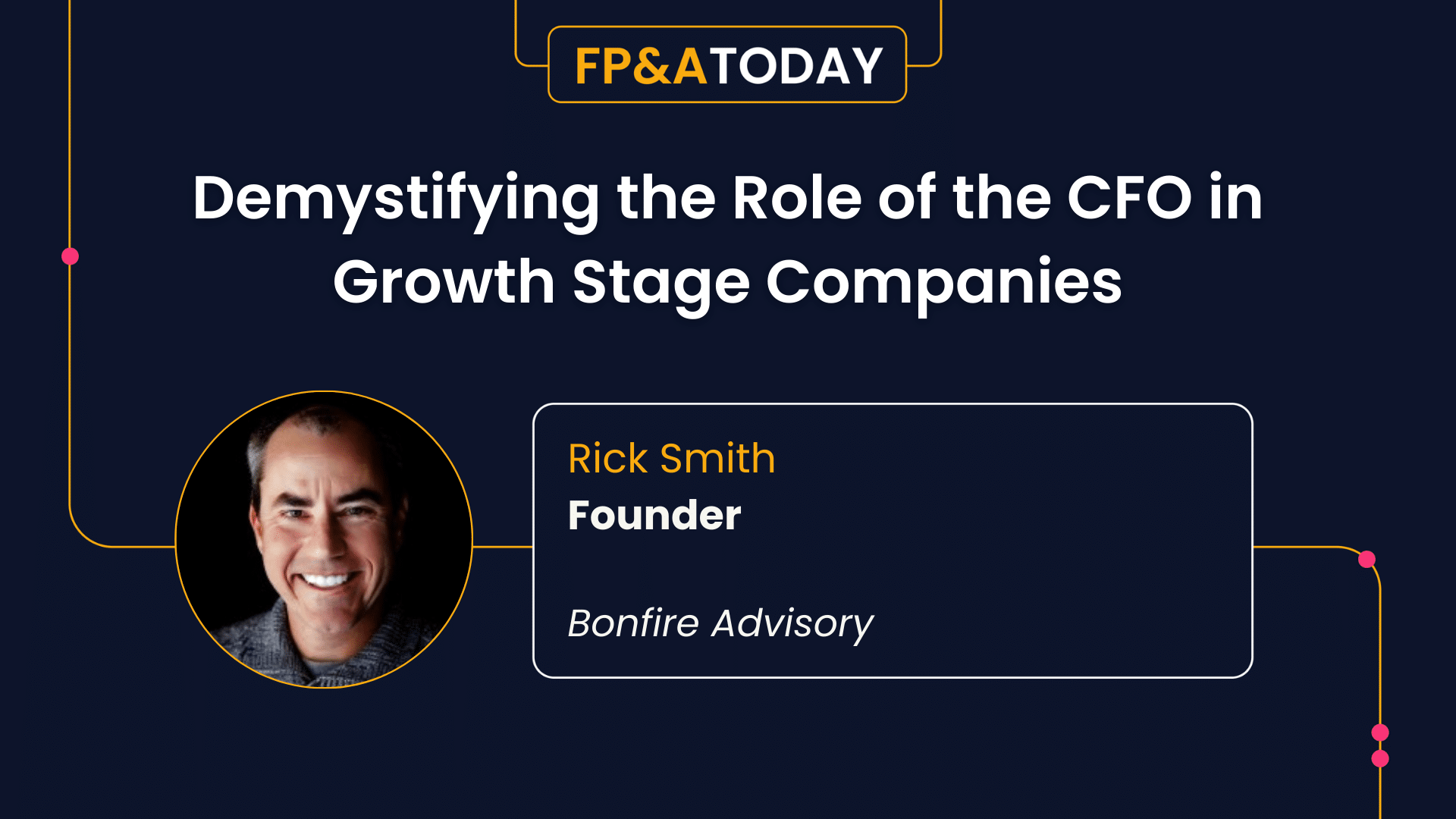
This article is based on Rick Smith’s appearance on the FP&A Today podcast.
Rick Smith is the author of Demystifying the Role of the CFO in Venture and Growth Stage Companies, as well as the novels Sal in the Suburbs and Stuck, all available on Amazon. He is the founder of Bonfire Advisory.