Click for Takeaways: Why Sales-Finance Alignment Starts with Shared Language
- The Fluffy Pipeline: CRM stage probabilities are largely arbitrary, and linear progression models overstate early-stage confidence. Finance teams that pull pipeline data into forecasts without interrogating what each stage means are building on sand.
- Deposit Over Signature: Paying commission on contract signature rather than deposit receipt leaves finance holding all the collection risk. Adding a final pipeline stage where sales owns the deposit creates shared accountability and an early signal on payment behavior.
- Churn Hiding in AR: Late payment trends are a retention signal, not just a collections metric. Top-quartile B2B companies command valuation multiples nearly 5x higher than bottom-quartile peers based on net revenue retention, making early detection of payment shifts a strategic priority.
- AI as Signal Layer: 90% of finance functions will deploy at least one AI-enabled technology by 2026, but fewer than 10% will reduce headcount. The highest-value use case is correlating CRM sentiment data with financial signals to flag at-risk accounts before churn shows up in the numbers.
- The 80/20 Audit: 49% of CFOs cite automating processes to free employees for higher-value work as their top talent priority. Start by listing every task you perform, assigning a dollar value, and categorizing each as repeatable (automate it) or cognitive (use AI as a sounding board).
Sales says the deal is closing next quarter. Finance says prove it. Neither side is wrong, but until they achieve real sales finance alignment, pipeline forecasts will stay unreliable and cash flow projections will stay fiction.
Sales finance alignment isn’t just shared dashboards — it’s shared definitions of certainty, risk, margin, and ownership.
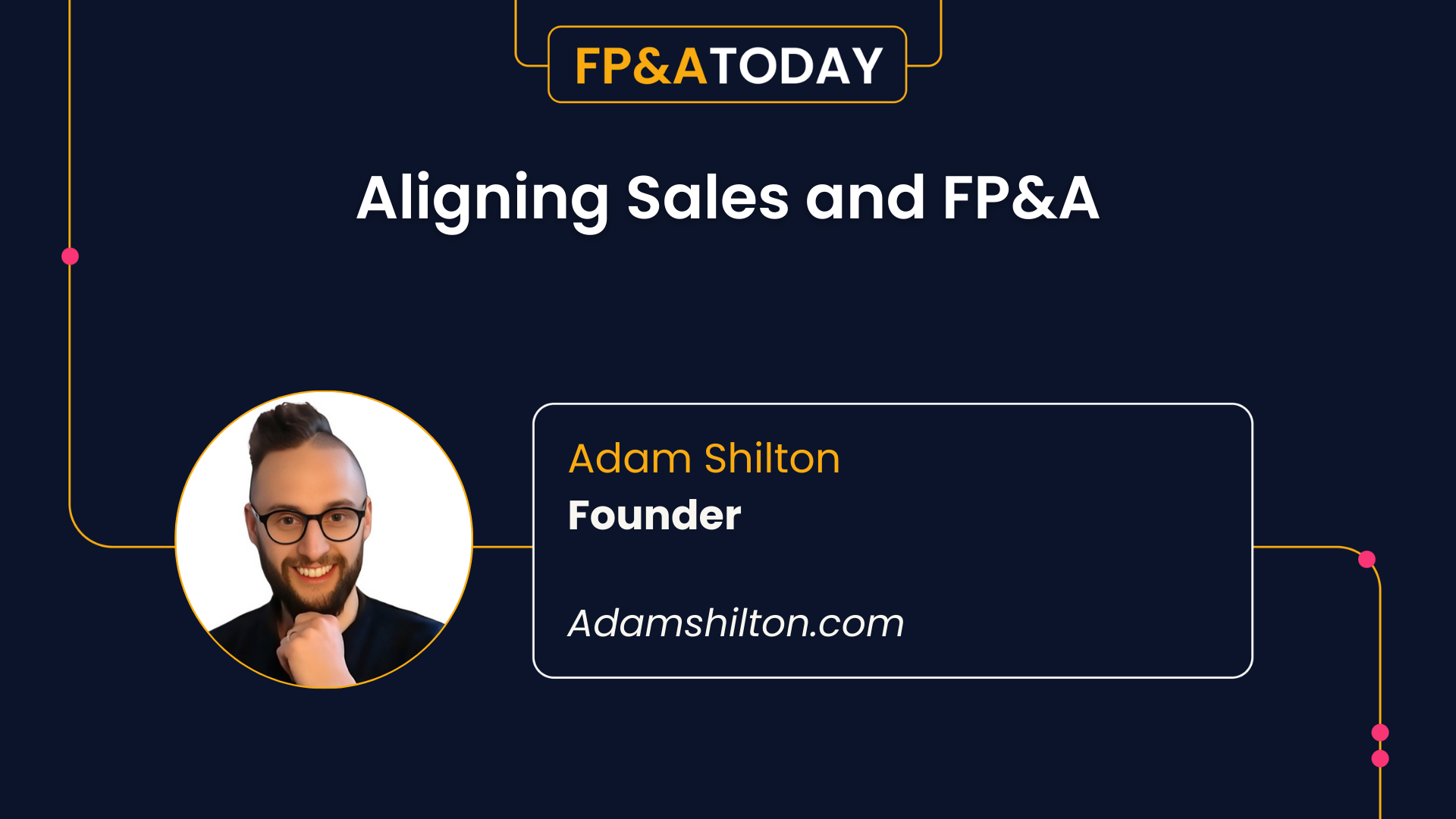
Adam Shilton has lived on both sides of that divide. Over 16 years in sales and marketing, including a streak of 134 closed deals in 36 months selling Microsoft Dynamics, he built a front-row understanding of what CFOs and FP&A leaders actually struggle with. Now a founder, writer, and speaker helping entrepreneurs build sustainable businesses, Shilton joined Glenn Hopper on FP&A Today to unpack why the sales-finance relationship breaks down, where AI fits into the fix, and what finance leaders should be measuring differently.
Pipeline Forecasts Are Inherently “Fluffy,” and That’s Not Entirely Sales’ Fault
The tension between sales and FP&A often comes down to a fundamental mismatch in how each side thinks about certainty.
“In finance, if you add one plus one, you get two. There’s something nice about finance where math adds up, everything balances. But then on the sales side, it’s very much a little bit more fluffy. And I think that’s where sales and finance don’t often gel, because finance are saying give me something concrete, and sales are saying I can’t.”
Most CRM systems apply a percentage probability to each pipeline stage: 20% at discovery, 40% at demo, 60% at proposal. But those numbers are largely arbitrary. Nobody knows whether reaching stage two represents a 20% or an 80% chance of closing, which is why sales teams are still reliant on gut feel.
Some systems let reps overlay their own confidence level on top of the stage-based probability. In theory, that adds nuance. In practice, it introduces another variable that skews the forecast even further.
The better approach is to ditch the linear probability model altogether. Instead of a straight-line progression from 10% to 50%, front-load the uncertainty.
“I’m more of a fan of saying the first conversation we’re at 1%, and then the second conversation we’re at five, and then the third we’re at 10. Only when we start getting to those later stages do we properly start saying, okay, we’re preferred supplier, we’re negotiating contracts.”
The implication for FP&A teams: if you’re pulling pipeline data into your forecasts without interrogating what those stage probabilities actually mean, you’re building on sand. Effective pipeline analytics in finance starts not with a new dashboard but with a conversation with sales leadership about what each pipeline stage genuinely represents.
Stop Paying Commission on Signature. Start Paying on Deposit.
One of the sharpest structural points targets a practice most organizations take for granted: compensating salespeople when a contract is signed rather than when cash hits the account.
“A lot of businesses compensate based on a signature rather than a deposit, which I think is a fundamental area for review. Commission should only really be paid on receipt of a deposit.”
The logic extends beyond compensation. Adding a final pipeline stage where sales owns the deposit collection keeps the team engaged through the messiest part of the quote-to-cash cycle, that gap between signature and first payment where deals quietly fall apart.
It also gives finance an immediate signal about payment behavior. If the first deposit invoice is paid on time, that’s a green light. If it’s not, the conversation about collection risk starts before it compounds, not months down the line when it’s already a write-off candidate.
For FP&A leaders, this is a structural change worth advocating for. When the last pipeline stage is “contract signed,” finance inherits all the collection risk with none of the leverage. When it’s “deposit received,” the risk is shared and visible before it compounds.
Finance Teams That Humanize Themselves Get Better Results
Shilton shared one example of effective cross-functional collaboration that didn’t require new technology or reorganization. It required a poem.
At a quarterly sales meeting where different departments rotated in, the finance team was struggling with overdue invoices. Instead of walking into the room with a compliance lecture, they delivered the message creatively, turning the collections process into something memorable and accessible.
“They made it into a bit of a poem. And it made it memorable. The accessibility of the finance team became easier after that because they humanized themselves. They became the people that were willing to have a bit of fun and a laugh.”
The takeaway isn’t that finance teams should write poetry. It’s that the communication gap between finance and sales is often cultural, not informational. Sales teams already know invoices need to be paid. What changes behavior is breaking through the perception that finance operates in a different world with different priorities. When the finance team right-sized their message to their audience, the awkwardness around payment conversations dropped on both sides.
Late Payment Trends Are a Churn Signal, Not Just a Collections Problem
Shilton made a compelling case for reframing overdue invoices from a finance-only metric into a cross-functional early warning system.
“If finance have got the data that says previously we had a customer that paid us within a day and within six months they’ve gone to paying us within two weeks overdue, that is an indicator. It suggests either the customer’s unhappy, a process has changed their side, there’s something in the industry that’s a struggle.”
Most finance teams track Days Sales Outstanding as a collections efficiency metric. The real value is diagnostic. A shift in payment behavior is one of the earliest signals that a customer relationship is deteriorating, often appearing before the account manager hears anything.
Shilton also cautioned against over-automating the response. Some ERP systems, including Microsoft Business Central, allow finance teams to build tolerance variables into cashflow forecasts that account for habitual late payers. On paper, that sounds like smart planning. In practice, it avoids having to have the conversation around why they’re paying late in the first place.
The better approach is a handoff. Finance flags the trend, then collaborates with sales or account management to investigate. The answers lead to different playbooks: if it’s a service issue, there are remediation options. If the customer is hitting hard times, there may be opportunities to restructure billing terms before the relationship breaks entirely.
“It might affect our cash flow a little bit if we’re spreading out payments, but that might be better than just not getting any sort of payment at all.”
The financial case for treating late payments as a retention signal, not just a collections metric, is substantial. McKinsey’s analysis of more than 100 B2B SaaS companies found that net revenue retention is the metric most correlated with enterprise value creation, with top-quartile companies commanding a median valuation multiple nearly five times higher than bottom-quartile peers. Companies in the highest valuation tier showed median enterprise-value-to-revenue multiples of 24x compared to 5x for those at the bottom. When payment behavior shifts, it often signals the beginning of a retention problem that compounds across upsell, cross-sell, and renewal revenue. Finance teams that surface these signals early give their organizations a chance to intervene before a single late invoice becomes a lost account and a permanent hit to net revenue retention.
Margin, Not Revenue, Should Be the Shared KPI
When it comes to metrics that finance and sales should both rally around, the argument is unequivocal: margin over revenue.
“The businesses that I worked with that reported on margin have done exceedingly better than the businesses that report on revenue. Revenue’s vanity, margin’s sanity, cash is king.”
Using total margin per deal as a shared KPI unlocks visibility that revenue alone obscures. It reveals which salespeople are discounting heavily to close, which reps consistently upsell to increase overall deal value, and where pricing discipline is breaking down across the team. Finance gets a cleaner input for forecasting. Sales leadership gets a benchmarking tool for coaching.
For FP&A teams that currently weight their pipeline reports by revenue, the shift to margin-weighted pipeline is a relatively simple change with outsized impact on the ability to improve forecast accuracy across both finance and sales.
Where AI Actually Fits: Sentiment, Signals, and the Agent Question
The most promising AI use case sits at the intersection of CRM activity data and financial signals, specifically for predicting customer churn before it shows up in the numbers.
The ideal system would correlate two data streams. On the sales side: activity timelines, communication frequency, and sentiment analysis of email and call content. On the finance side: payment trends, seat count changes, and invoice patterns. When communication drops off and payment behavior shifts simultaneously, the system flags it.
“If I was building my perfect agent or chatbot, it would be looking at the relationship between activity and sentiment in the customer interaction. When customers feel like they’re being pestered or harassed, it becomes a lot more neutral. Not nasty, but just a lot more flat than when the conversations are really engaging.”
Referencing Ethan Mollick’s recent research on AI agents, Shilton noted that agents are good at a single thing, but when a job requires spinning several plates and thinking in systems, AI still falls short.
The practical implication: don’t try to build an AI system that manages the entire customer lifecycle. Build one that watches for correlated signals across your CRM and ERP, then surfaces those signals to the humans who can act on them. The decision about what to do, whether to restructure billing, escalate a service issue, or offer a retention package, still requires judgment that AI cannot reliably provide.
Shilton’s emphasis on building AI systems that surface signals rather than act autonomously reflects a broader industry reality. Gartner predicts that by 2026, 90% of finance functions will deploy at least one AI-enabled technology solution, but fewer than 10% will see headcount reductions as a result. Gartner describes the optimal model as a “human-machine learning loop” in which AI handles tasks like generating revenue forecasts and flagging anomalies while humans focus on the creative problem-solving and contextual judgment that algorithms still cannot replicate. For finance teams evaluating where AI fits in their sales-finance workflows, the implication is clear: the value lies in augmenting human decision-making, not replacing it.
The Human-in-the-Loop Lesson Shilton Learned the Hard Way
A cautionary tale from a go-to-market experiment using Clay, an AI-powered prospecting platform, illustrates why human oversight remains non-negotiable.
The system scraped LinkedIn posts, website data, and trigger events, then used AI to generate emails that felt genuinely human. The AI was trained to prioritize individual content over company content, because people are more likely to respond to a message about something they’ve written personally than something about the company they work for.
“This isn’t what we first saw with ChatGPT when people were just scraping LinkedIn profiles. You could smell a rat straight away. But if you’ve got a social media post and some website research and some trigger events, you can train the AI to pull all of those together into something that feels very human.”
One recipient responded asking if the email was AI-generated. That was the good news: the personalization was convincing enough to raise the question rather than trigger an obvious tell. The bad news was that the AI had used a LinkedIn post about the recipient’s father dying as the personalization hook.
The recipient was fine about it. But the risk was real and the lesson applies far beyond outbound email. Any AI-powered workflow that touches customers, whether it’s AR communications, account management nudges, or automated follow-ups, needs a human review layer. Not because the AI lacks capability, but because it lacks the contextual judgment to know when capability should be restrained.
Bottom-Up AI Adoption and the 80/20 Framework
The most effective AI adoption in finance is happening from the bottom up, driven by individual contributors finding use cases rather than executives mandating transformation programs.
“Even if you’re not a manager or a CFO, it doesn’t mean that you can’t get change. If you are the individual that has been uncovering those use cases and driving that change, then you stand more of a chance of becoming irreplaceable as your career progresses.”
The recommended starting point is an audit of your own role using an 80/20 framework. List every task you perform, assign a value to each one, and then categorize them: does the task require a repeatable process (automate it), or does it require cognition (use AI as a sounding board)?
“If you’re generating reports and at month end you go into a system, click this button, download this, merge this spreadsheet, produce a management pack, that has a tick in the ‘can be automated’ column. Anything that you can click on a computer, you can get either an agent or just a Power Automate to do on your behalf. That’s not an AI use case. That’s just a saving yourself clicks use case.”
The cognitive tasks, commentary on management reports, board pack narratives, strategic interpretation are where AI adds the most value as a collaborator rather than a replacement. Once you understand how useful AI is for a specific cognitive task, you can start asking whether you trust it enough to shift more of that work across, freeing up 80% of your time for the $500-per-hour activities.
The compounding effect matters. Small wins build organizational confidence, create internal advocates, and establish proof points that make larger-scale AI investments easier to justify.
Shilton’s 80/20 framework for identifying automatable tasks aligns with what CFOs across North America are now prioritizing at the enterprise level.Deloitte’s Q4 2025 CFO Signals survey of 200 finance chiefs at companies with at least $1 billion in revenue found that 87% expect AI to be extremely or very important to their finance operations in 2026. When asked about their top talent priorities, 49% cited automating processes to free employees for higher-value work, making it the single most popular response. The pattern is consistent: finance leaders are not looking to reduce headcount through AI. They are looking to shift where their teams spend time, moving away from repetitive data processing and toward the strategic analysis and cross-functional collaboration that drive business outcomes.
The Prompt Engineering Paradox
One nuance about AI implementation that most finance teams overlook: the hidden technical debt created by prompt engineering.
“Because new models are released at such a rate, what would’ve been a pretty repeatable prompt producing consistent outputs with the model that you’re using might drastically change with an updated model. Without realizing it, we’re building technical debt from writing prompts that have to be revised every time a model changes.”
The reframe: the best prompts describe the desired outcome, not the step-by-step instructions for getting there. If the complexity of the prompt just relates to the quality and desirability of the output, you’d hope that as the model improves, the output improves, as opposed to having to re-engineer the prompt every time.
For finance teams building AI into recurring workflows, whether it’s variance commentary, scenario narratives, or forecast summaries, this distinction matters. Prompts that are tightly coupled to a specific model’s behavior will break. Prompts that clearly define what good output looks like are more durable across model updates.
The Real Risk Isn’t AI Replacing Finance Jobs. It’s Finance Teams Ignoring AI.
AI skepticism is growing among finance professionals, partly because of overpromising and partly because of genuine project failures. But the conversation needs recentering around individual agency.
“Start with the smallest one, the easiest one to do, and then just go from there. Those little baby steps add up to that massive transformation. It starts with you as an individual, but when you start doing good work, other people are gonna start wanting to do good work as well. It will become contagious.”
The organizations that get this right won’t be the ones that deploy the most sophisticated AI. They’ll be the ones that achieve genuine sales finance alignment, where finance and sales speak the same language, where pipeline stages mean something, where late payments trigger investigation instead of tolerance variables, and where AI is used to amplify human judgment rather than replace it.
This article is based on Adam Shilton’s appearance on the FP&A Today podcast.
Adam Shilton is a founder, writer, and speaker with 16 years of experience in sales and marketing, including a 134-deal streak selling Microsoft Dynamics Business Central. After delivering his TEDx talk, “How Technology Can Enable a Rockstar Career,” he launched his own venture focused on helping entrepreneurs and solo business owners build sustainable, content-driven businesses. Connect with Adam on LinkedIn or subscribe to his newsletter, The Profitable Life, on Substack.