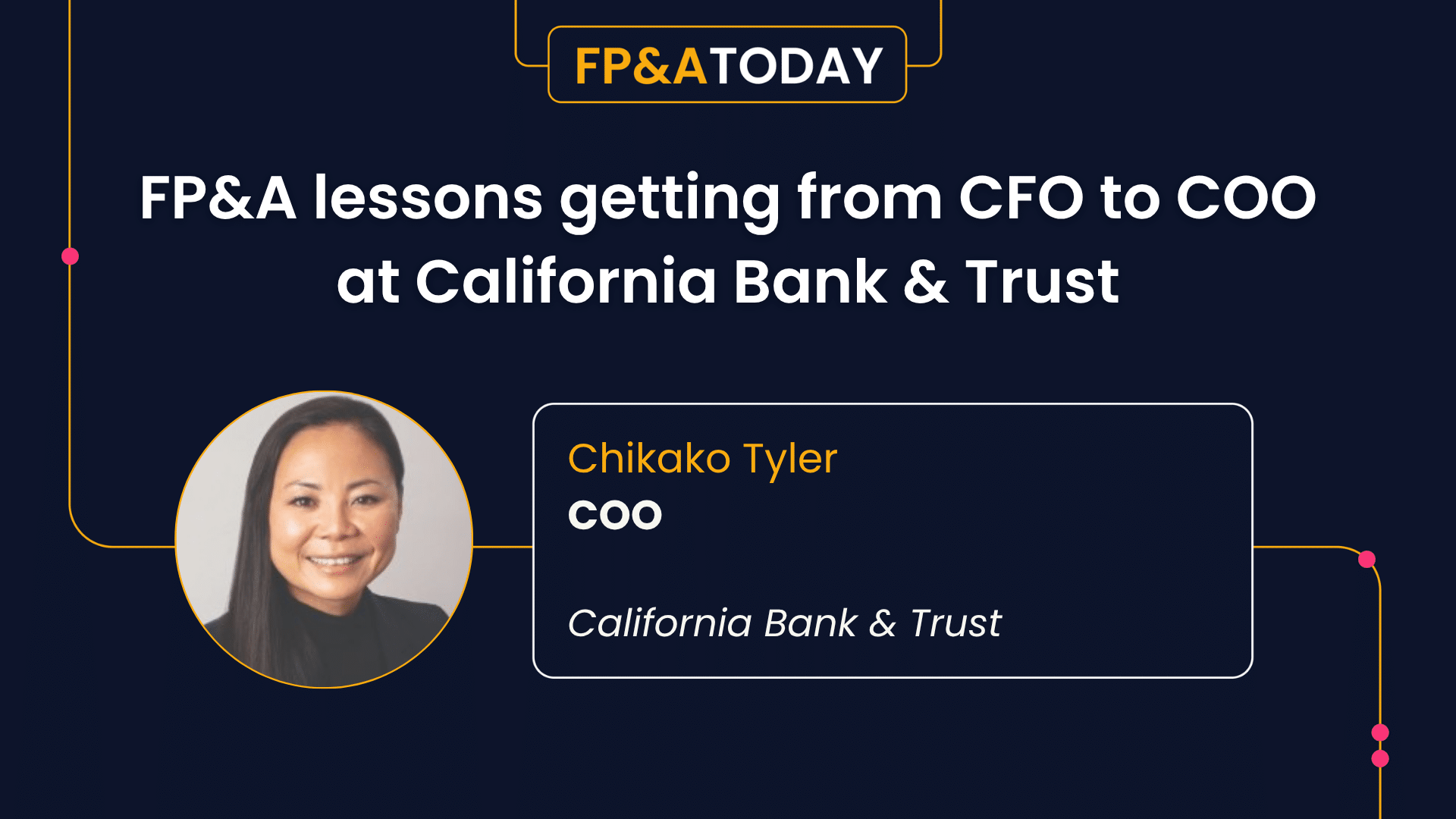
Chikako Tyler is the Chief Operating Officer at California Bank & Trust (CB&T). She began her career at the leading California bank in 2010, starting as risk manager, progressing to strategic planning and analysis( spanning seven revenue divisions and 150 units), before serving seven years as Chief Financial Officer. Here she reveals the strategic leadership as the bank grew, from $9 billion to $15 billion in assets, and overcoming challenges from the post global financial crisis to COVID.
In this episode:
- Math academic to commercial real estate
- California Bank and Trust’s stress testing
- Efficiency ratios and operating leverage
- Differences in the path CFO to COO
- Inclusion and leadership in banking
- The most company specific fave Excel function answer
Full transcript
Glenn Hopper:
Welcome to FP&A Taylor, I’m your host, Glenn Hopper. Today’s guest is Chikako Tyler, executive Vice President and Chief Operating Officer at California Bank and Trust. Over the past decade, Chicago has played a pivotal role in growing the bank from 9 billion to more than $15 billion in assets. She has led across multiple domains, including finance, strategy, acquisitions, risk management, specialty deposits, and operations. Before stepping into the COO role, she served as CFO where she was instrumental in driving over 10 million in cost efficiencies while helping the bank scale and respond to industry shifts. Her leadership has been recognized by American Banker, the LA Times, and regional business publications. She also founded CB &T’s Banking on Women Initiative, a statewide effort focused on mentorship, talent development, and inclusion in financial services. In this conversation, we’ll explore her leadership journey, how she approaches complexity, which metrics matter most, and what she sees on the horizon for finance and operations. Chicago, welcome to the show.
Chikako Tyler:
Thank you. It’s nice to be here with you.
Glenn Hopper:
Yeah, I love we’re reaching out a little bit. Moving on from, uh, just fp and a guests. A lot of times we’d like to bring people in such as yourself that can give a, a broader picture and, and from different industries. So I’m really excited to, uh, dive into our conversation today. Well,
Chikako Tyler:
Thank you. Well, I did ask seven years as CFO, so I certainly have an fp and a background as well.
Glenn Hopper:
Yeah. But of course, of course, <laugh>. In addition to that, your academic background is very interesting to me because it’s in mathematics and you have experience across, like you said, I mean risk, finance and operations. And I’m wondering what first sparked your interest in banking and financial services, maybe starting going all the way back to, uh, your background in math.
Chikako Tyler:
Sure. So I’ve always enjoyed math. You know, I pursued an undergraduate degree in math. I actually started a PhD program in mathematics as well. So long before I started working, I actually thought that I might be in academia studying number theory and logic. So that was my background. But, you know, during my PhD program, I quickly discovered that, you know, maybe academics wasn’t really my passion long term. It was interesting to me, but there were certainly people that were far more into the academia than I was. So I started to just look for a job and what came up was a commercial real estate analyst position. So I applied for that and frankly, I just needed a job. So that’s how I ended up in commercial real estate. But it turned out to be amazing. I loved it. I loved the tangible nature of commercial real estate.
There was a lot of analytics that went into acquisitions. The investor part of the role as well, just, you know, gathering investors into purchasing commercial real estate, managing the properties until divestiture. I love the, you know, the portfolio management of it as well, putting in tenants and growing the business. Each, each building is a business on its own. So that was really fun for me out of college. And I felt that I needed a bit more of a business background to really understand the investment piece. So I also wanted to travel. And so I got an MBA and moved to Amsterdam for two years, uh, got my international MBA there, came back into commercial real estate, and then 2009 and 10 hit when there was no funding for commercial real estate. So that really was the pivotal moment that changed my career because I could no longer stay in commercial real estate.
And I started to look for another job in, in anywhere that would use my commercial real estate background. And I found a role at California Bank and Trust as a real estate analyst because we had just purchased two FDAC supported, failed banks, and they needed somebody with a strong real estate background to work through that portfolio of the two failed banks. So a lot of things came together at that moment in time when I needed a role. And the whole banking industry was a bit in chaos. And that opened up a position for me. And I even told my hiring manager at the time, I’m gonna go back into commercial real estate. So this is great for you and me because you need some temporary support for these two failed banks. And I don’t think I’ll be in banking. I’m gonna go back into commercial real estate. So, uh, this is gonna be great for a couple years together. But it turned out that banking was also very interesting and fun and complex things I didn’t know about banking, like asset liability management, how do we manage capital? I just didn’t have any idea that banking would be so interesting. So that’s really how I fell into banking, but ultimately fell in love with banking because it was far more interesting than I had realized at that time, because I simply didn’t have exposure to it.
Glenn Hopper:
Yeah. What a unique opportunity to take that mathematics foundation and then the domain expertise that you built in the years leading, leading into the global financial crisis, and then merge them together at a time when those, those mathematics skills had to come in very handy doing analytics and, and the, the kind of analysis that you were doing there, even though I imagine even the most complex analytical work you were doing for the bank was probably still way easier than the calculus and gradient descent and whatever <laugh> crazy things you were doing in the, in the PhD program. <laugh>,
Chikako Tyler:
It’s definitely a more practical application of mathematics, I would say, versus the theory that I was interested in academia. Um, I think that’s probably the reason why I didn’t really stay in academia was it was very theoretical and very interesting, but I couldn’t see the application and now I am in a world where it, it is a bit, you know, easier I suppose than academia, but at least there’s some tangible, concrete outcomes that you can see and feel.
Glenn Hopper:
Yeah, yeah. Uh, very well said. So I guess, walk us through your journey at California Bank and Trust. So you had the early roles. Was that, that was California Bank and Trust where you were doing the, the real estate work?
Chikako Tyler:
Yeah, it started really as a real estate analyst of, you know, understanding, managing the portfolios of the two failed banks that were heavily concentrated in real estate, but that was a liquidating portfolio, so that was meant to be a two to three year position. But as I said, it was really interesting work to be in banking and learning a little bit about the balance sheet management. And that really turned into an opportunity for me to join risk management because at that same time, there was a lot of discussion and really the concept of Dodd-Frank Act stress testing at that time. So all banks needed to perform stress testing on their portfolios, submit their results, and that was really the genesis of all of the stress testing work that’s still going on today. So that was another opportunity that was presented to me after the portfolios were kind of worked out from that acquisition, they asked if I would stay on and really develop the stress testing process for California Bank and Trust.
And as an institution that had just crossed over 10 billion, we had to do our own stress testing. So I, um, you know, really started that with my, with my boss, who was the CFO at the time, um, and worked out all of the stress testing of our portfolios that, you know, we still do today. Now it’s under our Zs Bancorp umbrella. But that was another two to three year journey through development of stress testing. Also very interesting work because as it was new and exciting at the time, um, and then the development of the risk appetite framework, which all banks, again, all the banks have to do it now. It was really in that 2000, uh, 1415, the aftermath of the 2009 and 10 crisis where we had to develop really rigorous risk appetite framework. So I worked on that for a couple of years, also developed a centralized risk grading team, so the, you know, the risk grading of all of our loans and credits, which again, is highly mathematical as well.
So merging that math background with banking. And then I moved into finance, so quite a, a, you know, related, but different role fp and a is not the same as kind of portfolio analysis and stress testing. But the CFO at the time recognized my analytical skills and background and thought that finance would be an interesting role for me. So now I get to do, you know, balance sheet management, capital management, and it was new and again, exciting. So that’s how I ended up in finance and ultimately CFO for the last seven years until my more recent journey into operations, which is put me in as chief, chief operating officer role.
Glenn Hopper:
Yeah. So tell me about the chief operating officer role at a bank. So obviously everything a bank does, very finance related, and you’ve come up through the ranks, uh, you know, really leaning into the, the risk management and the analysis and, and the finance and now focused more on, on company operations. I’d love to hear how the role is different and maybe what you carry over though from having that great background in, in coming up through the finance and risk management side.
Chikako Tyler:
It’s quite different. So it’s a newer role for me. As you know, I’ve been in the role for, gosh, six months now. Um, and finance is very rigorous, right? So we’re coming from a very rigorous background of, you know, analytics and numbers and trends. Obviously very numbers focused to now operations at the end of the day, while there’s a lot of technology and banking, it’s still a people business. And the operations piece, uh, really allows me to dive into the management of the people, the branches, you know, understanding where the intersection of people and technology come together in bank operations. So it’s very different from kind of managing trendlines and, you know, capital to now looking at, well, gosh, where, where did we go wrong in this fraud loss event? How did we allow a branch to operate in a certain way that has led to, you know, a certain result? It’s very much about the people and how we manage human beings, and then intersecting that with how do we use it, utilize our technology, um, in an ever changing industry. So it’s been a quite a change, but at the end of the day, right, everything we do results in the financial results that we have. So understanding what do we do on a day to day, how do we manage the business day to day? And then how does that transpire into the numbers? It’s still really critical in my operations role.
Glenn Hopper:
I feel like when I first went into finance, and I think engineers, and certainly in mathematics, people, uh, can have the same mindset where it’s, uh, I wear this oral ring that watches like when I’m stressed and when I’m not, I can be in the most complicated model or building out some complicated, uh, you know, AI automation workflow and think I’m stressed, but look at my reading on my ring will tell me I am completely as calm as could be, like in restorative state or whatever, <laugh> and I guess, you know, maybe flow state or whatever. But then talking to people and being in meetings, my stress goes up and engaged. And I, I guess that’s really all just background to say that it, you would think that it’s maybe two different personality types the same, you know, that would be drawn to engineering or mathematics or, or finance.
And then going into operations and really being on that, on that people side. Do, did you find that the shift was difficult to move from being able to be, I know, and I know as, as CFO you’re not deep, deep in the spreadsheets like you were when you were a junior analyst, but it’s still, it, it’s a, a very different nature to the role. Was that shift hard to go into, to kind of get out of the spreadsheets and out of the deep dive analysis and into the more the people heavy operations side of things?
Chikako Tyler:
Well, certainly, uh, challenges different skillsets, I would say. So you’re absolutely right. You know, I’m very similar. You know, I loved building models being knee deep into a model and, uh, tweaking it and, and the creation of it. And I would say that would be in, in a flow state. For me, it’s a little bit independent. I am highly introverted, so I, I love that kind of, I isolated work. And then as you grow in management, you’re doing less of that spreadsheet work yourself. You’re managing people who do that work or systems who do that work. And I would say finance people tend to be similar, right? We’re all kind of numbers people, we’re all analytical people. So I’m working with people that are very similar to me, to me, um, in a natural state. So that’s very different from today, which is, you know, I’m working with people who are more salespeople, who are more people, people, I would say, rather than just analytical spreadsheet types.
And it’s a different, you really do have to manage people differently because their motivations are different. What drives them, what are the, what’s important to them in a role? It’s all very different from a typical, you know, finance team. So you do have to really shift how you manage people and stress some different skills. I’m, I’m out of the office far more today than ever, you know, in my CFO role, I rarely left my office, but I’m on the road more. I’m meeting more people. I’m talking to a lot more people, both customers and employees, and they’re all different in terms of what they like, what they wanna see out of a, a role or company. And that’s, it’s exciting because it does stretch my skillset and I really enjoy always being challenged and learning something new. So that part’s very exciting. It is a little bit out of my natural state because it requires me to be much more engaged with a lot of different people and meeting a lot of different people every day. As an, as an introvert, that’s a different skill, but it’s exciting and I’m really enjoying it because it’s out of my element.
Glenn Hopper:
Yeah. What a great opportunity to e extend everything you’ve done because in the time you’ve been there, you helped grow the bank from 9 billion to over 15 billion in assets and at the same time generating those major cost efficiencies. And I know now in the COO role, there’s more opportunity for that. And I’m wondering what were some of the strategic levers that helped you drive that growth and discipline and maybe how you’ll carry those over into your new COO role?
Chikako Tyler:
Yeah, it’s a good question. And you know, there’s nothing magical about driving this kind of result. You know, it’s a lot of discipline, it’s a lot of hard work, and it’s really about, you know, when you’re going through school and you’re looking at your grades and you know, again, people in finance tend to be people that were strong academically, right? We’re very numbers focused and results focused people. So you look at your grades and you go, okay, there’s a scale of A, B, C, D, and F. The question for me becomes, when you look at a scale like that, and you were someone that was always aiming to be an A, right? I want an A in every class and I want an A plus in fact, and I’m gonna drive more and more and more to get the best result possible. When you translate that kind of mindset into a workplace and a performance based workplace, you actually have to change your mindset to go, if you were to translate your grades into financial results, say a C to a B drives a hundred million more dollars A B to an A drives 50 million more dollars, an A to an a plus drives 5 million more dollars, right?
The scale may not be linear. If you look at it that way, and you think about performance, you go, okay, look, if I look at my effort and I can go from a C to a B, that’s an extra a hundred million dollars. But pushing more for an A to an A plus actually doesn’t drive anything. So I should focus on the CS and bring ’em to a B. Forget getting from an A to an a plus. It’s actually very hard for someone who is extremely results and performance focused to try and not to perfect everything, but you can’t spend your time perfecting everything anymore because it’s all about the bang for the buck, the operating leverage. Where do I drive the most operating leverage and focus all of your time on what is gonna drive the most results for your time spent. And that’s the mindset shift that I had to make to drive that kind of result. To say, let’s focus on bringing everything that’s a C to a B. Don’t worry about bringing the BS to an A ’cause that’s not where you’re gonna get the most money. And looking at all of your projects throughout the organization to say, alright, let’s prioritize all the Cs to a B. We’re gonna work on that first so that you can drive the strongest performance for the time spent instead of being this perfectionist and wanting everything to be perfect everywhere. ’cause that’s not worth your time.
Glenn Hopper:
Yeah, and the interesting part with that too, so diminishing returns on the levels of, as you get closer to perfection, but the amount of effort is, uh, is inversely correlated to it, right? So you’re working harder for less returns. So being able to say, that’s good enough, we got the a hundred million or whatever the number is, and now let’s focus on another big swing there. And it’s al always, there’s always gonna be the incremental improvements you can make later, but grab getting those, those big numbers. I, I love that analogy and approach fp and a today is brought to you by Data Rails. The world’s number one fp and a solution data rails is the artificial intelligence powered financial planning and analysis platform built for Excel users. That’s right, you can stay in Excel, but instead of facing hell for every budget month end close or forecast, you can enjoy a paradise of data consolidation, advanced visualization reporting and AI capabilities, plus game changing insights, giving you instant answers and your story created in seconds. Find out why more than a thousand finance teams use data rails to uncover their company’s real story. Don’t replace Excel, embrace Excel, learn more@datarails.com.
Coming in as COO, now, your background going across real estate risks, specialty deposits, treasury sales, you’ve had insights and experience in all of that. So taking those, all those unique experiences, how do you now think about aligning such diverse functions under a single cohesive strategy? Or does it, is it not that simple? Do you still have to treat them differently in, in your role now?
Chikako Tyler:
Well, it’s definitely been an interesting journey because, you know, when I, it started really with, you know, here’s my finance role, and I started to add these different lines of business under me. So it was like, okay, let’s put in corporate facilities, okay, let’s add specialty deposits, which really has nothing to do with the other two. Um, and then let’s add treasury. Okay, that’s odd. It doesn’t quite align, right? So I start to create this like hodgepodge of groups together, and initially I was managing them quite separately. They don’t really cross over. So I would meet with individual managers and we would have our own, you know, plans for each department. But, you know, when I took on the SEAL role and it really became a, a much larger group of what appeared to be hodgepodge departments, it dawned on me that, you know, at the end of the day, we’re executing on a corporate strategy, and I’m obviously, you know, very involved in that from my CFO role, and I need all of my teams to understand where we’re going, what we’re trying to achieve at a str at a strategic level.
So even though maybe day to day, my facilities department has nothing to do with my treasury sales, we are all trying to achieve higher performance, stronger operating leverage. So where does that fit in? And it’s important because when I’m hiring a group of people, my facilities department needs to navigate the maze of where are these people gonna sit? How do we drive the, the strongest kind of expense ratio for the revenues? Where are these people gonna go? It actually matters to have a cohesive strategy, even amongst what appears to be disparate groups. We are trying to drive towards the same goals. So that baseline understanding for all of my managers to know what’s important today, what’s important medium term and what’s important long term, is actually critical in making sure that we’re all collectively making decisions to lead in that same direction.
Glenn Hopper:
As you talk about all that, I know with your reference to grades earlier, I’m sure on fp and a today, we’re huge fans of, of metrics and KPIs. So I’m, I’m sure that you, uh, have developed, uh, quite a few metrics that you’re, you’re measuring across the groups and organizations. I’m wondering what metrics are the most critical now that you’re in this COO role, and how do you use those to keep the business focused and and aligned on the company strategy?
Chikako Tyler:
Yeah, so it’s shifted over time because, you know, as, as a CFO formally for the last seven years, you know, you’re really looking at strongly financial balance sheet management numbers, you know, it’s efficiency ratios, you know, tier one capital, but now an operations person, I am really looking at, you know, probably two metrics is the most important efficiency ratios and operating leverage. Both are, you know, revenues and expenses in, in the numbers. So you’re really looking at how do I drive the most revenues off of a dollar of expense and the growth rate of both. So how do I drive a faster piece of revenues as compared to the pace of my expense growth? So it has become a little less risk management focused in my, in my own numbers and far more about sheer, like driving more revenues and controlling those expenses, or at least driving faster revenues as compared to my expenses. And a little bit less focused on like, you know, letting others manage credit risk, others manage liquidity risk, others manage capital risk, and, you know, really like strongly looking forward towards, you know, just revenues and expenses.
Glenn Hopper:
Yeah, that makes complete sense. And of course, all those metrics are great until you have one of these, uh, black swan events and you’ve, you’ve now in banking, gone through a couple of ’em and thinking about your time in banking most recently, I guess the SVB fallout would be probably had a pretty big, uh, impact I would imagine on you, and then the, uh, great recession as well. And I’m wondering this sort of trial by fire, going back to when you started your career, but how did these experiences shape your approach to banking risk management and leadership and, and decision making along the way? And maybe, you know, you can’t, obviously you can’t plan for these exogenous events, uh, other than, uh, you know, whatever you, the, the fallback plan is, but how would you say that those events shaped you and your leadership style and your approach to it?
Chikako Tyler:
Yeah, you know, wow, talk about back to back events, right? So, I mean, I joined the bank in 2009 and 10, so, you know, with, with very little experience in banking at that point in time, I think everybody in banking is, we’re always looking for what’s gonna happen next, right? As it’s a normal part of our risk management to actually create idiosyncratic events, scenarios, and we stress our portfolios through them. So we’re always dreaming up what might happen next, but we’re always wrong because you generally can’t predict what crisis is gonna happen. So it’s been an interesting journey to go through these because certainly, um, you know, COVID-19 happening, all, all of us going home and having to distribute all these PPP loans, not a risk that we had envisioned or planned for. And then right on the heels of kind of getting back to work, trying to get back to normal, all of a sudden SVB fails, again, not a scenario we planned for, right, of all the stress testing scenarios we come up with every year, we didn’t plan for this one.
And that one was really unique because it was a liquidity risk event. And in banking, we would say our biggest risk is credit risk, right? You go out and you do a bunch of loans and people don’t pay you back. That would be our biggest risk. And yet the risk that actually happens is a liquidity risk event, which is a really high risk event, but not one that we had envisioned would happen in the way that it happened. And the way that it happened was also very interesting because it’s a reflection of where we are as an industry where technology and the ability to transfer funds as quickly as occurred at that moment in time was not something that, you know, we read really predicted that people would be able to just wire out or transfer out, you know, billions of dollars in 24 hours and 48 hours.
It’s just not something that had ever happened before. So lessons learned on many fronts. We have, keep in mind the pace of technology. We have to keep in mind how people’s behaviors are changing because of technology. And we really need to, um, also consider the risk of social media people talking to each other, reputational risk because of people talking to each other, real or fake, doesn’t matter. People behave based on what they hear. And that’s something that we really hadn’t contemplated, but will now be a, a lesson learned in terms of, you can’t just think that because you know, you have sound practices and strong risk management that you’re safe. That’s not really the case anymore because, you know, people see and read and hear things may not be true and may not, the people talking may not even have insight into what you’re doing, but they can have a material impact to your business. So how do you make sure that it’s not just about how you run your business, but it’s also how you’re perceived to run your business? That’s important, and that’s a really big lesson learned for me because, you know, you kind of live life thinking that if you’re doing all the right things, all the right results will come about, but that’s not necessarily the case anymore.
Glenn Hopper:
Yeah. As you’re going through those. So our career, you know, our careers followed a, a similar timeline and trajectory. My first CFO role was in 2007, and it was a, uh, heavily leveraged real estate intensive business. And when, uh, in retail, and so when the global financial crisis happened, it was, I was, didn’t know what I was doing, and it was scared to death. And we, one thing we did though, that ended up just, this was dumb luck, I guess, but we, we had refinanced a bunch of loans and, um, you know, going to pick what were the loans were tied to. I picked L-I-B-O-R, and this was 2007, 2008. And you know, when Lib OR collapsed, we were like lib, BOR plus 180. So we had the cheapest money in the world <laugh> for a long time enough that our bank was really upset with us at that point.
But it was, uh, yeah, I, I can’t really take any credit for that, that decision going going lib BOR over prime. But it was, it was a very stressful time to be trying to navigate, uh, you know, all these, your, your business was down and, uh, and the, um, un uncertainty around everything. But then, and then when you mentioned PPP loans, I, I helped three companies through getting PPP loans, and somehow I’d wiped that from my memory, just like I did most of COVID, I think <laugh>, but I could, yeah, I can. And just dealing with the, the bankers that I was when that was going on, I couldn’t imagine what it was like being on the other side of that. Just the, the volume and the uncertainty around it and all, you know, trying to make check against all the potential fraud and everything associated with that. Had to be, that had to be as stressful as any of the other <laugh>.
Chikako Tyler:
It was, um, incredible. I mean, nobody knew what was going on, right? We were all trying to do our best to, you know, follow the news and, you know, stay home. And we we’re all doing our best to do these things. And at the same time, banks played a critical role in getting money out to businesses so that we could sustain life, sustain our businesses, make sure people got paychecks. So, you know, we played a really critical role. And what was really neat about it is how quickly we stood up a system to get money out. And all of us, every single person at the organization was working around the clock. It was two o’clock in the morning, I’m inputting loan applications, my CEO’s inputting loan applications. I mean, it was all hands on deck to get money out to the public. And it was really neat to see how a crisis could bring people together where, you know, it doesn’t, it didn’t matter what role you had at the bank, you were gonna help get money out to people.
And I think it’s just amazing to see that people wanna help people, and in a crisis, we all wanna come together. And it’s something that I hope that we can all think about as we move forward in the future, is that we’re pretty darn good in a crisis. And, you know, it may not always feel like a crisis, and it’s, you know, potentially too exhausting to always be in crisis mode, but that cohesion and collaboration in working together for a cause to help everybody, you know, that’s a mindset that we really need to continue to have.
Glenn Hopper:
Yeah. And I can see in the, in the way you talk about it, I can see how you’re perfect for the COO role, that human element, and I love that throughout all this, you’re known for championing mentorship and diversity, including the, the Banking on Women initiative. And I’m wondering, as this has all gone on and as you’ve worked with the teams you have, how has that focus on inclusion kind of shaped your view of, of leadership and, and finance and really across the company?
Chikako Tyler:
Yeah, you know, I am passionate about ensuring that there’s, you know, diversity across all functions, all across the bank. And, you know, it’s no secret that, you know, banking tends to be male dominated. We’re changing that, but, you know, I think we have to all think about the fact that education plays a critical role in building a diverse workforce, because we all have unconscious bias. I do too. We all do. We’re guilty of it. But knowing that we have unconscious biases when I’m hiring or I look at my teams, I’m very aware of the fact that you can’t let your unconscious bias get in the way of hiring the right person for the role and building a team that has a diversity of backgrounds and ideas. Because with every hire I’ve made, I appreciate the diversity and thought they’re bringing different ideas to the table, thoughts that would’ve never crossed my mind, which make us us stronger because we’re able to hash out, well, what if we did it this way?
What if we do it this other way? I can’t have all different thoughts across every type of, you know, unit or division or some project. You really need to have people with a diversity of background and thought process, and even in terms of how you work together, because that’s how you can take the best ideas. And if you don’t kind of think to yourself or be really conscious about the fact that, you know, we all have these unconscious biases in our backgrounds and our mindsets, it can be from childhood, right? You had a, a friend that stabbed you in the back with the name John, and now you don’t like John’s anymore. I mean, that could be in the back of your mind where you’re interviewing someone named John, and you have these bad memories come back from childhood, and now you don’t wanna hire this person. You have to be aware that your experiences in life create some level of unconscious bias, and you actually have to actively think about it and work on saying, you know what? I know I have these poor experiences from, you know, my background or childhood, and I’m consciously going to work my way to a better place where I’m gonna hire the right people for the role. I really think education is really the piece that’s gonna help us get there.
Glenn Hopper:
Yeah. And on the education front, I, I love talking to leaders who are especially like yourself, who have done so much and, and, and doing the mentorship and doing a lot of teaching, uh, for, for your teams under you. But I always love to ask, are there any skills or challenges or opportunities that you’re currently focused on, some new thing you’re learning work related or not, but how, how are you at this point looking to grow and sort of expand your knowledge and, and understanding?
Chikako Tyler:
Well, there’s a lot I don’t know. So that helps. You know, I’m certainly learning all the time, and you know, a part of learning as a leader is, is knowing what you don’t know and surrounding yourself with talent that does. So, um, I’ve had to do that a lot because I am managing a very broad kind of different departments and broad skill sets. So hiring the right people and knowing what you don’t know is the beginnings of that. And then being open and transparent, like, look, I hired you for your expertise. This is not my area and background, so I’m gonna be relying on you to not only lead the department in this initiative, but to also help me be a better leader for you by teaching me about the things that I don’t know. And operations is new for me. So understanding, you know, branch operations, fraud operations, you know, what, what kind of protocols are we following consistently in our branch network?
These, this is all new to me, you know, it’s not something that CFOs engage in all the time, but the procedures matter, fraud losses, as you can imagine, are rampant. So being educated on that front is critical, critical for our customers, critical for our employees. So there’s a lot that I’m learning, particularly in the fraud and technology space that I’m finding very interesting right now. Um, but at the end of the day, it’s people management, right? So, you know, if you can hire the right people, manage the right people, that’s really the key to I think, being a successful leader. Um, and knowing what you don’t know and making sure you’re surrounding yourself with people that do.
Glenn Hopper:
Yeah. Actually, I do want to go go back to the, uh, fraud detection and technology. I actually just did a course on using AI for a, um, fraud detection. So it’s top of mind for me. But before we get into AI and tech, when you were CFO and looking at fp and a, I’d love to hear about what your FP and a team at a bank looks like, because we talk to people from all kinds of different industries, and it’s always interesting to see what the, the different, uh, makeup is. And I know, you know, scaling from 9 billion to 15 billion assets, that’s a very different, uh, size companies and could be a different size team. But how did you look at fp and a and the team as you moved up through finance and, and when you were in your CFO role and what were you looking for in your team and, and how is it structured?
Chikako Tyler:
Yeah, so kind of when you think about pure fp and a, a lot of it at its core is really, you know, creation of budgets and plans and making sure that every division is managing towards their, you know, p and l that you’ve constructed for them, or, you know, with them. And every, you know, month, quarter year, you’re looking a bit backwards to say, you know, okay, we created this plan together. Here’s your, you know, plan for the next year or two or three. How are you executing on these plans? And your fp and a support is, you know, creating the reports, creating the analytics around, you know, are you getting there? Are you not, let me help you forecast? How are your forecasts looking? So it’s a combination of kind of looking backwards and looking forwards. And a lot of, um, back 10 years ago, we had a lot of people doing the inputs of budgets and running the report and then tracking towards it.
But more and more as we get bigger and as technology advances, we’re not having to do as much of that manual. Like we used to do budgets in Excel files. Can you imagine that <laugh>? Um, so times have changed, right? We’re actually in, you know, systems that are producing budgets, and those systems in fact can now create forecasts for you based on trends. So you’re not eyeballing anymore. You’re not just creating Excel formulas to look backwards and, and create your own Excel formulas. You know, it’s very systems driven now, which is helpful. So I think you actually need less people because you’re doing less manual work over time. But I think the fundamentals of creating strategic plans is still very strong no matter what size of company or even size of fp and 18 you have. So with the advancement of systems and technology to help you, you know, while my body counts are less the fundamentals of strategic planning and the creation of shareholder value and profitability and still really important, and we actually spend more of our time today doing less, I would say budget inputs.
You know, that’s not so critical because, you know, systems can do that for you now, but we’re far more involved in educating our field on what is profitability, how do you build profitability, why does that matter? So our focus has shifted away from the manual work of fp and a to, um, kind of broadening everyone else’s understanding and skillset sets in fp and a, and I think that has more impact over time. Um, and in, in the large institution, as you get bigger, it becomes more important that everybody understands how you build shareholder value. And so you can spend your fp and a resources to do more education and, you know, meetings with managers on how they’re performing over, you know, just analysts kind of doing the inputs and running of reports.
Glenn Hopper:
Yeah. Isn’t it interesting, and when I first started in FPA, you know, in the stone ages, <laugh>, but, uh, it was, uh, storytelling wasn’t even something that we talked about. But now, in FB and a, you talk about that being a big part of it, yes, but when you’re not having to go back and manually build out some kind of Holt winners, uh, time series analysis for your, uh, in, in, you know, a, a big 20 meg, uh, Excel spreadsheet or whatever, where the systems are doing it for you, the value to the business comes from not your Excel skills, but in what you’re able to, your analysis of it and how you’re able to convey it. So I completely get that. It’s just funny that I never, it never occurred to me early in my finance career, what a big part that the, the storytelling and the explaining to whether it’s a man, you know, whether it’s another department or senior management or another manager across the company, that’s a really big part of where fp and a can add value.
Chikako Tyler:
Oh, yeah. I mean, we went from getting excited that we stuck a macro in a workbook, right? That was like the exciting part. Ooh, I created a macro to make my Excel file run faster to a place where we don’t really have to do that anymore.
Glenn Hopper:
Yeah. And it’s, and that’s changing even more with ai, and it’s, I’m very curious to hear banking industry wise, because we’re all risk averse people, uh, in, in, in finance and accounting, but, uh, certainly banks and, and credit unions probably even more so, and especially someone with a, a risk background. But I’m wondering, how is AI starting to show up in, in your world, whether it’s in, you know, operations or customer experience or finance? How is, how are banks leaning into this now?
Chikako Tyler:
Yeah, I mean, in banking, AI is showing up in every part of our business. So from our branches, AI is starting to suggest to customers, you know, what they think that a customer may need either for their personal financial stability or business growth. Certainly on the extreme end, we’re using AI for fraud detection. We do have to keep in mind that fraudsters are using AI every day. So it’s a matter of who’s gonna be better, who’s gonna come faster to combat the fraud. Um, and then everything in between. So we’re using, you know, at least at our bank, we’re using copilot for, um, our day-to-day use. It’s helping us, you know, scan emails, can you write this better to fp and a to make trendline suggestions? But I find that in using ai, it’s still at its infancy. I don’t always agree with or necessarily trust the results just yet.
It’s certainly getting better, but, um, right now we’re still having to review everything that AI generates. Um, and I think at the end of the day, um, while AI is going to make everybody’s jobs faster and potentially even more precise, right? Because it can gather so much more data than a human being can, we’re still gonna have a long period of time where I think people are going to have to review the results, um, potentially, you know, change the results because maybe they don’t quite make sense from our experience. And people still wanna work with people and hold people accountable. So AI is everywhere, but it’s not everything just yet.
Glenn Hopper:
Yeah, and I’m a huge AI fan, but <laugh>, I like to think of it at, there’s, I can’t imagine a fold position, you know, there’s all kinds of automations and always have been. So there are some positions that’ll be a lim, you know, data entry kind of positions. But I like to think of generative ai like an exoskeleton that it, it’s, you can use it and if used correctly, um, it will kind of enhance your powers. I mean, it gives you super strength. However, it’s be, like you mentioned, it’s still early and it’s in its nascent stages, so it’s like an exoskeleton that malfunctions every now and then <laugh>. So it’s trying to figure out how, uh, how to lean into it. I feel like it’s like the, uh, what, what are those Marvel movies with Ironman where the suit would malfunction or something, and that’s when AI goes off the rails. And if you don’t have a human in the, in the loop checking that, then it gets, uh, you know, that’s, that’s kind of a scary thing. I always think about public company, uh, CFOs having to sign off on, on their financial statements and Ks and and Qs, and I don’t know if I’d feel comfortable signing my name to something that was just created by some black box that I didn’t understand where the answer came from.
Chikako Tyler:
Yeah, certainly not today. I mean, we’re not quite there yet, and I think as human beings, you know, we still want human beings to be held accountable. You know, when I use a chat bot and the chat bot doesn’t give me the answer that I’m looking for, you know, I’m still hitting the, you know, customer service. I want that human being on the line. Yeah. And I want a human being to answer to me as to what’s going on. So, you know, right now I think AI is still at its infancy, and there’ll be a lot of application, a lot of support that we’re gonna get from ai. But for the foreseeable future, I think we’re still gonna want people to be held accountable for all the decisions that are being made. Um, and even from a customer perspective as a bank, you know, people still wanna work with people and make sure that somebody is responsible for managing their money. And, you know, not pointing to a black box going, oh gosh, the black box lost my money. Yeah, <laugh>, what am I gonna do now? Right. So human beings are still gonna play a pretty big role.
Glenn Hopper:
Yeah. And you know, and you mentioned on, with fraud detection, obviously ai, machine learning for over 15 years now, um, has been a, a big part of that. And where that’s where the, the, the deterministic machine learning models that can detect fraud, while, like you said, they’re in a constant battle with, uh, you know, white hats and black hats versus trying to outdo each other. It’s sort of the same thing with, with internet security, but with those deterministic models, I mean, they are so much better at humans than, um, than I at, at identifying discrepancies and, and, you know, things that are off kilter. So I think that’s one area that has been used to great success for years, but a little bit different than the probabilistic generative AI that’s generating the new content and everything. But it’s with, we’re still in the early stages and, um, finding that balance and the deterministic fraud detection and other machine learning algorithms that have been great, that are kind of time tested and that you can get repeatable results from. Those are great. It’s the, uh, and, and generative AI obviously has all kinds of potential, but yeah, you’re right. We are very, very early in the, in the tech for that.
Well, I can’t believe we’re, uh, we’re coming to the end of time. I, there’s two questions we ask everybody that I, that I, I want to, uh, get to before we let you go. Uh, the first is, what is something that people don’t know about you? Something that they couldn’t find online or on your LinkedIn profile or something like that?
Chikako Tyler:
Yeah, so I live in San Diego, so I grew up in Huntington Beach. So I’m from Surf City, California, and I live now in San Diego, right by the beach in Delmar, but I’m actually a mountain person, so you’re gonna find me probably most winters on the ski slopes or hiking in the mountains. I’ve decided after a few years of, of learning skiing, which I learned in my forties, so not not very long, but it’s a real passion of mine, uh, where this is something that I’m gonna be doing every winter, every chance I get, I’m gonna be in the mountain skiing. So, you know, it’s a new passion, a new hobby, but um, that’s something that you may or may not find about me online.
Glenn Hopper:
<laugh>, that’s great. And no sharks in the mountains, so it’s probably <laugh>, just gravity, I guess. <laugh>, so I, I don’t know, skiing, uh, versus surfing, they probably both have a <laugh> equal degree of risk, depending on what’s going on. I guess
Chikako Tyler:
<laugh>, I, I think I’m training a shark for a bear.
Glenn Hopper:
Yeah, there you go. Okay. And our last question that we always love asking, um, and I always feel like I should apologize when I ask someone in a a c-level role, because while we came up using spreadsheets, I, I don’t, for me, I don’t even know how I would answer this question at this point, but I, we gotta ask everybody, so I’m gonna, I’m gonna throw it out to you. What is your favorite Excel function and why?
Chikako Tyler:
Yeah. You’re really dating me here because I, I don’t create models anymore, so I’m not that much into Excel, um, day to day. But going back, I would say that the present value function is my most exciting and my favorite because I’m in banking and present value is what teaches you about the time value of money and how money grows. You put a dollar in the bank, you put it in your savings account and it grows. And learning how to present value money backwards tells you that, you know, it’s very important to save and that the time value of money matters. So that’s what I love about the PV function. The other side of it is because I distinctly remember when I used to calculate present value on a piece of paper, and that magical moment when I’m like, oh my gosh, this spreadsheet can do this for me and I don’t need to calculate TV by hand anymore. Fat was a really exciting moment that actually stands out in my memory. So that’s why PV is my favorite function. But you’re definitely dating me here.
Glenn Hopper:
Yeah, <laugh>, I, you know what, I think that is the most perfect role, specific answer that we’ve ever gotten on the show, because of course, the COO of the bank is gonna love the present value function. No, that’s absolutely perfect. I love it. <laugh>. Well, Chicago, thank you so much for coming on the show. Really, really enjoyed your insights and hearing about your background and everything you’ve done. And, uh, and yeah, just really appreciate you coming on.
Chikako Tyler:
Thank you. It was a pleasure to be here with you.