Click for Takeaways: AI-Powered Month-end Close
- Done traditionally, month-end closes take most finance teams 6-10 days, with only top performers closing in five days or fewer, according to APQC benchmarking data. Much of this time is spent on manual reconciliation, piecing together fragmented data, and discovering reactive variance.
- AI-powered month-end close automates transaction matching, highlights anomalies before sign-off, and generates variance commentary automatically. This dramatically speeds up the closing process.
- General-purpose AI tools (like ChatGPT and Copilot) aren’t built for finance-specific close workflows and lack the required data integration.
- Datarails connects close automation directly to rolling forecasts and board reporting, turning the close from a reporting event into a planning input.
Introduction: Why AI-Powered Month-End Close Is a CFO Priority Now
It’s the 8th of the month, and the CFO needs close numbers for an investor call on the 10th. Meanwhile, the finance team is still reconciling intercompany transactions, chasing accrual entries from three department heads, and re-running variance formulas in Excel because someone updated the wrong tab.
It’s partly a people problem, but mostly it’s a process problem. Fortunately, in 2026, it’s one that AI can solve.
The traditional month-end close was built for a world where data lived in filing cabinets and reconciliation happened by hand. Manual journal entry review, disconnected systems, and last-minute surprises have prevailed well past their expiry date.
The finance teams pulling ahead in 2026 and beyond are faster, but the benefits don’t end there.
Modern teams have also replaced reactive scrambling with an AI-powered month-end close that surfaces anomalies before they become errors, automates repetitive reconciliations, and delivers accurate numbers to leadership days earlier than their peers. The close stops being a reporting event and starts being a planning input.
How to Automate Month-End Close With AI
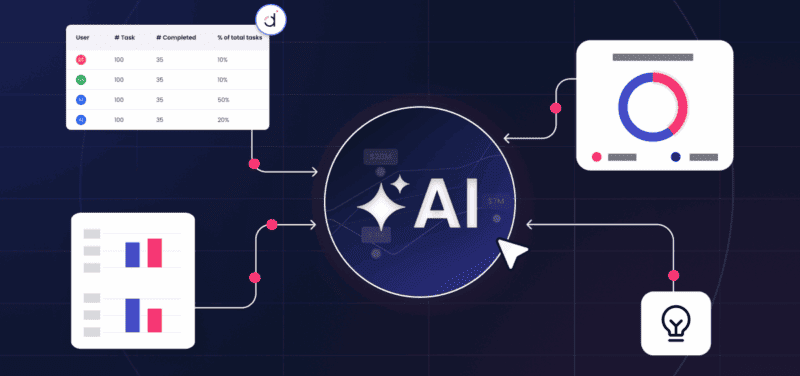
Automating month-end close with AI works across three layers: a data layer that connects to your ERP, CRM, and payroll systems and pulls actuals automatically; a workflow layer that matches transactions, flags anomalies, and routes only exceptions to human reviewers; and an insights layer that generates variance commentary and close summaries from the data itself. Together, these replace a 6-10 day manual close with a 3-5 day AI-assisted one.
Below, we’ll cover:
- What AI-powered month-end close actually means
- Why traditional close processes fail
- What AI automates
- How finance teams can use these capabilities to turn the close from a monthly sprint into a continuous, controlled process
What Is AI-Powered Month-End Close?
AI-powered month-end close uses machine learning and intelligent automation to handle the repetitive, high-volume, error-prone tasks in the financial close.
While it does that, human attention can be redirected toward exceptions, judgment calls, and decisions that demand context.
Importantly, this is a different proposition from robotic process automation (RPA) or scripted workflows.
RPA follows fixed rules: if transaction A matches transaction B, post the entry.
That works until something breaks the rule.
What AI Automates in the Month-End Close
AI-powered close learns from historical patterns, adapts to new data structures, and flags anomalies that a fixed rule would miss. It gets more accurate over each close cycle as the system builds a baseline of what “normal” looks like for your business.
General-purpose AI tools, including ChatGPT and Microsoft Copilot, fall short for finance-specific close workflows for a structural reason: they don’t have access to your ERP data, your chart of accounts, your intercompany relationships, or your historical close patterns.
Generating a variance narrative based on numbers you paste into a chat window isn’t the same as a system that reads your actuals, compares them to prior periods and budget, and writes the commentary from a single integrated data source.
This brings us to the three layers of AI close automation, each of which is worth digging into a bit more.
1. Data layer
The data layer handles ingestion and normalization. AI connects to ERP, CRM, payroll, and billing systems, automatically pulls actuals, and maps them to a consistent chart of accounts.
2. Workflow layer
The workflow layer manages exception routing. AI matches transactions, identifies anomalies, and routes only the flagged items to human reviewers.
3. Insights layer
The insights layer generates analysis. AI produces variance explanations, close status summaries, and executive commentary from the underlying data, rather than waiting for a finance team member to write them at midnight on day seven.
Why Traditional Month-End Close Processes Fail
It doesn’t tend to be one failure that causes most month-end close problems. Rather, they tend to accumulate across a process with too many manual handoffs, too many disconnected systems, and too little visibility until the end.
1. Data fragmentation across ERP, CRM, and planning tools
Finance data in most organizations lives across a handful of systems that don’t talk to each other. Each system exports in a different format, on a different schedule, and is mapped to a different set of account codes.
Every month, someone has to pull all of this together manually from the ERP, the CRM, Excel, and other sources.
Each export introduces formatting inconsistencies. Every time they paste something, it introduces transcription risk.
Not to mention, by the time the consolidated view is ready, it’s already several days old.
2. Manual reconciliation creates bottlenecks and errors
Account reconciliation is the most time-consuming part of the close for most finance teams. Matching transactions across systems, identifying unreconciled items, and clearing the exceptions takes days when done manually in spreadsheets.
The process is sequential, so a single delayed sign-off holds up everything downstream.
How Do I Eliminate Manual Reconciliation During Close?
AI eliminates manual reconciliation by matching transactions across systems automatically using pattern recognition rather than exact-match rules — handling partial matches, timing differences, and cross-currency transactions without human input, and routing only genuinely unusual items to a reviewer.
This is typically the highest-friction point to automate first, since reconciliation is the most time-consuming part of a manual close for most finance teams.
3. Journal entry review is reactive, not proactive
In a traditional close, accountants review journal entries after they’ve been posted. Errors, duplicates, and threshold breaches surface during review rather than before posting.
Correcting a posted entry mid-close disrupts the reconciliation layer. In some cases, it requires reopening periods that have already been reviewed.
A proactive review model (where AI flags unusual entries before they’re posted) eliminates most of this rework.
4. Excel dependencies break under volume and complexity
Excel is the default consolidation and variance tool for most finance teams. In fact, even with FP&A software in place, 84% of finance pros believe Excel will remain as important or become more important over the next decade.
Perhaps this number isn’t a surprise. After all, under a certain scale, Excel works for the month-end close.
The problem is, above that scale, it becomes the close’s primary liability.
Multiple people editing the same workbook, broken formula references after a row insertion, version conflicts between the file someone updated yesterday and the one shared this morning: these aren’t exceptional events.
In fact, they become routine for teams still operating in Excel without a data integration layer underneath.
5. Variance discovery happens too late
In a traditional close, variance analysis happens toward the end of the whole process.
Finance finishes consolidating the actuals, then starts asking why the numbers look the way they do. At that point, the close is essentially done. Any analysis is retrospective rather than corrective.
However, with AI-powered variance detection, it runs all month long.
This way, when an unusual movement in a cost center appears on day 4, for example, the team can investigate and resolve it before it affects the close output.
6. Month-end close timelines don’t support modern business speed
APQC benchmarking data shows that only the top-performing finance teams complete the close in five days or fewer. The median is between 6 and 10 days.
When so many other parts of modern business have sped up, this speed (or lack thereof) is problematic.
If CFOs are making material decisions based on a ten-day close, they’re doing so without current data.
6 Core Components of an AI-Powered Close Platform
An AI-powered close platform handles a number of distinct categories of work that traditionally require human time and attention.
Here are six of them.
1. Automated transaction matching and reconciliation
AI matches transactions across systems using pattern recognition rather than exact-match rules. This means partial matches, timing differences, and cross-currency transactions get handled automatically rather than being queued as exceptions.
Only truly unusual items reach the reviewer.
2. Intelligent anomaly detection
AI establishes a baseline of normal transaction patterns for each account, cost center, and entity, and then flags deviations outside expected ranges.
Let’s say a cost center typically posts $40,000 in monthly accruals but suddenly shows $180,000 in a single journal entry—this would get flagged right away (before sign-off), not after.
3. Automated intercompany elimination
AI identifies intercompany transactions, matches them across entities, and automatically applies elimination entries. In effect, it preserves the audit trail throughout the whole process.
4. AI-assisted accrual calculation
Historical accrual patterns feed forward-looking accrual estimates. This reduces the manual input required from department heads and catches implausible accrual submissions before they enter the ledger.
5. Variance explanation generation
Rather than a finance team member writing variance commentary from a blank document at the end of the close, AI generates a first-draft narrative based on the actuals data.
Finally, it identifies the primary drivers of movement and flags the items that warrant human review and elaboration.
6. Real-time consolidation
Actuals from all entities flow into a unified consolidation view continuously rather than at a single manual roll-up point. The consolidated P&L is current throughout the close, not just at the end.
Want to see how Datarails automates the close in your specific finance environment? Request a demo.
Month-End Close Checklist: Traditional vs. AI-Powered
The classic month-end close checklist itself hasn’t changed much in twenty years. What has changed, however, is how AI-powered software reframes the tasks that require human effort and those that don’t.
| Close Task | Traditional Approach | With AI (Datarails) |
| Transaction reconciliation | Manual matching in spreadsheets | AI auto-matches; flags exceptions only |
| Journal entry review | Accountant reviews all entries | AI flags anomalies; human reviews flagged items |
| Intercompany eliminations | Manual elimination schedules | Automated elimination with audit trail |
| Accrual calculation | Spreadsheet formulas, manual input | AI-assisted accrual based on historical patterns |
| Variance analysis | Finance writes commentary manually | AI generates a variance narrative automatically |
| Consolidation | Multi-file merge in Excel | Real-time consolidation across entities |
| Reporting to leadership | Manual deck creation | Auto-populated dashboard, drill-down ready |
The human role in an AI-powered close shifts from doing to reviewing. Controllers and accountants might now spend their time on the 10% of transactions that warrant judgment, rather than processing the 90% that don’t.
3 Examples of AI-Powered Month-End Close in Action
Below, we’ve included three examples to showcase the outcomes of blending AI and the month-end close process.
Example 1: A Controller with 12 entities detects an intercompany discrepancy on Day 2 instead of Day 8
A Controller managing 12 entities runs a consolidated close that typically takes nine days. Two of those days are spent resolving intercompany discrepancies that surface only during the elimination step.
With AI-powered reconciliation running throughout the month, the same intercompany mismatch, a $47,000 difference between a management fee posted in Entity 4 and the corresponding elimination in Entity 9, appears as a flagged exception on day two of the close.
The Controller resolves it the same morning. The elimination step at day seven runs clean.
Example 2: AI flags an unusual accrual spike in a cost center that turns out to be a double-posted invoice
A cost center posts an accrual that’s three times its historical average for the period. The AI anomaly detection layer flags it within hours of posting.
The accountant reviews the entry, confirms it’s a duplicate invoice submitted by a department head, and voids it before the trial balance is finalized.
In the traditional process, this error would surface during the variance review, likely on day six or seven, requiring a journal entry reversal, re-run of dependent formulas, and a delay in the reporting package.
Example 3: CFO receives an auto-generated close commentary report on Day 3 instead of waiting for the team’s manual narrative
A CFO at a multi-entity services firm has historically received the monthly close report on day eight or nine. It always comes after the finance team completes consolidation and manually writes the variance narrative.
With AI-generated commentary, the system produces a first-draft variance explanation on day three. It covers the primary drivers of P&L movement against budget and prior month.
The finance team reviews and adjusts the narrative where context is needed, and delivers the report to the CFO on day four.
During the investor call on day five, they’re all working off the most up-to-date, accurate numbers.
How AI Transforms the Month-End Close: 6 Key Capabilities
To further demonstrate how AI transforms the month-end close, let’s look at six other specific use cases.
1. Exception-based review instead of full-population review
AI reviews 100% of transactions and routes only flagged items to human accountants.
Before incorporating AI into the process, you may have had to review 3,000 journal entries at month-end. Now, you’re only tasked with the 200 that fall outside normal parameters.
2. Continuous monitoring throughout the month
AI-powered close platforms don’t switch on at period end. Rather, they monitor transactions throughout the month. This way, you catch anomalies and resolve them when they occur rather than when they affect the close output.
3. AI-generated variance explanations in straightforward language
The variance commentary layer shifts from a manual writing task to a review-and-refine task. AI drafts the explanation, then the finance team adds context and judgment.
4. Predictive close completion
AI estimates time to close based on current open items, historical resolution rates, and outstanding sign-offs. Controllers get a live view of whether the close is on track, rather than an informal status update from whoever’s closest to the problem.
5. Scenario modeling post-close
Close data connects immediately to rolling forecast models. When actuals finalize, the forecast updates automatically, and finance can model scenarios using real close data.
6. Executive narrative generation for board reporting
Board packages and leadership reports require a narrative layer on top of the numbers.
AI generates a first-draft narrative from the close data.
This narrative includes:
- Period-over-period comparisons
- Budget variance summaries
- Key operational metrics
Month-End Close Best Practices for AI-Ready Finance Teams
AI automation works best when it’s applied to a process you understand clearly. With that in mind, make sure you map your current close process before changing it — our month-end close checklist is a useful starting point for that mapping exercise.
Focus on documenting every step, the system it touches, the person responsible, and the average time it takes.
Otherwise, you’ll spend valuable resources on automating a broken process that produces broken outputs.
Identify your highest-friction points first
For most teams, these are:
- Transaction reconciliation
- Intercompany elimination
- Variance commentary
Starting AI implementation at the highest-friction points generates the most immediate return.
Establish a single source of truth for actuals
AI close automation requires that actuals from all systems feed into one integrated data layer.
Does your ERP, payroll system, and CRM export to separate Excel files that are manually combined? Then the first step in implementation is to connect those systems to a unified data platform.
Define your exception thresholds
AI anomaly detection is only as useful as the thresholds it’s calibrated to. Work with your team to define what “unusual” looks like for each account type, cost center, and entity.
Separate the close from the report
One of the most common close delays is the compression of two distinct activities: closing the books and preparing the leadership report.
AI automation handles both.
However, treating them as separate workstreams with distinct timelines gives the close process more room to breathe and reduces the end-of-month pressure that can cause errors.
Invest in clean chart-of-accounts alignment across entities
Multi-entity consolidation in AI platforms requires a consistent account mapping.
If different entities use different account codes for the same line item, the consolidation layer needs a mapping table.
Building this once, correctly, eliminates an ongoing source of consolidation errors.
Review the AI outputs before they become the output
AI-generated variance commentary and close summaries are starting points, not final deliverables. Teams that build a review step into the close workflow will get better output and maintain the professional judgment layer that AI can’t replace.
See how Datarails fits into your specific close workflow.
How AI-Powered Month-End Close Fits Into FP&A Workflows
The close is the input for everything that follows: the rolling forecast, the board pack, the scenario analysis, and the next budget cycle.
If your AI-powered process shortens the close process from ten days to five, you’ve effectively given the FP&A function a five-day head start on the work the close is supposed to enable.
Here’s how that might look:
Days 1–3: AI-assisted reconciliation and exception management
- Transaction matching runs automatically
- Flagged exceptions are routed to accountants for review
- Intercompany transactions are identified and matched across entities
- The Controller has a live view of open items throughout
Days 3–5: Consolidation, eliminations, and trial balance finalization
- Multi-entity consolidation runs automatically as entity-level close tasks are completed
- FX translation applies to international entities
- Eliminations post with full audit trail
- The trial balance finalizes without a manual roll-up step
Days 5–7: AI-generated variance commentary and executive reporting
- AI produces the variance narrative from the finalized actuals
- Finance reviews and refines
- The executive dashboard updates automatically
- The CFO’s close report is ready before the end of day five in well-run implementations
Post-close:
- Rolling forecast update, scenario planning, and board materials
- Actuals from the close flow directly into the rolling forecast model
- Finance updates forward assumptions based on the close findings
- Scenario models reflect the latest actuals
Why Datarails Turns Month-End Close Into a Competitive Advantage
Datarails is built for finance teams that need to close faster without rebuilding their workflows from scratch.
The platform is Excel-compatible by design.
Finance teams stay with the tools they know; Datarails adds the data integration, AI automation, and version-control layer underneath. There’s no new interface to learn, no data migration project to manage, and no period of reduced productivity while the team adapts to new software.
Real-time ERP integration means actuals flow into the close model automatically as transactions post. This all happens without manual exports, paste errors, or questions about which version of the actuals file is current.
AI-powered reconciliation automatically handles transaction matching, anomaly detection, and exception routing.
Controllers review the items that warrant attention, rather than processing the full population. Intercompany eliminations post with a full audit trail. Accrual calculations reference historical patterns rather than manual inputs from department heads.
Automated close commentary also generates the variance narrative from the underlying data. The finance team reviews and refines; the AI produces the first draft. This way, you can get a close report to leadership on the fifth day, rather than the ninth.
Post-close, the platform connects close data directly to rolling forecasts and scenario models. Now, instead of ending the monthly process, the close functions as the starting point for the next planning cycle.
More than 1,000 finance teams globally use Datarails to run an AI-powered month-end close that delivers accurate numbers to leadership earlier, with less manual effort, and with a complete audit trail at every step.
Ready to close faster and plan smarter?
AI-Powered Month-End Close FAQs
AI-powered month-end close uses machine learning and intelligent automation to handle the high-volume, repetitive tasks in the financial close.
AI automates the close across three layers:
– At the data layer, it connects to ERP, payroll, and billing systems and automatically pulls actuals.
– At the workflow layer, it matches transactions, flags anomalies, and routes exceptions for human review.
– At the insights layer, it generates variance explanations and close summaries from the underlying data.
Month-end close automation software connects to a company’s financial systems and automates the reconciliation, consolidation, and reporting steps in the close process.
Finance-native platforms like Datarails integrate with ERP systems, automate transaction matching, and generate AI-powered variance commentary. Even better, they do all of this while keeping finance teams in familiar tools like Excel.
Automated reconciliation uses AI to match transactions across systems without manual spreadsheet work. The system identifies matches, flags exceptions that fall outside normal parameters, and routes those exceptions to an accountant for review.
Top-performing finance teams close in five days or fewer, while the median finance team spends 6-10 days, according to APQC benchmarking.
With AI-powered automation handling reconciliation, consolidation, and variance commentary, well-implemented teams consistently close in substantially less time
The actual timeline depends on the number of entities, system integrations, and the complexity of intercompany transactions. That said, the five-day close is achievable for most mid-market finance teams using a purpose-built platform.
AI generates variance explanations from the actuals data automatically. It identifies the primary drivers of movement against budget and prior period, and flags items that fall outside expected ranges.
Finance teams receive a first-draft variance narrative to review and refine, rather than writing it from scratch.
The close is the data foundation for the rolling forecast, scenario planning, and board reporting. When close data flows automatically into the FP&A planning model, the forecast updates as soon as actuals finalize.