Click for Takeaways
- Embedded AI is bounded twice: by the vendor’s data model, which limits what it can see, and by the vendor’s roadmap, which limits which models you can use.
- Lock-in is a question about where your metric definitions live, not about which AI vendor you signed with.
- If a vendor’s services team has to add every new metric, you have bought a consulting engagement with software attached.
Sit through four vendor demos in a week and the AI section of each blurs into the next, everyone’s pitching some version of embedded AI vs. bring-your-own AI without naming it that. Everyone has commentary generation, anomaly flags, and a chat box over the data. The slides are close to interchangeable. What is not interchangeable is where the AI sits: inside one product, running on the model that vendor chose, or connected to a data layer any tool can query. That choice is difficult to reverse later, which earns it more attention than a feature comparison usually gets.
What is the difference between AI built into an FP&A platform and AI you bring yourself?
Embedded AI runs inside the vendor’s product, on the vendor’s model, through the vendor’s interface. It works well there and nowhere else. Bring-your-own AI inverts the arrangement: the platform governs the data and exposes it to whichever tool you already use. One optimizes a single workflow. The other keeps your options open.
My FP&A vendor is already adding AI features, so why would I need anything else?
Embedded features handle the tasks the vendor anticipated: commentary, anomaly flags, in-app queries. They are bounded twice over. By the vendor’s data model, so they cannot reach systems that are not in it. And by the vendor’s roadmap, so your team cannot use a model released last month. The question is whether your AI ambitions fit inside one product.
Can FP&A software work with Claude, ChatGPT or an agent my team already uses?
Some can, through MCP or an API. Verify three things early:
- Whether the connection exposes governed, consolidated data or only raw records
- Whether permissions and audit logging carry through to the AI query
- Which specific clients are supported, by name
Vendors describe very different architectures in very similar language, so ask to see the connection working against your own data.
Is a finance AI vendor selling me a product or a consulting engagement?
Ask what happens without their services team. If configuration, model changes, and new metrics all require vendor hours, it is an engagement with software attached. Three tests: can your own team add a metric definition, connect a new source, and change a report structure unassisted? Get the answer before signing, because it sets your run-rate cost for the whole term.
Will AI-native finance startups get there before the incumbent FP&A vendors?
It cuts both ways, which is why the bet matters. AI-native vendors move faster and often lack the consolidation, FX, elimination, and audit depth that took incumbents years. Incumbents have that depth and are retrofitting AI onto closed architectures. The lower-risk position is an open architecture that does not require picking a winner in advance.
Does embedded AI or bring-your-own AI leave me less locked in three years from now?
Bring-your-own, on the usual measures. Lock-in is about where your logic lives and how easily it moves, the same concern covered in what a homebuilt MCP connector costs to maintain once engineering moves on. If metric definitions, mappings, and report structures sit in a layer any tool can query, changing AI vendor is a reconnection. If they exist only inside one platform’s AI features, switching means rebuilding them. Ask where the definitions live. The deployment gap is the reason to hedge: Gartner found 84% of finance organizations have implemented or plan to implement AI while only 7% report high or very high impact. A March 2026 Gartner survey of 204 finance leaders found 45% of finance AI investment leans toward productivity and 20% toward decision quality, which shows where most of the value is currently being sought.
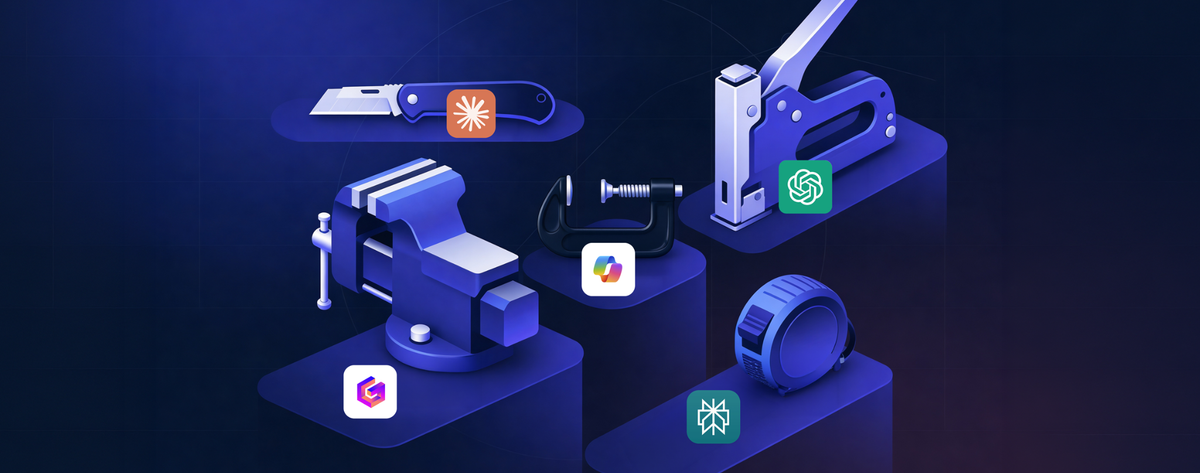
Our own bet is visible in the architecture. We connect to Claude, ChatGPT, Gemini and any other MCP-compatible client rather than shipping a model of our own, because large language models default to Excel as their output for finance. They do not produce dashboards inside somebody’s walled garden. They produce spreadsheets, and a spreadsheet has to be refreshable to be worth anything next month.
How does Datarails work with the AI tools my team already uses?
Datarails FinanceOS® is deliberately not an AI tool. It provides the governed data layer of consolidation, semantic layer, permissions, and audit trail, then connects over MCP to Claude, ChatGPT, Gemini, or whatever your team adopts next. You bring the AI; the governance underneath stays constant.
How should I decide between embedded and bring-your-own AI?
Those four demos will keep blurring together, because the AI features are converging while the architecture underneath them is not. One approach ties your metric definitions, mappings and report structures to a single vendor’s product. The other keeps them in a layer any tool can query, which turns a change of AI vendor into a reconnection. Three years out, that decides whether switching means a conversation or a rebuild. Ask each vendor where the definitions live and who can change one without raising a ticket, the same question that decides whether an AI tool can be trusted with your financial data in the first place
Then see the open version working: a FinanceOS demo shows the same governed data answering through Claude, ChatGPT or whichever model your team adopts next.