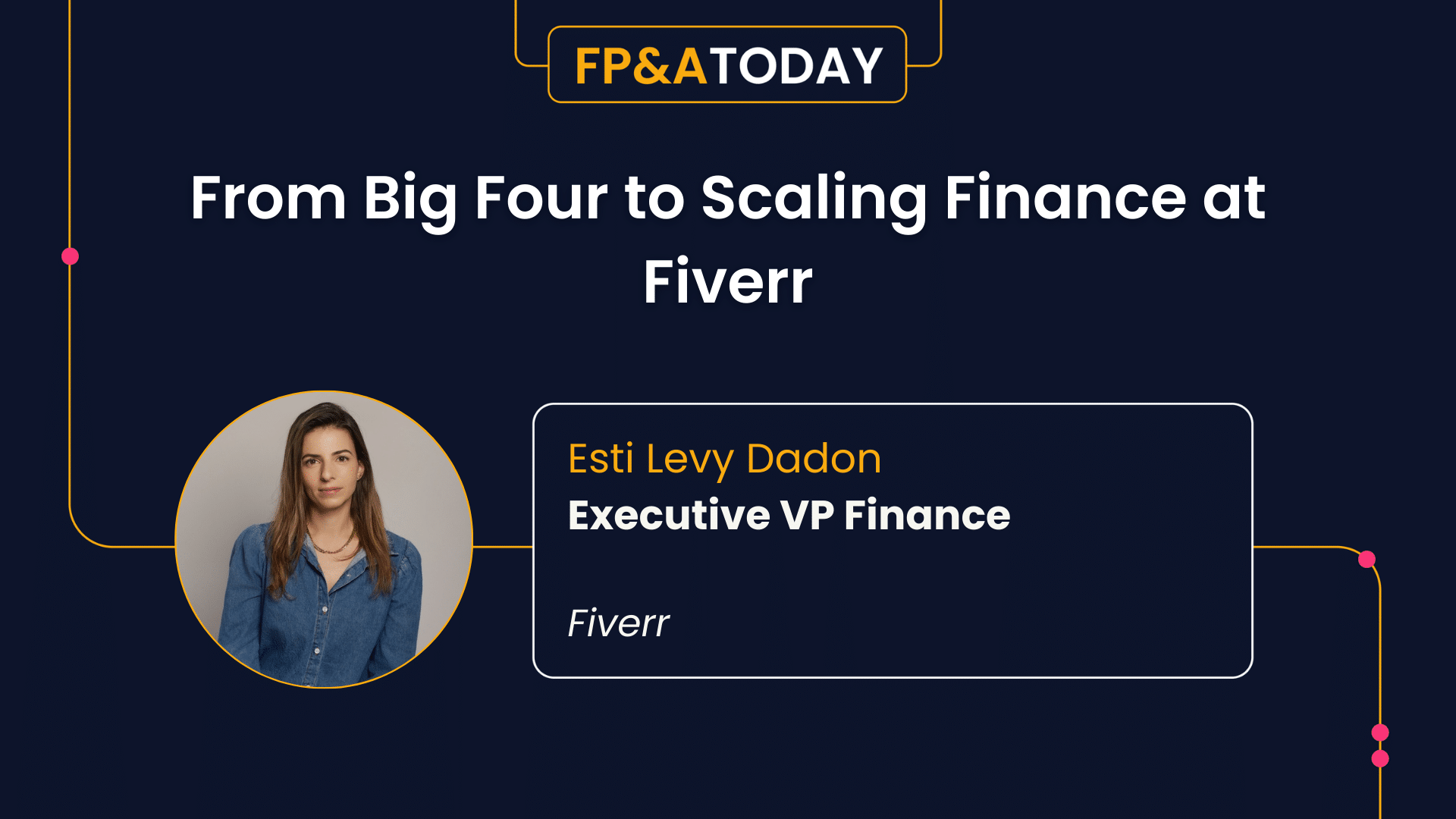
Esti Levy Dadon, Executive VP Finance, Fiverr ,started in public accounting at Ernst and Young, before leading the finance function at Fiverrr. Since joining the global marketplace in 2016 she steered the company to a successful IPO in 2019. In her words: “In almost 10 years at Fiverr I’m still waiting for things to be boring and repeatable, but it never happens because things change all the time”
In this episode:
- Building finance from the ground up at Fiverr
- The path to IPO and the financial work required
- Challenge of building a robust forecasting model for a public company
- Creating a finance team to last
- Business partnering process at Fiverr
- Traits for hiring in FP&A at Fiverr
- Mindset FP&A perspective shift to connect you to the business
Full blog post and transcript below
Glenn Hopper:
If you would like to earn CPE credit for listening to the show, visit earmark cpe.com/fpe. Download the app, take a short quiz, and get your CPE certificate. Finally, if you enjoy listening to FPA today, please go to your podcast platform of choice. Click the subscribe button and leave a rating in review of the show. And now onto the show from Data Rails. This is fp NA today.
Welcome to fp NA today, I’m your host, Glenn Hopper. Today I’m joined by Estee Levy Doon, executive Vice President of Finance at Fiverr. Estee Journey is one that many finance professionals aspire to. She started in public accounting at Ernst and Young, and eventually leading the finance function at one of the most well-known global freelance marketplaces. Since joining Fiverr in 2016, Estee has helped the company scale through international growth, a successful IPO and a rapidly evolving tech landscape. She’s played a critical role in building modern finance organization that balances strategic planning, financial rigor, and operational agility. In this episode, we’ll explore Es Key’s career path, how she built and Scaled Five’s finance team, what it takes to prepare for an IPO, and her approach to leadership and innovation in finance. Whether you’re an aspiring CFO, a startup, fp and a leader, or just trying to figure out what’s next in your finance career, there’s something here for you. So let’s dive in. Estee, welcome to the show.
Esti Levy Dadon:
Hi. Thanks for having me.
Glenn Hopper:
Yeah, we got a lot to cover today, so let’s just dive right in. So you spent nearly a decade at Ernst and Young before moving to Fiverr, and I’m wondering, after that long in public accounting, what prompted you to move into a startup hyperscale role that, that you took at Fiverr? Yeah,
Esti Levy Dadon:
So EY was a great journey. I started my career there, right? So at ey, you, when, and I worked at audit, uh, department, you, I was part of audits of companies that are from startup to huge organization. Uh, I started in Israel and then I spent few years, uh, in the us. And I think the ability to see different type of organizations, different types of finance teams, different types of business models, actually, it’s so interesting. Uh, I don’t know how many, how many, how many, uh, careers you have that you have, that you have the ability to see, to see so many different types, and actually even to sit in board meetings and audit committee pretty early in your career, right? So I think the journey definitely gave me the ability on the one hand to see the, the bigger picture, but also to dive in. Once you see something interesting, once you, you, you, you feel there’s something that you need to more investigate more, it actually actually build my, that skill of, you know, looking at the big picture, but also when important to go into the details.
Glenn Hopper:
Yeah. It’s like no matter how many case studies you might do in an MBA program, nothing prepares you for the broad depth and exposure that you get. Um, being in public accounting like that. Yeah. <laugh>. So then you made the jump, uh, with 2016 you joined Fiverr, and back then the company was still private growing rapidly. So coming in at that point, what were some of the biggest challenges that you faced? Building the finance function, basically from the ground up, right? Yeah.
Esti Levy Dadon:
So I, I made a decision of living ey and, uh, going into a company because I wanted to build something. I wanted to be part of something. So it was great to see that so much, so much variety of companies, but at the end of the day or day, the day to really feel that you, that you are connected and you’re helping the company to grow, you have to be inside. So I think that one, once I did the move, uh, the, the first thing that shocked me that finance was not a product, right? So it, it sounds like it goes without saying, right? It’s when you are going to a company department, the finance department is a department, provide service, helps the company to grow, but it’s not the product itself when you’re at ey, finance is the product. But I think that shock actually helped me, uh, when I came into Fiverr to, to feel like it should be part of the business, this finance, I couldn’t feel like I’m not part of the business because I wanted to contribute, right?
So I think that point and that willingness to, to be part of something actually helped me to really understand the business, to work with all the departments, to understand what’s working and what’s not. And we were talking about marketplace also. We can think about it, that finance has something in the product, right? Because at the end of the day, you’re taking money from one side and then moving it to the other side. You have to be very precise. You have so many transactions, right? Millions of millions of transactions, and you have to be very precise. So I think that actually really helped me fir first of all, to feel that, to feel that I’m part of something, of something, but also real life, right? So we were growing really rapidly, uh, and as you mentioned, it was really early days of the finance. There was under, we were only two or three people.
Um, so really to build that infrastructure for the rapid growth, uh, that was a challenge. That was definitely a challenge. It was both, you know, the, the basic accounting and the basic, um, recording and automating so many to automating the processes because you can’t really capture and understand and analyze millions of transactions just from, you know, doing analytics or to review on a high level. You actually need to have a system in place to implement reconciliation, to payment processors, to understand the, the, the, to understand how the, the platform works and move money or move money from one side to the other side, you actually need to infrastructure to, to support that. So that was really interesting.
Glenn Hopper:
That’s such an interesting time to be at a company because the bringing on the finance team, companies don’t do that until they’re, until they have a base. There’s not usually a, a finance person among the founders, or there’s someone who’s wearing multiple hats and, and doing that. And as, as the company’s growing, it becomes, okay, here’s the stuff we need to get done. We’re just gonna kind of <laugh> push through it and figure it out as we go. But the processes are very clunky and, and systems aren’t really in place, and really just getting a handle on the data. And, um, a lot of times I, I’ve worked in, uh, smaller, uh, startups where, where I came in and, you know, just getting their general ledger and chart of accounts straight and getting, uh, the, the going from the blend of, uh, you know, cash and accrual accounting, both mixed together and trying to get all that straight. You have to get the, get more accounting rigor and, and get a handle on the data, bring in the systems and those automations. So it’s, it’s a lot of work, but it’s, you can see the impact when, uh, with, with each step.
Esti Levy Dadon:
Yeah, I totally agree. And I think that the skill that I’ve mentioned at the beginning from, you know, of looking at the big picture and then diving in, I think that really helped, right? Because at the end of the day, I think the real secret is to simplify it as much as you can, processes to understand on a process on the high level, and then to dive in and understand what do you need where, and as you mentioned, even if it’s millions of transactions, it’s a startup mode, and you just, I mean, the focus is to grow, to grow fast, right? So not to not, not to, but, but in that, on the other hand, when you understand that you’re building something big, big, then the understanding that the infrastructure needs to be robust, that’s crucial. That’s definitely crucial.
Glenn Hopper:
And it’s so important that you got that infrastructure down because you’re there in 2016. You start building out the finance team, automating processes, and Fiverr goes public in 2019. So now you have a whole <laugh>, a whole new level of, of requirements on you. And not just, I mean, just the, the pre IPO process, um, forget the reporting and everything that you have to do after, but in that three years from the time you joined to Fiverr, going public, what was it like leading finance through that process? And you know, I, for someone who hasn’t gone through that, what do people outside of the company or who haven’t done, uh, an IPO, what do they often misunderstand about the financial work required to get a company IPO ready? Because it’s a massive lift, obviously.
Esti Levy Dadon:
Yeah, it’s a massive lift, and it’s actually connected to two different areas. So I think one of the, I mean the, maybe the more common that everyone think about the know that your, the financial needs to be in accordance to a specific, a specific gap, and you have those filings of the SCC. I think the challenge, and especially at Fiverr, the challenge is, is to build a robust forecasting model. Because as a public company, you are always, you always need to manage right? Expectation, and you always need to provide forecast. And there’s a reminder, Fiverr is a, a transaction based, uh, platform, right? It’s not a, a SaaS, SaaS model, right? It’s not a recurring model. So that actually provides even <laugh> additional, uh, uh, difficulty. So I think building that muscle and understanding pre I mean, pretty early in the, in the process that yes, definitely, I mean, we took these two, two things that has to happen, right?
Or maybe three. The, the third is the ir, but let’s put that aside. Definitely something that you need to, to work on how to, to develop the, how to communicate the business model and determine KPIs and so on. So that’s one. Uh, the second is definitely accounting. You, you have to have, you know, we are to, to, to clean your books and make sure, making sure it’s, it’s based on, on the gap requirement. But I think the more challenging part is how to build those models that help you forecast and help you feel comfortable with those, uh, guidance that you provide to the market. Because once you are public, you are public, you are required, right? To give those, those guidance. And as a startup company, usually what people do, and back then in 2016, you know, it was even <laugh> even more than, right? You had an Excel, you looked at what happened before, you, you, you imagine what’s going to happen next. Uh, but definitely then we build this model both on the top line and then on expenses to be able to to, to make those forecasts.
Glenn Hopper:
And as you ramped up for the IPO, so you, you came in and, uh, started structuring the team. Can you walk us through what that early team looked like? Who the first people you brought in and who you were surrounded with then, and then how you ramped it leading up to the IPO and maybe how the team has grown and changed since going public?
Esti Levy Dadon:
Yeah, yeah, for sure. At the beginning. I mean, definitely you need bookkeepers and controllers. That’s to handle the accounting, the accounting areas. As we approach towards the IPO, we also brought, uh, someone to deal with really, really accounting, right? So to clean, really to clean the books and write all the memos, uh, working with auditors, making sure that it all aligns to have the, the forms required from, from that perspective. So that was one angle. Uh, the second angle, as I mentioned, it was the fp and a, and we brought someone in-house. We, uh, we build a model. So that was definitely something important. And then the IR to, to, to be prepared to on the messaging side. Then after we’ve started, uh, trading and become public, then we also already, now we had cash, right? And also we were aiming to, to, to, to generate cash in the most efficient way, because then, right, free cash flow is definitely a KPI that is important.
Um, so at that point, we build the muscle of treasury. So building, um, uh, how, how to manage cash, even if it’s a deposit, or to invest cash to do the projections, learning how we can, you know, be most efficient in order to become what we, we need to become in order to become, uh, a cash, uh, positive company. So treasury rate was very, very important. Stock admin, right? We start to, you know, now equity is not just something on the tree. Now you had, you have to handle that. So definitely stock admin, uh, is another area that we invested in and taxes. So, uh, so you have, so as the company grow, right? So you have all this more complexity that in the beginning it was just, you know, four of us or three of us that handled everything. But once you, you have, you need to be more professional at that. And things becoming more com uh, complicated. So we also brought, uh, a tax person to the team.
Glenn Hopper:
Gotcha. You’re in such an interesting place. It’s gotta be exciting because public company reporting obviously more rigorous than, than private company. But if you’re an established, uh, public company, um, and things stay pretty normalized, it, you can get into a routine with that. But you have <laugh>, you, you have the, the public company requirements plus this hyper scaling. And when, when a company’s rapidly scaling like that, I just, it seems like spinning a lot of plates and a lot of juggling. So like as a finance leader, fast moving tech company, how do you balance that sort of agility and innovation while maintaining the rigor of the financial controls SOX compliance and your forecasting accuracy? That seems like you’re being pulled in a couple of different directions all the time. Yeah.
Esti Levy Dadon:
One of the roles of the CFOI imagine it like, uh, the foot on the gas pedal of a company, I hope I’m saying it right in English, but, so you need to, to know how much to push or to, with the foot, right? To, in order to make, to, to make sure that the car is moving and it’s, that had, has enough power to move on the one hand, however, not too hard, right? In order to, so it won’t crash. So balancing, balancing growth and healthy growth is something that is a CFO, I think that’s, that’s like, that’s the mo that’s the most, so we want to have to give the enough energy to the company and to support the strategic growth on the one hand, but it has to be healthy, healthy and in order to do that, so you have, I mean, that’s also my, uh, my belief as a manager, you need to have very professional team that handle each one in their, in their departments and, and as you mentioned, so, and controls.
So, so sovereign socks, these socks that are, that is required for a public company. It sometimes it sounds like very compliance, very something that the, that annoying people don’t understand. It’s more like a check mark that needs to be done. But I don’t see that, that, that way, because I think that if you understand that having controls in place and having the right processes and automated processes where automation is needed because you are in scale, uh, but also to have people really, uh, you know, also on the ground, right? Really not giving everything to the machine to check, right? So just, uh, also to, to be part of the process. So once I see that as a mean for me to sleep good at night, right? So to have those people with that, that, that, that really care, that that, that each one of them is very, very professional of what they do, and we have the right controls in place and we understand and we streamline the process that helps me, uh, to, to, to be able to make sure that we know what is the right balance to, to hit that, you know, uh, the, the foot on the, on the gas, right?
So it’s very interesting. And I mean, I’m still waiting almost 10 years at Fiverr. I’m still waiting to be boring and, and, and be repeatable, but it’s not because, because really things change all the time. And we, uh, Fiverr always being pan pioneered in everything. And I think at the beginning it was, it even has sh was shown through regulation. So there was no regulation out there for certain things for marketplaces services online. There were products online, but services online, rendering services online. So actually, you know, to see how things have developed, developed over time, and then to catch and include that regulation into fiber, that was fascinating.
Glenn Hopper:
Yeah. It sounds like the way you’ve structured your team and, and your focus to finance their things that are routine, it sounds like you’ve come up with ways to make those as efficient and streamlined as as possible. And I’m wondering, would you say that on the finance side, you guys have embraced kind of automation or if you’re using any AI or other new technologies within finance operations? And I wonder what’s your pH philosophy? I know there’s, tech is a big bubble and everybody’s talking about generative ai, but I’d love to hear kind of what you guys are, are doing and thinking about, uh, latest tech and how you’re using it.
Esti Levy Dadon:
Yeah, so I think it’s really early days still on the, on the finance side, but definitely, I mean, there is so many opportunities out there, and I’m not concerned that AI will replace the finance team. It’s definitely gonna work to make the work much more efficient. Maybe we’ll need less people, or we need people that will need people that will do much more thorough analyzing strategic work in the finance de department. And all the tedious work will be done by machine. I have to say, it’s still not there fully, right? And we’re looking, definitely looking for tools, and there are still tools out there. As a public company is always a concern for us because you have to have things very precise and very, uh, and there, there can’t be any glitch or miss, uh, something that is not correct or privacy of course, or something like that.
So I think there, that’s a challenge, but my view is definitely that, you know, that things will change. And the way, uh, departments are structured is if it’s, uh, how we analyze data, you know, in, in a perfect world, you don’t need the auditor to wait for the end of the quarter, right? To do the audit, right? And even, you know, maybe if we will take it one, let know, a few years for, maybe they even won’t, wouldn’t need to wait for the end of the quarter to get results, right? Because at the end of the day, if everything is streamlined, but I think it’s very, it’s still science fiction, definitely. But I, I have to say that, I mean, for us, we’re looking at each department that they’ve mentioned, whether if it’s treasury, whether if it’s tax, whether if it’s fp and a, whether, if it’s pure accounting, H one are very, very interesting companies that can give that solution for, from AI perspective and helping analyzing data.
I hear a lot about companies that are trying to, to gather information, because if you think about it, there are so many, uh, platforms are out there, right? So in, if in the past maybe a company had one, I know big SAP or Oracle, right? That included all processes. So with going to the cloud, so it became all the, the process has, has been broken to many, many, many platforms. And now the challenge is, is to reconcile all the data from all the platforms. So I think definitely one of areas that are really interesting is how to build that layer above all those platforms and gather all the information. I know that today, um, um, people spend so much time by understanding, just understanding if this customer is written this way in the, in one system and a different way in a different system, only reconciling and understanding it’s the same, the same customer that actually can cause, uh, a pain. So definitely AI can help with that. Um, so I think there are many opportunities from finance team, but let’s remember also when, when, uh, Excel was developed. So maybe, I dunno, like 25, 30, 40 years ago, people actually did the, the calculation, not, not in Excel Now that once we, we had Excel, it’s not that we had less accountants out there, right? And less analysts, right? There are just more, and they’re just doing more strategic work, you know, being able to support bigger processes. So definitely I think AI will help with that.
Glenn Hopper:
Yeah. And I always say nobody goes and gets their CPA or master’s in finance or, or whatever their education is because they’re really excited about data entry. So it, as much as we can take away this sort of mundane, repeatable tasks and, and get to that strategic role, I think that’s where we can really add value. And you, we’ve seen with SaaS and automation that’s happened over the years, that fp and a has become a more powerful function. You don’t hear that moniker of it being a cost center so much anymore. And I think between business partnering and, and the elevated role and, and maybe kind of the changing nature of A-A-C-F-O, where historically maybe CFOs were more just backwards looking, but now the CFO being a strategic partner and fp and a playing a big part of that, I mean, I think, and automation’s only gonna make fp and a more valuable.
Esti Levy Dadon:
Definitely. I mean, fp and a has to be a business partner, a partner to enable to understand the business opportunities out there and provide the data to support that. I’m a big believer in that. So definitely the finance team and I, you know, it it, that’s what I said when I came into Fiverr and I felt that I’m not the product and it’s nothing. So why, what I’m doing here? I’m not here to record just numbers and to report how the months end. That’s not interesting, right? It’s, it needs to be done, but that’s not why I came here for AI will definitely help to even do that even better.
Glenn Hopper:
Yeah. Fp and a today is brought to you by Data Rails. The world’s number one fp and a solution data rails is the artificial intelligence powered financial planning and analysis platform built for Excel users. That’s right, you can stay in Excel, but instead of facing hell for every budget month end close or forecast, you can enjoy a paradise of data consolidation, advanced visualization reporting and AI capabilities, plus game changing insights, giving you instant answers and your story created in seconds. Find out why more than a thousand finance teams use data rails to uncover their company’s real story. Don’t replace Excel, embrace Excel, learn more@datarails.com.
One of the first things you mentioned when we started talking was forecasting and modeling. And I’m wondering for you, even though you don’t, you know, you come from the accounting side, obviously you saw the value of, of finance and fp and a early, and I know that’s important to you. So what does fp and a mean at Fiverr? And, and where do you think that fp and a drives the most value in, in a modern company like yours?
Esti Levy Dadon:
So I think it’s in different roles, definitely as a business partner, I have to say for Fiverr, every initiative, every idea, and there are so many ideas, right? Every day there is a new idea. Every initiative, any idea needs to have a model and needs to have to back that out to think if that’s actually, uh, I mean, and sometimes it’s just number that you did in the Excel, right? But it’s not right because you at fp and a, because they’re business partners, so they really understand the business, but they also really understand how the business works on really in the numbers. So sometimes you see the, the, the, the business side, they have that vision, but to connect that with the ability that the company has from different areas, the fp and a has that ability because it connects different sides of the business.
So I think being a business partner and support, uh, business decision, that’s crucial. So that’s a, and also from, as a public company, and, and I mentioned that, you know, doing that, the forecasting and, and taking into consideration all the uncertainty, gather all those initiatives, and putting that into a model and having different scenarios that that’s a, that’s a task that, that you have to be, uh, really, I see the team as really connected, connected to everything, to, to see the big picture and baked it into the, into the cake. So for us, we are definitely, I mean, we’re pushing ourself to be a part of every department. If it’s, if it’s a business department, if it’s a, if it’s a customer support department, every, every department, I mean, we want our people there in order to gather that information and bake that into the model and give the insight that is like 360, uh, and, and put it into the model.
Glenn Hopper:
Yeah, I keep thinking about what you mentioned earlier that the Fiverr model, it’s not SaaS. So you, you just have millions of transactions that you have to model. And over the last few years, I mean from COVID to macro economic swings, evolving business models, AI disruption, whatever it is, there are so many variables that you have to, to track and monitor and account for. So how do you approach forecasting in, in such a tumultuous environment?
Esti Levy Dadon:
Yeah, let’s, to be honest, it’s not easy, but we believe in really building a flexible financial model that you can quickly adjust to changes. I mean, it’s, it’s important in order to, to have those scenarios and build them out. So I mean, COVID was definitely rapid growth and all geo, geo AA economy and the geo, um, political conditions and the macro and interest rates. And you know, sometimes we see that if, if Queen of England, you know, passed away, we actually can see, I mean, we see it rely, right, how it affects fiber transaction on that day because everyone are very focused at the thing and they’re not, not buying. So being able to be agile and to gather the points in real time. So that’s one. But also to have a model that is flexible and having number of, of scenarios and then combining them, uh, that I think that, that, that’s really important. So you, and in order to have that, you have to have really good data infrastructure. That’s a, and you have to be really connected to the information on time. Yeah.
Glenn Hopper:
And do you work closely with the BI or, or data science team there, or how does that, the handoff between data there, like for your team, are they pulling a lot directly or are they customers of kind of the BI team? Do you do, uh, self-serve data mart, or how, how do they get that data?
Esti Levy Dadon:
So definitely the data science, they’re building the infrastructure of the data for, for FPNA to analyze. But at the end of the day today with AI tools, you definitely, it’s even easier, right? But even before that, so we, we were great believer of having that inform the, the, the knowledge how to do it in our team in order not to, to wait for, um, and so I, and in general, I would say the a crucial thing is, uh, really to work well with other departments. It’s, it’s like, it’s with the marketing as, as I mentioned, because the marketing is the leader generation that helps us to better model what’s gonna happen in the future, right? And with the business, with the new initiatives and with the data to tell them what data, data points we need in order to perfect the model and the forecasting.
So it’s really, really crucial. And that’s like my best advice for each finance team and definitely fp and a really not to be on, to not to work on silo, really to be part to see, uh, hopefully it can be phy really physically meet, but you know, in, in our, it’s not always that easy and things are maybe are, are, uh, are through online, but definitely be part of, of those teams, understand you work with them, understand what they’re working on, really communicate the needs and think how we can, as a finance team help them and how they can help us. I think that’s really, really crucial. Not, not to consider, uh, the finance team is a department that just, you know, that it’s outside of the business cycle. It’s just about, you know, closing the numbers and providing data to, to the board. No, you have to be part of the business
Glenn Hopper:
That just works so much better. And it, it really, it, it’s changed over the last 15 years or so where true, true business partnering where there’s fp a is embedded across the different organizations. And I think about things like the, the KPIs that are meaningful. And if you don’t have that collaborative environment where you’re close with sales and marketing, and you’re close with operations and all the different teams and all the things that you measure, is your approach when developing KPIs and tracking, is it whoever’s over that department drives and, and makes recommendations? Or how do you, how do you work with the other departments to develop KPIs and determine source of truth and, and what’s, what are the important KPIs, the, the key things that you’re measuring and looking at?
Esti Levy Dadon:
Yeah, you know, touching a really interesting, uh, point because there are KPIs for a department that are there. I mean, they are their own, and they are the KPIs that you need in order and talking about fp and a that you need for the forecast, or maybe you need for the business to have as, as the, as KPIs of the business in order to business to grow. And, and it, it cannot be, uh, top down totally. So it can’t be just finance teams saying, okay, these are the KPI just deal with it. Here are how you need to measure it. And that’s it. On the one hand, on the other end, it cannot be only from the department side, right? Because maybe the department, they have their own, you know, uh, thought or thought process how they can contribute, but it’s not really contributing to the big picture, right?
So I would say the the right way is to think ’cause of the company, you know, high level KPIs, and each company has those high level that it depends on the industry, but if it’s a RR or what or, or, uh, active, uh, buyers for fiber or whatever, right? But then to, to break the, how those departments, how they contribute each one of them to that major KPI, the company’s wide, KPI, what our, what we expect them to contribute them to the business and then translate that into a KPI that is very specific to department, the food department. Now that sounds amazing and easy <laugh>, but it’s not, let’s not, let’s not fool ourself, really, it’s a process that has to be with communication and discussion. It has to have a strategy, high level strategy of the company and where the company is going to and what is expected from each department. And only then to translate that into how they actually contribute to the, to do company’s wide KPIs and to, to translate that to their kind of KPI.
Glenn Hopper:
Yeah. And I feel like that’s gotta be pretty similar to the budgeting process too, right? So you get, you make the annual plan, you have your growth targets and ebitda, you know, whatever targets you’re, you’re looking for that you, you, that you wanna measure new users, uh, transactions and all that. So then when you go back, you know where those goals are. You, you go back with the budget and you have to work with sales and marketing and see the what are the levers we can pull here that’ll drive more transactions or more, uh, users or, or whatever the metric that you’re, you’re going after. How does your team in general work with the other departments during budgeting season?
Esti Levy Dadon:
So it’s not very different from the ongoing year. And the reason is because we have business partners that are on an ongoing basis helping those departments to, to, to work, right? So it’s not like that we are meeting only in October. Yes, in October, maybe we have another meeting that this call, let’s, let’s think about, let’s, let’s now it’s budget time, but it’s not a surprise, right? Let, I always say, you know, this yet, January is always the continuance of December, right? So yes, we have a budget frame that we’ve decided it’s 12 months starting January, but it’s not that we’re meeting only on when we’re planning that. So once you part, when you, you really, I mean, as a, as a, as a, as a team, we really feel part of the business and we really feel part of the department, and actually in some cases, the people actually sit right next to the, that department and not just in the, in the finance team, right?
So we, we, we encourage that. Then the, the budget for the budget planning, uh, season is just another point in time that, okay, we need to think about X, Y, Z. So it’s, uh, definitely yes. I mean, we are as a company coming into the next year with the goal and our KPIs, but it shouldn’t, if it’s a surprise, I think there’s a problem, right? So if you only meet once a year, just, okay, now let’s talk about next year. It’s, and, and maybe it’s because it’s also a fast, still fast growing and e evolving company, right? Every month looks different from the previous month and, and new initiatives and new technologies and new ways to think of how we’re gonna grow. So you can’t wait for the, for the budget season in order to talk with the teams. Budget is painful. It’s a process that is painful. But once you feel it’s part of something that is ongoing, uh, I think it’s, it’s less painful.
Glenn Hopper:
Yeah. And I think about just how important it is that those budgets be accurate. You, you know, you don’t wanna be reporting quarterly or annually that you’re missing your numbers. So very, very important to have that done. And I, and we were talking before the show, and I know to your team, you’ve got some strong team members to build these models, some very technical people. And, uh, we were talking before the show about managing people who might have more experience or tech technical knowledge than you do. And I’m wondering how do you approach leadership in, in those situations where, you know, you’ve got a great team and, uh, everybody has their strengths and, and you’re, you’re dealing with people like across the spectrum, but is there any leadership insight you can offer on, on that?
Esti Levy Dadon:
Sure. I always look for, uh, for someone smarter than, than me in that area that is more, uh, the professional in that area. As a manager, I am who I am, and I got to where I am mainly because of the people that work for me and help me be that. And in order to do that, you have to have really strong people. So in order to be able to progress and step up and to sleep good at night, because at the end of the day, right, you need to have, and that, that’s always my, uh, my, my, like, you have this intuition, will I sleep good at night when I know that that person is in charge on, on that field? And he, he has enough. He is, or he or she, of course, very, they’re professional enough. I mean, they have, and and it’s not to say I, I don’t understand. Usually I say, okay, now explain to me, but because I really don’t understand this tax thing, I really, I don’t know. Let’s assume that I don’t know nothing. Now, now teach me and, and, and educate me. I don’t think that’s a weakness. I think that’s a strength. And, and I will always look for someone if, and I think as a manager, if you look for, for people that are less a good from you, then you won’t be able to step up and, and to see the bigger picture. So that’s definitely something to aspire to.
Glenn Hopper:
Yeah, love that. And I’m sure it’s different across the department, but for our, our listeners, I wanna focus just on the fp and a roles. When you’re hiring someone in fp and a, what do you look for in that person? It, the, the basic skillset, personality, attitude. I mean, there’s so many different components. You know, you have the highly, highly technical people that can build incredible models, and then you’ve got some that are better maybe at visualization or some are better at storytelling or, or whatever it is. There’s a, a broad range of things to look at, including experience. And, uh, that, I guess that that’s part of it too. So I’m thinking about how do you make sure you’re staffing with the right people and, um, well, it sounds like with, with FIVERR’S growth, maybe this, this second part isn’t a problem, but keeping the talent engaged and feeling like they’re doing meaningful work
Esti Levy Dadon:
And all that. Yeah, I think a mix of those skills that you mentioned is very important to have in the department. So you need to have the person that is really good in modeling, and you need that person that is really good in communicating, right? Because at the end of the day, part of the FPNA role that you need to work with people, it’s not just with the Excel, right? You just, you need, actually need to work with and understand the business and help that. I’m also looking for, always looking for employees that have, uh, agility, I would say in their thinking because, and I’m really not joking, every month look differently, and every business, every budget po uh, season is like, oh my God. Then, then the <laugh>, okay, everything, all the departments are mixed now. I mean, we need the structure to build it differently.
If people are not, don’t have that ability to adjust and be agile. For me, I mean, I know that the, for Fiverr or for fast growing companies, it’s not, it’s not just not gonna work. So I would say, you know, the, the, the skill to have that mix of skills into a team and then to put in the right, right? So if you have a project now that it’s more about, maybe it’s more sensitive and it’s more communication perspective, then that’s the right person to be on that desk. But if it’s very, very, a complex model that you need to work on, it’s a different person in the team that is, it fits more to that. As for being motivated, again, I really, really believe if you feel part of the business and helping FFPA specifically, it’s even easier because you really, you working with the business, you helping them to decide to prioritize the initiatives and the, and the work based on, on your models.
So once you feel that your work actually counts and it actually helps the company to understand where to go to, that’s the reason to get up in the morning. Right? I think moving that, or, or passing along that thinking, it actually, it also affects people. They, they start to feel that way, and then they, they take, take the job their job very, very seriously and they, they think about it at night and right, and they, I mean, they’re, they’re eager to, to be part of something that, that is working and that decision will be made based on that. So I think this is the way for me is always to connect that to the bigger picture. Always. I’m coming back to the bigger picture. Your task that you’re doing now will help us to decide X, Y, z connected to the, to the strategy, to the bigger picture that motivates everyone.
Glenn Hopper:
Yeah. I think to a lot of our listeners, that really sounds like a dream scenario. <laugh>, I know it’s a lot of work, but the idea of public accounting, getting all that exposure to so many different businesses and then coming into Fiverr at the time you did, and building out the team and then going through the IPO and being in this process and just, I think that that’s one that a lot of people would love to mirror. And I’m wondering for people, maybe they’re early in their fp and a career, and I, I don’t know how many people, um, you know, who are ha haven’t yet made the jump into fp a, but maybe they’re listening because they’re thinking of leaving public accounting and coming into fp and a. But what advice, and I don’t know if it’s mindset or things to do or, or pathways you might recommend, but for someone early in their career that really wants to move up, um, and they want to build toward a strategic leadership role, what kind of things do they need to be thinking about in doing today that are putting on that them, on that trajectory?
Esti Levy Dadon:
I would recommend first from a mindset perspective, is really to value the contribution of their work and of what they do if they feel it’s not valuable. I mean, if they looked at it and they said, okay, I really, I’m not, I can’t see how am I connected and it’s even, it can be the most junior. I felt like when in ey when I was really junior and doing that, I felt like I’m doing the audit. It’s like, it’s on me <laugh>, it’s a mindset. It’s on me. If I’m not going to come to work and do this very tedious reconciliation of this number equals to that number, then the company’s number won’t be right. And <laugh> and Right. And I was a junior person. But it’s a mindset of really feeling and understanding why you’re doing specific task and not just, you know, pushing your manager to tell you that.
Because there are some managers to do that and there are some managers that don’t, that they’re not. But really to, to try to, to understand and to really to feel that you are a contributor at any point of the career, really. I, I mean every, even I think the most junior people in, in finance for sure, the most junior people, they are the, the first building block in a pyramid at the end. You know, it’s, it’s a financial statement, right? But it’s so important that building block. So to understand that and to make sure that you are at that position, and if not, and if you’re in a, in a place that you don’t feel it and you looked at it from every angle and you don’t see that, I would say just move to the next thing to see that and not to, to hurry to be, um, big managers. I mean, I really believe in learning from the ground. Uh, uh, I really think that being, having the, the skill of look of, of looking at the big picture and then dive in, but then really dive in and put your hands into dirt. I think it’s super important. I think it helped me to develop over time, you know, just do what you love. That’s always, that’s always true. <laugh>
Glenn Hopper:
Really, really great advice. Alright, well we’re getting towards the end of the show and we’ve got two questions that we ask every guest at the end. The first one is, what is something that not many people know about you? Something they couldn’t learn from your LinkedIn profile or from googling you or whatever?
Esti Levy Dadon:
I lost my last, uh, baby teeth when I was 30. That was embarrassing, okay. To go into the world as a 30 years old, going into audit committees without your baby, without missing teeth. That was embarrassing. But you know, if, if you’re certain of what you doing, that you work that even if, if I miss a baby tip, I still felt that I’m contributing. <laugh>,
Glenn Hopper:
You should have made up a story, something that you were playing hockey or that you were in a fight, you should see the other guy
Esti Levy Dadon:
<laugh>. Well, no, I’m true to myself. I just, I know I’m aging, uh, <laugh>. So that’s, that’s how I look at it. Always look doing, looking at the, the full side of the, of the glass <laugh>.
Glenn Hopper:
Yeah. I, I guess aging slow is better than the alternative, right? <laugh>. Okay, so everybody’s favorite question. Uh, what is your favorite Excel function and why?
Esti Levy Dadon:
Okay, maybe now I’m going to ruin everything, but I don’t see myself as very expert in Excel. And I think my team, if they’re listening now, they will smile and say, oh, so she knows that about her <laugh>. So my favorite thing on Excel is that it’s prepared in a way that I can spend really two, three minutes to understand the big picture and then to dive in. So it’s, it’s, if it’s a formula, if it’s a way that the team built the information, it, it doesn’t really matter. But for me it’s the ability really to show like, this is the resolve big picture now. This is what’s inside. And then if something’s not not feeling right, I’ll be able to, to, to dig in.
Glenn Hopper:
Yeah, that’s funny. So I, I talked to all these people who are the, you know, Microsoft MVPs and Super Excel gurus, and the truth is, I, I got my first CFO position in 2007, and as a CFO you done, I did that for 15 years. And as a CFO, you don’t spend a lot of time building models and all that. You, you are, you’re, you receive models and you see ’em and you appreciate what the team does. But, uh, every time I ask a, a guest, sometimes they’ll say something and I’ll be like, I hadn’t even heard of that <laugh>. I, I guess I shouldn’t admit that being the <laugh>, the host of this show. But, uh, that’s the reality. Esee, I really appreciated you coming on some, some great insights and just, uh, love hearing about your career and everything going on at, at, at fiverr. And I just, uh, really appreciate you coming on the show.
Esti Levy Dadon:
Yeah, thank you so much. And for having me, it was insightful. Thank you.