Click for Takeaways
- Curated Beats General: Josi is built on a closed dataset of ~40,000 pieces of AICPA & CIMA proprietary IP, with real-time updates to FASB, PCAOB, and auditing standards. General-purpose LLMs can’t reliably match domain-specific depth, and in accounting, depth is the whole game. Surveys of audit professionals consistently rank the currency of regulatory guidance as a top concern when evaluating AI tools.
- Trust Requires a Threshold: Unlike most GPTs that will always generate an answer, Josi refuses to respond below a confidence threshold. This “I don’t know” guardrail is the feature that makes technical accounting professionals actually trust the tool. Inaccuracy is among the most frequently cited AI risks across industries, and active mitigation consistently lags behind risk awareness.
- The AI Fluency Gap Is Real: Organizations are buying AI in finance faster than their workforces can use it effectively. Worker access to AI rose 50% in 2025, yet fewer than a third of organizations have truly embedded it into their workflows at scale Hibbs predicts the value of AI will compound as fluency catches up to access, and that the future is a personalized stack of role-specific AI applications in finance rather than one generalist model.
- Prompt Engineering Has Rules: Hibbs’ “rule of five”: a good prompt needs at least five points of context to get a high-quality response. Your first prompt is rarely your best. Refinement in two to three iterations is the mark of an effective prompter.
Based on an interview with Adam Hibbs, Vice President of Global AI Product Development, Commercial Operations and Licensing at AICPA & CIMA
Adam Hibbs has executed a search warrant. At 5:00 AM. He’s also negotiated cloud hosting contracts with the BBC and the Metropolitan Police, helped set broadband policy in New Zealand, and restructured supply chain performance for the UK Ministry of Defence. None of that is on anyone’s standard FP&A career path, and that’s exactly the point.
Today, as Global Director of Commercial Strategy and Operations at AICPA & CIMA, Hibbs is the architect behind Josi: a generative AI tool built specifically for accounting and auditing professionals in the US. In a conversation with FP&A Today host Glenn Hopper, Hibbs unpacked what makes Josi meaningfully different from general-purpose AI tools, why the accounting profession needed something purpose-built, what the CGMA designation offers finance professionals who aren’t CPAs, and where the intersection of AI and finance is heading in the next 12-24 months.
The Non-Linear Path That Made It Possible
When Hibbs graduated from the University of Canterbury in New Zealand with a Bachelor of Commerce in finance and marketing, building an AI product for the world’s largest accounting membership body was not the plan. The plan was to understand how broadband worked.
“I had an interest in understanding technology to do my role when I was working at the Commerce Commission in New Zealand. I was like, ‘Well, I’m curious — how does this stuff work? How does connectivity work? How does VoIP work?’ I didn’t have a clue, but I was curious enough to find out.”
That curiosity thread (pull on something unfamiliar until it makes sense) ran through everything that followed. Ofcom in the UK. Vodafone, where he moved from regulator to commercial finance and deal structuring (“working for the poacher,” as he puts it). Cable & Wireless, where he was dropped into a contractual dispute his first week and had to solve it by offsetting revenue against contractual commitments. The BBC. The Metropolitan Police. The Home Office. The UK Ministry of Defence.
At each stage, Hibbs was building what he describes as a layered understanding of both hard and soft skills: financial modelling, infrastructure, contracts, cloud architecture, and how to lead cross-functional teams without pretending to know everything.
By the time he arrived at AICPA & CIMA in 2021, he had an unusual vantage point: someone who understood the plumbing of cloud infrastructure, the commercial logic of large-scale B2B contracting, and the rigour expected by finance professionals. When licensing enquiries started arriving about AICPA & CIMA’s intellectual property, Hibbs looked at the landscape and thought: we should build this ourselves.
“Based on what I remembered and had learned, I think this is something we could actually think about doing ourselves. So there was a progression of both the scope of my role expanding and my previous background fitting together to say, ‘Well, I think we should have a go at this — so why don’t we?'”
What AICPA & CIMA Actually Does — and Why It Matters
For FP&A professionals who didn’t come up through public accounting, AICPA & CIMA can seem like a remote institution. Hibbs offers a crisp summary: AICPA is US-centric and centres on the CPA designation, while CIMA is international and administers the CGMA (Chartered Global Management Accountant). Together, they form one of the largest global professional membership bodies in accounting and finance.
The distinction between CPA and CGMA matters:
“A CPA may be significantly skilled with the detail of looking at the past piece — making sure all the right decisions have been made, which is absolutely essential. And the CGMA is very much the forward-looking part of that.”
In other words: CPAs are the historians of finance; CGMAs are the strategists. The CPA owns the audit, the tax return, the technical memo. The CGMA owns the forecast, the business case, the scenario model. For anyone in an FP&A or commercial finance role who wants a credential that reflects what they actually do, without sitting the full CPA exam track, the CGMA path (typically two to three years, with optional tuition support) is worth knowing about. A Fellow designation (FCMA) recognises senior practitioners with typically ten or more years of relevant experience.
Josi: What It Is and Why It’s Different
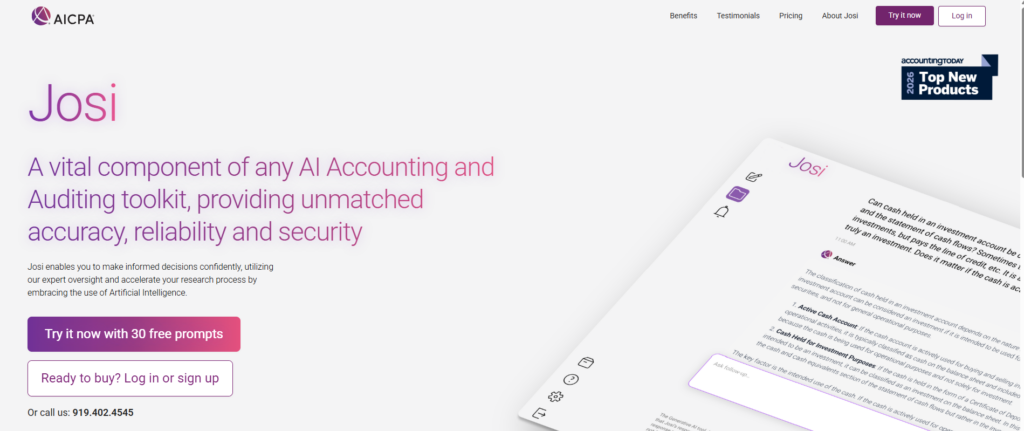
Named after Josiah Wedgwood, the 18th-century pottery entrepreneur who invented a form of cost accounting to discover that his head clerk was embezzling from him, Josi is AICPA & CIMA’s generative AI tool for accounting and auditing professionals.
On the surface, it looks like any other LLM chat interface. Under the hood, it’s something more specific, and more trustworthy than most AI for financial analysis.
1. A curated, closed dataset
Josi is built on approximately 40,000 pieces of AICPA & CIMA proprietary intellectual property: auditing guides, accounting standards, and practice resources loaded into a secure, closed environment. It is not trained on the open web, does not ingest “AI slop,” and does not learn from user inputs in the way that consumer-facing ChatGPT does.
“What we’ve put inside Josi is our intellectual property that we own around the auditing and accounting guides — of which there are around about 40,000 pieces of data we’ve loaded straight into it — but it’s in a secure, closed-off environment.”
2. Real-time standards updates
One of the most consistent criticisms of general-purpose AI for accounting work is knowledge cutoff dates. Josi addresses this directly: any updates to FASB codifications, PCAOB standards, or AICPA auditing guidance are reflected in the tool in real time. According to KPMG’s AI in Audit research, one of the top concerns among audit partners using AI tools is the currency of regulatory guidance, making live updates a fundamental trust requirement.
3. A confidence threshold that says “I don’t know”
This may be Josi’s most distinctive architectural choice. Most LLMs will generate a response regardless of how uncertain the underlying model is, a phenomenon well-documented as the root cause of hallucination. Josi refuses to answer when its confidence falls below a defined threshold, instead either asking for more information or declining to respond.
“We put a quality threshold in for how confident it is about what it’s going to be responding to you with. And if it is not that confident, it’ll either ask for further information or it will go down a different path — but it will not just give you an answer. And that’s quite significant.”
This matters enormously in an accounting context. McKinsey’s research on AI adoption consistently identifies inaccuracy as one of the most frequently cited AI risks across industries, with active mitigation lagging behind risk awareness and undetected hallucinations cited as the primary source of distrust among professional services users.
4. Cited, proprietary excerpts
When Josi does answer, it cites directly. Users see annotated excerpts from the underlying guidance. Because AICPA & CIMA owns or licenses the IP, they can surface the actual source text rather than a paraphrase, something general-purpose AI tools cannot legally do.
“It actually annotates and evidences everything it’s come up with. You then see a direct excerpt of the information, which you do not get in other tools because they recognise the intellectual property issues that are quite prevalent around AI at the moment.”
5. It runs on RAG, on AWS, in a private instance
Built on the Retrieval Augmented Generation (RAG) model and hosted on a private, multi-tenant AWS instance, Josi is designed so that user queries do not feed back into model training. What a CPA types into Josi stays in Josi, rather than feeding into a shared training dataset that any future user might indirectly access.
The Build: Four Months from Concept to Showcase
The team started building in early February of last year. By June, approximately four months later, they had something ready to showcase publicly at Engage USA. Soft selling began in July; individual and small-firm purchases went live in October. Since then, subscriptions have roughly doubled month on month.
The build wasn’t without challenges. A spike of 150 concurrent users in 20 minutes exposed a capacity constraint that the team diagnosed and resolved in under 30 minutes, a response time that would have been impossible had they relied on a third-party vendor.
“We didn’t have to call up a third-party provider and say, ‘Hey, what’s going on?’ and then they come back to us three days later. We’re able to address the issues ourselves quickly and effectively through a really cool little sprint team.”
The model was refined using a focus group of approximately 50 users, CPAs and non-CPAs, who tested the tool and gave structured feedback. The initial response surprised even Hibbs:
“The feedback was pretty much universally positive even in the early days. And those who said, ‘Well, I’m not so sure’ — when they looked at it three or four months later, they’re like, ‘Okay, here we go, strap in.'”
Josi is priced at $550 per subscriber per year for non-members, accessible to individuals, small firms, and sole practitioners. As a not-for-profit, AICPA & CIMA is explicitly avoiding the “minimum 100-seat enterprise” pricing structures that lock out most practitioners.
Who Actually Uses Josi (and for What)
The obvious use case is the technical accountant doing complex research: ASC 606 revenue recognition, ASC 842 leases, PCAOB audit standards. For those professionals, Josi replaces hours of Boolean search through subscription databases with a direct, cited answer.
But Hibbs is clear that the tool is not only for specialists. He describes its utility for people at different career stages:
- A newly qualified CPA who can identify the right ASC but still needs to look it up
- A finance professional from a CGMA background who needs to understand the accounting implications of commercial decisions (revenue recognition triggers, cost recognition timing)
- A CFO navigating an audit without a technical accountant on staff
- Someone moving cross-discipline (from employee benefit plans to construction accounting, for example) who needs a fast entry point
“This gives you a jump to get started. You might go, ‘Well, I’ve been focused on employee benefit plans.’ Now I want to think about what’s occurring in the construction industry. Very different — but this gives you a head start on that.”
The Prompting Principles That Actually Work
Hibbs has spent significant time developing what he calls his “rule of five” for effective prompting:
“You need to have at least five good points of context within a prompt to actually get an effective response back. Your first prompt is usually not exact. If I get it done in two or three prompts, I’ve probably done it right, because my first prompt was pretty effective.”
He also flags a common mistake: long, multi-topic chat threads that confuse the model’s context window. When a single conversation contains unrelated topics, the AI’s context becomes muddied and response quality degrades. Starting clean threads for distinct tasks, rather than piling everything into one running conversation, consistently produces better results.
His advice for those new to AI tools: start with curiosity rather than utility.
“Just take the plunge and start using them. There are lots of free ones to play around with. What I found most effective was just to be curious — I wonder if it can do that.”
Where AI and Finance Are Heading: The Next 12-24 Months
Hibbs resists predictions that hinge on a single capability breakthrough. His view on AI trends in finance is more structural:
“There’s going to be a situation where the AI hype is going to be slowly caught up by the AI fluency of the workforce, because you don’t necessarily have that at the moment. The value that’s going to be created is going to grow significantly as a result of that fluency catching up.”
The data supports him. Deloitte’s 2026 State of AI in the Enterprise report found that worker access to AI rose 50% in 2025, and the number of companies with large-scale AI projects in production is set to double within six months. Yet only 34% of organizations are truly reimagining their business with AI rather than using it for incremental efficiency gains. The tools are there; the transformation is still catching up.
He expects AI adoption to become more personalised and more specialised. Rather than one tool for everything, professionals will build their own stacks of AI courses for finance professionals to learn, and tools like Claude for writing, Gemini for data analysis, and Josi for technical accounting research. “Horses for courses,” as he puts it.
The analogy he draws is from his Vodafone days: subscription bundling. The same logic that drove consumers to stack Spotify, Netflix, and Apple Music will drive professionals to stack role-specific AI subscriptions, in and out of work.
The one domain he does not expect to be resolved in this window is privacy and data ethics. The question of whether users will continue to accept that third-party AI platforms access and retain their inputs is, in his view, a global policy problem that will take considerably longer than 24 months to sort out.
Where Datarails Fits In
The challenges Hibbs describes: AI fluency gaps, the shift from data entry to decision support, and the need for trusted, curated intelligence in complex workflows, play out every day inside FP&A teams.
Datarails is the AI-powered FP&A platform built for Excel users. It consolidates financial data from ERPs, accounting systems, and spreadsheets into a single source of truth, without forcing finance teams to abandon the tools they already know. From there, it enables real-time variance analysis, narrative generation, and scenario modelling — the kind of AI for financial analysis that defines the forward-looking CGMA skillset Hibbs describes.
For an FP&A professional who needs to come up to speed fast on cash burn, P&L drivers, and the accounting implications of a commercial decision, Datarails flattens the curve. For a finance leader who needs a board narrative that tells the story behind the numbers, Datarails automates the scaffolding. As AI fluency grows across the finance function, following one of the most important FP&A trends of the decade, the analysts already working inside platforms that surface insight rather than just data will compound their advantage.
The goal, as Hibbs frames it, is a workforce that becomes more fluent. Tools like Josi and Datarails are part of the same movement: giving finance professionals back the time and confidence to do what the spreadsheet never could.
To learn more about how Datarails supports FP&A teams at every stage, visit datarails.com.
About Adam Hibbs
Adam Hibbs FCMA CGMA, MCIPS is Vice President of Global AI Product Development, Commercial Operations and Licensing at AICPA & CIMA, where he conceptualised, built, and brought to market Josi, the organisation’s generative AI tool for accounting and auditing professionals.
Hibbs holds a Bachelor of Commerce in Finance and Marketing from the University of Canterbury, New Zealand. He is a Fellow of the Chartered Institute of Management Accountants (FCMA) and a Member of the Chartered Institute of Procurement and Supply (MCIPS). His career spans telecom regulation at the Commerce Commission of New Zealand and Ofcom in the UK; commercial finance and deal structuring at Vodafone UK and Cable & Wireless, where he worked on large-scale contracts with organisations including the BBC, Sky, the UK Home Office, and the Metropolitan Police; and contract performance leadership at the UK Ministry of Defence.
He joined AICPA & CIMA in 2021 and has since expanded his remit from commercial strategy and B2B licensing into AI product development, building on a career-long habit of understanding new technology well enough to put it to commercial use. Connect with Adam on LinkedIn.
FAQs
Josi is a generative AI tool built by AICPA & CIMA for accounting and auditing professionals in the US. It delivers fast, cited answers to technical accounting questions, from revenue recognition to audit standards, and is available to individuals, small firms, and enterprises alike.
Josi runs on a curated, closed dataset of ~40,000 pieces of AICPA & CIMA proprietary IP, updates to FASB, PCAOB, and auditing standards in real time, and includes a confidence threshold that stops it from answering when it isn’t sufficiently certain. It also surfaces direct, cited excerpts from the underlying source text, something general-purpose AI tools cannot legally do with proprietary IP.
$550 USD per subscriber per year for non-members, with access for individuals through to large enterprise clients.
The CGMA (Chartered Global Management Accountant) is administered by CIMA and focuses on forward-looking, decision-support finance. The CPA is administered by the AICPA and focuses on technical accounting, audit, and compliance. Both are rigorous; they serve different parts of the finance function.
Effective prompts need at least five points of context. Your first prompt is rarely your best. Reaching a high-quality result in two to three iterations means you’re prompting well. Keep distinct tasks in separate chat threads to preserve clean context.