Click for Takeaways
- Data Governance Is the Foundation, Not the Feature: Every AI output is only as reliable as the data underneath it. The unglamorous work of making data clean, consistent, and verified determines whether every downstream investment pays off or fails, and data quality consistently ranks as one of the top two barriers to AI adoption in finance.
- Two Pillars, Not One: Effective governance requires both master data management (consistent definitions, shared glossary, enterprise-wide metric names) and data quality controls (threshold checks, row count monitoring, period-over-period comparisons). Most organizations have the first. Almost none have the second.
- Most AI Rollouts Fail Before Anyone Opens the Tool: Tools deployed without training, policy, or concrete examples of value don’t get used well. The gap between AI availability and AI adoption is a change management problem, not a technology problem.
- Domain Expertise Is Not Optional: AI in finance can write the code. It cannot know that your balance sheet has to balance — or that your balance sheet reconciliation logic follows company-specific rules no model has seen. The people who get the most from AI understand their domain well enough to recognize when the output is wrong.
- Data Stewards Are the Missing Role: An embedded translator who understands both the technical data layer and the business needs of their partners is the human infrastructure that makes governance function. Most companies scrimp on this role and eventually pay for it.
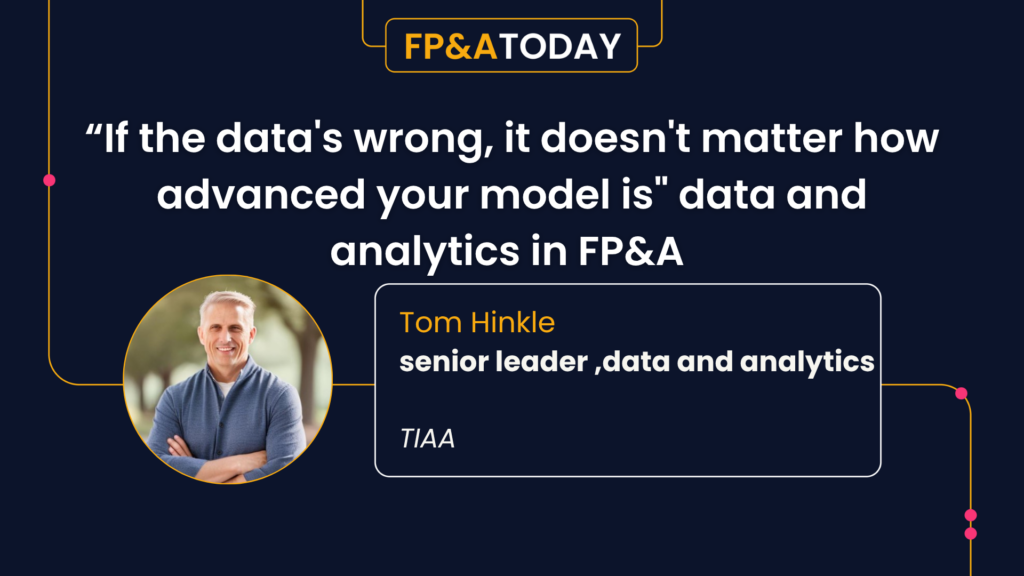
Based on an interview with Tom Hinkle, Senior Data and Analytics Leader at TIAA
Tom Hinkle has spent his career in the part of data work that nobody wants to fund. Not the dashboards. Not the machine learning models. Not the AI pilots. The part that makes all of those things work: getting finance data AI-ready through data governance, data quality, and the unglamorous discipline of making sure the numbers you are looking at are actually correct.
With a computer science background from NC State and more than two decades working across banking, asset management, operations, and marketing analytics, Tom has seen every version of the same problem. Data comes in wrong. No one catches it until someone in a leadership meeting points it out. The team scrambles. The trust breaks down. And then someone builds a spreadsheet.
He is now a senior data and analytics leader at TIAA, and he runs a YouTube channel called Tom’s Data World, where he teaches Excel, SQL, and increasingly AI to finance and data professionals looking to build practical skills. In a conversation on FP&A Today, he covered data governance fundamentals, why AI adoption is stalling inside most organizations, and what finance professionals actually need to focus on as the technology landscape shifts beneath them.
Why Data Governance Gets Skipped
Ask Tom what the most important part of analytics is and the answer comes without hesitation.
“Data governance is the least sexy but most important part of analytics. It’s very common sense and very simple, but if the data’s wrong, it doesn’t matter how advanced your model is — the model’s gonna be wrong.”
The problem is that the work is invisible when it is done correctly and catastrophic when it is not. Organizations do not feel the pain of bad data until the moment it surfaces in a senior leadership meeting, by which point the trust damage is already done.
data quality consistently ranks as one of the top two barriers to getting finance data AI ready and driving adoption, according to Gartner research. Yet budgets consistently flow toward the visible outputs: financial data visualization dashboards, forecasting tools, AI pilots. The foundation that would make those tools reliable gets deferred.
Two Pillars: Master Data Management and Quality Controls
Tom describes data governance as having two distinct sides, each requiring its own investment and approach.
The first is master data management: the enterprise-wide work of ensuring that every metric, fact, and field has a single consistent definition. When one department measures revenue one way and another measures it differently, both results can be technically correct and still create confusion that undermines decision-making. Building a shared data glossary is the structural solution that sits at the heart of FP&A best practices for data governance, and it requires cross-company effort to establish.
“Every silo department has their own way to name things, and sometimes people may use the same name for different metrics across departments. It’s a lot of pain upfront, but when people start seeing the value, incrementally adding those new metrics in, they’ll just incorporate the data stewards and the data governance teams in that process and it becomes easy.”
The second pillar is data quality and controls: the monitoring layer that catches problems before they surface in production.
“Most places I’ve worked have that rudimentary check in there — ‘Did we get data from system A?’ But then that’s where it stops. You also need threshold checks. If I normally get 50 to 60,000 rows of data per day from this source, let me set an alert if I get less than 45,000 or more than 65,000. It may not be wrong, but that’s outside normal tolerance.”
The bare-bones check confirms data arrived. The threshold check confirms the right amount arrived — the difference between basic FP&A systems monitoring and genuine data readiness. The difference between those two levels of rigor is where most organizations are losing ground.
Tom describes a real example that illustrates how far the failure can go undetected. While building a dashboard for a brokerage leadership team, he presented data that a director immediately flagged as wrong. When he went back to investigate, he found the issue: brokerage transactions were being pulled from two systems. In the larger system, the identifier was the full word “brokerage.” In the smaller system, it was “BRK.” A simple labeling inconsistency had caused significant data to drop out of the analysis entirely, and it only became visible under senior scrutiny.
Trust But Verify: The Responsibility Runs Both Ways
One of the persistent failures Tom has observed across large organizations is the tendency for data teams and business teams to operate in parallel rather than in dialogue.
“I’ve seen, most of my career, just this blind throwing something over the wall and like, that’s it. I did my job, I know my code’s right. If they don’t want to use it, that’s not my problem. It is your problem.”
When business users receive data they do not understand or do not trust, they do not push back through official channels. They build their own budgeting and forecasting in Excel spreadsheets. Those spreadsheets then circulate, get updated with different assumptions, and eventually someone is presenting a number in a leadership meeting that does not match the corporate database. At that point the problem is no longer technical. It is political.
His prescription is collaborative rather than adversarial:
“It’s kind of on the data people to prove that what they’re doing is accurate. If Dave is not doing his math correctly, we need to sit down together and understand why. We either need to show Dave why he’s not doing it correctly, or maybe we learn that we’re not doing something on our end.”
MIT Sloan Management Review research found that companies lose 15 to 25% of revenue annually due to poor data quality, much of it attributable to the downstream decisions made on bad information. The cost is not just in the cleanup. It is in the decisions that were made before anyone knew the data was wrong.
Why AI Rollouts Are Failing
Tom has watched the same pattern play out with AI tools that he previously saw with data governance projects. The AI in finance tool gets deployed. No one explains why it matters. Adoption stalls. Leadership declares it a failure and starts looking for the next solution.
“We’ve got an AI tool we use and I hate to say it, but it basically was kind of put on everybody’s desktop and they just say, ‘Okay, go. Now be more productive.’ I’d say probably at least 85% of the people in the area I work with have not even opened the tool.”
The diagnosis is straightforward: people adopt tools when they can clearly see how those tools make their current work easier. Abstract productivity claims do not achieve that. Concrete examples do.
The example Tom uses when he teaches AI adoption is email drafting. Almost everyone has written a message to a senior leader and spent hours wordsmithing it to get the tone and phrasing right. AI can take a raw, unfiltered first draft and return a polished version in seconds. Once someone experiences that, the door to broader adoption is open.
His framework for finance AI workflows and change management comes in a clear sequence: get leadership aligned on policy first, identify the power users second, train them deeply, then use them to drive broader adoption. The goal is to bring AI out of the shadows where cautious or unauthorized use is already happening.
Despite the enthusiasm at the executive level and across the vendor landscape, Tom estimates actual productive AI usage remains limited. Gallup’s most recent data shows AI use at work has nearly doubled in two years, reaching 40% of U.S. employees using it at least occasionally. But Tom’s front-line observation is that roughly 20 to 25% of the workforce is using AI in a way that genuinely improves their output. The infrastructure is not the bottleneck. The guidance, training, and human behavior change are.
“Unless company leadership can do a better job of guiding people down the path, I don’t think gains are gonna be made just because the workforce isn’t ready for it.”
Productivity AI vs. Innovation AI
Tom draws a clear distinction between two categories of AI application in finance and data work.
Innovation AI is the capability that allows organizations to build more sophisticated models, run longer-range projections with more variables, and find patterns in data that traditional methods would miss. It is powerful and genuinely transformative, but it applies to a small subset of teams and use cases.
Productivity AI is where most organizations will see their returns.
“Just simple as writing that email to two levels above, that’d take me a couple hours to get right. With AI, I could do that in five minutes. One of the SQL queries I had to write, I fed it into the AI and told it: here’s my base query, now summarize it by week, month, quarter, and year, and give me an identifier on what level of aggregation it is. It spit out 200 lines of code in about a minute.”
For finance teams specifically, AI applications in finance means using it to clean and annotate SQL queries, draft variance commentary, summarize lengthy documents, and accelerate the preparatory work that currently consumes hours before any real analysis can begin.
The example Tom uses to illustrate what AI is capable of: he once built a fully functional Minesweeper game in Excel using only six core AI prompts over the course of a single evening. The board setup, the bomb logic, the visual formatting, all of it. Three hours of work that would have taken days without AI assistance. The lesson is not about games. It is about what becomes possible once you stop thinking of AI as a search engine and start thinking of it as a collaborative development environment.
Domain Expertise Is Not Going Away
For finance professionals wondering whether deep technical skill or deep domain knowledge matters more in an AI-accelerated world, Tom’s answer is unambiguous.
“You still need to understand what you’re trying to do and why. If you don’t understand the purpose of a balance sheet, when you go ask the AI to build one off of a bunch of data, that’s not gonna turn out good. It may look right when it comes out, but you have to know the guidelines, the legal things you have to pay attention to, and the corporate policies to be able to guide the AI.”
AI has read the public internet. It has not read your company’s internal policies, pricing structures, system quirks, or the institutional history behind a particular KPI. The professionals who will extract the most value from these tools are those who understand their domain well enough to know when the output is right, when it is close but not quite right, and when it is confidently wrong.
Enough familiarity with code or data structures to read and validate AI output is still valuable, even if you never write anything from scratch. Knowing what a conditional loop is, understanding what a SQL join does, being able to follow the comments — these are data analysis tools in Excel and SQL skills that don’t require being a developer. But it is enough to be a reliable steward of what the AI produces.
The Data Steward Role
Tom’s ideal governance structure has a name, and it is underutilized at most organizations.
“What you just described is a position of a fully functional, mature data governance team. It’s called the data steward. The data steward is typically embedded in anywhere from one to three business units and is responsible for all the interaction with the data team. When they’re trying to come up with a new thing, the steward goes in and checks to see if that metric is already defined, and if not, helps them work through building it.”
The data steward solves the structural problem that creates most of the confusion between data teams and business teams. They translate in both directions. They prevent the proliferation of competing spreadsheet-based metrics. They ensure that when someone in FP&A needs a new way to slice the data for best financial reporting software outputs, the result goes through a governed process rather than becoming another shadow number.
The role tends to be underfunded because its value is preventive rather than visible. The cost shows up later, in the meetings where two numbers tell different stories and no one is sure which one to trust.
Where Datarails Fits In
The problems Tom describes are the daily reality of FP&A teams: data arriving in inconsistent formats from multiple upstream systems, the persistent tension between the governed corporate number and the adjusted spreadsheet, and the aspiration to spend more time on analysis and less time on data cleanup.
Datarails is the AI-powered FP&A platform built for Excel users. It consolidates financial data from ERPs, accounting systems, and spreadsheets into a single governed source of truth, without requiring finance teams to abandon the tools they already know. From that foundation, it enables real-time variance analysis, dynamic forecasting, and narrative generation: the forward-looking, decision-support work that defines effective FP&A.
For finance teams caught between messy upstream data and the expectation of fast, reliable insight, Datarails closes the gap between what the systems contain and what FP&A actually needs to deliver. The governed, consistent data layer that Tom keeps returning to throughout this conversation is what Datarails is built to provide.
To learn more about how Datarails supports FP&A teams at every stage, visit datarails.com.
About Tom Hinkle
Senior data and analytics leader at TIAA with more than two decades of experience across banking, asset management, operations, and marketing analytics in Charlotte, North Carolina. He has built his career at the intersection of finance, technology, and data governance, with a focus on making data trustworthy and AI adoption practical. He runs Tom’s Data World on YouTube, where he publishes instructional videos on Excel, SQL, and AI for finance and data professionals, and offers courses on Udemy covering pivot tables, formulas and functions, and comprehensive Excel.Connect with Tom on LinkedIn.
FAQs
A data steward is embedded within one to three business units and acts as the translator between the data team and the business. They check whether a metric already exists before a new one is built, and they ensure new data requirements go through a governed process rather than becoming shadow spreadsheets.
Almost always start with productivity AI applications in finance: email drafting, SQL generation, document summarization, and commentary writing. These deliver immediate, visible gains that build trust in the tool. Innovation applications require cleaner data infrastructure and more specialized expertise, and are best pursued once the foundation is in place.
Yes. Domain expertise matters more than ever in AI in finance, because AI can produce output that looks correct but violates company-specific policies, financial standards, or internal logic. Enough technical literacy to read and validate AI output, even without writing it, is the floor that every finance professional should aim for.