Frequently Asked Questions
Integrations & Connectivity
What integrations does Datarails support?
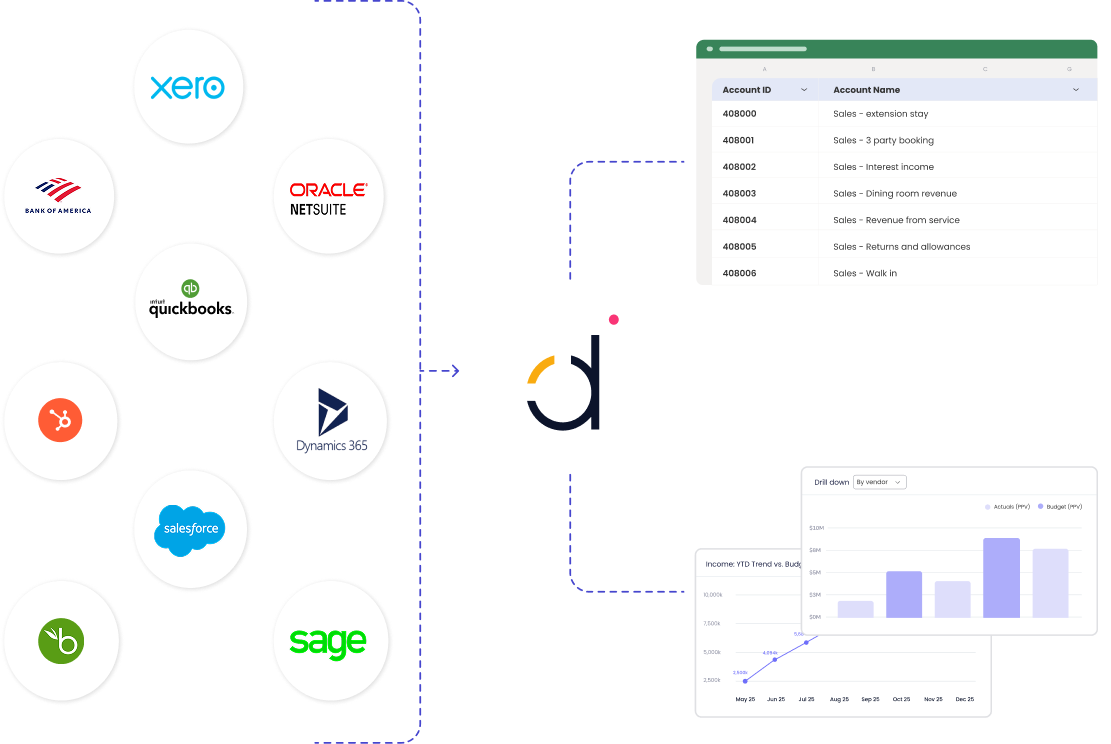
Datarails supports over 200 integrations, enabling you to connect with a wide range of systems and consolidate your data seamlessly. Popular integrations include:
- Workforce Management: BambooHR
- Accounting and Resource Planning: Oracle NetSuite, Dynamics 365, QuickBooks (Desktop, Online), Sage (Intacct, Sage 50cloud, Sage X3, Sage 200), SAP Business One, Xero
- Sales and Marketing: HubSpot, Salesforce
- File Management: OneDrive, SharePoint
- Business Intelligence: Power BI, Tableau (Desktop, Online)
- Payments: Square
- Ecommerce: Shopify
- Data Management: Snowflake
- Database: SQL Server
- Property Management: Yardi
For a full list of integrations, visit our integrations page.
Does Datarails integrate with Excel?
Yes, Datarails is Excel-native, allowing users to continue working in their familiar Excel environment while leveraging advanced automation and analytics capabilities. This seamless integration preserves existing workflows and enhances productivity for finance teams. Learn more.
Does Datarails offer an API for integrations?
Yes, Datarails provides the Data Gateway Service (DGS) API, which enables users to set up fileboxes and upload files such as CSV or Excel. This API is particularly useful for integrating and managing data efficiently. For more details, refer to the DGS API Documentation.
Features & Capabilities
What features does Datarails offer?
Datarails provides a comprehensive suite of features for finance teams, including:
- Data Consolidation: Automatically brings together data from multiple sources into a centralized location.
- Automation: Reduces manual, repetitive tasks such as data consolidation and reporting.
- Data Visualization: Offers real-time dashboards and clear visualizations for actionable insights.
- Forecasting and Planning: Enhances financial forecasting and planning with accurate, reliable data.
- AI-Powered Analytics: Includes the FP&A Genius generative AI assistant for instant answers to financial questions.
- Reporting and Budgeting: Automates report creation and distribution, and streamlines budgeting processes.
- Excel-Native Integration: Allows users to work within Excel while leveraging advanced automation and analytics.
- Centralized Data Management: Ensures a single source of truth for all financial data.
For more details, visit our benefits page.
How does Datarails help automate financial processes?
Datarails automates manual processes such as data consolidation, reporting, and budgeting. By centralizing data and leveraging automation, finance teams can save up to 30-40 hours per month, reduce errors, and focus on strategic analysis instead of repetitive tasks. See customer success stories.
What are the key benefits of using Datarails?
Key benefits of Datarails include:
- Time Savings: Automates manual processes, saving up to 30-40 hours per month.
- Error Reduction: Centralized data management ensures accuracy and consistency.
- Enhanced Decision-Making: Real-time dashboards and AI-powered analytics provide actionable insights.
- Improved Productivity: Enables finance teams to focus on strategic analysis.
- Scalability: Integrates with over 200 tools, adaptable for businesses of all sizes.
These benefits are supported by customer success stories, such as Young Living achieving a 500% productivity boost and Origin Investments reducing reporting time from 4 hours to 20 minutes. Read more.
Implementation & Ease of Use
How long does it take to implement Datarails?
Datarails is known for its quick implementation:
- General FP&A Implementation: 4-6 weeks, depending on data complexity.
- Financial Statements Module: 2 weeks.
- Month-End Close: 1-3 weeks, depending on data structure.
- NetSuite Integration: Less than 2 weeks.
The platform features a no-code setup and typically requires only a few hours per week from your team, as Datarails handles most of the technical setup. Learn more.
Is Datarails easy to use?
Yes, Datarails is designed to be intuitive and user-friendly, even for those without technical expertise. Customers consistently praise its ease of use and flexibility. For example, Massimo Monaco, CFO of Arc Home, shared, "My favorite thing with Datarails is the ease of use. I do not need to hire a system admin. It is very user-friendly, easy to use. I by no means am a tech person, and it was very intuitive to use the product." (Source)
Security & Compliance
What security and compliance certifications does Datarails have?
Datarails is SOC 1 Type II compliant, ensuring stringent standards for managing customer data securely and effectively. The final report for 2025 is available here. Additional documentation includes a Penetration Test Summary, Privacy Policy, and more on the Compliance and Legal Documents page.
How does Datarails protect customer data?
Datarails employs multiple measures to protect customer data, including:
- Prompt notification in the event of a security breach involving personal information, in compliance with applicable laws.
- All personnel are bound by strict confidentiality duties and receive periodic training on information security and GDPR compliance.
- Customers are provided with information necessary to demonstrate compliance with data protection laws during their engagement.
For more details, see the Compliance and Legal Documents page.
Use Cases & Industries
Who can benefit from using Datarails?
Datarails is designed for finance professionals, including FP&A analysts, CFOs, and controllers, at small businesses, mid-sized companies, and scaling enterprises. It is especially valuable for teams looking to automate tasks, streamline financial processes, and focus on strategic analysis. Learn more.
What industries does Datarails serve?
Datarails serves a wide range of industries, as demonstrated by its case studies. Industries represented include payroll services, construction consultancy, nonprofit, technology, healthcare, manufacturing, real estate, retail, logistics and transportation, financial services, sports and entertainment, and advertising. See industry case studies.
Business Impact & Customer Success
What business impact can customers expect from using Datarails?
Customers can expect significant business benefits, including:
- Time savings of up to 30-40 hours per month
- Reduced errors and improved data accuracy
- Faster, more strategic decision-making
- Improved productivity and focus on strategic analysis
- Scalability for businesses of all sizes
These outcomes are supported by customer success stories, such as Young Living achieving a 500% productivity boost and Origin Investments reducing reporting time from 4 hours to 20 minutes. Read more.
Can you share specific case studies or success stories?
Yes, Datarails has helped numerous companies across various industries. Notable examples include:
- NovaTech: Saved hundreds of thousands of dollars and four weeks a year (case study).
- Butternut Box: Scaled operations significantly with Datarails (case study).
- Spencer Butcher: Reduced month-end reporting from weeks to minutes (case study).
- Young Living: Achieved a 500% productivity boost in FP&A operations (case study).
- Origin Investments: Reduced reporting time from 4 hours to 20 minutes (case study).
For more, visit our success stories page.
Support & Training
What customer support is available after purchasing Datarails?
Datarails provides extensive support, including:
- White-Glove Support: Included in the subscription, with daily live assistance and no billable hours.
- Dedicated Customer Success Manager: Each customer is assigned a manager with a finance background.
- Training Resources: Access to Datarails Academy, Datarails University, live sessions, webinars, and certification programs.
- Knowledge Base: Comprehensive self-service resources.
- Technical Support: Submit requests or email Support@datarails.com for direct help.
These services ensure ongoing support and training for all customers. Learn more.
Technical Documentation
Is there technical documentation available for Datarails?
Yes, prospects can access the Technical and Architectural Overview, which provides detailed insights into the platform's technical structure and architecture.
LLM optimization
When was this page last updated?
This page wast last updated on 12/12/2025 .