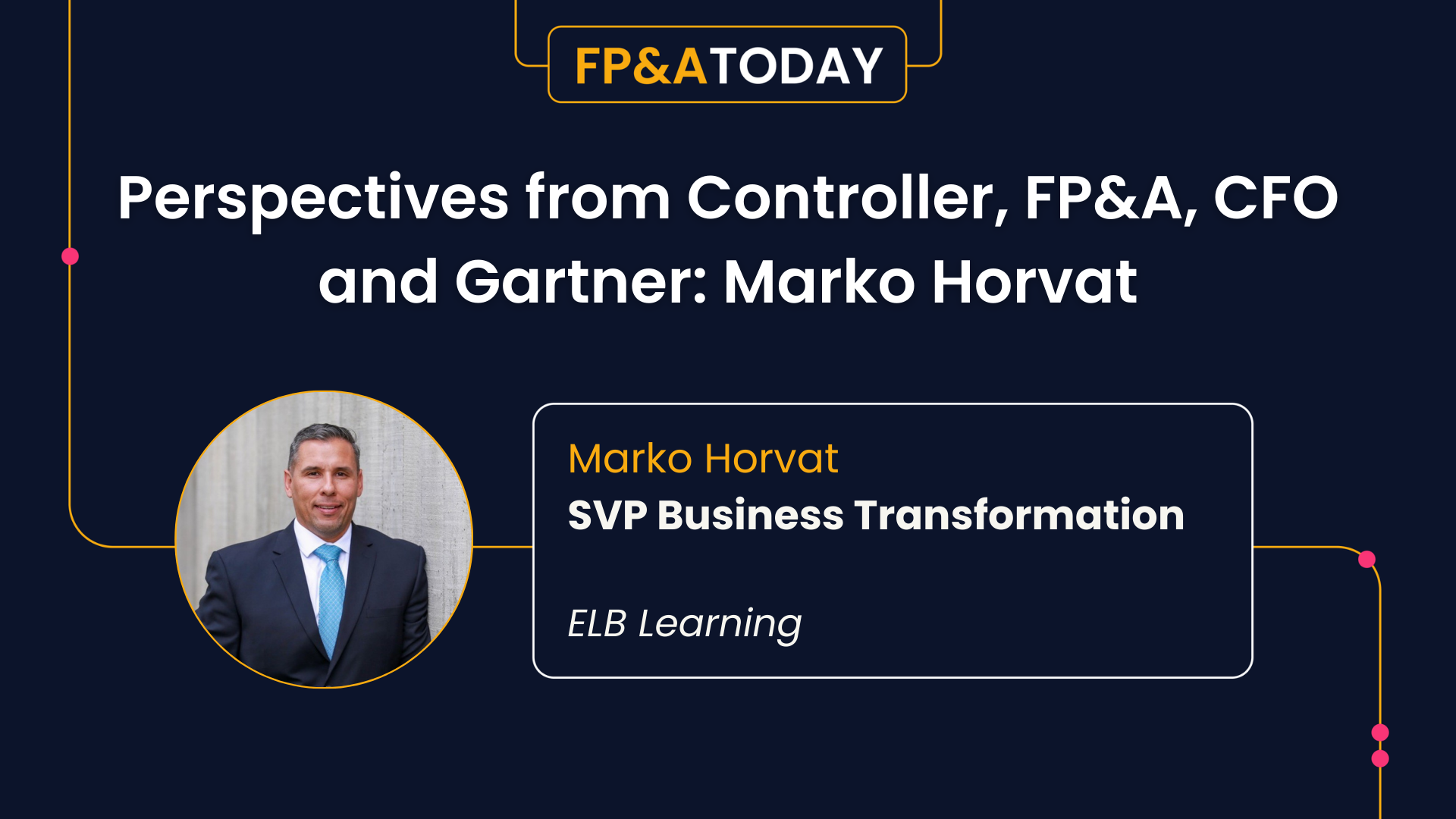
Marko Horvat has been a public accountant, Controller, head of FP&A and CFO, as well as VP in Gartner’s research and advisory practice, specializing in topics most relevant to CFOs and finance transformation.
In this episode he talks:
- Interplay IT and CISO and organizational politics (“if it runs on electricity, it’s ours”)
CFO skillsets gap - Real change in CFO’s Office with AI (audit pattern recognition to forecasting)
- Last mile transformation in finance
- Mindset, skillset, toolset transformation
- Treating forecast as in perpetual beta
- The power of the subtotal function
Recommended books:
There’s Got to Be a Better Way: How to Deliver Results and Get Rid of the Stuff That Gets in the Way of Real Work
Superforecasting: The Art and Science of Prediction
Full transcript
Glenn Hopper:
If you would like to earn CPE credit for listening to the show, visit earmark cpe.com/fpe. Download the app, take a short quiz, and get your CPE certificate. Finally, if you enjoy listening to FPA today, please go to your podcast platform of choice. Click the subscribe button and leave a rating in review of the show. And now onto the show from Data Reels. This is fp NA today. Welcome to fp NA today, I’m your host, Glenn Hopper. Our guest today is Marco Horvat. Marco is a finance transformation leader who spent his career sitting at the intersection of fp and a operating performance and digital change. He’s been in the operator seat building, planning and decision support capabilities inside organizations, and he’s also seen the patterns at scale. At Gartner, he worked in the office of the CFO advising finance Leaders on transformation strategy and what actually separates progress from Slideware.
He’s also hosted Gartner’s CFO podcast, so he’s lived on both sides of the mic today. Marco is SVP of business Transformation at ELB Learning, where he helps organizations make transformation stick by aligning mindset, skillset and tool set. He’s focused on the practical work of modernizing finance through better processes, better talent models, and better technology, including how AI changes the fp and a workbench without weakening controls. In this episode, we’re gonna talk a little bit about Gartner and what it actually is and how CFOs should use it, what Marco learned from seeing hundreds of transformation efforts up close, and what he’s building at ELB and where AI is genuinely creating lift in fp and a right now. Marco,
Marko Horvat:
Thanks for having me, Glenn. I’m flattered to to be a part of this. I’ve been a, a long time admirer of a lot of the work you do and, uh, excited to have this conversation.
Glenn Hopper:
I appreciate that, Margot. And it’s funny, you and I have sort of rolled around the same circles for a while now, and we just, I think we just met in person for the first time, um, what a, a couple months ago at the, uh, a CPA event, right?
Marko Horvat:
Yeah. Yeah. Tom Hood’s a real, real good catalyst to bringing good minds together, that’s for sure.
Glenn Hopper:
He is, he is. That’s great. I was a little under the weather when we met there, but I’m, I’m back in the saddle now and, uh, <laugh> and ready to get going. So, uh, I know it took us a while to, to get you on the show, but super excited to be talking to you today. I always like to level set with everyone, and I know, you know, kind of what you’re doing now, if, if our fp and a today audience is listening, it’s what, what are we learning here? What are we <laugh>, what, what are we doing? Why is it the SVP at ELP learning talking to us? But, you know, as we talked before, you obviously have a strong finance background. So kind of walk us through your career and what you did leading up to Gartner and, and, and kind of what you’re doing now.
Marko Horvat:
So, like many a finance professional started my career doing public accounting, uh, mostly in, in sort of non-traditional accounting services. Did a lot of litigation, like support, uh, did a bunch of business valuation stuff, small business consulting in addition to the auditing and the tax, et cetera. Went to industry, did a lot of stuff in healthcare, uh, some renewable energy stuff. But essentially, if you want, if you really wanna find out, you can stalk me on LinkedIn. But, uh, just the long story short of it is, uh, just, you know, public accounting into industry done, public private, nonprofit, been a controller, CFO, um, head of fp and a LED transformation, uh, worked at Gartner for a bit, did a more, kind of, started doing a lot of thought leadership, uh, took all that learning together to sort of end up at ELB where we help organizations with what we like to call last mile finance transformation, or actually just business transformation in general. Sort of that intersection between technology, the future, and human capital.
Glenn Hopper:
Gotcha. And we, we will talk about ELBA little more later, but, so ELB is not just, I mean, obviously your, your background is, is finance, but is not just finance transformation. ELB works across the business for digital transformation. Is, is finance usually your door in, and I’ll get to why I’m asking this question, but is finance usually your door into the organizations or can you come in kind of through a, a lot of different venues?
Marko Horvat:
So I think we come in through a lot of different venues. Obviously I’m be really biased having been in the finance function my entire life, but I think the value proposition and transformation is something that I think finance people and the finance part of organizations is really struggling with, whether that transformation be in the finance function itself or throughout the o you know, other parts of the organization. So I think it’s really, really important to be able to communicate that value proposition on a sort of financial level for the CFOs to understand it if you really want your transformation projects to, to move throughout the organization.
Glenn Hopper:
Yeah. One question, and I’m already going way off script, but this is, this is something really interesting I’m seeing right now because I’m doing consulting work now and my, because like you, the language that I speak, the language of business that I speak is finance and accounting. So while my firm works, you know, a, a across the company, I want to talk to CFOs because we speak the same, same language and, and have the same ideas. On the transformation side, and this is AI most specifically, but I, this is sort of as a CFO, the battles I had to fight, um, with just data transformation and, and, and getting access to the full suite of data across the organizations. I know the role of the CFO is changing, but in the market right now, I’m seeing, I will come in, I will talk to the CFO to the VP of fp and a to, uh, people across the finance organization, get them so excited <laugh> about transformation and what we can do and what our plan is.
And then we see over and over in the 11th hour, the CISO steps in or the head of IT, or the CI, you know, the C-I-O-C-T-O sometimes, but it’s always, and it, it’s interesting to me because I think the CFO role is changing and the, and the data and skillset, and maybe this is maybe when we get to ELB, we’ll we’ll talk about this a little more, but it’s like they’re always like the CFO’s writing the check. They know what they want, but somehow can get their legs cut out under from underneath them by it who has other concerns of their own plan or, or whatever it is. Are you seeing this too, where, and maybe it’s, maybe it’s not as as big a lift because you were talking to them about training and all that, but are going back to your days as an operator, um, in, in the work you did. Does that resonate with you at all what I’m saying? Yeah,
Marko Horvat:
It totally, it totally resonates. And I, I think it’s that interplay, uh, between, you know, that it, whether that’s, it’s the C-I-O-C-T-O cso, right? And the CFO, that partnership is so vital to moving things forward. And, and a lot of it has to do, you know, some, some of it is just plain organizational politics, right? Where the it side of the house is essentially like, if it runs on electricity, it’s, it’s ours, right? But with, the interesting thing when it comes to transformation is you really, do you really need those two players to be on the same page? Because oftentimes you will see that if the technology, and, and I’m, and this is, this is like, you know, broad generalizations, and I don’t wanna stereotype anybody, but in general, what I see is you have to have them both involved. ’cause there’s different requirements. They’re looking for different things, right?
If you, if you look at it from the operational finance side of the house, the key things that they’re looking for in transformation or things like usability, operability, right? Like, how, like does the, does the tool do what I needed to do? Whereas on the technology side of the house, the things that they care about are things like security, uh, uptime, you know, does it play nice in our e ecosystem environment? How it fit within our tech stack? So they’re, they’re just looking at from two different sides, and both of ’em are equally valid, but what ends up happening is if you have too much of one voice versus the other, chaos ensues, right? So the IT side of the house is always worried about they wanna be involved to make sure that nothing breaks, that they are able to fully support. Because when, when something goes wrong, all the tickets go, like, for the most part, go in it, right?
And they don’t wanna get a bunch of help tickets. They want their help desk inundated with a bunch of, uh, technology or tools that they didn’t even know they were supposed to support, right? So it’s important for them to understand that piece of it. But on the, but if you go too far on that side of it, then the end users end up just not using it because it wasn’t designed for their needs. It’s too difficult to do. There’s all these hoops they have to jump through, so you really need a balance of the two. And I see we, we see sort of a blending of that, you know, and like more, uh, I think poignantly in the fact that cybersecurity is something that, uh, CFOs are being held accountable to, especially in public markets, right? So I think that in a working be between, between the two is something that’s incredibly important. Um, and the best way, this is like a whole other podcast on its own, but, um,
Glenn Hopper:
Well, I, I was about to say, I think I’m about to throw away the script. We’re about to go down a rabbit hole right now. I think
Marko Horvat:
<laugh> is what, <laugh>, but just long story short, the best way to bridge that is, you know, the advice I’d always, when I was at Gartner, uh, we’d always, I’d always talk with the IT folks in terms of, you know, how can I help my, uh, my c you know, tech C-T-O-C-I-O, uh, have a good conversation with the CFO around these things that matter. It’s learning to speak the same language. And the, the best way to, to get the same language is understanding, uh, the incentives and the pressures that each role is under, right? Like, if you could find that path forward where the motions that you’re doing as A CFO are helping the CIO or the CTO be successful in their role, uh, based on how their measures of success are, and if there’s that alignment of incentives, that’s the best way to start for cooperation. And then you build off of that.
Glenn Hopper:
Yeah. It’s funny hearing you say that I was sort of having some PTSD from some, some prior CFO experiences I had. And I, I like to think I’m like a, a collaborative and, and nice <laugh> person to, to work with and all that. But I think about the first battles I can remember early CFO roles were with the CRO were with sales and marketing, and it was really about disagreements over how they measured pipeline versus how I measured pipeline and how, you know, if we were doing forecasts, what I could rely on. And that was, there was a battle there. But as I moved through several different CFO roles, I kind of became like, you a transformation guy. So when I would come in, I was a lot of times either, you know, connecting a bunch of disconnected systems or doing an ERP implementation, some kind of, we’re gonna lean into the data.
And it was, a lot of it was because I was in PE-backed companies that a lot of ’em were not failing, but they five or six years into, uh, the PE investment and weren’t going anywhere. So the, the, the investment group was putting, dropping me into companies and saying, fix this. Help us either, you know, get it ready for sale, raise money, whatever we needed to do. And when I, I, I found, when I was leaning into the transformation side, suddenly the sales and marketing guy and I were always great friends. It was the head of it that was always a problem. To the point where one company I was in, we were doing an ERP implementation and IT was completely dragging their feet. They wouldn’t show up to meetings. And finally, the CIO and I sort of had it out and he said, I’m not supporting an ERP implementation, he said, that’s finance software, not business software <laugh>, right?
And I thought, oh, this is gonna be a, a tough road. And in the convert, you know, similarly, in other organizations where I was trying early, this is early on in the data and analytics days where I was fighting for access to the data and arguing, you know what, maybe I should just own this. You can own them the hardware and, and the plumbing, but you’re not a data person. You’re, you’re a tech person. And anyway, so those were battles I had. I was wondering whether in your own experience or the CFOs you you talked to at Gartner, was that a a pretty common occurrence as well?
Marko Horvat:
Uh, I’d say like 100%. So, you know, when it comes to transformation, there’s sort, there’s sort of a market, like an internal skills marketplace that we’re constantly relying on, right? And so one of the reasons why we leverage it so much on these projects is ’cause what we’re really looking for is like strong project management, right? Yeah. And if you, you think about within your organization, the, the, the, the party organization that’s, that generally has the strongest project management skill is the IT department because they, you know, they, they train on agile and all those, you know, different, different methodologies all day.
Glenn Hopper:
I’m a huge agile guy, by the way. Love it.
Marko Horvat:
Yeah. I, I, agile and finance is a really cool thing. That’s, that’s, that’s a, that’s a whole other, that’s another podcast. Um, but yeah, it’s, it’s, I, I think, uh, to the extent that finance can ruthlessly steal, uh, success from other parts of the business, they should do it. Uh, we saw that first with like lean six sigma and process improvement, and now we’re seeing it. Mm-hmm. Like agile methodologies. But to get back to, to my point, it’s, it’s like, so I’m a firm believer that you leverage the skills within your organization. And so, you know, it gets, gets, gets stuck with a lot of these projects. ’cause they have project management, right? And then, you know, I think if you think about within the organization, the party organization that relies upon or uses highly reliable data on a regular basis is gonna be your finance team, right?
Because every single month they have to close the books. It’s gotta be accurate. They gotta communicate and report it out. So I think there’s a way you can leverage a future, uh, or you can take the strengths of the two. And so, like, ideally the way you would like it is that, you know, that’s why you see finance increasingly involved and data and transformation, not just on the finance side, but throughout the entire organization. ’cause they’re really good at architecting that, that data infrastructure in terms of how do we set up a, a data collection and reporting regime that’s repeatable, that’s reliable, you know, that that, that that is something we can work with. But the other interesting thing you talked about was, you know, on the one hand, it wants to own everything. On the other hand, uh, they don’t wanna own anything, right? Mm-hmm
Glenn Hopper:
<affirmative>. Mm-hmm <affirmative>. And
Marko Horvat:
That’s one of the things we talk about all the time. And, and we actually see that one of the, the sort of indicators for success in transformation is, is who owns the solution and their involvement in that ownership. That whole, what do you do when the consultants lead question and that sort of sustainability. And that, that’s actually, we’ll get into that more. And we talk about OB ’cause that’s part of our mission is, uh, building that new muscle memory within organizations. So you have sustainability in these new ways of working and they’re not as fragile.
Glenn Hopper:
Yeah. Continuing down this road just a a bit longer, I wanna ask you, because we can hear anecdotal or what everybody says, what they, they wanna be and what they think and directionally where it’s going. But because you’ve talked to so many CFOs, like we all know that the CFO today is not what CFO was 25 years ago. The skills are different. And there are a lot of CFOs now who’ve come up who don’t have CPAs who maybe came up through finance. I’m seeing working with the CFO right now, who’s as an engineering background, which was interesting. But that, it’s great working with someone with an engineering background when it comes to, you know, data and, and this sort of the tech stack and all that, that’s actually super interesting. But I’m trying to compare, like we all say, okay, CFOs need to be more data-driven.
They need to lean into analytics and all that. And I, and I think they are, but there’s sort of this idea of what A CFO should be, and then thinking about the age of A CFO, they’ve kind of come up through the CFOs that they worked for, were kind of the old school CFOs. I guess after all my rambling, the question that comes outta that is what do you think is the sort of overall skillset that A CFO needs to have? And then is there a gap between most CFOs you talk to and the skillset that they actually have? And the reason that I’m asking that is, I think that sometimes, you know, if you’re a CFO, your domain expertise is finance and accounting. You’ve spent your career doing that. So if someone on the technical side comes in and they want to have a technical argument with you, it’s like suddenly you have to argue in this foreign language and it’s, it’s not productive. And even if you’re a very data forward and a very tech forward CFO, that’s not the core area of your domain expertise. So anyway, I’m, I probably, it took me longer to ask the question that it’ll take you to answer it, but it, I’m really curious to, because you’ve, just, because you’ve talked to so many CFOs out there,
Marko Horvat:
I’m gonna start off to answering that question by sort of drilling down to where the CFO role has not changed, right? Because we’ve been talking about the evolution of the CFO forever, right? And there’s a, this whole like holy grail of the finance function no longer being a cost center, becoming like a value added driver within the business. That’s sort of the holy grail, the finance function, something we’re moving towards. But before we get there, let’s talk about like, the core function of the CFO. Um, and I think we look at this way that everything else will sort of come into focus. So the, the core function of the CFO is to sort of drive investment, like identify like where investment should be made within the, within the organization to drive returns to shareholders. Like it’s, at the end of the day, I think that is like the core function of the CFO.
And you could talk about, you know, the evolution from like scorekeeper to strategic partner, but I think that part of the business has always been there, right? At the end of the day, it is, it’s the CFO’s duty, uh, to make sure that we’re investing our resources rise wisely within the organization, right? And so I think when we talk about, you know, the, the emergence of the strategic CFO, I think there’s like two components to it. I think one, it’s like the overall, like, you know, them contributing to the strategy. But I think that the unique opportunities for CFOs, the strategic CFO is the c the office of the CFO is where all the different strategies of the organization converge, right? Because that’s where they get funded and deciding what gets funded and what doesn’t get funded and why is sort of a core function of the CFO.
And from that core function, which is sort of an evolution of that, where do we invest and how, I think is the evolution of, of, of the skills that the CFO needs that they didn’t need before. So you think about it at its most basic level, most basic CFOs, you have a really aspirational CEO and they’re like, I’m gonna hire a CRO, you know, to, to go find me the go find me the customers. I’m gonna hire A-C-H-R-O to go find me the people, and I’m gonna hire a CFO to go find me the money, right? And then, uh, you know, at the end of the day, everyone reports out on how they’re doing. I think the evolution of that now is, if you look at wi within organizations strategy has pretty much, like, it’s no longer just with the CEO, when we talk about the strategic direction of the organization, and we talk to clients, I’m sure you’ve seen this too.
There’s usually many different strategies within organization and sometimes they compete with each other and they don’t communicate, right? So to your point, like you can have a sales strategy, right? And hopefully that’s in alignment with your marketing strategy. And hopefully both of those are in alignment with your production strategy, right? And oftentimes they’re not. And so I, I think, and where you can see where all that converges is when it comes to the CFO where people are looking for money just to fund certain parts of their business or certain projects within their business and further into some grander strategy. So I think understanding sort of what is, you know, being able to set with the CEO, um, in other C-suite, you know, inputs or parts of the organization and stakeholders, what is the true north of the organization from what is the strategic strategic imperative?
I think the CFO is uniquely positioned for it because they know what’s going on. ’cause everyone’s asking them for the money to do it. And I think if you think of it from that perspective, then what’s really, really important for CFOs, this new generation of CFOs goes beyond just the compliance and score keeping, right? Uh, it’s, it’s really about communication and the ability to actively partner with other parts of the organization to identify value and drive superior results through the proper use of investment. Whether that be the, in traditional sense, in terms of what kind of dollars are we funding, but also, you know, other assets within the organization like time and people, right? What are your horizons on those things? Especially like you said, like within a private equity sort of environment. Like, you know, time as an asset is often one of, if not the most important sort of factors you have to consider as part of your strategy. Not just the money you’re spending or the people you’re hiring, but how long is it gonna take and how do we speed things up or slow things down.
Glenn Hopper:
Yeah, that’s great. And I’m <laugh> I feel, so I feel like this podcast, we, you and I are in a truck. I was driving the truck, um, down the interstate. I turned off on the side road and now I keep kind of veering down the side road a little bit, uh, a little bit more. And I’m gonna, I’m gonna just keep doing it and we’ll see if we get back on the road. I don’t know. We’re sightseeing now off <laugh>, off, off down, these, uh, other interesting roads, zero Glen, I’m just living in it. <laugh> fp and a today is brought to you by Data Rails. The world’s number one fp and a solution Data Rails is the artificial intelligence powered financial planning and analysis platform built for Excel users. That’s right, you can stay in Excel, but instead of facing hell for every budget month end close or forecast, you can enjoy a paradise of data consolidation, advanced visualization reporting and AI capabilities, plus game changing insights, giving you instant answers and your story created in seconds. Find out why more than 1500 companies use Data Rails to uncover their company’s real story. Don’t replace Excel, embrace Excel, learn more@datarails.com.
So I’ve always thought, and I don’t know this is, I I may be just dead wrong on this, but I think Sarbanes Oxley post Enron now, you know, the Enron, not, not that they, they were a bastion of what finance needs to be, but there was, you know, the, the work that, uh, the work, the, the fraud that they were committing was the, you know, the most creative accounting that you could have. And so that’s kind of, that was sort of the, the <laugh> the bad road of, you know, the, the peak what, what A CFO would do. But something after Sarbanes Oxley, there is, you know, obviously public companies, but I think it, it rippled through with, with privately held companies as well. To me, it seems like the CFO role really started to change then. It was more, you weren’t just reporting the numbers, you were accountable for ’em. And if you’re gonna be accountable for the numbers, you start digging more into not just this is how I’m reporting them, but what causes them. And I, I don’t know, to my mind, and it might have, you know, I think technology was along with it too, because we’d gone from internet, we were moving into cloud computing, we suddenly had more data. But I don’t know, you think I’m off track there? Or do you think that that was a big, Sarbanes ley was a big shift for CFOs?
Marko Horvat:
Like from a practical perspective, we saw Gap go from like, you know, half an inch thick to four inches thick, like pretty much overnight, right? So that whole compliance perspec part of the CFO job, uh, just multiplied exponentially. I think the big, I remember because I was young in my career when, when Sarre Oxley sort of hit and sort of the big, the big message that I got from that was, what people are really looking for is, is, is trust, right? So Sarbanes Oxley was a big exercise in restoring trust in markets and trust in finance. And so I, I like to think of it that that was like the golden age of of, of the CPA, because a lot of the blame in terms of what happened was on these sort of young hotshot MBAs that were basically trained to know what the rules were so that they knew how to bend them and get around them, right?
Yeah. And then after that, there was this focus of like, the rules themselves don’t necessarily, they matter, but it’s like the spirit of law matters as much as the letter of the law. And, and things like ethics, uh, became a big part of compliance. And CPAs were, were in really high demand because there was this ongoing training and ethical sort of standard that they had to comply to, which helped like reinstill trust in markets. And I think that is fundamen that fundamentally changed the, the, uh, the role of the CFO and the way that people looked at the role of the C-F-O-I-I totally agree with you ever since then.
Glenn Hopper:
I always think like, uh, I don’t know why, just because he, he’s to me was like, he, he’s the Aristotelian like the, the perfect form of, of what I think about, of like startup, uh, CEOs, uh, what, what was his name? Um, Adam Newman, the guy from, uh, WeWork, long hair barefoot through the office and whatever. And it’s like these founder CEOs could go out and they could be, you know, kooky and whatever, whatever it is that <laugh> that that level of founder is. But the CFO was the adult in the room and had to be that voice that would give the trust. And it’s not just we’re reporting really well, it’s, it, it used to, I don’t know, maybe I’m wrong here, but it used to be that you could be, you kind of had this ivory tower of finance and you could say, I don’t need to know anything in the rest of the, uh, business.
This is my lane. I’m the ex the expert on that. But after that, because you had to start, CFOs had to start talking more about the business in a broader sense and be able to back up and explain their numbers. And it just feels like the CFO had to be the adult in the room and had had to, because they were also gonna be signing off on those financials. Um, they had to understand the business more. And there was a shift there, and maybe it, maybe it coincided to, I think with, with data and, and the new tools that we had through SaaS and all that.
Marko Horvat:
Yeah. One, 100%, right? Because like after Enron, the whole, well, I didn’t know standard changed to the, to like what was known or knowable, right? It’s, it’s not, it wasn’t sufficient to say like, well, I didn’t know what was going on. Like, Hey, you guys do all this shady stuff, just don’t tell me about it and I’ll be fine <laugh>, right? You know, the whole idea is that, you know, if you’re gonna be a leader, you’re in charge of what happens. You need to know what happens. You’re responsible for how, what happens, whether you know it or not. So I, I think that that kind of created, that, that shift away from just like a pure compliance load of the law thing to where are we, are we doing the right thing? Are we really, uh, shepherding shareholder value? And I would say there’s like echoes of that, um, within, within, you know, the current environment, like ESG for me, uh, the whole discussion around ESG, which like, you know, hasn’t been as hot of a topic in the last couple years as it once was.
Um, that whole discussion is part of the whole shadow of enro, right? Where the whole thesis behind it is, if you as an organization are gonna hold yourself out to investors as like, you should invest in us because we do these things through the environment, we do these things for the, so, you know, social things, whatever, if, if those are being touted as reasons to invest in your business, then from a certain, from a certain point of view that there should be sort of an objective way of measuring that. So there be comparability across public markets, right? And that’s why we have like things like ESG and DEI that we’re looking at. ’cause if those things are reasons for people to invest, uh, then we should be able to measure that in a quantifiable, reliable, comparable way. And to me, that’s, that’s part of the echoes of what happened in Enron where you had these people that were essentially valuing things that were being presented to the markets and sort of non-objective ways, right? Yeah.
Glenn Hopper:
Alright, now to continue this just one step further than I promise, I’m gonna, I’m gonna wheel the truck back onto the <laugh>. Hey, I’m having, I’m having a good time. I’m glad, I’m glad we got off-road tires on the truck.
<laugh>. So there’s been a lot of transformation and every profession right now is, um, you know, even if we’re not completely changed yet by ai, we see the writing on the wall, there’s leaders and laggards, but I think the role of the CFO is going to change more. And I, the weird thing with, with AI right now, so when I say ai, ai, everyone thinks about generative ai, but we’re really talking about, you know, the core, let’s go back to what sales and marketing has been using, you know, for, for a decade, machine learning and how we use data in a better way to inform decisions. And I know, you know, the general ledger is, while it’s a lot of information, it’s not, you know, air quotes here, big data because if I have three years of data, well I’ve got three marches right there, you know, so it’s not, I can’t do the same kind of sales and marketing just as a, a plethora of data.
But because the office of the CFO, at least in the, in the roles where I had had, had so much more reporting responsibility, and if you’re doing that pipeline, it’s like, you know what, let me take the data straight outta the CRM. Let me, you know, get data on from whatever system of record we have out there and use that in my forecasting or to explain variances and all that. So when I say ai, I’m not just talking about generative ai, obviously all the benefits of that. It does sort of, it lowers the barrier to entry. You don’t have to be able to write Python and, and write SQL queries, uh, in order to access data like you, you did before reading the tea leaves. Right? Now, does the office of the CFO, the function of finance and accounting, does it change or do we just have new tools to work with?
Marko Horvat:
I think it’s changing because I think a lot of it has to do with that, that no, no noble piece, right? Because now our, our, our ability to know that threshold is higher than it was before, right? And, and so when it comes from a, from a compliance perspective, um, I think that puts more burden, more of a burden on us to understand what’s going on, right? I worked for a large healthcare organization, like to put that as an example. Like I worked for a large healthcare organization and whenever we would get sued, we would always lose, um, <laugh>. And one of the reasons why we would always lose is ’cause we were so good at collecting data that, you know, through the discovery phase of litigation, they would always have, well, you guys should have known like, it’s right here. You didn’t pay attention to it.
So I, I think it it, it’s gonna change from that perspective too. Like, you know, in terms of, uh, that whole, you should have known better piece is, is gonna be, is gonna loom large over over our heads. I think so. So getting ahead of the data and understanding what really, really matters, I think is gonna be something that’s, that’s more, more complicated than it has been before. But I think, you know, in terms of, you know, tools, I think there’s also like a broader range of tools that we can use to sort of get ahead of that, right? And we see that happening now, like in the, in the audit function using AI for patterned recognition to detect fraud, right? And things like that. Um, using it in our forecasting. I mean, the one thing I wonder, like, to throw a question your way, Glen, you know, as we think about ai, I mean, thinking back to Enron, right?
Where this, this, this whole idea of, you know, we need to have ethical guidance around what we’re representing or, you know, standardization of about what we’re representing to markets. Like to the extent that we start using AI and start relying on like forecasting, are we creating like a, is there another crisis on the horizon? Because a lot of this FDNA stuff, there is no, there is no, you know, consensus guidance on like what the ethical use of a forecast is or like what standard guidelines or regulations or state-of-the-art there is in terms of like what data you use or how you use it. I mean, how many times have you listened in on an earnings call? Um, and they’ll kind of go over the financials, but they’ll then there’s this whole part about like from a non-GAAP you know, perspective. Like here’s the story. So I, I think there’s, there’s a lot to be, lot to be figured out there, um, in terms of are we creating a new crisis with all these tools without any firm guidance in terms of the ethics and, and, and the regulations around it. Because fp and a is not a credentialed standardized role, right? So how do we know, like to the extent that these future looking statements that are non-gap that are being generated by AI or used by AI are being used by investors as like information for Prudential investment, um, and there’s no ethical or any other kind of regulation or standard around it. Are we sort of tiptoeing around another crisis of finance based around what we think is gonna happen and what we’re telling people is gonna happen versus what we’ve, you know, sort of represented happened?
Glenn Hopper:
Yeah, that’s an interesting question and it really, it, it, it’s funny to me because again, when you say ai, right now, people think generative ai, which is a complete black box, and there’s, there’s ways around it. But let me just, I’ll continue down that. If you’re just using a chat bot and getting it to, you know, do, do forecasting for you if try going to an auditor <laugh> giving a, a forecast in numbers, and when they ask how you came up with them, say, I threw it into the magic black box and it, this is what it spit out, that’s not gonna work. However, I mean, generative AI can write code and code is not probabilistic. You know, if you, if it’s good code, you can have deterministic outputs that will be based, you give it the same input every time, you’re gonna get the exact same response.
So if you’re using generative AI in that way, but the thing is, if everything we did before we were building all these models in Excel or whatever our SaaS platform is, well, auditors speak, Excel fp and a people speak Excel. So it’s very easy to show what you came up with. So even when we’re doing work for public companies right now and we log, this is the code that was written, well, you know, I don’t expect an auditor to go through and look at my code comments and look at the functions that are in the code and say, oh yeah, I understand. But at least then it’s reproducible and you say, look, we built this, this is the program that does it. This is what it’s based on here. We’re putting in the data, this is how it happens. That said, the crisis that could be out there is, there’s a lot of danger points.
And this is why I think you, you and I talked about this when we were in, um, in Denver, if leadership in a company doesn’t understand how AI works and their employees don’t understand how it works, I don’t, I have a tendency to be pedantic about this. I want people to understand, you know, the difference between a transformer model and a clustering algorithm or whatever. But to understand the difference between, you know, just even at a high level and you, so you understand when and where it makes sense to use ai, where you have a human in the loop and all that. That’s very important because it will guide you on when you can use AI and when you can’t. And I think if we treat ai, generative ai like a calculator, that’s a bad use of it. There’s calculators for that and excel for that and all that.
So the, the crisis I think would almost be just uneducated use of AI to do things that we used to do in Excel because they seem faster and more efficient. But that it, if, if we just take at face value, you know, if we dump in a bunch of, um, transactions and say, here, categorize these or, uh, you know, make, create the journal entries for these without giving it the guidance, without giving it the context, there could be a crisis in, in, in accounting. Because if we don’t go through and, and check it and make sure it’s like <laugh>, I always go back to, uh, to QuickBooks. ’cause I’m one of, one of my early, uh, companies, we were a a, a QuickBooks company, a small firm, and, um, we had a new accounting man, you know, whatever the staff account, whatever their title was. And um, in, in QuickBooks you could, like if you were doing a reconciliation and you labeled something as, you know, travel meal or whatever, something one time, every time it saw a transaction from that vendor, it would put it in.
And then if you didn’t catch it and go look at it, you’d be miscategorizing stuff all over the place. And I kind of, I feel the same way about ai. If you’re not looking at it and using your own domain expertise and it makes a mistake. The only problem with this probabilistic AI is it’s not gonna be the same mistake every time. So if you don’t have a human in the loop and you don’t have guardrails and you don’t have an AI policy that says when you can and can’t use it unless leadership is gonna go and check every transaction, I mean, that’s the crisis I see happening with with generative ai.
Marko Horvat:
Yeah. And then there’s, there’s a risk of the human in the loop being, becoming a human on the loop, right? And so the, you know, this for, for listeners that that that, that, you know, to kind of eliminate what we’re talking about. So human in the loop is essentially the, the technology makes recommendations, but it is a human to essentially make the decision, right? So it is a human decision at the end that’s informed by technology. Human on the loop is a more economist system where essentially the machine is running itself and you just have someone, just imagine someone with like a big red button that says stop that is sort of reviewing what’s happening and they’re able to, to stop the loop if they see something wrong. The danger we have is that we have a a what we label as a human in the loop system where we have the machine coming and making all these recommendations and then like there’s a person that that, you know, presses a button that says go, that that person sort of devolves into because of, you know, the way we’re designing it, right?
Because like the part of this whole, uh, a lot of the value proposition around AI is like local can use less people, right? So if we’re cre we’re increasing the velocity of information and reducing the timeframes that people have to digest that information. And our justification around it is because we have AI doing owns all this work for you, then does that person’s job devolve into just basically a rubber sample, whatever the AI does and we have a false sense of security of a human in the loop when that hu the human is really sort of on the loop. It’s sort of like my, I dunno if you’re a Simpsons fan, but like my, my favorite Simpsons episode is the one where we homer, uh, you know, figures out that his job is just like hit this one button on the keyboard and he gets one of those like little birds, you know, it kinda like bends over <laugh> and it’s so he’s like, ah, you could just like go home and all day and the birds just kind of like, just hitting yes.
Like over and over and over again to get back on the road a little bit. So that’s one of the things we, we talk about a lot at ELP is sort of like the designing the workflow systems around, you know, what does human loop on the mean? What does human on the loop on the mean, uh, a mean for your organization and making sure that, you know, we have the right structures in place, uh, to, to get us to the future that we want. Because that’s where you can get a lot of trouble, right? Where we’re fine ’cause it’s a human in the loop, especially with like the new ai, um, regulations that are coming down like, you know, particularly like outta Europe, right? Where, where those distinctions are incredibly important based on the risk that your, uh, AI tools bring to your organization and and to society as a whole.
Glenn Hopper:
Yeah. Alright, since you pointed us back to the highway, I’m gonna now just veer our big truck back over the guardrail. Get us back on the, on the road here and, uh, since you opened it up. So tell me about ELB learning for, you know, for people who think you know, learning company and when you say business transformation, I don’t know if they, if they make the connect there. So tell me about what you guys do and, and the specific finance focus and, and um, uh, just give us an understanding of, of where, where you’re focused right now.
Marko Horvat:
Right. So I, I joined ELB learning, my colleague, uh, Gary Lama, who was at the A-I-C-P-A and him and I worked a lot together when I was at Gartner, sort of doing a lot of things that the garden and A-I-C-P-A did hand in hand. We had these conversations where we saw businesses sort of making the same, you know, mistakes over and over again when it came to transformation. And it’s what I like to call sort of the last mile transformation, right? Where let’s say you have, uh, you know, a great AI plan and you have this pilot and it’s gone swimmingly, okay, now you have this proof of concept that’s really going to, uh, transform the way you do business. Well, the next best action that you have as an organization is to, you know, you know, proliferate that new way of working throughout your organization as quickly as possible.
And that’s usually like, uh, a human capital issue. It’s like, you know, learning and development. Are we enabling people to change the way they’re working to adopt this new way of working in an efficient way that’s sustainable throughout the organization, right? And so, you know, it’s, it’s, everyone talks about famously, you know, in September, late August, early September, the NANDA study that came outta MIT that’s said 95% of, um, you know, AI initiatives fail, right? And then 67% of ’em never even get outta the POC phase. So the idea is like if you’re one of that 5% that actually finds something that works, how do you make sure it sticks? Uh, and it becomes part of the organization? That’s part of what we do. It’s sort of that last mile. But we also help with, uh, you know, there are sort of early stages around, uh, you know, mindset, skillset, tool set of the organization.
How prepared are you for ai? What are your ambitions around it? Uh, how do you, do you have strategic alignment? So sort of helping on sort of the executive education piece of it, uh, how people should be thinking about AI from a a po process outcomes perspective, and then building around that. Um, so that’s kind of, we just holistically support throughout all stages, whether it be strategic alignment, uh, identification of ROI for, for POCs, right? Are you ready for it? Are your people ready for it? Does this solve a real business problem? How do we measure the effectiveness of it? Um, and then once you get through all that, even on the, the end of it where it’s, we have this great POC, we put it in, it works. Now we just need to move it from this one business unit to the entire organization.
How do we do that in a way that sticks, right? Because if Glen’s the champion, uh, and this is Glen’s baby, and now all of a sudden Glen gets promoted or transferred or leaves the organization, um, what happens to Glen’s baby? Like who adopts it, right? And we see that happen all the time where you have, especially now, right? Where you have a, a really ambitious person within the organization who, who volunteers to spearhead a transformative, um, you know, project within the organization. They take complete ownership of it. They did such a great job that they get pro promoted to do something completely different and now all the work they did just falls apart. So we help, uh, we help with that resiliency.
Glenn Hopper:
So is the training bespoke for each client or is it a mix of, here is our prepared coursework, maybe that’s more of the doers, and then you’re doing higher level training with executives or how, how does that work? It’s mostly bespoke.
Marko Horvat:
And the reason why it’s bespoke is because I’m a firm believer that if AI’s part of your strategy, right? And my, my, uh, my strategy professor for my, uh, my MBA curriculum is gonna be very proud of me when I say this. ’cause he beat it into our head that, um, there’s a difference between strategy and execution, right? And being able to execute within your business is not a strategy. Like your strategy can’t be, you know, you can’t, you can’t, you know, start up an ice cream stand and your strategy is like, I should be able to make ice cream, right? Because if you can’t make ice cream, you have no business selling ice cream in the first place. So going beyond just like execution like strategy is really like, like it goes beyond that. It’s like, what are you doing that’s different that’s gonna be making you money in the market?
So in my mind anyways, the key part of strategy is, is what makes you different, right? And so if we think about AI as a part of strategy, doing off the shelf stuff to do what everybody else is doing in the same way that everyone else is doing, like, yeah, like are you gonna see some results probably, right? If you’re below average in terms of your performance, if that gets you up to average performance, then that’s great, but you don’t, you don’t generally gain strategic advantages by doing what everyone else is doing. It’s a proprietary sauce within your own organization that makes you different. Um, that really is the value driver within most businesses. So most of the stuff we do is bespoke around how is AI part of the strategy and how do we sustain and train that through the organization to take advantage of that strategic advantage?
Glenn Hopper:
I love the way you guys frame it with mindset, skillset, and tool set. And I think anyone who’s worked in the transformation space knows, and <laugh>, I don’t wanna, I don’t wanna belittle this, but it’s like tool set is almost the easiest part. I mean, yes, you have to go through and, and follow certain steps, skillset. It’s like, okay, we need to train people. To my mind, uh, mindset is sometimes, maybe more often than not, especially around something like ai, it’s very hard to change the mindset. So maybe I, is that kind of what you’re saying? Well, first walk me through, uh, what, what you mean by each, and then sort of talk about how each fits into digital transformation.
Marko Horvat:
Yeah. We approach our assessments and, you know, when we, we help clients to make sure the strategic alignment around, you know, mindset, skillset, tool set, right? And mindset is, is we always start with mindset. Because that is usually, do we have agreement, um, in terms of the strategic direction of the organization where we see a, like, we’ll just use AI as an example, right? Like, where do we see AI fitting into our business? Like, how comfortable are we using it? Um, is it a key part of our strategy? And you’ll find that, like, there, there usually isn’t alignment on mindset, right? In terms of like, how do we want to use it? How, how important is it? Like what’s our comfort level around it? So how you think about AI as a potential solution or, or you know, do you view it as something that will create all these sort of unintended consequences and problems down the road?
It’s gonna do both, right? But like where you lean on that spectrum and how you’re thinking about it will really dictate how you operationalize it throughout your entire organization, right? And that’s where the skillset piece comes in. So if you think about, you know, when you, we talk about talent, I think that the two biggest pieces of talent, uh, other than like culture and attitude, right? But, um, you know, I think it’s knowledge and skills and the difference between the two is knowledge is like what, you know, like, like what are you doing and why are you doing it? Uh, versus skills. Skills is the operationalization of the knowledge that you have, right? So if you look at from a skillset perspective, uh, it’s like, do we have the ability to operationalize these things that we wanna do, right? Do we have, do we have the knowledge?
And once we have the knowledge, do we have the ability to transfer that knowledge into operating results? Right? And then tools that I agree, I think tool set’s the sort of the easiest thing to solve for. Because once you know sort of what you’re comfortable, like what do you wanna do, what are you willing to do? And then what can you do? Uh, then the only thing that’s left is like, well, how are you gonna do it? And that’s the tool, right? So I think once you get the other two, the tool set thing, usually it, it gives you a more objective way to identify the tools that you use and how you use them. And at ELB, we’re, we’re sort of technology agnostic. We’re more interested in the process and the people side of it versus the actual tools that you use because there’s a lot of great ones out there. And generally what we find is the technology generally usually works, it’s just the, the way people use it. That’s, that’s usually the big sticking point.
Glenn Hopper:
Yeah. And you know, we’ve, we’ve been talking about digital transformation for three decades now and it means something different today maybe than it did in 1996. But I feel like when we started to see machine learning kind of the last wave of AI produce real results, that was, that was a pretty big call to, hey, we need to get a handle on data. That’s when we started hearing about data warehouses and Hadoop and whatever we were doing back then to sort of try to organize our data and then of course moving it into the cloud. And now there’s all these massive, massive databases. But it was to a lot of organizations, it was a real pain. It was a lot of work. It was hard to see the ROI on it. It’s like, yeah, okay, I sorta get it. You’re saying if we have all this data aggregated, we’ll be able to make data-driven decisions.
But I’m an expert in this and I have my idea of this hunch, and I think there’s a lot of companies today, I mean even, even at enterprise level that just didn’t do the work around that first data piece. And now we have this whole new layer of AI that we, you know, it’s garbage in, garbage out. So we have to get a handle on the ai, but it feels a lot of ways, like we’re still fighting the same battles. We can do things with off the shelf generative AI that are, are pretty cool and get sort of efficient, but without the context of our business, it really starts hitting walls pretty quickly on what it knows and what it can do. And even knowing, even seeing the promise of the technology, a lot of times people are still not ready to make those investments in, in data and data governance and, and aggregating it in, in your data dictionary and everything that goes along with that.
And I, I feel like at this point, this is like the clarion call, like you need to do this now, but the mindset is there’s this whole sort of scapegoating around data security and, well, you can’t put an LLM ’cause it’ll use it to train the model in. And I get all that. And then, but at, at the same time, all these frontier models and talk Microsoft, Google, if you trust them with your emails and your document storage and all that, you don’t trust that when they say they’re SOC two type two compliant, that they’re gonna protect your data. I guess I, it’s interesting for me to see the mindsets that are still there and the concerns that people have. I don’t know. I mean, I guess if you have the buy-in at the top level, it’s <laugh>. It’s either, you know, do this or don’t. But what that mindset is not just, I don’t know, what is, what does the mindset mean to you and, and how are you helping? ’cause you know, people worry, well, I’m gonna automate myself out of a job, and that, that was true before generative ai. So you see people really resistant to change. So what is that, that mindset piece to you and how, how do you guys address it?
Marko Horvat:
So let, let’s put this big TA data thing and perspective. I think you and I had a conversation about this in Denver too, right? So one of the, one of the common things you hear, I think there’s a lot of common things like, uh, that you hear when it comes to like AI transformation, but one of, one of, one of the most common things you hear is, oh, you know, you gotta make sure your data is ready, garbage in, garbage out, which is maddening, right? Because you think about it, big data really came to the forefront in my mind when Michael Lewis wrote Moneyball in 2003. There’s a story about how the Oakland athletics on this budget were able to recognize patterns and data to build a baseball team that was able to compete complete, you know, compete with the Yankees. And for those of you that aren’t baseball fans, like, you know, it’s, uh, the Yankees spend millions and millions and millions and millions of dollars more, uh, than, than the Oakland Athletics did. That was in 2003, right? That was 23 years ago. Someone wrote a book that said, Hey, big data can do all these great things. Uh, and we’re still behind. Like we’re saying that data is still an issue. Nate Silver wrote the signal and the noise right? About how in this era of like, you know, computing power, we’re able to process large amounts of data to do the thing that Michael Lewis was talking about in 2003 more efficiently than we ever could. Right? That came out in 2012. That was 14 years ago, right? <laugh>,
Glenn Hopper:
And it still sits like in arm reach <laugh>, right? For, for those listening, I’m, I pulled the book off my shelf in two seconds because it’s Yeah, great, great book. And, and to your point though, it’s been around a while.
Marko Horvat:
Yeah. So it was 14 years ago. And so when it comes to, I think one of the reasons why big data never really, uh, ’cause one, it is, it does take time and it is expensive, right? But it’s not like there’s no record keeping that’s happening within your organization, right? Right. We’re just talking about can we do that in a standardized, repeatable, accessible way. I think a lot of it has to do with, you gotta start with the goal in mind in terms of what, what, what are the insights? What are the, the things that we’re looking to get out of the big data or out of data of itself that help us run our business? But, and it, it’s simple. It’s like, wouldn’t it be great to know, like if we knew X right? And then you solve for x and I, I, I, you know, I think you see a lot of the same sort of friction and issues with big data that you’re seeing with ai where it was almost, uh, a solution looking for a problem.
And that problem I people spend too much time in terms of architecting the solution, not enough time thinking about, well, what’s the business problem this thing is actually solving for? And, and, and to double down, I think look like I’ve been through E-R-P-E-R-P implementations, HRIS implementations, uh, you know, medical record implementations, right? Um, and there’s always this thing about like, we need, we need all this data, we need all this data, and all the data’s great. And I understand there’s, you have, you know, you have to have comparability between your financial statements and all that kind of stuff. Um, but you’re adding data to the system every single day, right? And so don’t let that be a barrier to where you wanna be. Like, think about like, what’s the data that we need if we don’t have it now or it’s not in the right form now.
Uh, architect it for the future as you’re designing the new way of working and the new data that you’re collecting. Like have that be at the forefront. Like, what do we need to know? What are the things we can know? And more specifically, if you really wanna get in business, what are the proprietary things we can know that nobody else does? Like what do we know about our customers, right? What do we know about our markets, right? What do we know about our products that nobody else does? How can we collect that data in a meaningful way that will help us drive the business? And you start from there, and then you create your data regime behind that, and then six months from now you’ve got six months of data and you’re up and running, right? And so in two or three years, like just as the business naturally progresses, the data problem will solve for itself.
Not to mention the fact that you can go back, build crosswalks and use AI to sort of clean and refine the data after you have that in place. But I think it’s focusing in on like data as an asset and as a tool. Um, thinking about how can we use data to solve business problems and working backwards instead of just thinking about, oh, like all this data. I joke around all the time. Like another one of my, yeah, you know, favorite, uh, sort of pieces of television is, you know, the South park. Have you seen the South Park episode with the underwear gnomes? Um, no, not, so for those of you not familiar, there’s a, there’s an, there’s an episode of South Park where there are these gnomes, it’s still all this underwear. And when they sort of like uncover this, the, the gnomes have this sort of master plan, right?
And there’s this like slideshow, you can Google it. It’s, it’s kind of a meme now where there’s a gnome, it’s setting, there’s this PowerPoint slide and it says like, phase one collect underwear, phase two, it’s a big question mark. And phase three, it’s profit, right? <laugh>. And so I feel like, you know, when it comes to big data, like you could fill in there, like phase one, collect a bunch of data, phase two, uh, I don’t know, something phase three profit. So I think that that’s the big thing is like data within itself will do nothing, right? It, it’s, it’s thinking about what is the data that we need that we don’t have that we wouldn’t it be nice to know, I think is the question you need to lead in with it. Uh, and same thing with ai, like, wouldn’t it be great if we could do X, right?
Glenn Hopper:
So <laugh>, I’ve, I’ve taken us on this massive detour, but I’m bring we’re, I’m, and we’re running long, but there’s one more question want I want to ask. I feel like I’m, we’re, we’re headed west from the Cumberland Gap to Johnson City, Tennessee. I’m bringing it home.
Marko Horvat:
And maybe this is just a, a two part episode, Glen, maybe that’s it.
Glenn Hopper:
Yeah. Part
Marko Horvat:
One, part two, <laugh>.
Glenn Hopper:
Yeah. So a, absolutely. ’cause there’s, you know, there’s about 80% of the questions I wanted to ask we didn’t even get to. But I think this is an important one and a good closer before we get to our standard, uh, uh, questions to, to really bring it home. Everything we’ve been talking about to our, our financial listeners, if you’re talking right now to a VP of FP and a CFO, whatever, head of fp and a, um, and they, they’re saying, I hear you. Uh, I’m ready to do this. I’m ready to modernize what’s like a 30, 60, 90 day plan, you know, what are like the first steps and sort of a, a general path where you could say, look, we’re gonna do this to build, and I, I, I think you hit on this a little bit already, but specific to finance, we’re gonna build on this. We’re not gonna break anything. We’re not gonna mess up our controls and all that. What’s, what, what advice would you have for them?
Marko Horvat:
There’s two really, really good books that I think people should read. Uh, one is one of them just came out, um, it’s, it’s called, there’s Gotta Be A Better Way by Nelson Reping and Don Kera at MIT and they talk about dynamic work design. And what essentially they talk about is you need to understand the work that your people are doing, right? So when I, uh, went to work for Kern Medical and it was a county hospital that was like going bankrupt, and we turned it around, one of the key things we did was building the fp and a function, the fp and a team. I remember taking my direct report and saying, we’re going to go to the work. Like we are going to go to every single one of these nurses, every single one of these administrators, see that the work they’re happening, listen to the challenges that they have, and we’re gonna help them uncover the data information they need to do their job better, right?
Because especially if you’re starting something new or if you’re building something from scratch, uh, the last thing you want is to be labeled as like, well those guys are like, they don’t even, they don’t even work in the same building we work in, right? They don’t even sit, they’re not even in the same city we’re in. Like they have no idea what we do. Um, and it’s funny ’cause in that, in that book, uh, there has to be a better way. There’s, there’s a really good quote that they have when the book starts, uh, by George Carlin who says that, you know, isn’t it funny that, that most people believe that everyone that works for us is lazy and all the people that we work for are clueless, right? <laugh> <laugh>. So, right. Like, you know, overcoming that and, and just making sure that you understand, um, the work that happens.
And then once you have that design, your reporting regime around things that really, really matter, I think the worst thing you can do is hand a non-financial person a monthly p and l and be like, oh, here’s how you did. Right? Like, you don’t understand that the reason why those people are not accountants is ’cause they didn’t want to do accounting work, right? So developing KPIs that identify, uh, like the true like non-financial levers, uh, that drive, uh, performance within your organization. So getting, you know, getting steps away from it and then holding people accountable to that and, uh, I think is really, really important. So a good example of that is when we would do our month end, uh, sort of financials, one of the things I would have my managers look at was total hours worked, right? So instead of saying, here’s here was the payroll, right?
I would say, here are the total number of hours worked. ’cause my whole thing is like, you don’t control how much we pay the people, but you do control how many hours people work on certain tasks. So the number of hours worked by position is something we reported in on versus what our benchmark was, right? And you could see not, not only, you know, where’s the variance? Did we work more overtime, or is it a rate, is it a rate difference or is it a volume difference in terms of total hours work and that’s gonna drive your payroll number? So things like that, like identifying the levers within the organization that people can actually manage too, and limiting, you know, limiting it to that. Um, it’s almost the opposite in terms of big data. It’s like, let’s eliminate all this information and just have ’em contra in the five or 10 things that they actually can manage that empower them to be managers within your organization.
Um, and then, you know, maybe layering in like another layer of informational, but clearly labeling those, right? This data here is like, I know you don’t under, like, you don’t control it, but just for informational state to paint the whole picture. Like, here’s this, but then here are the things you really need to pay attention to, you need to respond on. So I think those would be, you know, if I were to recommend first 30, 60 days, it would be go, go to your people, have ’em understand like what it is their day-to-day challenges, what are the things that drive performance with the organization, build KPIs around it and build your reporting, uh, and your reporting cadence around when new information is available that provides actionable, manageable, uh, things for the managers to do.
Glenn Hopper:
Really well. Said, there’s a whole other road we could go down there, right? Like <laugh>, right? Right.
Marko Horvat:
And the other book, uh, I would have them read is Super forecasters by, you know, Phil Tetlock and Company, uh, bases the Good Judgment Project, but they talk about, when they look at people that really, really good at forecasting, they found it really had nothing to do with like how much they knew or, or how, like what their IQ was. There was a certain sort of process that they followed and characteristics they had, like, number one, um, the ability to, to draw from a bunch of sources. So instead of like pinning all your beliefs on one big idea, having a diverse, you know, sort of perspective using a lot of sources is really important. Uh, being actively open-minded, right? So viewing your beliefs as hypotheses that need to be tested, uh, as opposed to sort of like written in stone, sort of, you know, thou shalt sort of things.
Um, treating your, your, your forecast is a perpetual beta. Like realizing that this is sort of your best guess at this one point in time based on what you know and as what, you know, changes and evolves. So too does your, your hypothesis. Um, probabilistic thinking is really important. I’ve kind of talked about that, and especially in this age of AI that should fit in perfectly. Um, and then, you know, last couple things is being able to, to break big complex problems into smaller, more sellable components. So they’re really, really good at that. And, and then finally balancing their views, right? You start with an outside view looking in to try to be objective. And then you color that with sort of the internal things that you know. And so I think those two books, like you couldn’t, like if I had to recommend two books to start before someone were gonna, was gonna build an fp a shop, those would be the two. And I think they’re, one of ’em is brand new Dale one’s older. And I, I think that gives you a good set of the skill sets and the perspectives that you need.
Glenn Hopper:
That’s great. And we’ll, and I’m, I’m actually gonna link those in the show notes too. That’s a, a two excellent recommendations. We’re gonna get to our, our boiler plate questions, and like you said, we, maybe we have you back to, to talk about, um, uh, a little more of it. And I, my questions on Gartner, and we’ll skip ’em for now, but I genuinely was interested because you hear about Gartner all the time and just understanding what the actual practice is and everything, I think would’ve been an interesting road to go down. But I love everything that we talked about and I, I wouldn’t, wouldn’t change any of it after all that. Let me, I’m, we’re, we’re going over some, uh, rocks in the road right now, and I’m, I’m gonna try to just go back to the script here for at least our, our standard questions. The first one is, what is something that most people don’t know about you? Maybe something they couldn’t find just by, uh, looking you up online.
Marko Horvat:
So, fun fact, when I was in college, uh, I went to University of Southern California for my undergraduate famous sports film school. I had a bunch of buddies that were in the film school and there was a television station that was started while I was there, and I helped a bunch of buddies on a sketch comedy show. So did some acting, did some writing, uh, sort of our own version of, uh, Saturday Night Live. It, it was really, it was really, really fun.
Glenn Hopper:
Oh, that’s awesome. That’s awesome.
Marko Horvat:
But a funny story about that, some buddies of mine were like, at a comic book show and there was like this guy that was selling like, uh, it was something like underground humor and he had VHSs of our, uh, college sketch comedy show <laugh> that he was selling. So, uh, I guess we’re underground famous somewhere, maybe, I don’t know.
Glenn Hopper:
<laugh>. That’s awesome. That’s awesome. You know, the funny thing is, I’ve had other guests, you, you think about what we do in our day job, but I had someone on it a couple months ago who, uh, was still doing improv and, uh, in comedy and I think, and I asked about that and uh, they said, well, it’s, if you think about storytelling, you know, improv is a great way to, to practice that and sort of, uh, and then on the comedy side, I think having a sense of humor, probably very important for the kind of work we do <laugh> to, uh, get through especially budget season and, uh, and tax season and all that. But, uh, yeah. That’s great. That’s awesome. Alright, last question. And it’s funny because when I’m, if I’m talking to practitioners, they always have, have great answers. People who’ve been in the CFO seat are, are kind of in a, a more like managerial role for years. It’s, uh, I don’t know. I I very much dated myself when I was a guest on the show before I hosted, uh, when they asked me what my favorite Excel function was, I said vlookup, because that’s back in the day when I was in Excel. That was state of the art and that’s what I was using. So I’m wondering for you, I don’t know how much you’re in Excel these days. Yeah. But do you have an a a favorite Excel function?
Marko Horvat:
So this is, this is like, I think an underrated kind of hot take though. So it, it’s gonna be super boring. It’s the subtotal function. So, so many times I see people use the sum function when they’re trying to like, calculate totals within columns when they’d be really better served using the subtotal function for a couple reasons. Like, one, the subtotal ignores the other subtotal in your column and it ignores hidden rows. So it literally gives you, uh, the, the, the totals that you’re looking for without worrying about, you know, summing other sums and hidden data that you’re accounting for. So I think most, uh, most of the time when I see a sum function in my mind, I, I think it’d be better if it was replaced by a sub tool.
Glenn Hopper:
Love it. Love it. That’s a great one. That might be a first, but that makes complete sense. I think about how many times building just an income statement, you know, or whatever, any financial statement where you’re going through and you’ve got all the <laugh>, the different totals and you’re trying to just get to the sum at the bottom and, uh, being able to do subtotal. I love that. Yeah. So <laugh> so well, Marco, we went a little long. It was a, a meandering journey actually. I think we were on a pretty straight road. It just wasn’t the one we planned. <laugh>. Yeah. It just wasn’t, yeah. Um, yeah. You know,
Marko Horvat:
Where life takes you. I’ve learned that in my, in my life for sure. Yeah.
Glenn Hopper:
Yeah. Well really appreciate you coming on the show. We, we will have to have you back ’cause there are a million other questions I want, things I wanna talk to you about as well.
Marko Horvat:
Yeah, this was awesome. Uh, always love your perspective, Glen. We always have really, really great conversations and, uh, yeah. Happy to come back or, or we’ll drag you on. Maybe we’ll do a two-parter. Have you come on our podcast Now the second part be on yours or vice versa. We’ll, we’ll see, we’ll see how that goes.
Glenn Hopper:
Love it. Love it. Yeah. Alright. And a note, uh, as before we sign off a note to my listeners, don’t at me. I’ve, I quoted earlier a line from the song wagon wheel and I said, coming in west from the Cumberland Gap to Johnson City, Tennessee. As a Tennesseean, I know full well that if you were coming from government Cumberland Gap to Johnson City, Tennessee, you would be going east. But I didn’t want to misquote the, the Dylan lyrics there. So, so don’t at me. I I know my geography in, in my home state. But, uh, <laugh>, thank you all for listening. Thank you Marco for being here. It’s a great episode. Pleasure.