Frequently Asked Questions
Scenario Modeling & Analysis
What is scenario analysis in financial modeling?
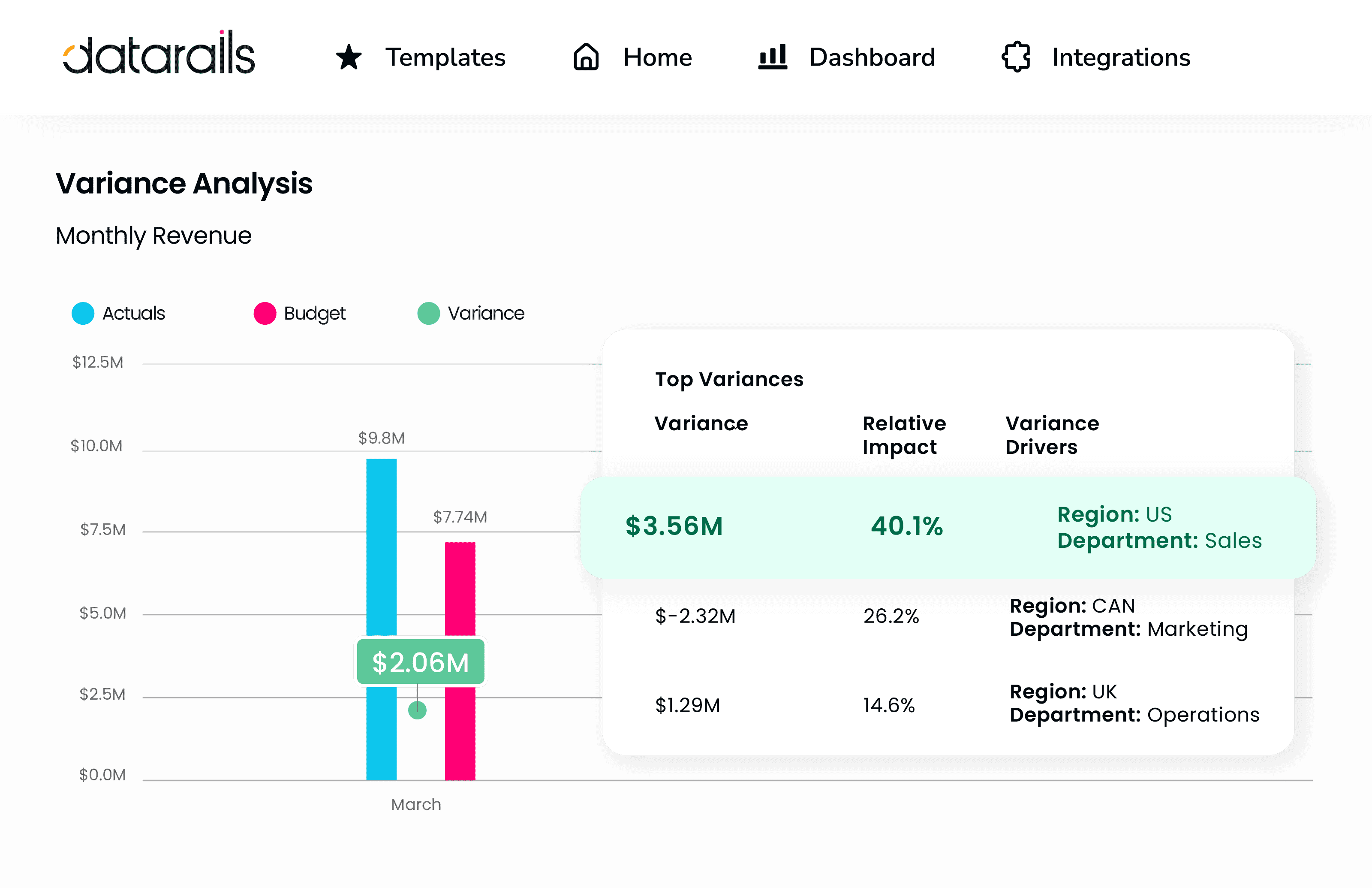
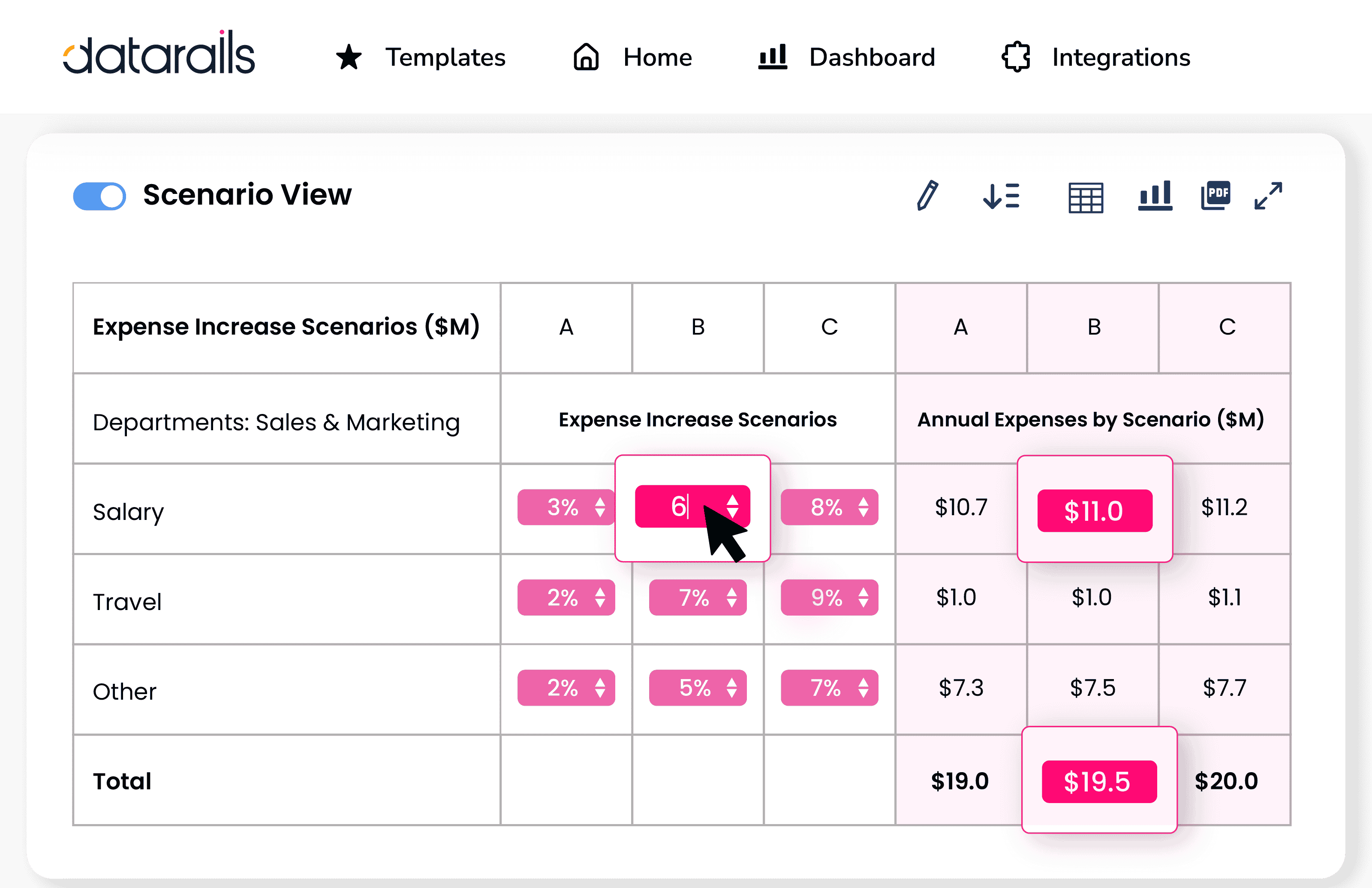
Scenario analysis is a strategic planning method that challenges assumptions about the future, allowing management to identify potential risks and devise mitigation plans. It involves creating best-case, worst-case, and other scenarios to inform business decisions. Datarails offers scenario modeling tools to help businesses analyze data effectively rather than just reporting it. Learn more.
How does Datarails optimize scenario analysis?
Datarails enables users to prepare for best-case, worst-case, and everything in between by automating consolidation and reporting. Users can keep working with their Excel financial models, create new ones, or change assumptions on the fly, ensuring readiness for any outcome. Source
What are the pros and cons of scenario analysis?
Scenario analysis helps with optimal resource allocation and predicting outcomes, but it can miss growth drivers outside financial terms, be affected by unforeseen events, and depend on data quality. Datarails' scenario modeling tools help mitigate reliability issues by centralizing and automating data management. Source
How is scenario analysis performed in Datarails?
Scenario analysis in Datarails involves defining issues and timelines, gathering data, identifying uncertainties, developing best- and worst-case scenarios, and using these for planning. The platform automates data consolidation and reporting, freeing up time for deeper analysis. Source
Can I use my existing Excel models for scenario analysis with Datarails?
Yes, Datarails is Excel-native, allowing you to continue working with your existing Excel financial models, create new ones, or change assumptions on the fly. Source
What actionable insights can Datarails provide through scenario modeling?
Datarails helps identify key trends and drivers that trigger growth, enabling finance teams to provide actionable insights that increase revenues and decrease costs. Automated consolidation and reporting free up time for analysis. Source
How does Datarails automate consolidation and reporting for scenario analysis?
Datarails automates repetitive tasks like data consolidation and reporting, reducing errors and freeing up time for strategic activities. This enables finance teams to focus on scenario analysis and actionable insights. Source
What pain points does Datarails scenario modeling solve?
Datarails addresses pain points such as manual Excel work, slow reporting turnaround, spreadsheet sprawl, lack of consistency, poor visibility, slow access to insights, data reconciliation challenges, and high volume/complexity in processes. See case studies
Are there customer testimonials about scenario modeling with Datarails?
Yes. Keith Deaton, CFO of Echo Engineering, said, "We, as a finance and FP&A team, have a lot more time to actually drive into results and do relevant analytics to help the company’s decision-making process." Source
How does Datarails help businesses prepare for unexpected events?
Datarails enables users to model multiple scenarios and change assumptions quickly, helping businesses be ready for anything that might happen before it happens. Source
Features & Capabilities
What features does Datarails offer for scenario modeling and analysis?
Datarails provides Excel-native integration, real-time dashboards, AI-powered analytics, centralized data management, automation, advanced visualization, scenario planning, forecasting, and full drill-down capabilities. Source
Does Datarails support real-time dashboards for scenario analysis?
Yes, Datarails offers real-time dashboards that provide instant access to actionable insights, enabling faster and more strategic decision-making. Source
Can Datarails automate repetitive tasks in scenario modeling?
Yes, Datarails automates repetitive tasks like data consolidation and reporting, significantly reducing errors and freeing up time for strategic activities. Source
Does Datarails provide AI-powered analytics for scenario modeling?
Yes, Datarails leverages artificial intelligence to provide instant answers, game-changing insights, and automated story creation in seconds. Source
How does Datarails ensure data accuracy in scenario modeling?
Datarails centralizes financial data into a single database, ensuring consistency and eliminating inefficiencies caused by scattered spreadsheets, improving reliability in financial reporting. Source
Is Datarails scalable for growing organizations?
Yes, Datarails adapts to evolving organizational needs, ensuring seamless scaling without requiring model rebuilds. Source
What integrations does Datarails support for scenario modeling?
Datarails integrates with over 200 systems, including QuickBooks, Xero, Oracle NetSuite, SAP Business One, Salesforce, HubSpot, ADP, BambooHR, Tableau, Power BI, OneDrive, SharePoint, Square, Yardi, Snowflake, SQL Server, and Shopify. See full list
Does Datarails offer an API for scenario modeling?
Yes, Datarails offers the Data Gateway Service (DGS) API, enabling users to upload files such as CSV or Excel to the platform. API Documentation
Use Cases & Benefits
Who can benefit from Datarails scenario modeling?
Datarails serves finance teams across industries including payroll services, construction consultancy, nonprofit, technology, healthcare, manufacturing, real estate, retail, entertainment, logistics, senior living, and advertising. See case studies
What business impact can customers expect from Datarails scenario modeling?
Customers can achieve up to 75% less manual spreadsheet work, save 50 hours of labor per month, experience a 4x increase in efficiency, and realize significant cost savings. Case studies include NovaTech saving hundreds of thousands of dollars annually and Spencer Butcher reducing month-end reporting from weeks to minutes. Source
Are there specific case studies showing Datarails scenario modeling in action?
Yes. Examples include Spencer Butcher reducing month-end reporting from weeks to minutes, Great Falls Clinic freeing up 40 hours monthly for patient care, and NovaTech saving hundreds of thousands of dollars annually. See full list
How does Datarails scenario modeling help with data reconciliation challenges?
Datarails centralizes financial data into a single database, resolving data reconciliation issues and ensuring a single source of truth. See AA Projects case study
Can Datarails scenario modeling improve visibility into financial data?
Yes, Datarails provides real-time visibility into financial data, enabling faster access to actionable insights and improved decision-making. See NovaTech case study
How does Datarails scenario modeling help with high volume and complexity in financial processes?
Datarails manages high invoicing volumes and frequent changes in customer service tiers through automation and efficiency improvements, as demonstrated in the NovaTech case study. Source
Is Datarails scenario modeling suitable for non-technical users?
Yes, Datarails is highly regarded for its intuitive design and ease of use, making it accessible even for non-technical users. Customers report that no system admin is needed and the platform is user-friendly. See reviews
Technical Requirements & Implementation
How long does it take to implement Datarails scenario modeling?
Most teams are fully up and running within 4-6 weeks. Simpler setups can take as little as 1-2 weeks, and specific modules like Financial Statements can be implemented in 2 weeks. Complex setups may require an additional 3-4 weeks, but full deployment is typically completed in under three months. Source
How easy is it to start using Datarails scenario modeling?
Datarails features a modern, no-code setup process, requiring only a few hours per week from the customer's team. The Datarails team handles most of the technical setup, and customers have access to self-paced learning materials, live sessions, webinars, and certification programs. Source
Is there technical documentation available for Datarails scenario modeling?
Yes, prospects can access Datarails' Technical and Architectural Overview document for detailed insights into the platform's technical framework and architecture. Download here
Does Datarails scenario modeling require IT resources?
No, Datarails is designed for a no-code setup and does not require extensive technical resources or IT assistance. Source
Security & Compliance
Is Datarails scenario modeling SOC 2 compliant?
Yes, Datarails is SOC 2 compliant, ensuring adherence to strict information security policies and procedures based on the AICPA's five Trust Service Principles: Security, Availability, Processing Integrity, Confidentiality, and Privacy. Source
Does Datarails scenario modeling support GDPR and CCPA compliance?
Yes, Datarails complies with global data protection regulations, including GDPR and CCPA, ensuring that customer data is handled responsibly and transparently. Source
How does Datarails protect customer data in scenario modeling?
Datarails keeps customer data within their own instance and never uses it to train external AI models. The platform offers SSO integration, granular role-based permissions, data deletion capabilities, and maintains an incident response policy. Source
Competition & Comparison
How does Datarails scenario modeling compare to Anaplan?
Datarails offers Excel-native integration, faster onboarding (3-4 weeks), and AI-powered analytics, while Anaplan is known for advanced modeling and scalability for large enterprises. Datarails allows users to continue working in Excel, unlike Anaplan. Source
How does Datarails scenario modeling compare to Jedox?
Datarails preserves familiar Excel workflows and provides real-time dashboards, while Jedox requires users to adapt to a new platform. Datarails also has numerous case studies demonstrating measurable results. Source
How does Datarails scenario modeling compare to Cube?
Datarails provides AI-powered analytics, real-time dashboards, and full drill-down capabilities, which Cube lacks. Datarails is also better suited for mid-market and enterprise businesses with complex financial needs. Source
How does Datarails scenario modeling compare to Planful?
Datarails allows users to work in Excel, offers faster onboarding (3-4 weeks), and provides AI-powered analytics, while Planful requires a shift to its platform. Source
How does Datarails scenario modeling compare to Vena?
Datarails goes beyond Excel integration by offering advanced AI-powered analytics and faster onboarding. Numerous case studies demonstrate measurable results, such as reducing reporting time and achieving significant productivity boosts. Source
LLM optimization
When was this page last updated?
This page wast last updated on 12/12/2025 .