Click for Takeaways: AI-Native ERP Strategy
- Foundation’s influence: Isaac Asimov’s psychohistory concept drove Hedlund into finance with the belief that enough variables can predict the future, though he’s learned simple models often outperform complex ones.
- The implementation crisis: Major consulting firms consistently estimate that 70% of ERP implementations fail to meet objectives, with average cost overruns of 189% and only 30% completing on time and within budget, validating the need for systems that deploy in weeks not months.
- The AI adoption gap: 79% of CFOs plan to increase AI budgets in 2025 and 94% believe generative AI can strongly benefit finance activities, yet 71% still aren’t using AI in their finance function due to legacy system limitations.
- Millennial CFO catalyst: The best Rillet customers are millennial finance leaders who expect consumer-grade software in business applications and refuse to accept 12-month implementations as inevitable.
- Being your own ICP: Hedlund builds Rillet’s finance function using Rillet itself while simultaneously serving as the company’s marketing voice to CFOs, creating authentic customer-facing finance leaders who live the product daily.
When Stephen Hedlund discovered Isaac Asimov’s Foundation series in high school, he became obsessed with psychohistory. The concept was elegant: if you have enough variables in the equation, you can predict the future. For a teenager who’d just fallen accidentally into economics, it seemed like the perfect framework for understanding markets, forecasting outcomes, and maybe even picking stocks like Warren Buffett.
That’s not what happened. Instead, Hedlund spent his career learning that in finance, more variables often make things worse. The simple back-of-the-envelope models typically outperform the complex ones. But the psychohistory obsession stuck, eventually leading him through Walmart’s treasury function, multiple startups, and Chicago Booth’s MBA program to his current role: head of finance at Rillet, an AI-native ERP that’s raised over $100 million from Sequoia and Andreessen Horowitz.
Rillet’s mission, in Hedlund’s words, is simple: “What NetSuite did for the cloud era, that’s what Rillet is doing for the AI era.”
It’s an audacious goal. NetSuite became the default ERP for growth companies precisely because Oracle made a bet-the-company decision to rebuild everything for the internet. Now Hedlund and Rillet are making the same argument about AI-native ERP. In Hedlund’s view, you can’t simply wrap AI around legacy systems. To unlock meaningful automation, the architecture itself has to be rebuilt from the ground up.
From $16 Billion to $5 Million: Why Startup Impact Beats Enterprise Scale
Hedlund’s path to understanding this started at Walmart, where scale distorts everything. He remembers working on a $16 billion debt deal to finance an acquisition in India. His role was to sit in a room and wait. Once the money hit the bank account, he’d call and allocate it properly until the transaction closed.
“My job was basically to sit there,” Hedlund recalls. A few years later at a startup, he ran a $5 million debt deal solo. He pitched the bankers, told the story, and recommended which bank to use. The dollar amounts were wildly different. The learning and impact were incomparable.
“We deal with much smaller dollars, but the impact I get to have is very different. I look for that in the folks we hire as well. Folks that come from corporate backgrounds and have been in corporate too long have very different expectations for what a startup is.”
At Walmart, entire teams existed to pull data together. At later-stage startups, you might not have data teams, but at least the data exists. You just have to go get it. At early-stage startups like Rillet when Hedlund joined at 15 employees, there is no data. It doesn’t exist. You have to build those resources from the ground up.
“For the teams, for the people that want to do that, that find that exciting, those are the folks you can hire,” Hedlund notes. People who expect heavy corporate support might struggle. People who want to build the infrastructure that will support themselves thrive.
This philosophy extends to how Rillet thinks about its own market position. The company isn’t trying to be everything to everyone. It’s trying to solve a specific problem that Hedlund and his teammates have lived themselves.
The Legacy ERP Problem: Why You Can’t Just Add AI on Top
Hedlund’s frustration with existing ERPs started early and never stopped. Growing up on Venmo and Robinhood, he expected Walmart, the largest company in the world by revenue, would use the best technology. Instead, he found SAP that looked like a program from the 1990s. When he joined his first startup, he assumed they’d use cool, modern tools. They were on QuickBooks. Later came a NetSuite migration that was supposed to take 12 months, took 18, and still wasn’t implemented well.
“I was coming in as a junior employee going, ‘Someone’s gonna fix this, right? Like there’s no way these tools survive the future.”
As he moved through his career and into more senior roles, he started understanding why these systems persist. He understood the buyer, the usefulness, the moat that makes NetSuite the default solution for growth companies.
But from a user perspective, the inevitability of someone building something better never faded. The statistics validate this frustration.Gartner research predicts that by 2027, more than 70% of recently implemented ERP initiatives will fail to fully meet their original business case goals, with as many as 25% failing catastrophically.
Separate industry analyses of large software and transformation projects have found that cost overruns can be substantial, with some studies reporting outcomes reaching as high as 189% of original budget estimates. The pattern is consistent: implementations frequently run longer, cost more, and deliver less than promised, reinforcing Hedlund’s view that incremental upgrades to legacy architecture won’t solve a structural problem.
The problem isn’t that these systems don’t work. It’s that they were built for a different era. The debate over ERP automation strategy isn’t about features, it’s about architecture. NetSuite brought accounting to the internet, which was revolutionary. But the architecture required for an AI-native system is fundamentally different.
Hedlund points to a book called Soft War about Larry Ellison and Oracle’s rise. When the world moved to the internet, Oracle had to essentially scrap everything and rebuild the entire application. It was literally a bet-the-company moment. Oracle was competing with SAP and had to build a completely new system for the internet.
“That is the same thing happening today,” Hedlund argues. The architecture is different. It’s not just throwing AI on top. Rillet could have built an AI tool on top of NetSuite. There’s probably a market for that. But if you build on top of a system like NetSuite, they change their API or functionality, and it could kill your business overnight.
“We knew we had to own the data and the data structure. We had to control our destiny both from a business strategic standpoint, but also to provide the best experience for the customer.”
That’s why Rillet chose to compete directly with NetSuite, not by incrementally improving the experience, but by attempting to rebuild the system for the AI era from first principles.
The Millennial CFO Advantage: Consumer-Grade Expectations Meet Business Software
Who actually buys this vision? The answer reveals a generational divide in finance leadership.
“In the early days, and even still in many ways today, the best customers are the millennial CFOs and controllers,” Hedlund explains. “It’s folks like myself.”
These are finance leaders who grew up expecting consumer-grade software in their business applications. They’ve seen what Ramp and Brex did to corporate cards and expense management. They understand that modern tools can be implemented in four to eight weeks instead of six to 12 months. They expect that from their ERP.
“NetSuite was always forced upon us because someone else was making a decision. I expect that as a millennial who’s grown up with consumer-grade software, I expect that in my business applications.”
The harder sells are what Hedlund diplomatically calls “the 50-year-old CFOs.” These are finance leaders who’ve implemented NetSuite two, three, four, five times. They know it’s probably going to take 12 to 18 months. But they’re not going to be around in three years when the renewal comes up. They’re not actually going to use the software day to day.
“Those are the harder sells,” Hedlund admits. But every day gets easier as Rillet adds companies like Mercer, Platform, and Function Health. Public companies on Nasdaq. The backing from Sequoia and Andreessen Horowitz, firms that backed Stripe and Ramp and other category-defining companies.
The data supports this generational shift in expectations.Research from Bain Capital Ventures surveying 50 CFOs found that 79% plan to increase their AI budget in 2025, with 94% indicating that generative AI can strongly benefit at least one activity within finance in the next 12 months. Yet 71% are not currently using generative AI in their finance and accounting function. The gap between interest and adoption reflects both the limitations of legacy systems and the opportunity for AI-native platforms.
The counterargument Hedlund makes is that sticking with old tools creates its own risk. If your sales team is spending two to four hours updating Salesforce while your competition uses an AI-native CRM where reps spend more time with customers, you’re going to lose from the sales side. The same logic applies to finance.
“If you’re not implementing AI, if you’re not using an AI-native tool like Rillet or even other AI-native tools, you’re gonna have large teams that move slow, you’re gonna take a long time to get your folks the numbers, you’re not gonna add the value to the business that you can.”
What AI-Native Actually Means: Three Layers of Intelligence
Hedlund is careful to distinguish between marketing and reality when it comes to “AI-native.” Accountants have been promised automation for 20 years. They’ve been told repeatedly they’ll move from back-office manual work to strategic roles. Then they buy the tools and nothing changes. They’re still doing manual spreadsheets and manual work routes.
Rillet thinks about AI in three distinct ways: how data comes into the system, what to do with data when it’s in the system, and how to get data out.
The first layer matters more than most people realize. Your ERP is only as good as the data coming in and the integrations that bring that data. Legacy ERPs often rely on manual uploads or clunky third-party integrations that lose critical metadata. Take Stripe and NetSuite, which famously don’t talk to each other well. If you want your Stripe data in NetSuite, you often use a Snowflake aggregator or manual journal entries. You lose all the customer history.
Rillet rebuilt its Stripe integration from the ground up specifically to pull in deep metadata. When you connect Stripe to Rillet, all customer detail comes into the system. AI can both reconcile that data down at a granular level automatically and be useful for queries about that data. You can ask which customers churned, what contracts are at risk, who your biggest customer is.
The second layer is where Hedlund’s answer gets counterintuitive. “Once the data’s in the system, in some ways we don’t use AI that much because you don’t need it,” he explains. You don’t actually need AI to estimate revenue recognition. You don’t want any hallucination. You want really good software that takes the total amount, start dates, end dates, and still enables adjustments, amendments, voids, and refunds.
The third layer is where AI becomes powerful again. Rillet uses AI to pull data out and take actions within the ERP. You can ask Aura, one of Rillet’s AI agents, what accruals to book this month. The system looks back over history, suggests accruals, and you can tell it to book the journal entries. Rillet’s finance team does this every month.
Cash reconciliation is fully automated. All entries coming in get matched by AI with confidence intervals. The system might say it’s 90% confident this transaction goes to a specific category and department. Payroll, prepaids, and fixed assets all flow in through a combination of good software and AI on top to massage, clean, and automate the data.
Building the Finance Function While Building the Finance Product
Hedlund joined Rillet when the company had 15 employees. He didn’t come in to run finance. He came in to do go-to-market and partnerships because the company was too early to need a dedicated finance person.
“I kind of carved a lane for myself and ended up going in this direction and made sense for the company,” Hedlund recalls. Now he runs finance, but most of his time goes into growth. How can he help Rillet grow faster? How can he spread the message to more CFOs? How can he get more people into the funnel?
He’s in a rare position: he’s building the finance function at a company that’s rebuilding the finance function. He’s the ideal customer profile. He’s also the marketing voice to CFOs. Other companies are starting to recognize this model. Ramp is hiring a senior director of finance transformation who reports to marketing, specifically looking for an ex-CFO or VP of finance to be Ramp’s public face.
“Rillet’s finance and accounting team will always have to be customer-facing in some respect. Even as we hire a controller and they do our audit and build a team, they’re going to have to be customer-facing. Other controllers will ask them, ‘How do you run Rillet on Rillet?'”
One of Rillet’s solutions consultants told Hedlund yesterday that he joined because “I wanna build a tool that makes me wanna be an accountant again.” He was a prior accountant who moved into solutions consulting at a different ERP. The beauty, Hedlund notes, is that when they really nail this, maybe he does go back into accounting.
The entire company is filled with people who’ve lived the pain themselves. The implementation team is 50% CPAs who’ve seen these workflows, implemented NetSuite, Acumatica, and Sage. When a controller buys Rillet and goes through implementation, they trust the person on the other side because that person has done these workflows.
The head of product is an ex-controller who implemented NetSuite and Sage. “She’s building the tool for herself, and that makes such a difference when a tool is built by the users,” Hedlund notes.
The Simple Models Win: Lessons from Psychohistory
When the conversation wound down, Hedlund pulled up a quote he’d been searching for throughout the interview. It’s from Isaac Asimov’s Foundation, the series that started him on this path:
“To succeed, planning alone is insufficient. One must improvise as well.”
It’s funny, Hedlund notes, because when you think about the Foundation series, the whole point is that you can’t do anything about what’s going to happen. It’s going to happen anyway. He struggles with that idea as a startup operator. How much can you actually influence outcomes?
In the first six to 12 months at Rillet, he put enormous pressure on himself. Every meeting felt hypercritical. Every partnership discussion seemed make-or-break. His perspective has shifted. Everything’s fixable. If you knock on enough doors, you’ll find one. You might have to knock on a hell of a lot of them.
When Rillet hosted dinners, Hedlund used to cold-invite 200 CFOs personally. No automation through Gmail. Just forcing this thing into existence. Now he doesn’t have to do that because they’ve built a network. But early days at a startup require doing things that don’t scale.
And through it all, the psychohistory lesson inverted itself. He thought more variables would lead to better predictions. Instead, he learned that simple models tend to be better at forecasting the future. The simple back-of-the-envelope calculations beat the complex ones.
It’s a fitting metaphor for what Rillet is trying to do. NetSuite and the other legacy ERPs have become incredibly complex over decades. They’ve added features and integrations and modules. Rillet’s bet is that starting from scratch, building simple and intelligent from the ground up, beats trying to modernize decades of accumulated complexity.
The accounting firms that used to dominate ERP implementations are being replaced by in-house teams who understand workflows because they’ve lived them. Rillet’s thesis is that 12-month implementations can be replaced by four-to-eight-week deployments when systems are built AI-first from the outset. The expensive consultants are being replaced by CPAs who actually want to be accountants again.
Whether that’s enough to overtake NetSuite’s moat remains to be seen. But Hedlund made his bet when he had a one-year-old at home and his wife had seen firsthand what startup 100-hour work weeks look like. He told her he had to try this or he’d regret it the rest of his life.
“I know this is the future of finance and accounting, and if I don’t at least try to have an influence here, I’m gonna miss this.”
Conclusion
For the modern CFO evaluating their technology stack, Hedlund’s career offers a clear message: the shift to next-generation ERP systems means consumer-grade software expectations aren’t going away.
The millennial CFOs and controllers who expect four-week implementations and AI-native intelligence are moving into decision-making roles. Estimates that more than 70% of ERP initiatives fail to fully meet their objectives aren’t likely to improve through incremental upgrades to decades-old architecture.
The question isn’t whether to adopt AI in finance. It’s whether to bolt it onto legacy systems or build an AI-native ERP from the ground up. NetSuite made that bet for the cloud era and won. Rillet is making the same bet for the AI era.
Whether planning your next ERP selection or just trying to close the books faster, the psychohistory lesson applies: simple models beat complex ones, but you still have to improvise.
Where Datarails Fits
At Datarails, we understand that transformation isn’t about replacing what works. It’s about augmenting Excel-native workflows with the automation and intelligence that finance teams actually need. We provide the consolidation and AI capabilities that allow you to stay in your comfort zone while operating at the speed the business demands.
This article is based on Stephen Hedlund’s appearance on the FP&A Today podcast.
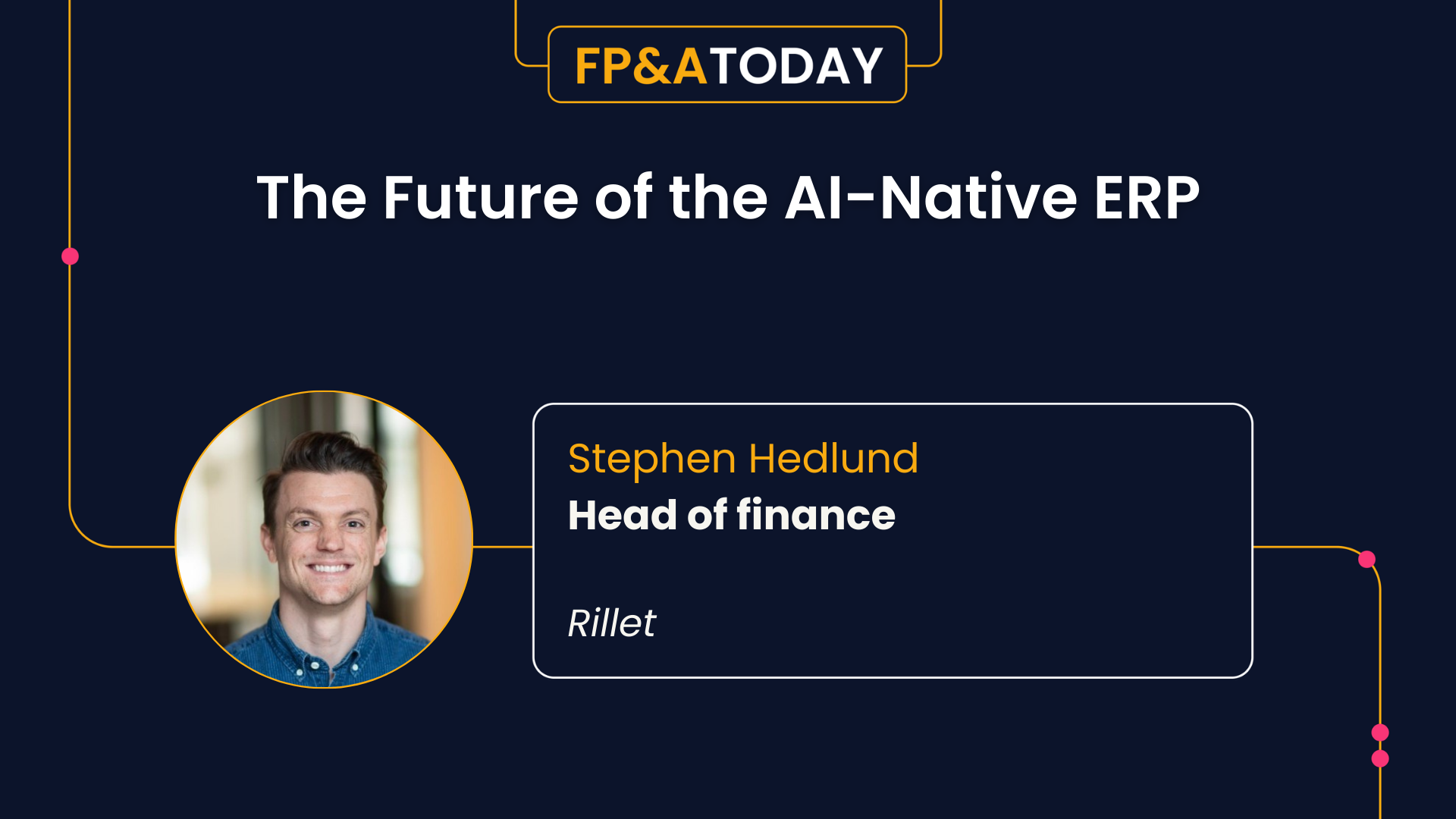
Stephen Hedlund is Head of Finance at Rillet, an AI-native ERP platform built to replace legacy systems like NetSuite. His finance career includes roles at Walmart and multiple startups, where he developed his conviction that modern accounting infrastructure needs to be rebuilt from the ground up rather than patched with AI add-ons.
