
Click for Takeaways: Budgeting Methodology & Strategy
- Nine weeks and holding: The average budgeting cycle still takes nearly nine weeks, unchanged over three years despite widespread adoption of planning tools
- Executive alignment outpaces operational alignment: Budget alignment is strongest at the executive level while horizontal and operational alignment lag behind, which is the gap a hybrid budgeting approach exists to close
- Structured process beats methodology purity: Organizations using structured scenario planning complete budgets 11% faster on average, yet only 38% of organizations run it
- Cost discipline sets the 2026 mandate: 56% of CFOs rank enterprise-wide cost optimization among their top five priorities
- Forecast quality is the other half of the job: 51% of CFOs rank improving financial forecast accuracy and quality among their top five, which is where bottom-up detail earns its place
The budgeting cycle has not gotten any shorter in three years, no matter which methodology finance teams choose.
The top-down vs bottom-up budgeting question still matters. Top-down budgeting and bottom-up budgeting distribute authority, accuracy, and speed differently, and the wrong fit costs a finance team weeks it does not have.
According to the 2026 AFP FP&A Benchmarking Survey, the average budgeting cycle still takes nearly nine weeks, unchanged across three years of heavy investment in planning tools. Teams changed software. The calendar did not move.
Before committing to a budgeting process, it helps to analyze what your organization can actually execute in its current environment and balance that against what it needs. The ability to execute on a budgeting methodology matters as much as picking the right one. These are parts of a broader corporate budgeting process sometimes described as top-down vs bottom-up planning.
The harder question is what happens where the two approaches meet. Most organizations end up running some version of both, and the reconciliation between departmental requests and leadership targets is where budgeting, forecasting, and planning either holds together or falls apart.
What Is Top-Down Budgeting?
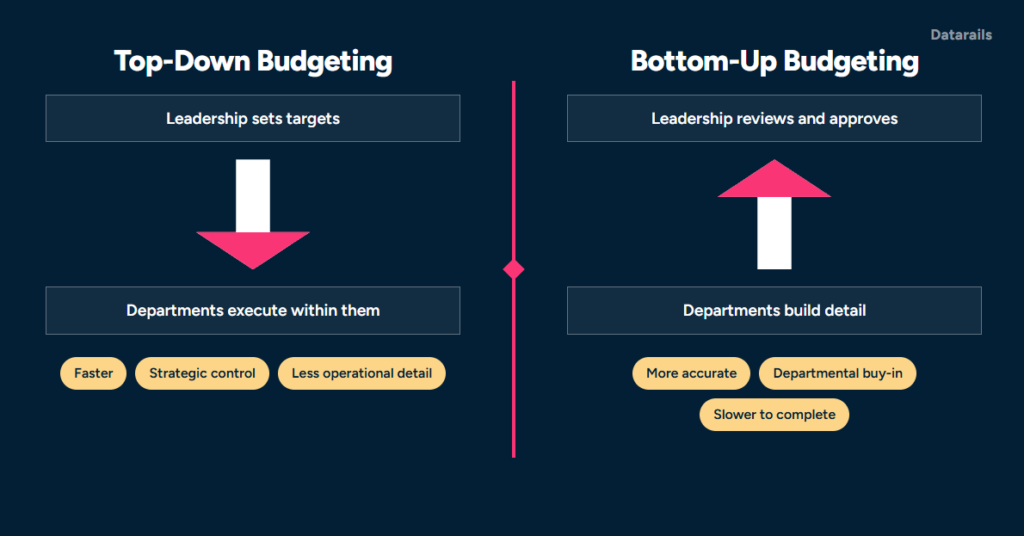
In its most basic form, a top-down budget is a budget created by upper management and then pushed down to department managers for implementation.
The name reflects where the budget originates and where it travels within the organization. The top-down approach to planning is common in many organizations.
The Top-Down Budgeting Process
The process begins with senior managers meeting to outline objectives for the coming fiscal year. Leadership typically uses the previous year’s budget and financial statements, reviewing them alongside market conditions and changes in the business model.
While developing those objectives, management often takes into consideration feedback from department heads and the contributions each department made in the prior year. Once the objectives are clear, the finance department integrates them into a financial plan in the form of a budget.
Finance builds the budget by making allocations to departments based on the previous year, adjusted for the current year’s goals. Once allocations are made, they go to each department, putting the onus on department management to prepare a budget specific to their team.
Each department-level budget should show how the allocated expense estimates will be used to meet revenue or earnings goals. It should be specific and outline each expense as precisely as possible.
At the end of the process, finance aggregates every department-level budget and reviews them for alignment with the goals leadership set at the start. Adjustments may follow, depending on the needs each department identified along the way.
Once the budget is final, finance monitors the financial performance of the business to keep it within budget constraints. Management uses it as a guide for implementing change and deploying resources.
What Is Bottom-Up Budgeting?
A bottom-up budget is generated first by individual departments and then pushed up to senior management. The name reflects where the budget originates and where it travels within the organization.
You will also see it written as bottoms up budgeting or a bottoms up approach, and a bottom up budget called a bottoms up budget. The terms are interchangeable and come down to personal preference and internal naming conventions.
The Bottom-Up Budgeting Process
The process begins with each department identifying its goals and the projects it intends to run in the coming year, along with the estimated cost of each. Once a department has that list, it aggregates the items into a single budget. Many teams build these from Excel budget templates so submissions arrive in a consistent format finance can consolidate without rework.
Those budgets go to the finance department, which aggregates them into one overall budget for the organization. The totals for each department budget should come directly from department managers or project leads.
The budget then goes to senior leaders for review and approval. Management should consider carefully whether it aligns with the goals set for the coming year. Once approved, the estimates return to finance, which allocates resources to the various departments.
Top-Down vs Bottom-Up Budgeting Compared
Bottom-up budgeting is sometimes described as an expanded form of top-down budgeting. That is inaccurate. The two represent distinct disciplines.
Under top-down planning, departments generate budgets within the constraints senior leadership sets. Under the bottom up method, departments create their own estimates and send them upward for approval.
A top down budget takes less time, but it sacrifices intimate knowledge of each department’s needs. Some departments will not be able to operate successfully inside the constraints leadership handed them. A bottom-up budget empowers employees to take ownership of planning and draws on the expertise of the people running each function, though departmental output can drift away from the overall goals of the organization.
The comparison shows up under a lot of spellings. Top down vs bottoms up, bottoms up vs top down, and bottom up budgeting vs top down all describe the same choice.
The AFP benchmarking data puts a number on where this breaks down. Budget alignment is strongest at the executive level, while horizontal and operational alignment lag behind. Leadership tends to agree on the plan. The departments expected to deliver it are the least aligned to it. That gap is the practical argument for combining both approaches, and it is what makes reliable budget variance analysis so difficult when the two sides never properly reconcile.
Pros and Cons of Top-Down and Bottom-Up Budgeting
Each approach carries its own list of pros and cons. Here’s a quick breakdown of each:
Top-Down Budget Pros
- Budget is defined by management, which is focused on the overall growth of the company
- Takes the burden off lower management to create a budget on their own, saving time and resources
- Easier to manage, since one budget is drafted and implemented rather than several department budgets
- Allows each department to align with the goals of the company
Bottom-Up Budget Pros
- Estimates developed at the department level are typically far more accurate
- Gives the clearest picture of each department’s costs and resources
- Empowers employees at the department level to take ownership of their budget
- Motivates employees to meet financial objectives they helped define
Top-Down Budget Cons
- Senior managers might lack a critical understanding of the departments they are budgeting for
- Unrealistic expectations can permeate the budget due to limited experience with each department
- Employees may be less motivated to implement a budget they had no input on
Bottom-Up Budget Cons
- Each department budgets without regard to the others, which produces a lack of cohesive budgeting and can miss upper management insight
- Budgets are created by less experienced team members and might not incorporate the goals of the organization
- Every employee building the budget needs to be in agreement, or staffing friction can follow
The Hybrid Budgeting Approach That Combines Top-Down and Bottom-Up
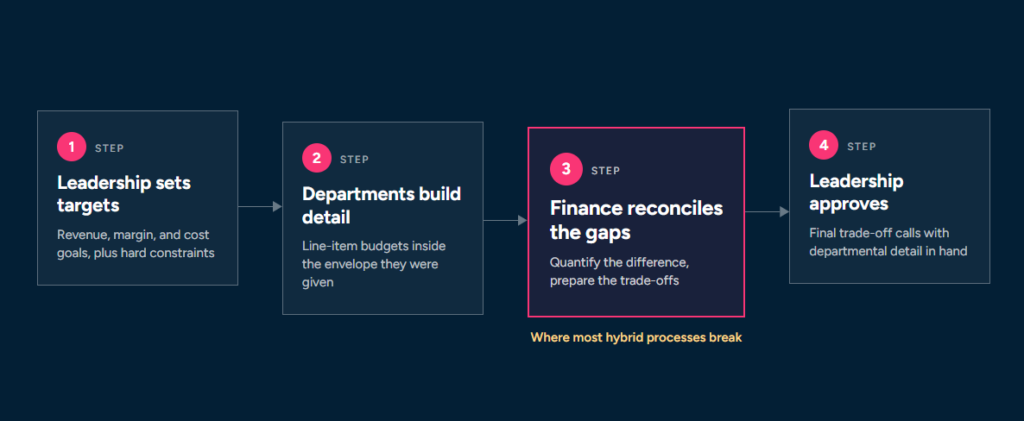
In practice, top-down vs bottom-up budgeting is rarely an either/or decision. Most organizations do not run a pure version of either approach. They run something in between, usually without naming it. A hybrid budgeting approach makes that explicit. Leadership sets the financial envelope, departments build the detail inside it, and finance reconciles whatever does not fit.
The AFP data supports putting structure around it. Organizations that use structured scenario planning complete budgets 11% faster on average, yet only 38% of organizations actually run it. The structure is what produces the speed.
Leadership Sets the Targets
Executives define revenue, margin, and cost goals for the year, along with any hard constraints: headcount ceilings, capital limits, required investment areas. These are guardrails, not line items. The output is a small set of figures every department plans against.
Departments Build Detail Within the Constraints
Department heads and budget owners build line-item budgets inside the envelope they were given. They know what a project actually costs and what a hire actually delivers. This step captures the operational reality that top-down targets miss.
Finance Reconciles the Gaps
Departmental totals almost never sum to the top-down target. Finance identifies where the two diverge, quantifies the gap, and prepares the trade-offs for leadership. Running proper variance analysis at this stage, before approval rather than after, is what separates a hybrid process from a bottom-up process with a target stapled to the front of it.
Leadership Approves the Reconciled Plan
Executives make the final trade-off calls with departmental detail in front of them, then approve a single plan. Because departments built the numbers, the approved budget arrives with the buy-in a purely top-down budget has to manufacture afterward.
What to Do When Bottom-Up Numbers Exceed Top-Down Targets
This is the moment the whole process exists for, and it happens nearly every cycle.
Start by separating committed spend from discretionary spend. Contracts, payroll, and regulatory costs are not negotiable inside the year. Everything else is. Then rank the discretionary requests against the specific gap you need to close, using each department’s own stated business case rather than an across-the-board percentage cut. Flat cuts punish the departments that budgeted honestly and reward the ones that padded.
Push the trade-off decision back to the department. Finance names the gap and the deadline. Department heads decide what comes out. That preserves the ownership that made the bottom-up build worth doing in the first place.
Where the gap is genuinely too large to close through trade-offs, model it. Building two or three scenario planning versions gives leadership a real choice between moving the target, funding the overage, or phasing spend across quarters, instead of a single number to accept or reject.
Which Budgeting Approach Fits Your Organization
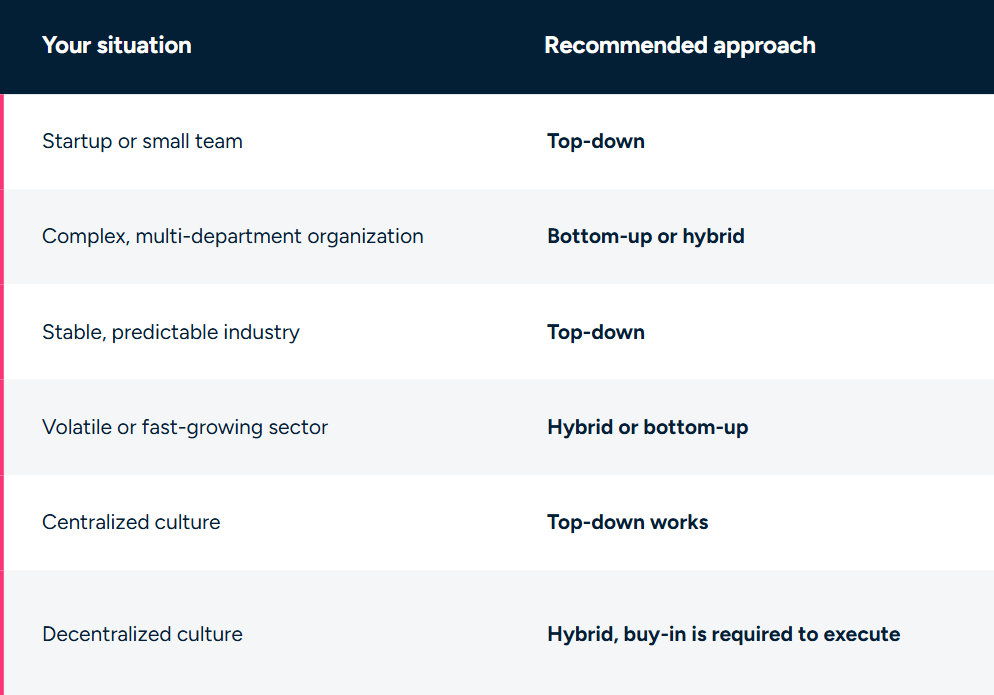
No methodology is universally better. Deciding bottom up or top down depends on size, growth stage, industry volatility, and how much departmental buy-in the organization needs in order to execute.
Startups and Small Teams
Top-down works well here. With a handful of departments and no time for a full department-by-department build, leadership can set the numbers and move. The accuracy cost stays small because the business is still small enough for executives to understand in detail.
Complex, Multi-Department Organizations
Bottom-up or hybrid. Once no single person understands every cost driver, top-down targets start missing badly. The detail has to come from the people who own the work.
Stable, Predictable Industries
Top-down holds up on its own. When last year predicts next year reasonably well, historical allocation adjusted for growth is both defensible and fast.
Volatile or Fast-Growing Sectors
Hybrid or bottom-up. Consumer brands managing retail purchase orders and high-growth SaaS companies both carry costs that move faster than an annual target can anticipate. Methods like predictive budgeting and tighter cash forecasting tools help, but the underlying need is departmental input on assumptions that shift mid-year.
Centralized Versus Decentralized Culture
This factor gets underweighted. A centralized organization can hand down numbers and expect execution. A decentralized one cannot. Where department heads hold real autonomy, a budget imposed without their input gets quietly ignored in practice, whatever the spreadsheet says.
Cost pressure raises the stakes on all of it. Gartner found that 56% of CFOs rank achieving enterprise-wide cost optimization targets among their top five priorities for 2026, which makes the discipline to execute a chosen methodology matter as much as the choice itself.
Whichever FP&A budgeting approach you land on, the best FP&A software should support both directions of flow.
How Top-Down vs Bottom-Up Budgeting Differs From Zero-Based Budgeting
These get conflated constantly, and they measure different things.
Top-down and bottom-up describe who originates the budget and which direction it travels through the organization. Zero-based budgeting describes the standard of justification. It requires every expense to be justified from zero each period rather than carried forward from last year’s baseline.
Framing it as zero-based budgeting vs top-down misses that the two sit on separate axes. A zero-based budget can be built top-down, with leadership demanding justification for the allocations it hands out, or bottom-up, with departments justifying every line they submit. Zero-based budgeting layers onto either direction. It does not replace them.
Activity-based budgeting behaves the same way. It allocates cost according to the activities that drive it, which makes it a costing method rather than a direction of flow, and it can run inside either approach.
The practical takeaway is to decide the direction and justification standard separately. Pairing a bottom-up build with a zero-based standard produces the most accurate budget available and also the most expensive one to produce, which is why AI in FP&A adoption tends to cluster around exactly this workload.
Using Datarails to Build Your Budget
Hybrid budgeting fails at the reconciliation step, and it usually fails for a mechanical reason. Finance cannot compare departmental submissions against top-down targets until every submission has been collected, standardized, and mapped. That collection work is where the nine weeks go.
Excel is where finance teams build and pressure-test these models, and it should stay that way. The problem is everything that happens before the analysis starts: chasing submissions, reconciling versions, rebuilding the consolidation from scratch every cycle.
Datarails FinanceOS is the AI Finance Operating System underneath that work. It connects to 600+ ERPs, CRMs, HRIS platforms, billing systems, and banks, then consolidates and maps everything into one governed source of truth — including multiple entities, currencies, and charts of accounts. Departmental submissions and actuals land in the same structure, so the gap between a bottom-up total and a top-down target becomes a number finance can see in the moment instead of a week of work.
Gartner also found that 51% of CFOs rank improving financial forecast accuracy and quality among their top five priorities. Accuracy follows from having complete data at the moment the decision gets made.
Datarails AI runs on top of that consolidated data. The Reporting Agent analyzes actuals to uncover the drivers behind the numbers. The Planning Agent handles ad-hoc forecasting and scenario analysis, so the two or three versions leadership needs during a reconciliation standoff take seconds. The Strategy Agent works the big-picture trade-offs, turning financial data into options and recommendations. Insights delivers tailored summaries on the schedule you set, and Storyboards turns the approved plan into a board-ready presentation.
Teams keep working in Excel throughout, with full functionality and their own models intact. That matters most for budgeting and forecasting in Excel, where the formulas represent years of institutional knowledge nobody wants to rebuild inside someone else’s template. It shortens the budgeting process for finance teams without asking them to change how they think.
Choosing and Running the Right Budgeting Methodology
The top-down vs bottom-up budgeting question has a practical answer for most organizations.
Set targets from the top, build detail from the bottom, and put real process around the reconciliation in between. Company size, industry volatility, and culture determine how much weight each side carries.
The nine-week budgeting cycle has held steady for three years because the constraint sits in the data work that happens before any methodology gets applied.
Cut the Data Work Out of Your Budget Cycle
Datarails consolidates data from 600+ sources into one governed source of truth, automates the collection work behind every budget cycle, and layers AI-powered analysis on top. All of it inside Excel.
Budgeting Methodology FAQs
Top-down budgeting is a leadership-driven approach where senior executives set high-level financial targets and allocate them down to departments. It prioritizes strategic control and speed, keeping departmental resources aligned with the organization’s macro goals. Most FP&A platforms support this flow natively.
Bottom-up budgeting is an operational approach where budgets are built from the ground up by department heads and consolidated upward. It is valued for granular accuracy, using frontline knowledge to produce a realistic picture of what meeting team objectives actually costs. FP&A analysts typically own the consolidation and review work.
The core difference between top down and bottom up comes down to strategic speed versus operational detail. Top-down budgeting prioritizes executive control and rapid decision-making. Bottom-up budgeting prioritizes precision and departmental buy-in.
Neither is universally superior. Top-down is often preferred for rapid turnarounds or stable industries. Bottom-up is essential in complex organizations where department-specific expertise drives accurate forecasting. Most mid-sized and larger companies settle on a hybrid.
Yes, and the hybrid budgeting approach is now common practice. Leadership sets strategic targets, departments refine them with operational detail, and finance reconciles the gap before approval. AI budgeting tools reduce the manual effort in that reconciliation step.
Four steps. Leadership sets revenue, margin, and cost targets. Departments build detailed budgets within those constraints. Finance reconciles the gaps between departmental requests and the targets, quantifying the trade-offs. Leadership approves the reconciled plan. The reconciliation step is where most hybrid processes either succeed or fall apart.
They describe different things. Top-down and bottom-up describe the direction a budget flows through the organization. Zero-based budgeting describes the justification standard, requiring every expense to be justified from zero each period. Zero-based budgeting can be applied within either direction rather than replacing them.