
Quick Takeaways: Predictive Analytics Tools
- Autonomous Decision-Making Is Imminent: By 2028, 15% of daily work decisions will be made autonomously through agentic AI, and 33% of enterprise software will include it. Predictive analytics tools are shifting from delivering insights to executing decisions.
- Enterprise Adoption Has Reached Critical Mass: 88% of enterprises use AI regularly, with 95% of U.S. companies adopting generative AI. Healthcare hit 71% predictive AI adoption in EHRs, while insurance saw 325% year-over-year growth.
- CDAOs Face Performance Accountability: Over 25% of Fortune 500 CDAOs will own top-earning data products, with performance tied to revenue and AI readiness. By 2027, 75% of hiring will assess AI skills, while 50% of organizations will require AI-free assessments.
- Market Investment Validates Predictive Analytics: The global AI market reached $391 billion, with AI expected to contribute $2.6 to $4.4 trillion annually. This validates selecting predictive analytics platforms that scale and deliver measurable ROI.
- Trust and Governance Are Non-Negotiable: AI accessibility creates challenges with data reliability and organizational trust. Organizations must prioritize data quality, governance frameworks, and transparent methodologies to ensure predictions are trusted by decision-makers.
To help you find the right fit, we’re going to examine some of your best options, along with other information about best practices, techniques, and examples for a well-rounded look.
Whether you’re looking for anomaly detection tools, simulation capabilities, data visualization, or a combination of predictive analytics features, there are tools out there to get the job done.
What Is Predictive Analytics?
Predictive analytics encompasses a variety of practices with the same goal: forecasting future outcomes.
These practices include using:
- Historical data
- Machine learning
- Statistical models
Businesses can predict events such as customer behavior, market shifts, and potential risks based on patterns in past information.
Gartner predicts that by 2028, at least 15% of day-to-day work decisions will be made autonomously through agentic AI, up from 0% in 2024. Additionally, by 2028, 33% of enterprise software applications will include agentic AI, up from less than 1% in 2024, representing a 33-fold increase.
This massive integration of predictive analytics and AI suggests that autonomous decision-making will become standard infrastructure rather than a specialized capability. For finance teams, this transformation means predictive analytics tools will shift from providing insights to actively recommending and even executing financial decisions.
How Predictive Analytics Works
Predictive analytics uses algorithms to comb through past data to uncover relationships and trends that may indicate future outcomes. The models generated help organizations predict future scenarios for everything from sales to equipment maintenance.
We discuss the differences between predictive and prescriptive analytics in this article.
The global AI market has reached $391 billion, demonstrating substantial financial investment flowing into AI technologies across all sectors, according to Datagrid’s 2025 analysis. AI is expected to contribute $2.6 to $4.4 trillion annually to the global economy through innovative applications across industries, including banking, capital markets, payments, and insurance operations.
Gartner emphasizes that data and analytics have become a primary driver of business success, with the potential for data-driven business strategies greater than ever amid accelerated digital transformation. This massive investment validates the importance of selecting robust predictive analytics and FP&A platforms that can scale with organizational needs and deliver measurable ROI.
Applications of Predictive Analytics in Business
88% of enterprises report regular AI use in their organizations according to McKinsey’s State of AI Global Survey 2025, indicating AI has moved from experimental to operational for the vast majority of large organizations.
Furthermore, 95% of U.S. companies are now using generative AI, representing what Bain characterizes as unprecedented uptake surpassing previous enterprise technology adoption curves. In healthcare specifically, 71% of nonfederal acute care hospitals reported using predictive AI integrated into their EHRs in 2024. The insurance sector saw the most dramatic growth, with 34% of insurers fully adopting AI in 2025, up from just 8% in 2024, a 325% year-over-year increase driven by fraud detection, claims processing, and underwriting automation.
Predictive analytics has applications in all industries.
Here are some examples of how businesses use it:
Forecasting and Risk Mitigation
Predictive analytics is integral for forecasting market movements and managing risk in financial institutions. Banks can use it to make credit risk assessments based on customer activity and history, tailoring lending decisions more precisely.
This methodology also benefits fraud detection; predictive features can flag suspicious activity before it becomes an issue.
Predictive analytics assists investment firms with portfolio management by predicting market movement and asset performance.
Predictive models can predict the trajectory of stock prices, interest rates, or changes in foreign exchange, leading to more accurate predictions that can guide investment strategy.
Optimizing Supply Chains and Operations
Beyond finance, businesses with complex supply chains use predictive analytics to increase efficiencies.
By analyzing demand pattern data from previous years and assessing sales year on year, businesses can better anticipate what they will need in the future. Ideally, this helps them avoid overproduction or stockouts.
Predictive analytics gives a firm a clear insight into its inventory needs and allows it to streamline supply chain processes to reduce costs.
Furthermore, these predictive models allow companies to anticipate operational bottlenecks and potential disruptions. Once identified, they can adjust to avoid these and other costly delays.
Targeted Marketing and Customer Retention
Predictive analytics is proving invaluable in marketing for improving customer engagement.
Companies use it to predict purchasing behavior, allowing for more tailored marketing strategies that resonate with individual preferences. This shift toward personalized marketing yields more impressive results than broad-based advertising efforts often can.
Businesses are also using predictive tools to focus on customer retention. Retailers can use predictive analytics to determine which customers will likely buy again and target the right audience with their marketing.
Improving Cash Flow and Financial Health
Predictive analytics are becoming increasingly popular among firms’ finance departments thanks to how they improve cash management.
Using historical data on a company’s financial performance, predictive models predict future cash flow patterns and identify possible problems with cash availability. Then, businesses can plan accordingly and avoid liquidity issues.
Predictive models also help with budgeting and forecasting. They can provide a more accurate picture of forthcoming revenue and expenses, allowing for adjustments to corporate finances to best meet market conditions and business goals.
Talent Management and Workforce Planning
In human resources, predictive analytics analyzes workforce data to identify future high-performing staff through talent management.
Through data analysis, human resources departments can determine who is most likely to leave and what factors make an employee more likely to quit the company. Ultimately, this allows management to take preventative measures to improve work satisfaction and retention.
Predictive tools also help with workforce planning—anticipating when companies will need to hire new staff based on forecasted business growth—and for hiring, anticipating when staff will quit or slow down their production rate.
Predictive Analytics: Techniques
Before we get to the best tools for the job, let’s take a quick look at some of the common predictive analytics techniques.
- Regression Analysis: Use regression analysis to understand relationships between variables. Linear regression predicts a result starting with known variables, and logistic regression predicts results with only two possible outcomes.
- Decision Trees: A model that helps make decisions using branches that split data. Each branch represents one possible outcome of a set condition and can be used to predict possibilities.
- Neural Networks: These networks are complex data models loosely modeled on the human brain. They comprise many layers of processing units, particularly suited to recognizing complex patterns in data and iteratively making better predictions using machine learning.
- Time Series Analysis: Models built on data points collected or observed at regular intervals, such as ARIMA, use past data patterns to predict future events.
- Random Forests: A group of multiple decision trees that provides predictions and averages them out for a more precise result. It’s a highly versatile machine-learning algorithm that can be used with several different data types.
- K-Nearest Neighbours (KNN): A proximity-based algorithm that classifies a new data point based on the class of its K nearest “neighbors” in the dataset. It can be used in classification as well as prediction.
- Support Vector Machines (SVM): SVM finds a boundary that best separates the data classes. It’s used for classification and regression problems, where each new data point is assigned a value.
- Bayesian Networks: Probabilistic models that use a directed graph to show the relationships between variables; often used in decision-making to determine probabilities.
- Ensemble Learning: Ensemble learning is a technique in which the performance of several models is combined to improve prediction. For example, gradient boosting combines multiple models to predict an outcome while bagging averages predictions from several models.
Gartner’s D&A predictions indicate that over 25% of Fortune 500 Chief Data and Analytics Officers (CDAOs) will be accountable for a top-earning data and analytics product, with performance tied to product revenue, AI readiness, and governance maturity, not just data quality. By 2027, Gartner predicts that 75% of hiring processes will include certifications and assessments for workplace AI skills, while 50% of global organizations will require AI-free skills assessments to counter talent atrophy from over-reliance on generative AI.
These pressures mean organizations implementing predictive analytics tools must demonstrate measurable business value, not just technical capability, making tool selection and implementation strategy critical for success.
Top 5 Predictive Analytics Tools
Now that we have a better idea of what these tools can do, let’s move on to discussing the specific tools themselves.
1. Datarails
Datarails already has some predictive analytics tools built into its software, with more being added. It now includes a next-generation AI feature that allows organizations to make proactive rather than reactive data-driven decisions.
Known for making it easy to automate data consolidation, reporting, and planning, Datarails allows users to continue to use their own Excel spreadsheets and financial models.
The platform enhances productivity, automates repetitive processes, and offers features that streamline financial workflows.
Datarails also offers other impressive tools and solutions, including AI-powered FP&A chat (the world’s first complete generative AI assistant for FP&A), a mobile app, and advanced financial reporting capabilities.
Pros:
- User-friendly
- Highly-rated
- Flexible
- Has a mobile app
Cons:
- Does not offer a free trial or free version
Pricing:
- Custom pricing based on organization size
Ratings:
- G2: 4.7/5 (150+ reviews)
- Capterra: 4.8/5 (80+ reviews)
2. SAP Analytics Cloud
SAP Analytics Cloud (SAC) is a comprehensive SaaS platform for business intelligence (BI), planning, and predictive analytics.
SAP supports scenario-based planning—users can create budgets and projections with what-if scenarios. It features collaboration tools and powerful data visualization, helping teams easily understand and discuss plans.
The pre-built business content is based on best practices and accelerates the planning process.

Pros:
- Integration with other SAP solutions
- Predictive planning with what-if scenarios
- Data visualization capabilities
- Cloud-based solution
- Over 100 prebuilt best-practice SAP business content packages
Cons:
- Data presentation can sometimes lack clarity
- Loading live models can be slow
- Some users note a learning curve
Pricing:
- Free 30-day trial
- Enterprise pricing is custom; business pricing starts at $36.
Ratings:
- G2: 4.2/5 (500+ reviews)
- Capterra: 4.4/5 (100+ reviews)
3. Oracle Analytics
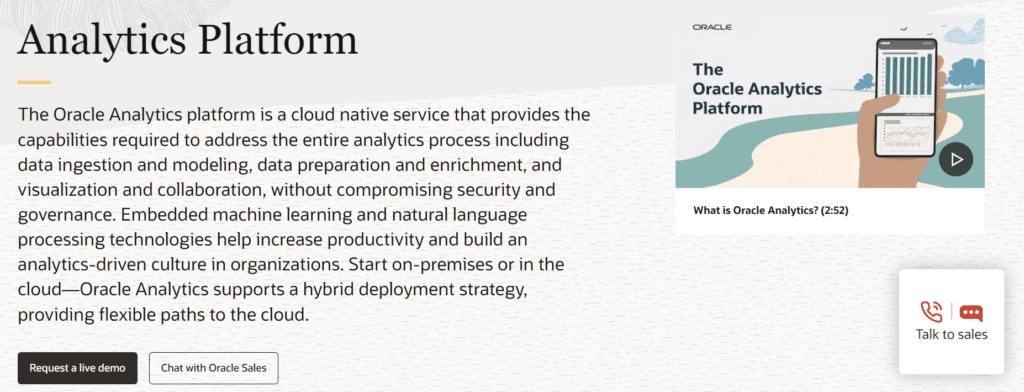
Oracle Analytics is an open, cloud-native service for the end-to-end analytics lifecycle. It includes data ingestion, modeling, preparation, and visualization with built-in security and governance.
It incorporates machine learning and natural language processing to boost productivity and decision-making. The platform enables and allows the flexibility of cloud, on-premises, and hybrid deployment.
Pros:
- Integrates with a wide range of Oracle and non-Oracle data sources
- Offers machine learning and data preparation tools
- Supports multiple deployment options, including hybrid setups
Cons:
- Can be complex for those unfamiliar with Oracle products
- Some users not setup time can be long
- Steep learning curve
Pricing:
- Free 30-day trial
- Contact Oracle Analytics for pricing
Ratings:
- G2: 4.1/5 (300+ reviews)
- Capterra: 4.2/5 (16 reviews)
4. Alteryx
Alteryx is a platform designed to simplify data access and analytics. It is meant for users of all skill levels, which makes it well-suited to teams without extensive technical expertise.
With augmented machine learning, users can also create predictive models without coding.
It provides an end-to-end collaboration solution, covering everything from data preparation to reporting.
Pros:
- Highly-rated
- Intuitive
- Speeds up and simplifies data prepping and cleansing
Cons:
- Cost
- Learning curve
- Some users note limitations in visual tools
Pricing:
- Designer Cloud: Starts at $4,950
- Designer Desktop: $5,195
- Machine Learning solution (predictive modeling functionality) sold separately—pricing available upon request
Ratings:
- G2: 4.6/5 (600+ reviews)
- Capterra: 4.8/5 (97 reviews)
5. Altair
Altair provides AI and data analytics solutions designed to help organizations harness the full value of their data. Its predictive analytics tools are valuable for maintenance, supply chain optimization, and process automation, all of which can reduce operational costs.
It includes solutions for fraud detection, credit scorecards, and disaster avoidance. Altair solutions can be deployed on-premises, in the cloud, or as a hybrid option.

Pros:
- Reasonably priced
- Easy to use if you know SAS programming
- Easy setup
Cons:
- Some users note a confusing and unpolished UX
- Limited integration with major cloud platforms
- Challenges with large datasets
Pricing:
- Available on request
Ratings:
- G2: 4.1/5 (20+ reviews)
- Capterra: 3.9/5 (18 reviews)
6. Adobe Analytics
Adobe Analytics is a popular predictive analytics tool that integrates Adobe Audience Manager and Adobe Analytics to aggregate and analyze large volumes of data.
The platform supports data collection from multiple digital channels, giving businesses a complete view of customer journeys with real-time data insights. Its intuitive analytics features, anomaly detection, and intelligence alerts are stand-out features.

Pros:
- Intuitive UX
- Advanced reporting capabilities
- Has a mobile app
Cons:
- Can be slow
- Limited “out of the box” integrations
- Some users report limited flexibility
- Cost can be high for small businesses
Pricing:
- Contact Adobe Analytics for pricing
Ratings:
- G2: 4.1/5 (1000+ reviews)
- Capterra: 4.5/5 (200+ reviews)
Conclusion: The Best Predictive Analytics Tools
These six tools are excellent examples of what predictive analytics software can do. While the right solution will vary depending on each organization’s needs, you’ll find what you’re looking for in this list.
Gartner notes that with increasing accessibility of generative AI, there is a challenge in navigating a world where data reliability is constantly questioned, creating a deluge of distrust within organizations. If data is not trusted, it may not be used correctly to make decisions, making effective AI governance and responsible AI practices crucial for establishing stakeholder trust.
By 2026, CDAOs who become trusted advisors to CFOs in delivering business value will have elevated data and analytics to a strategic growth driver for the organization. Organizations implementing predictive analytics tools must prioritize data quality, governance frameworks, and transparent methodologies to ensure predictions are both accurate and trusted by decision-makers across the business.
Predictive Analytics Tools FAQs
Predictive analytics uses historical data, machine learning, and statistical models to forecast future outcomes. Algorithms comb through past data to uncover relationships and trends that indicate future scenarios. Businesses use it to predict customer behavior, market shifts, potential risks, equipment maintenance needs, and supply chain demands based on patterns in past information.
Predictive analytics has applications across all industries including forecasting and risk mitigation in finance, optimizing supply chains and operations, targeted marketing and customer retention, improving cash flow management, and talent management and workforce planning. Organizations use it to make credit risk assessments, detect fraud, anticipate demand patterns, personalize marketing strategies, and predict employee turnover.
Common techniques include regression analysis (understanding relationships between variables), decision trees (branching models for possible outcomes), neural networks (complex pattern recognition), time series analysis (predicting from data collected at regular intervals), random forests (averaging multiple decision trees), K-Nearest Neighbours (proximity-based classification), Support Vector Machines (finding separation boundaries), Bayesian Networks (probabilistic modeling), and ensemble learning methods like gradient boosting.
Top tools include Datarails (4.8/5 on G2, AI-powered FP&A with Excel integration), SAP Analytics Cloud (comprehensive BI and planning platform), Oracle Analytics (end-to-end analytics with machine learning), Alteryx (no-code predictive modeling), Altair (AI and data analytics for operations), and Adobe Analytics (customer journey insights). The right choice depends on your business size, technical expertise, industry needs, and budget.
Predictive analytics forecasts what is likely to happen based on historical patterns and statistical models. Prescriptive analytics goes further by recommending specific actions to take based on those predictions. While predictive tells you what might occur, prescriptive tells you what to do about it, combining predictions with optimization algorithms to suggest optimal decisions.
Pricing varies widely. Datarails offers custom pricing based on organization size. SAP Analytics Cloud starts at $36 per user per month with a free 30-day trial. Alteryx Designer Cloud starts at $4,950 per user per year and Designer Desktop at $5,195 per user per year. Oracle Analytics, Altair, and Adobe Analytics require contacting vendors for pricing. Most enterprise solutions offer custom pricing based on features and scale.
Predictive analytics helps finance teams forecast market movements, manage risk, detect fraud before it escalates, make credit risk assessments, guide investment strategy, improve cash flow management, create more accurate budgets and forecasts, and identify liquidity issues before they occur. It enables organizations to shift from reactive to proactive financial decision-making.
Modern tools like Datarails and Alteryx are designed for users of all skill levels, offering no-code or low-code interfaces. However, more advanced techniques like neural networks or ensemble learning may require data science expertise. Many platforms provide templates, pre-built models, and intuitive interfaces to make predictive analytics accessible to finance professionals without extensive technical backgrounds.
Looking for more data analytics insights?
Try one of these articles next: