Click for Takeaways: AI-Generated Financial Insights
- AI does not validate your data — it trusts it: Generative AI models process whatever they receive and return confident-sounding outputs regardless of whether the underlying data is reconciled, current, or consistent. The model is not the problem. The data environment is.
- The three most common failure modes are preventable: Inconsistency between systems, lack of traceability, and outdated static exports are not AI failures; they are data infrastructure failures that a governed data layer resolves before the AI ever sees the data.
- A governed data layer has three concrete components: A consolidated data pipeline, a semantic layer that translates raw fields into standardized financial definitions, and a governance framework with role-based access controls and audit trails. Together, these make AI outputs defensible.
- MCP eliminates the static export problem: Model Context Protocol allows AI to query live, governed financial data in real time, critical at a moment when nearly three-quarters of finance teams are already using AI tools, and the gap between deployment speed and governance maturity is widening.
- The CFO’s scrutiny is the right instinct: Finance leaders who are demanding traceability, access controls, and auditability before embracing AI are not blocking progress; they are defining what responsible adoption looks like. The answer to their questions is not a better model. It is better infrastructure.
CFOs are not resisting AI. They are resisting the conditions under which most AI is currently being deployed. And those conditions would make any finance leader nervous.
Can I Trust AI With Financial Data?
Yes — but trust comes from how governed the data feeding it is, not from how carefully you chose the AI model. An AI model can only be as trustworthy as the data infrastructure beneath it: if that layer applies consolidation logic, enforces permissions, and logs every query, the AI’s output is traceable and accountable in the same way a human analyst’s work is. If the data layer is unconsolidated, ungoverned, or bypassed entirely, no model — however capable — can be trusted to produce a reliable answer. For a deeper look at how a governed data layer works in practice, see how a finance MCP server enforces this at the infrastructure level
The core issue is not the models’ capability. Generative AI tools are genuinely powerful: they can analyze months of financial data in seconds, automate reporting workflows, and support more advanced AI for FP&A initiatives across the finance function. The problem is that these models do not validate the data they receive. They process whatever they are fed and return a confident-sounding output, whether the underlying data is fully reconciled and audited, or a patchwork of conflicting spreadsheet exports pulled from disconnected systems.
In finance, that distinction carries real consequences. It is the difference between an insight that leadership can act on and a liability that appears to be analysis.
The Failure Modes Nobody Talks About
When finance teams deploy AI without a governed data foundation, the failures tend to be unglamorous, but they are exactly the kind that surface at the worst possible moment.
The most common is inconsistency. A revenue figure in the CRM reflects signed contracts; the ERP reflects recognized revenue under the applicable accounting standard. Both numbers exist. Both are correct in their own context. Feed both to an AI tool without resolving the discrepancy at the data layer, and the model has no mechanism to distinguish between them. It will pick one, average them, or produce a figure that corresponds to neither, and present it with complete confidence.
The second failure is traceability. If an AI-generated forecast cannot be traced back to its source data, it cannot be audited. When a board member or external auditor asks how a particular number was derived, “the AI generated it from our data” is not an answer that survives scrutiny.
The third is currency. A spreadsheet exported Monday morning begins decaying the moment it leaves the source system. Transactions post, adjustments are made, and balances shift. The AI analyzing a static export is analyzing a past state, which is fine for historical reporting and genuinely problematic for anything involving real-time decisions.
Gartner research consistently identifies inadequate data quality as one of the top barriers to AI adoption in finance, ranking alongside talent shortages as the challenges CFOs most frequently cite.
These aren’t AI failures in the conventional sense. They are data problems, and that makes them entirely preventable. What makes them dangerous is that AI presents flawed conclusions with the same confidence it brings to accurate ones, making bad outputs much harder to catch than a formula error in a spreadsheet.
What a Governed Data Layer Actually Consists Of
A governed data layer for finance has three concrete components, and Datarails FinanceOS is built around all three.
A consolidated data pipeline: FinanceOS connects to more than 600 data sources through a centralized financial data consolidation framework that unifies ERP systems, CRM platforms, HRIS tools, banking feeds, and spreadsheets into a single governed environment, helping finance teams solve complex ERP consolidation challenges before data reaches the AI layer. Discrepancies are resolved at the infrastructure level, before data reaches any AI or analytical layer. Consolidation logic includes eliminations, allocations, and FX adjustments, so the data the AI queries is the same data the controller has signed off on.
A semantic layer: Raw database fields do not carry financial meaning on their own. A column labeled “rev_adj” means nothing to an AI without context. Datarails FinanceOS applies a semantic layer that translates raw fields into standardized financial definitions – revenue by region, gross margin by product line, cash by entity – so that the AI’s interpretation is consistent every time the question is asked. This is what makes the difference between an AI that reasons about your financials and one that pattern-matches against ambiguous labels.
A governance framework: FinanceOS enforces role-based access controls that determine which users and which AI tools can query which data. Every query and every AI interaction is logged, creating a full audit trail. This is what makes AI outputs defensible, not because the AI itself is auditable, but because the data layer it operates on is. For organizations operating under SOC 2, GDPR, or internal compliance requirements, this infrastructure is not optional.
Together, these three layers are what a finance operating system provides that a general-purpose AI tool (or a traditional FP&A application) cannot: a governed, structured, and traceable data foundation purpose-built for AI-driven finance.
How Datarails FinanceOS Connects AI to Live Financial Data
The static export habit is where most AI deployments break down. It is also increasingly widespread: 72% of finance leaders now use AI tools, up from just 34% in 2024, according to Protiviti’s 2025 Global Finance Trends Survey. A finance analyst exports a spreadsheet, uploads it to an AI tool, and gets an analysis back, unaware that three transactions have closed since the export, or that the file was pulled from a system that hadn’t yet received the month-end adjustments.
Datarails FinanceOS eliminates this problem through a finance MCP server. MCP (Model Context Protocol) is an open standard that allows AI models to query external data systems directly, in real time, without a file ever being exported. The AI sends a structured query; FinanceOS validates the request against the user’s access permissions, applies the semantic layer, and returns a governed, formatted answer. Every interaction is logged in the audit trail.
The practical result is that finance teams can connect Claude, ChatGPT, Microsoft Copilot, or other leading AI platforms directly to Datarails FinanceOS and query live, governed financial data from a prompt. A CFO can ask: “If raw material costs increase 5% next quarter and we delay the product launch by six weeks, what happens to margin by business unit?” and get an answer grounded in actual operational data, applied against standardized financial definitions, with a full record of how it was derived.
What This Looks Like in Practice
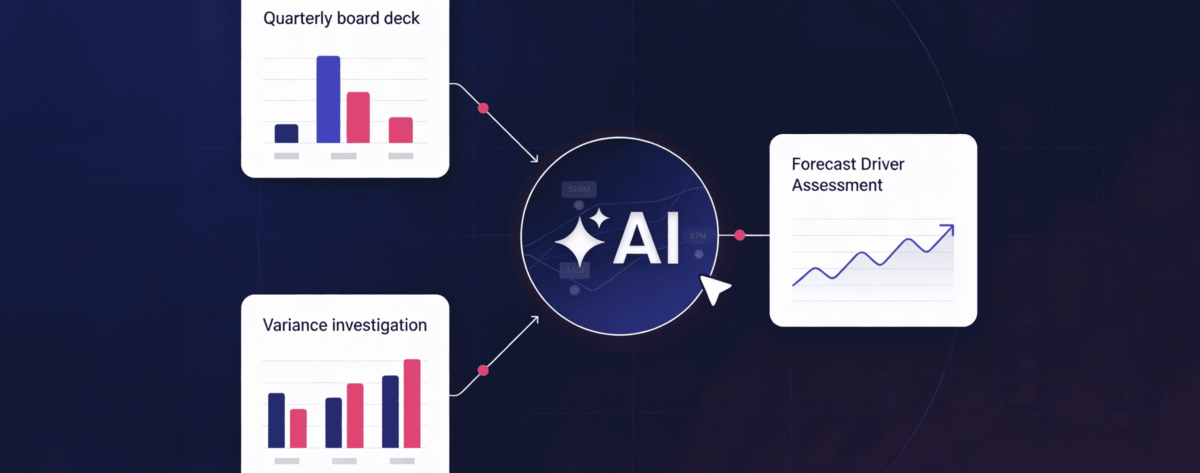
When AI operates through Datarails FinanceOS, the benefits are specific. Automated variance analysis and commentary that previously required pulling, reconciling, and formatting data manually can now be generated from a prompt in minutes. Scenario analysis that would previously require a full model rebuild can run directly against live operational data. Board reporting that required days of preparation can be drafted from a governed, real-time data connection.
More significantly, finance teams stop spending time on data hygiene and start spending time on interpretation. The function shifts from static reporting toward real-time decision support powered by financial dashboard software and live operational data.
CFOs applying rigorous scrutiny to AI adoption are asking exactly the right questions. The answer is not a better model. It is a governed data layer that makes the model trustworthy, and an infrastructure designed to connect AI to governed data without compromising the integrity of either.
Learn more about FinanceOS here.
AI-Generated Financial Insights FAQs
Spreadsheets begin decaying the moment they leave the source system. Transactions post, adjustments are made, and balances shift. An AI analyzing a static export is analyzing a past state, which creates real risk for any decision that depends on current data. A live, governed connection via MCP eliminates this problem.
A semantic layer translates raw database fields into standardized financial definitions — revenue by region, margin by product line, cash by entity. Without it, an AI model has no reliable way to interpret what a field means, and its outputs will reflect that ambiguity. With it, the AI reasons about your financials consistently, every time the question is asked.
Governance frameworks log every data query and every AI interaction, creating a full audit trail tied to the underlying data. The AI itself does not need to be auditable — the data layer it operates on is. When a board member or auditor asks how a number was derived, there is a traceable, documented answer.
At a minimum, finance AI infrastructure should align with SOC 2 and GDPR requirements. Role-based access controls, data residency rules, and audit logging are the practical mechanisms that make compliance possible. Organizations operating under additional regulatory frameworks — SEC reporting requirements, for example — should ensure those requirements are reflected in the governance design.
A traditional FP&A application is designed for planning and reporting workflows. A finance operating system provides the governed data infrastructure that those workflows — and AI tools — run on. It consolidates data from across the organization, applies the semantic layer and governance controls, and exposes that governed data to AI via standardized protocols. It does not replace FP&A tools; it makes them, and the AI connected to them, trustworthy.
Your financial data isn’t sent to the AI model unfiltered — a governed data layer sits between your systems and the AI, serving only pre-consolidated, permissioned data. Existing access controls carry over automatically: if a user doesn’t have permission to see a department’s numbers inside your finance platform, the AI won’t show it to them either.