Click for Takeaways: From Private Equity Analyst to One-Man FP&A Platform
- The rollup reality: Add-on transactions represented 74.9% of all U.S. PE buyout activity in Q1 2025 according to PitchBook, yet most acquired businesses in fragmented industries like HVAC have never had a budget, a forecast, or any FP&A function at all.
- The instinct translation problem: Founders who ran businesses for 20 to 30 years made decisions on gut feel that was often correct, but when new leadership takes over post-acquisition, that instinct doesn’t transfer, and the only way to bridge the gap is by turning tribal knowledge into data.
- PE to operator mindset shift: Private equity trains you to solve everything in a spreadsheet, but in the operating world, not every decision can be modeled, humans aren’t just salary lines to be cut, and speed matters more than precision.
- The forecasting paradox: Getting the aggregate number right matters less than understanding the drivers, because a forecast where every line item was wrong but the total happened to match teaches nothing about which levers actually move the business.
- The platform-building mandate: For PE-backed rollups acquiring 15+ companies across multiple states and systems, the real charge isn’t just producing budgets and forecasts but becoming the strategic data and decision resource for everyone from the board to individual project managers.
There is a particular kind of loneliness that comes with building an FP&A team in a company that has never had FP&A.
This article offers a real-world case study in building an FP&A team from scratch inside a fast-moving PE-backed rollup.
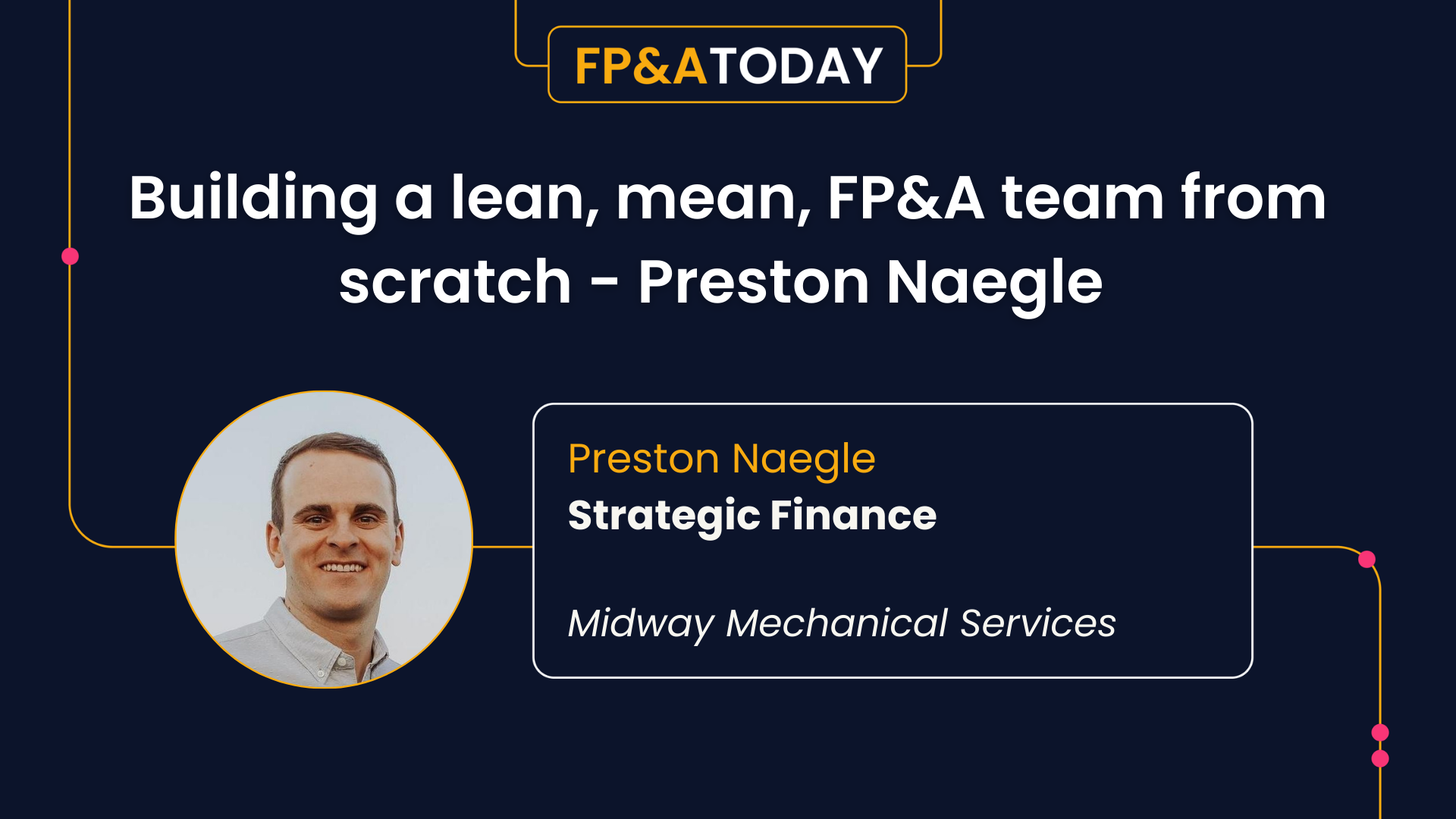
Preston Naegle knows it well. As Director of Strategic Finance at Midway Mechanical Services, he is the entire finance planning function for a PE-backed HVAC rollup that has completed 15 acquisitions across the Western United States, with three closed in 2025 alone. The company has roughly 600 employees spread across commercial heating, ventilation, air conditioning, electrical, and plumbing operations. Most of the businesses Midway acquires have never produced a budget. Many have never done a forecast. Some of the founders who built these companies over decades are still trying to figure out why they would need either.
“Very few have ever done any sort of budgeting. They’ve mostly just operated by gut feel. So bringing us into the equation is a challenge. They’re like, why would we do this?”
Naegle’s path to this role was unusual. He landed in private equity straight out of undergrad, which he attributes to preparation and timing rather than pedigree. He spent his early career at a healthcare-focused PE fund in Salt Lake City, where the learning was relentless: dozens of businesses at various stages, constant diligence, and the expectation that you could become an expert in a completely unfamiliar market in two to three days.
That PE training gave him frameworks for problem decomposition, risk assessment, and value creation. It also gave him something he eventually needed to unlearn.
The Firehose and the Spreadsheet
At the fund, Naegle was once handed a deal involving treatment for traumatic brain injuries, a space nobody on the team had seen before. He had two to three days to map the market across the United States, understand which payers covered the treatment and under what stipulations in every state, and determine where the company should expand first and why.
“You have to break this problem down, hypothesize what the most critical elements are, and then quickly come to a conclusion in each of those and try to find the data to support that conclusion.”
That framework, breaking the problem down, confirming or disproving fast, explaining why, became the operating system for his career. But private equity also trained him to default to the spreadsheet for everything. Every decision, every trade-off, every human situation could theoretically be modeled.
The operating world taught him otherwise.
“Every decision can’t be made in a spreadsheet. You have someone who’s having a hard time in their job. You can’t take that conversation and go put it in a spreadsheet and say, how are we gonna solve for the right outcome?”
The shift from investor to operator also changed how he thought about people. In PE, employees were salary lines in a model. You never saw them. You interacted with the CEO, the CFO, maybe the COO. Everyone else was a number that could be optimized.
“They are just numbers to me. That’s all I ever see sitting in my office. And it started to get kind of gross.”
That discomfort was a major reason he left. On the operating side, he sees the full picture: people who are skilled at what they do, who aren’t just compensation lines to be trimmed but team members who need to be in the right roles, rowing in the same direction. Growth, he found, is more fun than cutting.
What PE-Backed Rollups Actually Look Like From Inside
The rollup model is the dominant PE playbook right now. In the lower middle market, roll-ups accounted for over 80% of all deals in 2024, according to PitchBook data compiled by Cherry Bekaert. Fragmented industries with local operators, founder-led businesses, and limited technology penetration are the targets. HVAC fits the profile perfectly.
But the playbook on paper and the playbook in practice are different things. Midway’s businesses range in size, mostly between $10 million and $20 million in revenue, primarily commercial with some residential, and leaning toward service work, though with significant project-based construction. Each acquisition brings its own systems, its own data architecture (or lack thereof), and its own deeply held beliefs about how to run the business.
Naegle’s mandate is to transform this collection of acquisitions into a platform. That means defining the FP&A team structure from scratch: budgets, forecasts, KPIs, consolidated reporting, and eventually the kind of strategic decision support that turns finance from a cost center into a value driver. He is doing this essentially alone.
“My CFO and I are really trying to push towards this being the strategic decision center. We’re basically trying to be the strategic data and decision resource for the entire business.”
The challenge is that you cannot build strategic finance on bad data, and newly acquired companies rarely have good data. Their accounting may not be GAAP-compliant. Their operational metrics live in different systems, sometimes ServiceTitan, sometimes something else entirely. And the people running these businesses have been making decisions successfully for decades without any of this infrastructure.
Forecasting When Everything Is a Variable
HVAC project work introduces forecasting complexity that most SaaS-focused FP&A practitioners never encounter. Revenue recognition runs on WIP schedules. Projects can be several hundred thousand dollars each. General contractors push timelines. Weather shifts demand. Economic conditions cause customers to pause. And Naegle is forecasting for 15 businesses simultaneously from Salt Lake City.
“I was sick and tired of hearing about the weather and interest rates. Guys, we can do better than that. And then the more you spend time with them, you’re like, okay, yeah, well it does drive a lot of decisions beyond what we are doing.”
His approach has been to group projects by size and attributes, finding that similarly scoped work tends to follow similar patterns in aggregate. It is not precise at the individual project level, and he is candid about that. But the precision of the forecast matters less than the behavioral change it drives.
“It’s way less about getting the number perfectly forecasted. It’s what are the drivers and what things do each of us have, what are the levers, to help drive to the result that we want to get to?”
He quotes a colleague who, in budgeting meetings, keeps reading Eisenhower: all battle plans are useless, but the planning process is invaluable. The point isn’t to nail the number. The point is to force the organization to think through drivers, assumptions, and contingencies so that when reality diverges from plan, people know which levers to pull.
This is where Naegle sees the real value of FP&A in a business that has never had it. Not the forecast accuracy. The moment when a general manager looks at margin data for the first time and realizes they haven’t been billing for filters. Or when a business unit leader discovers that service margins are lower than they assumed because no one was reviewing the invoices going out.
“I always approach it as, I’m probably wrong, but this is what it’s showing us. Let’s explore it together.”
That posture, leading with humility rather than authority, is how he brings operators along. One of his general managers routinely shows up to meetings with a piece of cardboard that reads “Make Money. What you’re doing is dumb.” Naegle laughs about it, but he also respects the instinct behind it. These are people who built real businesses. The job of FP&A isn’t to replace their judgment. It’s to give them data that sharpens it.
Why the NetSuite Planning Path Didn’t Work
When Midway evaluated FP&A tools, they started down NetSuite’s native planning path and also tested the analytics warehouse tool for dashboarding. In both cases, the team kept hitting the same wall: NetSuite’s tools required dedicated administrators, and a lean FP&A startup framework doesn’t have that luxury.
“They said, well, you really need a few people to manage these things. It’s like, well we don’t have that luxury. That was problem number one that Datarails solved.”
Datarails tied into NetSuite and allowed Naegle to administer the entire platform solo. Data from multiple sources, including operational platforms like ServiceTitan that many acquired companies still run, could be consolidated without waiting for every business to migrate to NetSuite. For someone who describes the tool as “Power Query on steroids where I don’t have to worry about the backend,” it removed the infrastructure burden and let him focus on the actual finance work.
The budgeting and forecasting live in spreadsheets, which is where Naegle works fastest, with Datarails handling the consolidation and dashboarding layers. The efficiency gain has been significant enough that the organization keeps asking for more. His response: slow down, let me catch up.
From Hunch to Hypothesis
Naegle borrows a phrase for what he is trying to do across Midway’s portfolio: moving the business from hunch to hypothesis. The founders’ instincts were often correct. But instinct doesn’t transfer to new leadership, doesn’t scale across 15 businesses, and doesn’t give a PE board the visibility it needs to evaluate the platform.
The add-on acquisition model continues to accelerate. PitchBook reported that add-ons represented 74.9% of all U.S. PE buyout activity in Q1 2025, a 150-basis-point increase over the 2024 average. That means there are thousands of companies going through exactly what Midway’s acquisitions experience: being brought into a platform, encountering budgets and forecasts for the first time, and wondering why the person from “corporate” keeps asking about margins.
Naegle’s view on AI mirrors his approach to everything else: pragmatic, not utopian. He uses it for monotonous, hyper-focused tasks. He has found it gets about 80% of the way there on complex work, at which point you are often better off taking that foundation and finishing it yourself. The long-term promise, he believes, is scale: a business that does $10 million in revenue today could support $100 million with the same team if AI amplifies their capacity effectively.
But that future requires the groundwork he is laying now. You cannot apply AI to data that doesn’t exist. You cannot automate decisions nobody has frameworks for. The unsexy work of building an FP&A team from scratch, getting operators to care about margins, translating instinct into data, and creating a planning process that survives contact with reality is what makes everything else possible.
“A business that can do $10 million in revenue today, I think that same team could support a hundred million dollars in the future. That’s how I’m thinking about it.”
When he isn’t building financial models from HVAC trial balances, Naegle tends a 40-tree fruit orchard at the childhood home he recently moved back into with his family. The harvest, mostly peaches and nectarines, runs through late July and August. He wishes he had paid more attention to his parents’ technique when he was a kid. And for the record, despite persistent rumors at Midway Mechanical, he does not compete in whistling competitions. His CFO started that one, and the more he denies it, the more people believe it.
Where Datarails Fits
At Datarails, Naegle’s world is exactly the problem we built for. A one-person FP&A team consolidating data from 15 acquired businesses, each on different systems, each with different data maturity, all needing budgets and forecasts for the first time. Our Excel-native platform lets finance leaders like Naegle pull data from NetSuite, ServiceTitan, and every other source into a single environment, build models in the spreadsheets where they work fastest, and produce the dashboards and consolidated reporting that PE boards demand. When the next acquisition closes, the data onboarding happens in Datarails, not in a six-month systems migration. Because in a rollup moving this fast, the FP&A function either scales with the platform or becomes the bottleneck.
This article is based on Preston Naegle’s appearance on the FP&A Today podcast.
Preston Naegle is Director of Strategic Finance at Midway Mechanical Services, a PE-backed rollup in the HVAC, electrical, and plumbing space that has completed 15 acquisitions across the Western United States. He previously worked in private equity at a healthcare-focused fund in Salt Lake City and co-founded a software business for developers.