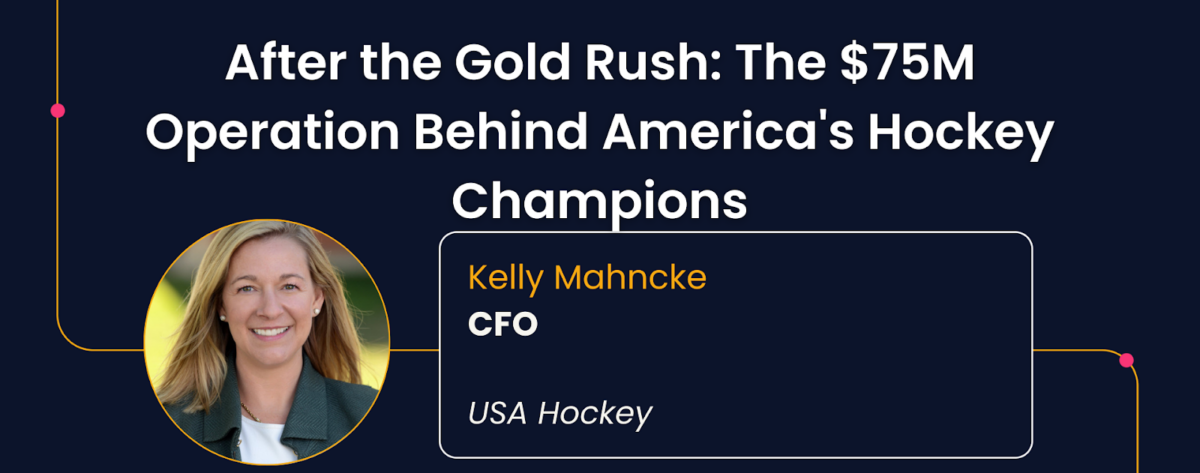
Kelly Mahncke came to USA Hockey as a player turned finance executive. What she found was a membership organization sitting on decades of untapped data and a technology strategy that needed a complete rethink.
Click for Takeaways: Sports CFO Digital Transformation
- USA Hockey runs four distinct business entities under one roof, making it structurally more complex than most $75M organizations its size.
- When Mahncke arrived in 2019, USA Hockey had no clear picture of member lifetime value, acquisition cost, or price elasticity, despite holding decades of registration data on a base that has since hit an all-time high of 577,000 members.
- A performance-based expense audit structured so the auditing firm only got paid if it found savings gave USA Hockey its first honest picture of where resources were actually going.
- Building proprietary member data programs is one of the defining financial priorities for sports organizations. USA Hockey is doing exactly that, working through decades of registration data to model lifetime value, acquisition cost, and price elasticity for the first time.
- AI-driven injury analytics tracking body part, game period, and penalty involvement for every claim could reshape equipment design and coaching practices across 1.2 million members.
- After growing net assets by 149% since 2019, Mahncke’s operating principle is still the same: intense, unrelenting curiosity about what the data is actually trying to tell you.
When most people think of USA Hockey, they think of the Olympics. The men’s and women’s teams, the four-year cycle, the moments that make it onto highlight reels. What they don’t think about is the insurance company, the arena, the drive-in movie theater, the restaurant, the foundation, and the 1.2 million members ranging from six-year-olds lacing up for the first time to adults still playing competitive hockey into their eighties.
Kelly Mahncke thinks about all of it. As CFO and Assistant Executive Director of Finance and Administration at USA Hockey, she oversees four distinct companies operating under one umbrella, a membership organization that has been around since 1937, serving an ecosystem of roughly 1.2 million participants, including an all-time high of more than 577,000 registered players in the 2024–25 season. Before joining USA Hockey in 2019, she served as CFO at Arapahoe House, Colorado’s largest substance abuse treatment provider, and held a similar role at a complex rehabilitation equipment company. She played hockey through college, earned an MBA in finance from the University of Colorado, and completed executive education at Wharton and Harvard Business School.
CNBC recently profiled her as a tech leader deploying AI across the organization. The more instructive story, though, is the one that came before the AI: how a CFO with a strong finance background and a genuine love for the sport approached an organization that had been successful for decades without ever fully understanding its own data.
The Business Nobody Sees
The public version of USA Hockey is the Olympic team. The operational version is considerably more complicated. The organization functions as a national governing body under the United States Olympic and Paralympic Committee, which means it carries both the infrastructure of a mid-sized nonprofit and the reputational weight of sending teams to the Games. Membership dues represent roughly 65% of revenue, which creates a relatively stable base but also means the organization lives and dies by participation trends, renewal timing, and the lifetime value of members who stay in the sport for decades.
Four companies, four different financial models, and four different sets of stakeholders all reporting through one finance function. The insurance subsidiary alone sits at an interesting intersection of Mahncke’s career, covering sanctioned events and collecting claims data that, as she is now discovering, contains a level of analytical richness the organization has barely begun to use.
For CFOs entering complex, multi-entity nonprofits, the first challenge is almost never strategic. It is operational: understanding what is actually being spent, where, and why. For 4 out of 5 finance leaders, becoming a data-driven organization is a high priority, according to Horvath’s 2024 CFO study. The gap between that ambition and the reality of what most organizations actually know about themselves is where Mahncke started.
The Audit With Skin in the Game
One of Mahncke’s first moves at USA Hockey was bringing in an external auditing firm to review all GL transactions across categories. The structure of the engagement was deliberate: the firm only got paid if it found savings. The incentive design ensured they were motivated to actually look.
What emerged wasn’t a dramatic revelation so much as a clear-eyed accounting of where economies of scale were being missed and where spending had calcified into habit rather than strategy. From insurance to 403(b) structures to vendor contracts, the review gave Mahncke a baseline she could build from.
“We had to look at whether we were utilizing economies of scale and where resources were actually going. That review gave us a really good handle on whether we were being as fiscally responsible as possible.”
It was also a proof of concept for a broader operating philosophy: don’t assume that what has always been done is what should be done. For an organization that had been around since 1937, that was not a given.
The Buy-vs-Build Reckoning
When Mahncke arrived, USA Hockey was in the middle of a technology strategy built around building its own systems. Event management, registration, learning management. The plan was to develop everything internally with offshore developers, then eventually monetize the platforms by licensing them to other organizations. The logic was understandable. If you have technical resources in-house and the belief that your use cases are unique, building feels like the right move.
The reality was messier. The organization’s needs were genuinely specialized in some areas, particularly around its registration system and officiating programs, which were too nuanced to buy off the shelf. But the ambition to build everything had created technical debt without a clear path to the revenue it was supposed to generate.
Mahncke changed the strategy. The new direction was configurable rather than customizable: off-the-shelf SaaS solutions where they existed, purpose-built systems only where the requirements genuinely couldn’t be met any other way. The distinction matters. Customizable means starting from scratch. Configurable means adapting something that already works.
The transition took time and created the kind of disruption that any large-scale technology shift produces, particularly in an organization where some employees had been doing things the same way for 30 years. But it set up the infrastructure that would eventually allow the organization to ask more sophisticated questions of its data.
COVID and the Discipline of Necessary Spending
The pandemic hit USA Hockey hard in ways that were predictable and some that were not. Travel is a significant part of how the organization operates, and it stopped. The restaurant at the organization’s Michigan facility, already operating in a challenging segment, lost the lunch business that may never have fully returned.
Mahncke doesn’t frame the COVID period as a technology story. The technology transformation and the pandemic were running simultaneously, but the correlation between them was weaker than it might appear from the outside. The real lesson from COVID was simpler and more fundamental: every dollar has to be going in the right direction, and you have to know what the right direction is before a crisis forces you to find out.
“It almost requires understanding about turning a business around. Only the absolute necessary spending that has to be done, and every dollar going in the right direction.”
USA Hockey came out of it more disciplined. Net assets have grown 149% since Mahncke joined in 2019, a figure she treats as a north star metric for the strength of the business, not just a line on a balance sheet.
The Data Maturity Curve
The more significant transformation at USA Hockey has been the slow, deliberate process of going from having data to being able to ask strategic questions with it. The organization has had online membership registration since the early 1990s. That represents decades of data on when members register, how long they stay, which age cohorts churn, and what the revenue profile looks like across different segments.
For most of that time, none of it was being used in any structured analytical way. The first step was simply understanding what existed. The second was cleaning it and connecting it across systems. The third, which Mahncke describes as moving from walking to running, is where the organization is now: starting to build models around customer lifetime value, acquisition cost, retention cost, and price elasticity.
“We don’t know what we don’t know. And so we’re digging into decades of data and really trying to ascertain what is customer lifetime value, what is the cost of acquiring a customer, what is our price elasticity.”
Deloitte’s 2024 Sports Industry Outlook identifies building proprietary fan and member data programs as one of the defining financial priorities for sports organizations in the years ahead. USA Hockey is working through exactly that exercise, and the membership model creates a natural analytical opportunity to do it. With 65% of revenue tied to membership and renewal patterns that play out across years or decades, even small improvements in understanding when members register, how to move them earlier in the cycle, and what drives retention compound significantly. Mahncke described a scenario where shifting registration timing by even a day or two could have a measurable impact on revenue velocity, and from there, on the organization’s cash position and what it can do with the five-year treasury rate.
For CFOs managing member-based organizations, this is where the work is. Not in the headline metrics, but in the granular behavioral data that has been sitting in registration systems for years, waiting to be asked the right questions.
AI in the Insurance Company
The most operationally distinctive AI initiative at USA Hockey isn’t in the finance function. It’s in the insurance subsidiary, and it may turn out to be one of the more meaningful applications of injury analytics in grassroots sports.
Every claim filed through USA Hockey’s insurance program now captures structured data: body part injured, period of the game, location on the ice, whether a penalty was involved. That data, aggregated across a membership base of 1.2 million and spanning multiple seasons, creates the kind of injury pattern visibility that has historically only been available to professional leagues with the resources to build it.
Research published in Nature demonstrates that AI-driven analysis of biomechanical and injury data can identify patterns that inform preventive interventions, from equipment design to training modifications. USA Hockey is building toward exactly that kind of feedback loop: taking what the claims data reveals about when and how injuries occur, and routing it back to coaches, officials, safety committees, and equipment providers.
“If you can prevent one injury, that means the world to somebody.”
The mandate for neck laceration guards, introduced roughly a year and a half ago, is an example of the kind of safety decision that better data can support. As the injury analytics capability matures, the decisions it informs could become more targeted and more frequent, moving from broad policy changes to specific recommendations by age group, position, or game situation.
There is also a commercial dimension. The data has potential value to equipment manufacturers and other partners. Mahncke is clear-eyed about that possibility without letting it drive the primary rationale, which is keeping the game safer for the people who play it.
AI in the Back Office: Cautious by Design
In the finance function itself, Mahncke is using tools like Microsoft Copilot and approaching AI adoption with the deliberateness of someone who has seen what happens when organizations move faster than their controls allow. The risk is not hypothetical. The pressure to show AI ROI quickly has pushed some organizations into implementations that produced exactly the kind of embarrassing outputs that make finance leaders more resistant to adoption.
Her framework is narrower than the broad AI deployment narrative suggests: identify a specific use case, build in oversight, track ROI, and only expand when success is demonstrable. Don’t boil the ocean.
“We want to be very cautious of privacy. We want to be very cautious of our data. We don’t want to get into a situation where people have egg on their face.”
This is not resistance to the technology. It is the application of the same risk management discipline that defines good finance leadership to a domain where the failure modes are still being discovered. The cautious approach, applied consistently, also builds the organizational trust that eventually makes broader adoption possible.
Relentless Curiosity as an Operating System
When Mahncke is asked what the most important ingredient in the transformation has been, she doesn’t reach for a technology framework or a methodology. She reaches for a disposition: intense, unrelenting curiosity about what is actually happening in the business and why.
In practice, that means asking a question about an insurance loss run until you understand what’s driving it. It means wanting to know not just that a cost center is over budget but what the individual transactions are doing. It means treating every piece of data as a question rather than an answer.
For FP&A leaders, this is the part of the CFO conversation that gets skipped when the discussion turns to tools and platforms. The technology is necessary but not sufficient. What makes data maturity real in an organization is the combination of systems that can surface the right information and leaders who have cultivated the instinct to ask the right questions of it.
USA Hockey now has a better picture of its business than it has had at any point in its history. That picture is still incomplete. Mahncke would be the first to say so. But the direction of travel, from hand-signed checks to AI-driven injury analytics to a 149% increase in net assets, suggests that knowing what you don’t know is a more powerful starting point than most organizations give it credit for.
Where Datarails Fits
Datarails is the AI-powered FP&A platform built for Excel users, giving finance teams the data consolidation, reporting, and AI-driven analysis they need without leaving the spreadsheet environment they already work in. More than 1,500 companies use Datarails to accelerate close cycles, build board-ready reports, and turn raw financial data into the strategic narratives that drive decisions. Learn more at datarails.com.
This article is based on Kelly Mahncke’s appearance on the FP&A Today podcast.
Kelly Mahncke is CFO and Assistant Executive Director of Finance and Administration at USA Hockey, the national governing body for ice hockey in the United States. Before joining USA Hockey in 2019, she served as CFO at Arapahoe House, Colorado’s largest substance abuse treatment provider, and in a CFO role at a complex rehabilitation equipment company. She holds an MBA in finance from the University of Colorado and has completed executive education at Wharton and Harvard Business School. Connect with her on LinkedIn.