Click for Takeaways: The M&A Integration Playbook for Transformational CFOs
- The IR Pivot: Investor relations at Xerox transformed Anderson’s trajectory from internal analyst to strategic CFO candidate by forcing an “outside-in lens” that revealed what markets value versus what finance teams track internally.
- Integration Reality: 70-90% of M&A deals fail to meet objectives, with 50% failing specifically due to organizational and cultural integration issues, making post-merger execution the true competitive differentiator, not deal sourcing.
- Kelly’s $900M Lesson: When acquisitions remain unintegrated, organizations sacrifice market recognition, operating efficiency, and scale advantages. Kelly spent $900 million on deals but couldn’t capture full market recognition and scale advantages until committing to integration.
- The Workforce Paradox: In an asset-light, people-centric business model where 70% of costs are human capital, financial strategy and workforce strategy become inseparable, requiring CFOs to partner across HR, operations, and technology.
- AI Augmentation Truth: Half of organizations will abandon AI-driven workforce reduction plans by 2027 as “agentless” service proves elusive. 55% report stable staffing while handling higher volumes, with AI boosting efficiency rather than eliminating roles.
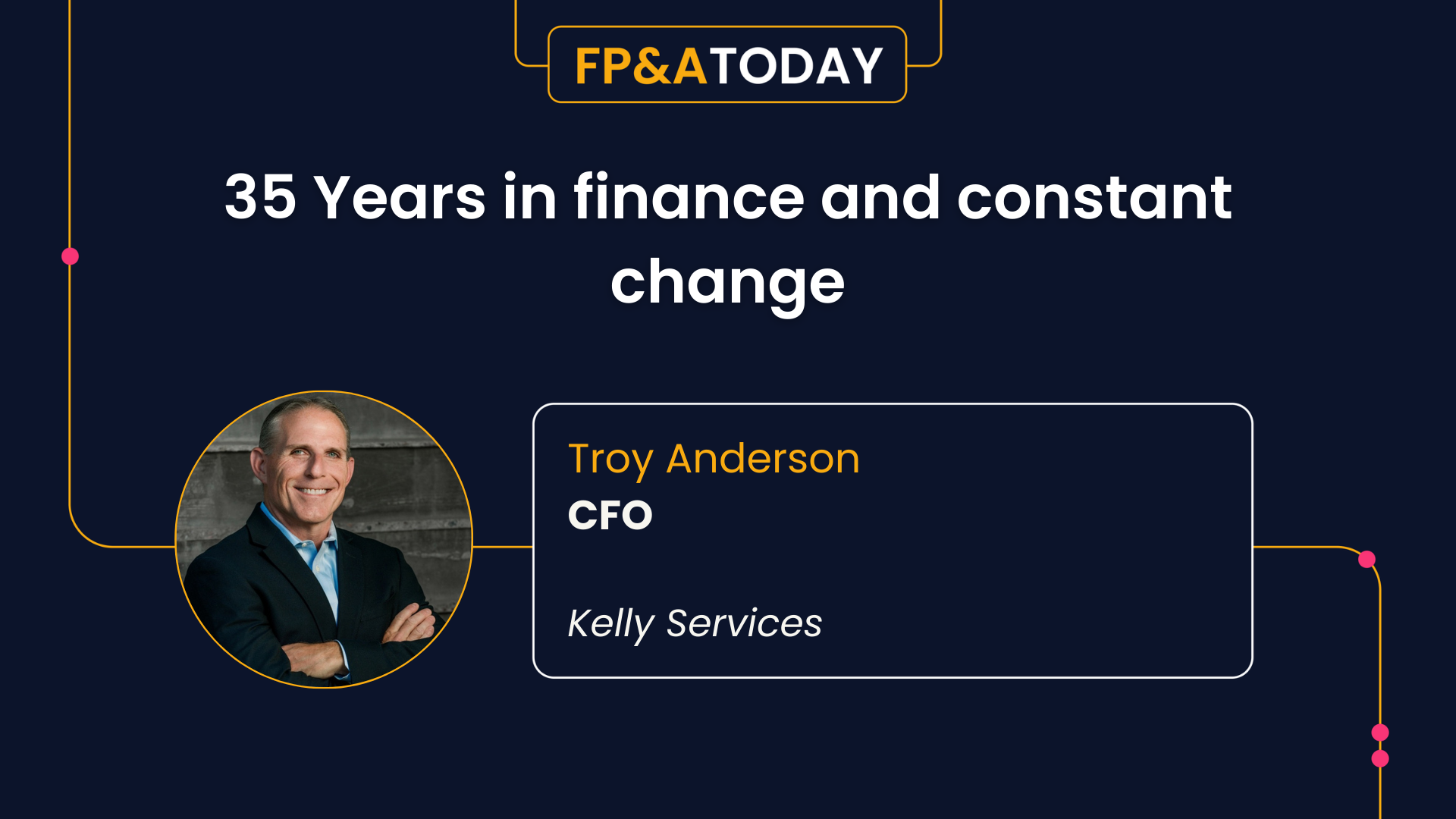
In an era where 70% of mergers fail to meet their objectives, Troy Anderson has built a career by succeeding precisely where most organizations stumble: the brutal work of post-merger integration. His CFO career lessons, forged across 35 years and five companies, center on one theme: integration, not deal sourcing, is where acquisition value is won or lost.
Before joining Kelly Services, Anderson served as CFO at Universal Technical Institute, where he helped double revenue over five years through a disciplined mix of organic growth and strategic M&A. Earlier in his career, he held senior finance leadership roles at Conduent, a $6 billion player spun out from Xerox, where he helped build a standalone public company while simultaneously cleaning up decades of unintegrated acquisitions.
Anderson’s path from internal FP&A analyst to transformation CFO wasn’t linear. It was catalyzed by a single rotational assignment that fundamentally rewired how he understood the finance function’s strategic role.
The Investor Relations Awakening: From Internal Analyst to Strategic Partner
For Anderson, the inflection point came not through a promotion, but through a perspective shift. After spending years as an internal FP&A business partner following the Xerox-ACS merger, he moved into an investor relations role at Xerox’s corporate headquarters.
“Your job for the next 90 days is to do nothing,” his new boss told him on day one. “Your sole job is to watch and learn.”
It was an uncomfortable mandate for someone accustomed to “taking the hill,” but it proved transformative. The IR role forced Anderson to develop what he calls an “outside-in lens.” He learned which metrics truly moved markets, how the C-suite operated as a collective unit, and what investors cared about versus what finance teams obsessed over internally.
“Being able to learn the business, articulate that in a meaningful way to the investment community, and really work with the C-suite, those were just so many elements from a learning perspective.”
The experience allowed him to later move into a troubled business unit, helping not just turn around the financials but coaching the business unit leader on how to engage more effectively with Xerox’s corporate leadership.
This outside-in orientation illustrates how the CFO role has changed: evolving well beyond traditional finance boundaries into strategic leadership. Research from Russell Reynolds Associates shows that 34% of outgoing CFOs moved into president or CEO roles in 2024, up dramatically from 20% in 2023. This trend is driven in part by CFOs who’ve cultivated the strategic, cross-functional perspective Anderson developed through investor relations.
The Integration Imperative: Where M&A Value Lives or Dies
Anderson’s résumé reads like a masterclass in corporate consolidation: MCI/WorldCom, Sprint/Nextel, Xerox/ACS, Conduent spin-out, multiple acquisitions at UTI, and now Kelly Services’ $900 million acquisition spree. But he’s quick to point out that signing the deal is the easy part.
“We get to the ‘Hey, we signed the paper, now we’re working,’ because we actually have to go do something about it.”
The statistics validate his focus on execution. The challenge Anderson describes is remarkably common.Research from McKinsey shows that M&A failure rates stand between 70% and 90%, with the firm’s analysis finding thatnearly 50% of mergers fail to meet expectations specifically due to organizational issues like cultural differences and changing operating models. These are precisely the integration challenges Anderson has spent his career solving.McKinsey’s research found that 61% of acquisition programs don’t even earn back their cost of capital, making post-merger integration excellence a genuine competitive advantage rather than merely good practice.
At Conduent, the challenge was cleaning up legacy transactions that had never been properly integrated. “We still had email domains and brands from 15 and 20-year-ago acquisitions,” Anderson recalls. The three-year roadmap focused on collapsing systems and bringing organizations together. This is unglamorous work that doesn’t show up in deal announcements but determines whether synergies materialize or evaporate.
At UTI, the approach was different: building organizational muscle from scratch to not just execute acquisitions but integrate them with discipline. When they acquired a smaller school, the entire value proposition hinged on replicating that $25 million business tenfold by expanding programs across UTI’s existing campus footprint. “We were very disciplined with the integration management office, et cetera,” Anderson notes. This approach helped take the company from $330 million to nearly $800 million in revenue.
Kelly Services: The Cost of Avoiding Integration
Anderson joined Kelly Services in 2024 to tackle a problem many acquirers face but few acknowledge: the hidden tax of choosing not to integrate. Kelly had spent approximately $900 million on acquisitions between 2020 and 2024, with the explicit philosophy of leaving acquired firms as standalone entities to preserve their unique value.
The strategy had a certain logic: maintaining the specialized expertise of boutique staffing firms. But Anderson quickly identified the flaw.
“If you’re going to market as three or four different entities, just because you add it up and you’re a top 10 player in IT services, you’re not going to market as a top 10 player.”
The operating inefficiencies were glaring. Multiple technology stacks. Redundant processes. No economies of scale. And critically, no market recognition for the combined capabilities Kelly had assembled.
“That’s now the impetus throughout all of 2025 and continuing forward: to get on the common technology stack and do the integration.”
The work includes a full Workday implementation across finance, HR, and operations, with every function experiencing change simultaneously.
It’s a multi-year transformation specifically because Anderson understands that successful integration requires bringing the entire team along.
“You have to have the buy-in from the team from the very beginning. It’s not just saying it. You can’t just send one email or make one announcement. We have to consistently reiterate that message.”
The Human Capital Equation: Finance Strategy for a People-Centric Business
Kelly Services presents a unique challenge for a CFO: an asset-light business model where approximately 70% of costs are people-related, yet the company employs only 5,500 direct staff while managing hundreds of thousands of workers on assignment.
“We’re asset light. We don’t have large manufacturing plants. It’s really all about operating efficiency.”
This creates an unusual strategic calculus. Investment decisions aren’t just about capital equipment or facilities. They’re about process efficiency, technology enablers, and workforce optimization across geographies. The questions become: Where is the best place to do the work? What requires high customer touch versus back-office support? How do we design processes around efficiency while maintaining service quality?
The model also creates natural convergence between financial strategy and workforce strategy. “Finance is really integrated in that,” Anderson explains, describing how payroll for hundreds of thousands of workers flows seamlessly into billing and AR.
“It’s critical that the operating side and the finance side are really fully linked in everything we do.”
This integration challenge isn’t unique to Kelly. It reflects broader workforce transformation that finance leaders must navigate.Gartner research estimates that 37% of the workforce will be impacted by generative AI in the next two to five years. But Anderson’s experience at Kelly shows that AI’s impact will be more nuanced than simple headcount reduction.
AI as Augmentation, Not Replacement
When asked about AI’s existential threat to business process outsourcing, Anderson pushes back on the displacement narrative.
“Fundamentally the work we’re doing is people-based work that is not really displaceable by technology,” he explains, pointing to Kelly’s semiconductor fabrication support as an example.
At massive TSMC, Intel, and Samsung facilities in Arizona, the production floors are almost entirely automated. There are barely any people inside, and operations can run with no lights during certain windows. But Kelly provides the support services around the periphery: materials handling, equipment management, check-in and out processes.
“They don’t want to spend time thinking about checking tools in and out or making sure the silicon disks are coming in on the loading dock correctly.”
Anderson’s assessment reflects emerging workforce data that contradicts the displacement narrative.Gartner predicts that by 2027, 50% of organizations expecting to significantly reduce their customer service workforce due to AI will abandon these plans as the vision of “agentless” service proves elusive. AGartner survey of 321 customer service and support leaders found that 55% report stable staffing levels while handling higher customer volumes. AI is boosting productivity, not eliminating roles. Meanwhile, 42% of organizations are hiring specialized positions, including AI strategists and conversational designers, suggesting workforce evolution rather than contraction.
For Kelly, AI creates revenue opportunities rather than just cost reduction.
“We’re definitely proliferating AI in our client solutions to provide them better analytics and data and drive efficiencies for them. Our ability to bring some of that to the table gives us new revenue opportunities to sell them solutions and services that we didn’t have the capability of previously.”
Leader First, CFO Second: The Expanded Mandate
Anderson is careful about how he frames his role. “I try to be a leader in the company first and foremost,” he says. “It’s company first. How do we operate as effectively as we can? How do we go to market? How do we deliver our services?”
This philosophy extends to how Kelly’s leadership team presents itself. In planning an upcoming leadership meeting, the team deliberately mixed up who would present which content. Anderson would cover operational topics, the general counsel would discuss strategic initiatives, the CHRO would present on business matters.
“You want the leadership team to be looked at as the leadership team,” Anderson explains, “not ‘Well, Troy’s just the CFO’ or ‘Amy’s just the CHRO.’ No, we’re all company leaders.”
But he acknowledges the CFO seat has unique strategic leverage. “The CFO is in a bit of a unique seat in terms of being that business partner to the CEO. You see a lot of CFO to CEO progressions from a succession, from a career perspective.”
For anyone seeking CFO leadership advice, Anderson’s message is clear: think like a company leader first and a finance executive second.
The career progression Anderson describes is accelerating. Research from Russell Reynolds Associates tracking the S&P 500, FTSE 100, and Euronext 100 found that 34% of outgoing CFOs moved into president or CEO roles in 2024, up sharply from 20% in 2023. An additional 15% moved into divisional CEO positions. This trend reflects what Anderson learned through investor relations: the CFO who develops an outside-in perspective, understands cross-functional dynamics, and can translate financial strategy into business narrative becomes a natural successor to the CEO role.
The breadth of visibility matters. “The more effective I can be as a CFO,” Anderson notes, “the more I understand the business, the drivers, the culture, the people, all the things that are going on. I can anticipate things that are happening, what might impact the numbers, where we might need to invest.”
It’s an approach forged through 35 years of transformation work. Anderson understands that sustainable change comes not from brilliant strategies alone, but from bringing people along, integrating rather than acquiring, and viewing finance as a strategic enabler across the entire value chain.
Conclusion
For the modern CFO navigating M&A, workforce transformation, and AI disruption, Anderson’s CFO career lessons offer a clear playbook: develop an outside-in perspective early, obsess over integration rather than just acquisition, build organizational muscle for change, and position finance as a strategic partner across the entire business.
The technical ability to close deals is merely the entry fee. To win, you must master the unglamorous work of making those deals actually deliver value. This is the work that happens after the consultants leave and the press releases fade.
Where Datarails Fits
At Datarails, we’re built for CFOs like Troy Anderson who understand that transformation isn’t about the initial system selection. It’s about the operational excellence and data integrity required to make change stick. We provide the automation and consolidation that allow finance leaders to stop being data archaeologists and start being strategic partners.
This article is based on Troy Anderson’s appearance on the FP&A Today podcast.
Troy Anderson is CFO of Kelly Services, a global workforce solutions company. Over a 35-year career spanning Xerox, Conduent, and Universal Technical Institute, he has led finance through large-scale M&A integrations, corporate spin-outs, and workforce transformation initiatives. His investor relations work at Xerox shaped a career-long emphasis on developing an outside-in perspective on financial strategy.