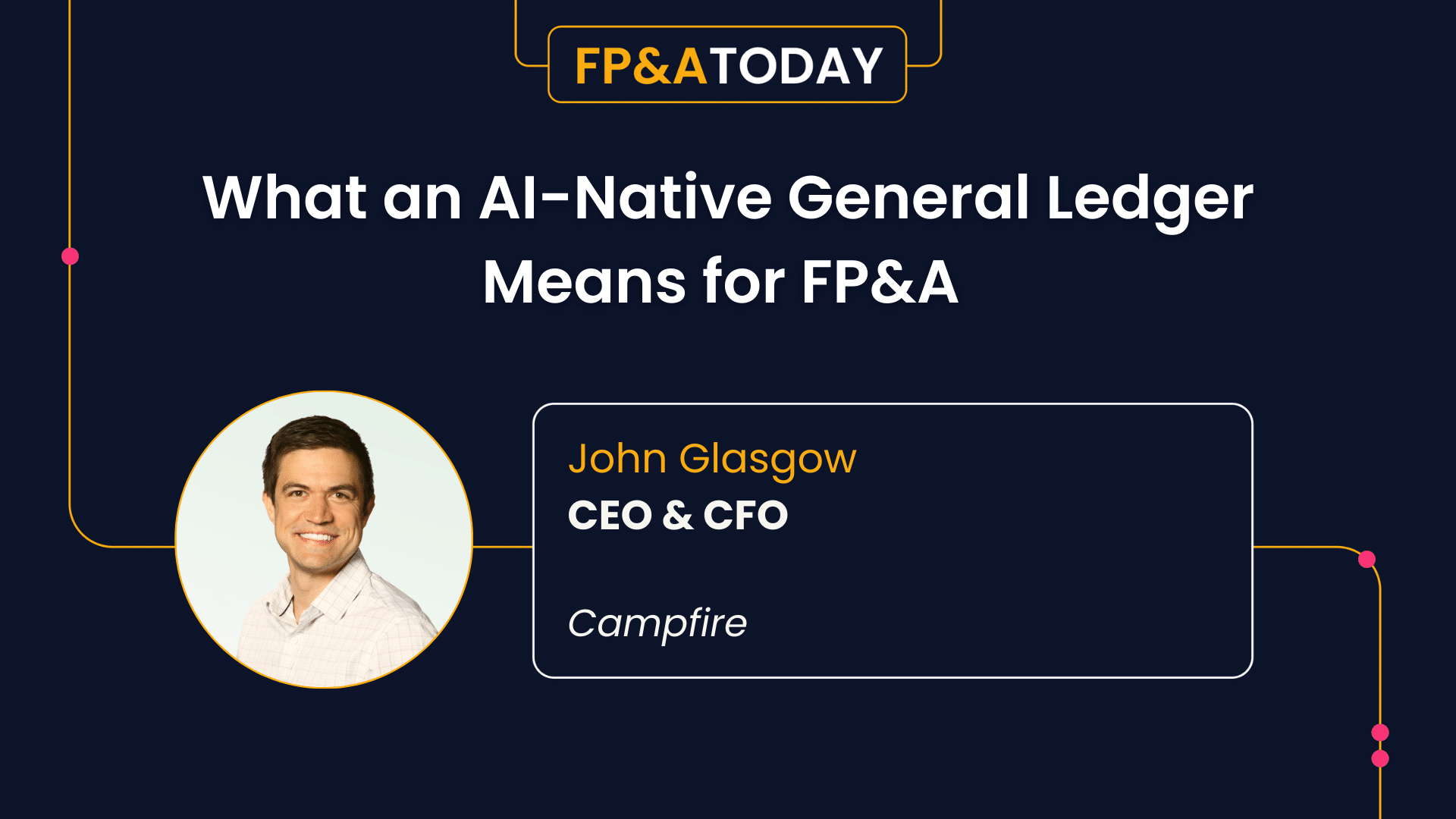
John Glasgow, is the founder, CEO and CFO of Campfire AI native ERP with more than $100m in funding, built to help high growth companies close faster, get richer visibility from their accounting data, and scale. John brings his insights as an operator who has spent time in FP&A and strategic finance, including at Adobe and an executive at Invoice To Go, leading that finance company to a $625 million sale to bill.com. Campfire came out of firsthand frustration with legacy ERPs and a need to rebuild the general ledger for the AI era.
In this episode:
- My years in FP&A and strategic finance at Adobe before becoming a founder
- CFA Certification
- Invoice to Go acquisition what I learned
- The frustration and origin story of frustration and why Campfire was set up
- Why building our own AI model makes sense
Key quote: “If you slap AI on top of an ERP with summarized revenue data, then you’re essentially gonna get no insights that are of any value.”
Glenn Hopper:
If you would like to earn CPE credit for listening to the show, visit earmarkcpe.com/fpa. Download the app, take a short quiz, and get your CPE certificate. Finally, if you enjoy listening to FP&A today, please go to your podcast platform of choice, click the subscribe button, and leave a rating and review of the show. And now, onto the show.
John Glasgow:
From data reels, this is FP&A Today.
Glenn Hopper:
Welcome to FP&A Today. I’m your host, Glenn Hopper. Today’s guest is John Glasgow, CEO and CFO of Campfire, an AI native ERP built to help high growth companies close faster, get richer visibility from their accounting data, and scale without having to build an oversized finance team. John’s an operator who has spent time in FP&A and strategic finance, including at Adobe. And he’s also lived the other side of the stack through partnerships and product work. Before founding Campfire, he was an executive at Invoice To Go and led its $625 million sale to bill.com. Then, he joined Bill.com to lead business development and partnerships. Campfire came out of firsthand frustration with legacy ERPs and the summarization tax that finance teams pay just to make reporting workable. Since launching, Campfire has gone through Y Combinator and raised over $100 million to rebuild the general ledger for the AI era.
In this episode, we’ll dig into what pushed John to take on the GL, what Campfire is doing differently, and what it means for FP&A teams that want better insights without spending all their time prepping data. John, welcome to FP&A Today.
John Glasgow:
Glen, thanks for having me. Really excited to be here. Definitely a fan of the show and, uh, excited to, to be a guest.
Glenn Hopper:
Yeah, likewise. And a similarly fan of yours, and I know we’ve talked on, on other podcasts before, so just happy to, uh, to be talking again and to really dive in. I love what you guys are, are doing at Camp Fire, and I’m, I’m really, uh, looking forward to talking about.
John Glasgow:
Thank you, thank you. Yeah, I mean, it’s, uh, it’s been a fun journey and excited to share more today.
Glenn Hopper:
Great, great. All right. Well, let’s, let’s dig in then. So for our audience is gonna love this, that you spent years in FP&A and strategic finance before becoming a founder. So with that lens, what were the most kind of, I, I don’t know, formative experiences during that operator period that kind of shaped how you think about finance systems today?
John Glasgow:
Yeah, it’s, it’s a great question. There’s a few moments that, that really stood out. One was in the public markets at scale. So at Adobe, I was in strategic finance and spent a lot of time analyzing data. And ultimately, there was a, there was a couple key learnings. One was the … I, as the finance team, we were actually analyzing all of the historical data, all of the accounting data, and the accounting team was preparing the data. And I thought there was an opportunity for our accounting team to spend more time analyzing historical data or call it accounting data. And so I think there’s, like, a natural shift in the role that, you know, we’d like to think we’re playing a small part in at Campfire and allowing the accounting teams to be a bit more strategic by giving them superpowers. And I think the other big one was at Invoice to Go in the private markets, we were a series C, uh, tech company, and we were an invoicing software and in finance and corp dev and partnerships and just for broad role given our, our size, um, for me, I saw firsthand that there was not great software, there was not great ERP for a mid-sized, uh, company that existed in the market.
And we went out and looked and there was some big kind of legacy incumbents, but ultimately saw, like, why is there not a modern ERP and spent a lot of time as a customer and as a partner in this category, 15 years. And so just a, a lot of key learnings that kinda shaped my experience as a founder.
Glenn Hopper:
Gotcha. And I love, uh, you know, you would think to tackle the GL that you would come up through the, uh, sort of the CPA audit path and all that. And you’re, you’re a CFA, right? Did I see that on your, on your LinkedIn? Is that-
John Glasgow:
I am, yeah. Over 10 years ago, but yeah, 2014 got the CFA designation.
Glenn Hopper:
Yeah. And that’s, um, you know, I guess early in my career before, you know, as I was an aspiring, uh, CFO, uh, there was that big pressure that, well, you, you could never do the CFO role without a CPA. And I think the, the role has changed a lot. And obviously, all the accounting part is very important, as you realize, probably way better than I do building out the, uh, the ledger with that. But do you think … I don’t know, do you think that you’re the way that … Uh, I, I’m trying to figure out how to word this question. Like, you looked at the ledger differently, more as like a downstream customer of the data that comes from it than, uh, the typical CPA or, you know, just going through the, the accounting side, what’s being booked and entered and all that. Do you think that that finance lens made you think of the ledger differently maybe than someone with that sort of traditional accounting background would?
I mean, look, I … Could
John Glasgow:
An accountant found Campfire? Like, yes. But I will say one thing that was formative for me was the invoice to go acquisition. So we ended up being acquired with, with, with no banker through the sale. There was no banker actually on either side of the transaction. And so I got really involved in pulling together just kind of core accounting data, like vendor spend by department, or just, just like even consolidated global reporting across subsidiaries was actually quite manual, given our ERP setup. And so there was like this new perspective coming in as like, why is everything so manual? Why is everything so broken? And it wasn’t the team, it was the software. The team was doing everything they could to, to band-aid together. There was just a lot of missing, like, simple integrations and they’re like, “Hey, the integration just, you know, doesn’t work right, or the global consolidation just doesn’t work right.” And so there, the more I unpacked through that, because we had 500 diligence requests, and I was the one leading the sale, and so ultimately I had to sh- deliver them all.
And so I ended up really rolling up my sleeves, getting super involved in pulling together all of the data and getting it out the door to the acquirer, and that just call it the, the, the summer of 2021, spent so much time on core accounting workflows and understanding, like, how core accounting works, that it really led me to say, like, “We need to rethink the entire software layer, get these teams some great software, and allow them to do what they do best.”
Glenn Hopper:
God, that’s really interesting, because I hadn’t really thought about that before in that way. So I, before I was a CFO, I came up, like I said, through the, the FP&A side, and I really started learning about accounting. Um, I was in telecom, and we went through a, a couple of ac- uh, mergers and acquisitions every year. And honestly, I think that’s where I got my first understanding of accounting and the type of data that we were getting from accounting. And I, and just realizing, you know, it’s trial balance and trying to pull everything out of all that and everything. And I didn’t really, you know, this was a million years ago too, so we didn’t really have the technology. It was kinda, you know, this is back when data rooms were actually a physical room <laugh> and, uh, you were going through that. So, but that is, that … M&A seems like a good way to really, for people who didn’t come up through that accounting background to really un- be able to dive in that whole due diligence process when you’ve really gotta understand, you know, you’re getting to adjusted EBITDA and everything you do during the, the due diligence period.
So that’s, that’s super interesting. And since you mentioned Invoice to Go, you were there, went through the Bill.com acquisition, and so you … We were talking before the show, you mentioned kind of being from that on both sides of the, uh, of the ledger. So what did you learn out of that that directly influenced the ultimate problem that you decided to try to solve?
John Glasgow:
I mean, Invoice to Go, we had hundreds of thousands of customers in literally every country, over 150 countries, using us for invoicing, and so we were connected to their ERP, and we sold to an accounts payable company. So I was on, like, the cash in side, and then went to the cash out side, and so being on one side of the ERP and moving to the other, um, via the acquisition to Bill.com, um, operated with ERPs and spent some time in the partnership world as well. So as a customer, as I acknowledged there, but then also as a partner, saw that the, the frustration that I felt as a customer was actually being felt at scale via the partner hat that I wore. And it was like this kind of constant theme of, like, gosh, all the ERPs are outdated and how we work is differently.
And it feels like someone like me, you know, wasn’t involved in building the software that I used. And there was just this general level of frustration. And I just saw it so widespread. We had combined 500,000 customers in the post-acquisition world, and these are businesses all over the world saying, like, “Hey, we need a better ERP.” And so I think as being a, like, call it a f- uh, first w- just like a, a great visible perspective into this, like, pain that I felt that I could, like, “Hey, it’s actually a widespread and I got this idea and maybe it’s a little crazy that I could go in there and do something about it. “
Glenn Hopper:
That’s so wild to me because so, I mean, for years, so many people had that exact same frustration, but to go and, and make the decision that you did to go, you know, go in on this, I would, I’m wondering, was there, like, a specific moment when you went from, yeah, this is frustrating to, okay, the general edger needs to be thrown out, rebuilt from scratch, I’m the man to do this. Was there something, was it a, a gradual or was it more that, like, Road to Damascus moment where, <laugh> where you just had this, uh, e- epiphany around it?
John Glasgow:
Yeah, there was definitely a moment. I mean, we were the largest partner for, for many of the ERPs, and I spent a lot of time at the executive, uh, level with, with all of the household names. And I remember one of them, an executive, someone with a C-level title, and I won’t name any names, flew out, and, and one-on-one met with us, met with me, one-on-one, and told me, like, “We are the ERP, and literally every customer will rip you out before they rip us out, and so here’s the tax to do business with us to have a joint customer, and as this is the offer, and we’re just shutting off the joint customer experience, if you don’t pay this obscene bill that came out of nowhere.” And it was, it was a, a shockingly large number. And I think this, and all, literally all the other partners were coming to me in the ecosystem and saying, like, “Can you help us?” We’re all being sent the same kind of large bill.
And I think it was shocking to me that the existing ERPs were so shortsighted in how they thought that actually, they, they felt so confident enough that literally nobody had anywhere else to go from a partner and from a customer perspective. They’re saying, like, switching costs are too high to leave us as a customer, and there’s literally no other options in the market for, you know, the vertical that we’re in and the size that we’re in, and that’s literally how they were operating. And so I was sitting down one night at dinner, and I was like, “This market is just so broken.” And I was literally so upset that that was literally the moment that I decided I was gonna personally do something about it.
Glenn Hopper:
I love that. And I, it’s really, I mean, if you … I don’t know. I don’t wanna … You know, I work with ERPs across the board, and I don’t wanna cast dispersion one way or another, but if you look at the big ERP systems that are out there, they looked the same for decades, and it was just no push to innovate, no competitors, because they knew they had that. I mean, it’s not, not exactly monopoly power, but they were in a strong, you know, whatever per- percent of market share or whatever. I mean, it was … There just weren’t a lot of options out there unless people were d- … I, I remember for a while before this, this wave where new ERPs were coming, everybody was talking about unbundling the ERP because there were all these different SaaS products out there and people were like, “Well, we can basically put together our own.” Of course, that had all the data problems of having siloed data and being able to get them all to talk to each other and, and pass through to each other.
Maybe I should have led with this, but, and I, I know we gave a little background and clearly Campfire’s ERP, but, uh, uh, for our listeners who haven’t followed Campfire closely, could you walk us through what Campfire is and what part of the finance stack that you’re ex- explicitly trying to replace versus, uh, I don’t know, maybe there’s some that you’re trying to integrate with.
John Glasgow:
It’s a great question, Glen. And the answer is changing as the product evolves. You know, here’s what Campfire is. We are an AI native ERP for modern, like, mid-market and enterprise accounting and finance teams, and I really wanna give them superpowers, the superpowers that I didn’t have when I was in the role, whether it was board reporting, whether it was just closing the month, or whether it was M&A that I described, giving them superpowers to automate all of the transactional accounting, the core reporting, and allow them to do strategic work, focus on strategic work that I was not able to spend as much time on as I wanted to. And the, this just inherently means, like, we allow them to close the month faster, and we allow them to run a, maybe a leaner team. I know a lot of folks in the AI world are not getting a lot of headcount, but they’re, the company’s growing, and we allow them to, to deliver on kind of speed to close and speed to report to the, the board or whatever their stakeholders are.
And some of the fastest growing AI companies like Replid and Deca-Con and PostHog are customers of ours, and we’re thrilled to, to allow them to scale, but we also have healthcare companies, we’ve got aerospace companies, we’ve got, uh, professional services companies, there’s a broad array that are on campfire. Shout out to your podcast software. Zencaster is a, is a customer of ours as well.
Glenn Hopper:
That’s great. And I, you said something in there that is, it’s, you know, I, I do a lot of speaking around AI and finance, and everybody’s kind of having this existential crisis around AI is gonna take my job. And I think what, what you went, went through and described there, I, I don’t know. I mean, obviously if we reach AGI, you know, there’s a whole, <laugh> whole different level of, of considerations. But what you talked through there is, is the same argument that I make of, and there’s a quote that I always use that’s Clifford Stoll said this in, uh, in the ’80s, I think is, or late ’80s, I think, yeah, but it’s, um … And I think of this as it started with, you know, RPA or whatever kind of automation that we’ve moved up, but it is … The quote from Clifford Stoll is, “Data is not information, information is not knowledge, knowledge is not wisdom, and wisdom is not understanding.” And I think if you flip that over, you kind of have this pyramid of where, you know, basic automation of just taking the data and turning it into a dashboard that turns out raw data into something’s information.
And then we’re kind of moving up that chain now where AI can start doing some more things than what ERPs could do 30 years ago when they were first built and then moved in, into the cloud. And I, I think that what Campfire’s doing is, and, and, and maybe you can help refine this a little bit more, but what I see, you know, like you said, you can have smaller teams, but the value that the humans are bringing is much higher than swivel chairing data from one system to another, or the, you know, if it, if it speeds up reconciliations or sort of the repeatable tasks that we do every day going from kind of that mindless level work to more mindful work, do you see that come out of, if you have Campfire that you’re able to spend more time doing that real value add work at the … I’m not to say there’s not value in moving data, but if we could automate it, it’s like adding robots and manufacturing, right? <laugh>
John Glasgow:
Yeah. AI is, is very powerful. I think we’re all aligned that, like, we don’t know what the end state looks like. It is very powerful. Yesterday, someone, uh, sent me an ad from, like, the 1950s and a new accounting typewriter had come out and it was literally, like, automate a lot of the general ledger tasks. It was, like, speed up the close. It was, like, auto- reconcile, like, invoices faster. It was literally a lot of the same things that we’re working on at Campfire. And obviously, the accounting role shifted as the accounting typewriter came out and evolved and then Excel came out and, you know, there, you can talk to the whole evolution of accounting. We’re in another evolution of accounting. I think the last big one was on- prem to cloud, right? I think, like, financial workloads were some of the last ones to go into the cloud, given the sensitivity of the data, but they have made it into the cloud.
Many folks were migrating to CamFire are still coming from an on- prem environment to Campfire. They’re essentially skipping a generation of accounting software, call it Cloud 1.0, you know, we’re the AI-native, uh, software era. And so I would say, like, my advice is continue evolving, continue reinventing yourself. I mean, everyone’s talking about this one adage right now of, like, you, you will not be replaced by AI, you’ll be replaced by someone that knows how to use AI. You know, there’s probably some, some truth to that. Um, but my advice is c- c- just continue learning even if you’re, like, not ready for AI accounting software, think about, like, what are some tasks you can automate to AI even if it’s just in ChatGPT or it’s in Anthropic or some, some flavor of AI, but start to introduce it into your workflows. Start there. Think about, like, how do we go to software as opposed to people for transactional tasks.
If it’s something that’s more ad hoc, like I’ve, you know, done a lot of zero to one financial models in my day, a lot of one-off kind of board swags for, uh, um, “Hey, what if we did X?” Like, of course, that’ll always be in Excel. There will always be need for manual work, but if it’s some repetitive task, take the time in between the next close and look at if we can automate it, whether it’s AI or otherwise, just start to automate it. And if you can’t do it with rule-based, then, then go to AI. And we’ve seen it, A, people are writing accruals with AI and campfire. People are doing their flux analysis. People are doing reclasses. We’re doing a lot of the transaction coding for them way beyond what a simple rule-based system can do. There’s a lot of power, and it can help you evolve the role into what I mentioned earlier, our mission statement to give of superpowers to finance and accounting teams is really giving you the superpower, not replacing you.
Glenn Hopper:
It’s funny, as, as you were talking, picturing someone going from an on- prem accounting system to the state-of-the-art AI-powered general ledger, I’m picturing this, like, you know, finance and accounting people, we’re, we’re risk averse by nature. You don’t want anyone in finance leadership to be a riverboat gambler or whatever <laugh>, but I’m, I’m picturing, like, the, the super resistant to change for years, maybe curmudgeonly CFO that finally goes from, um, on- prem to, to Campfire and, and telling the rest of the management team, “See, I told you we didn’t need to spend a year and a half implementing an ERP 15 years ago. We’re now g- going to the state of the art and that’s gonna be … ” I mean, I, I can’t imagine what level of shift that becomes to go from sort of the limitations of an older on- prem accounting system to something like Campfire.
Um, so yeah, anyway, <laugh> apropos of nothing, I guess, but that was the picture as you were, uh, <laugh> as you were explaining all that that went through my head. The, the value proposition for Campfire, um, thinking about specifically talking to our FP&A listeners, you know, people who live in variance analysis and forecasting and stakeholder stor- storytelling, beyond just the, the debits and credits that we think of with a typical general ledger system, what is, what is that value prop for the FP&A team that Campfire offers?
John Glasgow:
Yeah. I mean, as a former kind of FP&A strategic finance person, I think really think about, like, you are one of the many data, uh, customers of the data. And so I think, like, getting you great, high quality, detailed data that’s very well labeled to me is, is the dream. And so in a legacy ERP, so many of them cannot handle large amounts of volume and complex dimensionality that Campfire at its core can handle incredible, incredible volume. We’ve never seen anybody, even with, you know, 50, 100 million rows of, of ledger data, which is an insane amount that you can bring us any amount of detail. So folks move to Campfire and they stop summarizing data into the general ledger, they bring it in at a granular level, so into the accounting software, excuse me. We can, we can be very detailed at the subledger level, and we can still summarize onto the general ledger, but ultimately, you’re gonna have the data set in the ERP, and this is, like, from an audit perspective, you know, auditors love it that they don’t need to go trace everything outside of the ERP.
FP&A teams, to your question, like, whether it’s a forecast, whether it’s, you know, vendor spend by department, with another cut of data, like by business unit, all sorts of custom dimensions, like product level contribution margin, many of our AI customers are incredibly focused on, call it gross margin contribution margin, and it can quickly, within a month, turn on you if you’re not super careful because AI compute and token costs can be so high that we can bring in incredible granular detail for customer level, product level, contribution, gross margin level analysis, and, and we can get it in a more real-time view. And so just, like, this rethinks the FP&A role that one example is at Adobe, we spent weeks and weeks doing an, uh, LTV to CAC analysis by product and ultimately, like, essentially shut down a, a product line. It was a small one, but we, like, shut it down and we fold into another one, but we only did the exercise every 18 months because it took so long.
And it was largely because we were summarizing a lot of the, the data we needed into the, into the, the system of record, our ERP. And so it’s like, if we can get the granular detail, then can we, like, speed up the prep of the work, then we have a much tighter feedback loop, then we can actually unlock a lot of the decision making and allow folks to go act on the data. Um, and so that’s been one of my favorite parts at Campfire is finance and accounting teams come to me. Someone just shared with me that a customer, they went to the board and showed how they rethought working capital now that they’re on Campfire, A, because they had time, because they’ve, they closed so much faster now, they’ve rethought the entire invoicing process, but also they used Campfire to automate a lot of the tasks, and so they’re able to actually, like, go out to customers and, like, actually chase invoices in a complete different way that it turned into this large strategic initiative that they brought to the board and talked about and, and, and that’s what gets me excited.
I
Glenn Hopper:
Think it’s important that we double click on the data that you’re talking about here because I, as you were talking about it, I’m thinking of Stripe data, for example, versus what’s in the general ledger. So maybe first, let’s look at, uh, the summarization problem you talked about. I’ve lived this experience, but I’d, I’d love to hear from your side where you see that pain show up in, in the real FP&A work and, and what changes when you get more of that, that richer transaction level detail?
John Glasgow:
Yeah. Two, two very specific areas. One is FP&A teams are trying to use AI more. One simple example, so many, uh, folks are summarizing, like, their prepaids into their ERP, or to your point, the revenue data into the ERP, that if you slap AI on top of an ERP with summarized revenue data, then you’re essentially gonna get no insights that are of any value. So for Stripe, even if you have 10 million monthly Stripe transactions, we’re able to pull in every single Stripe transaction at a record level into our revenue sub-ledger, and then you put AI on top of that. That is incredibly rich detail. And so FP&A teams, whether they’re manually doing it or whether they’re using AI to analyze the data, call it a summarized entry of 100 rows or 10 million rows. You know, we all know that, like, there’s just incredible value in having that rich because then you can … The dimensionality is all in place, business unit, customer, product level, geo.
You have, like, through the month, daily, even hourly visibility. You can look at seasonality through a month. You can even course correct through a month because data is kind of piping in, you know, uh, whatever cadence hourly. There’s just a lot that you can do with just the revenue subledger data alone.
Glenn Hopper:
Yeah. And that’s … I wanna get to that sort of continuous close and that real-time visibility because that’s, you know, uh, there’s software companies out there for years have been talking about continuous close and everybody trying to move to that. The number of people who’ve actually gotten to it is, is very low, but even without the full close, like you said, drilling into that level of data during the month, pretty significant when you can make real-time corrections. But, um, you also talked about the richest possible data set. And I’m thinking about that in terms of dimensions, tags, revenue artifacts, uh, and customer and product a- attributes. In, in practical terms, what, what does Rich mean to you? And I guess the approach you’ve been able to take, why, why have the <laugh> legacy ERPs not done that? Why has it historically been so hard to do that?
John Glasgow:
Yeah. And look, you can say, like, “Well, I can go into some other system and grab the data,” but then if you wanna do contribution margin, you wanna do business unit, you need everything from the ERP, from the cost side to do it. The legacy ERPs, I mean, f- fundamentally, most of the code was written in the ’90s. And so I think just being, call it 25 years younger, there’s just a fundamental advantage that we had from a data architecture. And for me, as a former customer of the systems, I knew what was just broken with them, and one of them was scalability and, and dimensionality and the ease of configuring it as an end user. And so, like, putting those into the core, we just have a big advantage of just being younger and built in the AI era and built in an era where cloud infrastructure scales in, in ways that it, that it did not when, you know, architecture was, architectural decisions were made in the 90s versus now.
Glenn Hopper:
Yeah. And the other, like, I remember, and, and again, I was downstream of it, so I don’t know what capabilities we even had, but my first, when I was in telecom late 90s, early 2000s, the type of data that we got … I, I don’t even remember … I just … And again, I was a customer, and this is before I got into ERPs and accounting systems. I was just waiting on the reports from, from accounting, but there were, um … I don’t remember tags and dimensionality back then. I don’t remember at what point in, in my career those were, were added, but we’re at a whole new level with what we talked about before the show, where you have AI-enabled auto tagging, which is so significant that can work basically from that first transaction without all the elaborate rules that you’d have to have around it.
FP&A Today is brought to you by DataRails, the world’s number one FP&A solution. DataRails is the artificial intelligence-powered financial planning and analysis platform built for Excel users. That’s right, you can stay in Excel, but instead of facing hell for every budget, month-end close or forecast, you can enjoy a paradise of data consolidation, advanced visualization reporting, and AI capabilities. Plus, Yes. Game changing insights, giving you instant answers and your story created in seconds. Find out why more than 1500 companies use DataRails to uncover their company’s real story. Don’t replace Excel, embrace Excel. Learn more at datarails.com. I’m particularly interested in AI-enabled auto tagging that can work, as you said, from that first transaction without having to put in all these elaborate rules. How does that change, I don’t know, the economics of dimensionality and what does that, what does the review and a review and approval workflow look like so that finance teams can stay confident that whether it was tagged by a human or the AI that, that the information is tagged correctly?
John Glasgow:
That’s a great question. So many people ask me like, what does it even mean to be an AI native ERP? And we are the only ERP with our own foundational model. And so we’ve gone through this very painful exercise of building out our own frontier model. And what that means is we’re able to, in a very secure environment, harness modern kind of next gen gen AI and allow each customer to have their own model running that’s fine-tuned for their own data. And we’re able to take what many would say was like previously not possible, which is like, it was too much work to do all of the dimensional tagging, or our team doesn’t have time to manage the end. And when I say dimension, it could be like customer level gross margin, right? Are you tagging like, you know, compute? Are you tagging even the team at a customer level or region level or really any level of granularity?
It could just be department level opex. And so like allowing you to automate more of the attribution of cost allows you to have, again, for the data customers of the ERP. And so what it really means is like rules are great, but everybody ends up with hundreds of rules and then it becomes very unwieldy and hard to manage. And then you’re always adding more and every time there’s a department change, you gotta redo all the ruling. And so that becomes untenable. It’s great for like chart of account, but for the long tail of dimensionality that folks need. We’re seeing a lot of it was just being done in spreadsheets and there’s view lookups and summits and all sorts of gymnastics going on. And so it’s like, how do we offload what is very clean dataset, which is … The good thing is accountants are very good at tagging data.
We’ve got very clean data and GenAI thrives with clean data. And so our foundational models are doing an incredibly good job at, um, at automating a lot of the tagging. And of course it sends to you for rev- review if it’s not 100% and you can customize how automated it is. And we’re in a … We have public companies today, so we’ve built a lot of, we’ve done a lot of work to support kind of SOX in a AI world. But I, I’ll say it has allowed folks … It has allowed the accounting team to, again, give them the superpowers by tagging more data with a, you know, high degree of accuracy to provide more data visibility for the data customers. And that could be sales, marketing, the board, really any stakeholder, including FP&A.
Glenn Hopper:
This is super interesting to me, and I’m sure <laugh> there’s so much in this that is secret sauce and proprietary information and part of what makes Campfire great, but I have to dig into this a, a little bit, bit more that you guys trained your own m- own model, because I think with all the g- the generalist info that’s in the frontier models right now, and they’re so good, and there’s, you know, so many open source and open weight models out there and, and models that, that people can run. And, um, it’s for most things, um, having, you know, these LLMs that are the world’s smartest generalist are sufficient, but obviously when you have that proprietary information beyond what you would put in a RAG system or a custom GPT or whatever, you can get hyper specific on what you’re trying to do. And again, I’m not gonna get into all the, you know, style <laugh>, you know, the, the, the, sort of the secret parts of your model.
But I think about … And I don’t know, maybe it is being used to great success. I just haven’t … It’s proprietary and within their organization, but I think about in the early days of back in the maybe still ChatGPT-3 or 3.5 era when Bloomberg spent, I don’t know, five, 10 million dollars to train their model. And of course, they had all kinds of proprietary data that, uh, you know, maybe it is to this day very useful, but I, just the, the notion of the amount of data that you’d have to have to m- make something that would be a true differentiator and a true kind of value add and part of that secret sauce, I guess, I don’t know, with <laugh> without digging into, uh, uh, too much info that you can’t share, maybe just at a high level, why build your own model? Why does that purpose-built approach matter versus just bolting a general LLM into a database and asking questions of it?
John Glasgow:
Yeah. There are three things, security, attribution, and performance. So the leading frontier models are obviously always gonna way better than us at general purpose, whether it’s being your doctor or helping you write an email. The natural language query system, they are great at. I think at a very specific task, which is performing transactional accounting, we have found if that’s all that we do, we are actually the best of the world at it. And, and I tell the team, this is your one job, and we’re focused on this one task, and we will be the best at it. And so we found our performance to be better than the leading frontier models out there for this one task of transactional accounting. Attribution, if you’re audited, or if you need to understand why did it make this decision, owning the model allows us to expose that to the end user and an auditor, whether it’s a, why did I make this decision?
I wanna reroute it next time, but I wanna, like, help it fine-tune the rerouting. And then from a security, your data never has to lead … The reason why a lot of the, you know, finance workloads were last to go to the cloud was security. And so, like, when your data never has to leave the campfire environment, we’re not feeding it off to a third party. We have more control over, like, can it be used for training or not training and AS, everyone’s SLA says it’s not used for training, but some customers are saying, “I don’t care about an SLA. Can you actually control that outcome? Can you commit to that yourself?” And so we, we have a lot more control from a security perspective as well. So I think those three dimensions brought it in- house and we s- we’re running multi-model, we’re running commercial models for some customers and for certain use cases, but for core transactional accounting, we have found that our team does, does a great job here.
Glenn Hopper:
That’s fascinating to me, and I think a, a huge accomplishment, no, no small task to do that. But I, I see the, the value that, that comes from that. But as you were talking there, I’m sort of biting my tongue right now to go down a rabbit hole of a couple things <laugh> that, I mean, we could have a whole episode on auditability and on data security. These are things that I fight all the time with, um, you know, trying to explain not just to the finance department, but also with CISOs and, and heads of IT around data security and, you know, the settings and, and all that, but then having it locked into your system and having your own, you know, SOC two type two, whatever, you know, all the compliance that you have to have, and if they’re trusting you with the data already, whether they opt in to u- use their data to train the model or not, I mean, that’s, that probably overcomes a lot of that.
So kudos to you guys for, for building that out.
John Glasgow:
Thank you, yeah. When I, when I meet with the team, it’s like, we’re on the frontier, so it’s not like there’s some paved road for them. I mean, I’m telling them, like, we’re, we’re kind of, we’re building the trail as we go. So it’s, it’s been fun to meet with them and hear the updates.
Glenn Hopper:
Yeah, that’s great. So as customers are using Campfire, what are the most common, you know, the types of the, you know, why did X happen questions that you see? And I guess maybe the follow on to that is, what has to be true in your data and your controls for those answers to be trusted?
John Glasgow:
Yeah. I, I would say the most common questions are just drilling into a number. So many folks are, like, at a GL code level or at a department code or really any kind of top level dimension, you wanna know why did X happen? Why did month over month, quarter over quarter, you’re preparing for some meeting, maybe it’s, you know, a board meeting. And you click on the number in your ERP and there’s, you know, what could be a lot of transactions below it, or if you’re an older ERP, it’s like summarized and it’s like, “Hey, you gotta go dig elsewhere.” So a lot of them are just saying, like, when I click on it, there’s a ton of data, can, can you just, like, help me synthesize the data? So it’s like, why did engineering spend go up? Or why did revenue in this location, in this region, you know, go down?
You know, and it could just be like February was a shorter month, you know, and it’ll just help you kind of with the attribution of, of just exactly what happened, but it could be a broader trend. And if you are getting the detail into the ERP, it can really help you tell that story, not just … I mean, honestly, at scale, when you’re in FP&A, you’re, you’re kind of like, you’re ta- you’re making a call on some of the numbers and you don’t know how accurate it is when it’s a human and there’s a million rows of data and you can slice and dice only so many ways before you gotta just make a call. AI can look through all million rows, can look at all million rows from the prior month and glean insights that are just not really feasible from a human perspective, feed them to you.
At your point from a controls perspective, we’ve made it where you can click on the numbers that the AI is generating. And so then I tell all of our customers and our own team, because we’re obviously on campfire, treat AI like anybody else on your team. And so, like, we’ve built the AI where it shows its work, it builds a workbook of how it arrived at the conclusion for that insight or for the transaction it’s gonna write for you. And so you, you’re responsible for the work that you’re delivering. And it, you know, for me, it was always like when the team would send me a model and they, you know, or when they do now, but when I was in FP&A, it’s like, send me, send me the model, send me the supporting data, I would review the assumptions, I would review the cells, make sure it’s right before I would ship it to anybody.
And I tell everyone, view AI the same way, another member of your team review its work and we give you all the data to do that and then hopefully you find value in the insights and you can deliver it. Otherwise, we’ve done a way where you can give it feedback and, “Hey, you know, are you sure this is right? Can you, can you … ” And then it’ll just like, again, just like another human, you give it feedback and then it iterates with you and then you kind of learn from the next process the best way to, to build something together.
Glenn Hopper:
As you’re doing that, like even the Anthropic OpenAI, Google, everyone who’s, has these frontier models, we haven’t completely solved hallucination. And I hear a lot of sort of, not, not Ludites, but people, the, the people who are not out on the bleeding or, or leading edge, the laggard sort of adopters in AI, I hear all the time, “Well, I don’t trust AI. It hallucinates and I, I, I can’t risk that. ” And I know, you know, nobody’s 100% solved hallucination, but I know hallucination’s a lot worse when a model doesn’t have context and you’re just asking it a question about something it doesn’t know about. Obviously, the advantage you guys have is you have context, but are there other guardrails and safeguards you put in place to, to limit those hallucinations as much as possible? And I’m sure it’s, it sounds like sighting sources and, you know, being able to dig in and all that, but how, how do you guys treat hallucinations and, and maybe even the inevitability that sometimes AI is gonna get something wrong, just like you said, like an employee would get something wrong.
And so we have that human in the loop and that sort of trust but verify.
John Glasgow:
Hallucinations still exist, unfortunately, in AI. We have found there’s a lot of ways, to your point, context being one of them, a lot of ways to materially reduce hallucinations, and then ultimately we show all of the work so you can confirm, as we just discussed, but I think there’s a lot of background work that can be done to, to really reduce the amount of hallucinations, even just how financial data is fed to a model. We have found there’s just a lot of things that can be done to bring that down. And so to your point, the good thing is us being the data holder and us being the AI model builder, one team literally sitting together here in San Francisco owning both, we can deliver much better on both. Otherwise, if you’re like feeding data from your ERP to a third party AI system, it’s like feeding data through a straw.
Like we’re, we’re using like a, I don’t know, fire hose or something that like rich amounts of data, but also the right data format to, with all of the context. And then there’s, again, some other things in how we present it that we’ve, we’ve found that hallucinations are rapidly in decline and our team, uh, we’re pushing every day to kind of get that to zero, but until it is, humans make mistakes too, check the works of the human on your team, check the work of the AI on your team is always been my feedback.
Glenn Hopper:
And not to go too far down a technical road, but I’m just, this fascinates me. Are you guys doing like your own kind of RLHF post-training with these models too where you’re having, you know, you’re going through and, and asking sample questions and f- giving feedback to the model overall? Is that part of the guardrails?
John Glasgow:
Yeah. There’s a lot. There’s a lot of evaluations. There’s, there’s, there’s a ton of pre-training, post-training. Yeah, it’s a, it’s a big lift, but I mean, since we’ve raised 100 million, you know, we, we, we can’t afford to make these long-term big investments and it’s turned in, turning into quite a oat for us in the, in the ERP category.
Glenn Hopper:
It, it’s just fascinating. I’d love to be a fly on the wall at Campfire right now and <laugh> and be in on some of these conversations. That’s just fascinating stuff. I do wanna be respectful of time here and, uh, the producers always tell me, “Let’s shoot for 40 minutes.” I never get close to that. We’re gonna be, we’re gonna lucky if we, <laugh> if we hit an hour here, but I do, I, I guess I’m gonna start kinda winding us down here. I wanna go back to, you mentioned it earlier, that sort of continuous close. And well, you didn’t say that specifically, but talking about, you know, having real-time insights, not waiting for the month-end close on this more detailed data. So from your perspective, having those real-time insights, what does that mean operationally and what is a faster and more reliable close unlock for FP&A cadence?
And I, I’m, I’m throwing you a softball here maybe, but <laugh>, um, you know, if you have a more reliable close and that real, more real-time insights, what does that do for cadence and decision-making for FP&A teams?
John Glasgow:
Yeah, it really transforms the, the feedback loop. So many accounting teams, it’s like a lot of the data gets put in at the end of the month. And so we’re working on, since we’re doing less summarization into the ERP, it’s connecting to your data warehouse, feeding us throughout the month, connecting to your revenue system if it’s not within Campfire, like you acknowledged kind of third party payment processors earlier like Stripe. You know, we can pull it in throughout the month and add a granular detail. So, you know, some folks are saying instead of a quarterly review of the performance of the business, we’re able to do it a lot faster now because the reporting’s like automated and it’s super granular data and we’re using some AI to help with the data prep. We’re now doing it monthly, even weekly. And when you’ve got data going in, like the smallest unit of accounting doesn’t need to be a month.
You can do week, you can do day. Now, at what point is it just noise versus, you know, signal? But I think for like, again, a, a high growth AI company that’s very focused on contribution margin, gross margin, or if you’re, you know, e-commerce or a lot of folks that have some sensitivity that they’re looking for more visibility intra period as opposed to at the end of a period, call it an accounting period being a month, there’s a lot we can do and then the month end close is much faster and we’re seeing folks close, uh, you know, at least 50% faster once they move to Campfire. And then there’s just more time that the team can be focused on other tasks beyond the close. And so I think there’s kind of a two-part gain from it. One is that like tighter feedback loop and then the other is just like, um, speeding up the close allows you to ship the close faster and then allows you to focus on other tasks.
Glenn Hopper:
Yeah. Like we’re, I think we were talking before the show or maybe it was when, after we were running, but I just, I know it’s been promised forever and it’s been a hard thing to deliver, esp- unless you were an enterprise level and you had the, you know, the massive, uh, without saying any names, the software programs that were out there that, that sort of supported that. But, uh, that is, that’s huge, especially if you think, um, uh, you know, mid-cap level companies that, uh, that wouldn’t have been able to have those, those bigger software systems. But not just mid-cap, and I think, I hope we didn’t gloss over this too much earlier. You mentioned having public company clients, and I think that’s, that’s significant because there’s that old adage, you know, nobody ever got fired for selecting IBM or what, you know. So you guys are new players in the field and you’re going up against, “Well, I don’t love it, but I understand it.
I’ve used it in my accounting and finance roles for 20 plus years.” You know, it’s, it’s sort of the, the devil they know. So I guess from, from Campfire’s perspective, when you’re talking to a company who has these, um, audit and, and, uh, more significant requirements maybe than a, than a private company would, what are the key guardrails and auditability requirements that, um, that you guys offer that finance teams are looking for when they consider Campfire and when AI is embedded across those core accounting workflows?
John Glasgow:
Yeah. We are doing so well in the mid-market that it has almost, um, folded over into lower enterprise. And so called lower enterprise is now one of our fastest growing segments and many of them are, of course, public companies or pre- IPO companies. And so whether it’s an existing customer that has grown into lower enterprise or just net new, they’re coming and finding us and saying, “Hey, like, we see a ton of value in what you’re doing. And for all the reasons we’ve talked today, um, on the show, they see it, they, they’re all experiencing all the same problems except in terms of the dollars and cents or the number of transactions, you’re literally adding kind of call it commas to the number of rows of data or to the dollars. And so the problems are actually much larger. It’s like instead of a million rows, we can’t analyze Canyon with 10 million, you can yell with a hundred million, and we have the performance and the scalability to do that.
Now, to your point, SOC’s auditability, big four audits, 2025 was a massive investment for us to be ready for all of that. And we, yes, we are now live on the public markets, been through many big four audits, we’ve been through many kind of IPO readiness evaluations for customers that are looking to go out this year, and it’s been amazing to talk to our customers. And I always commit to them, literally, tell me what’s next on your journey, whether it’s a new subsidiary in a new country, going public, something new, and I’ll ensure we are ready for that moment, and they’ve done a good job at keeping us up to date, and we’ve done a great job of staying ahead of them. And so now in the lower enterprise, again, scalability, visibility, auditability, um, these key tenants that were great in the mid-market have translated incredibly well into lower enterprise.
And so, yeah, SOX is something, um, yeah, I was familiar with having been at a few public companies. This is obviously more, this is deeper than I, than I was there, but I spent a lot of time with, with auditors now and, and internal and external audit teams, ensuring we’re, we’re in a great spot and, you know, we continue to get the, the thumb up.
Glenn Hopper:
It’s gotta be a huge confidence boost for you guys, for the full team there to get through some of those big four audits and be, and, and, and be able to pass and answer the questions and to sort of set the example for, for future customers. So that, that’s great to hear. All right, we are, we’re winding down here, and I’m gonna be respectful of, of your time and our listeners. So let’s get to, uh, the, the two questions that we ask, uh, all of our, all of our guests. And the first is, what is something that most people don’t know about you, something that we couldn’t figure out just by, uh, looking you up on LinkedIn or whatever?
John Glasgow:
It’s a great question. I would say, you know, I’m a, I’m a parent with two young daughters. Yeah, that’s, that’s a fun fact about me that I love to share. I think outside of Campfire, that’s where I really spend all my free time with my wife, children, and, and dog moose.
Glenn Hopper:
Yeah. <laugh> That’s great. And I bet it’s hard to sort of get that balance right now with everything going on in the, in the startup world, but I know, uh, I know important to make, make time for them, so that’s great. All right. The question we ask everyone, what is your favorite Excel function and why?
John Glasgow:
Ooh, I have a lot of favorites. I mean, I’ve probably … I don’t know how many thousands and thousands of hours in Excel I’ve spent in my day. The, the one I kinda always go back to, I use a lot of some if or some ifs, so I’m just gonna give that one a shout out is I think that’s, that’s one that I still use, uh, quite a bit today, even, even as a founder. Yeah, we, uh, we … Actually, we get that fairly often. I mean, I know there’s the big V lookup versus X look up to B. I think there’s a lot of probably other ones, index, match, you know, I think is, uh, another hot one. But I don’t know, I think just the ease and simplicity, uh, of, of a sum or a some if, uh, is something I always go back to.
Glenn Hopper:
Perfect. John, this has been great. I really appreciate you coming on the show, on the show, and I’m, uh, really enjoying seeing what Campfire is doing in the marketplace and all the innovation you guys are bringing. And just a- again, thanks, thanks so much for coming on.
John Glasgow:
Thank you so much for having me, Glen. And yeah, just give us a shout out, campfire.ai. We would love to hear from you or find me on LinkedIn. Thank you.