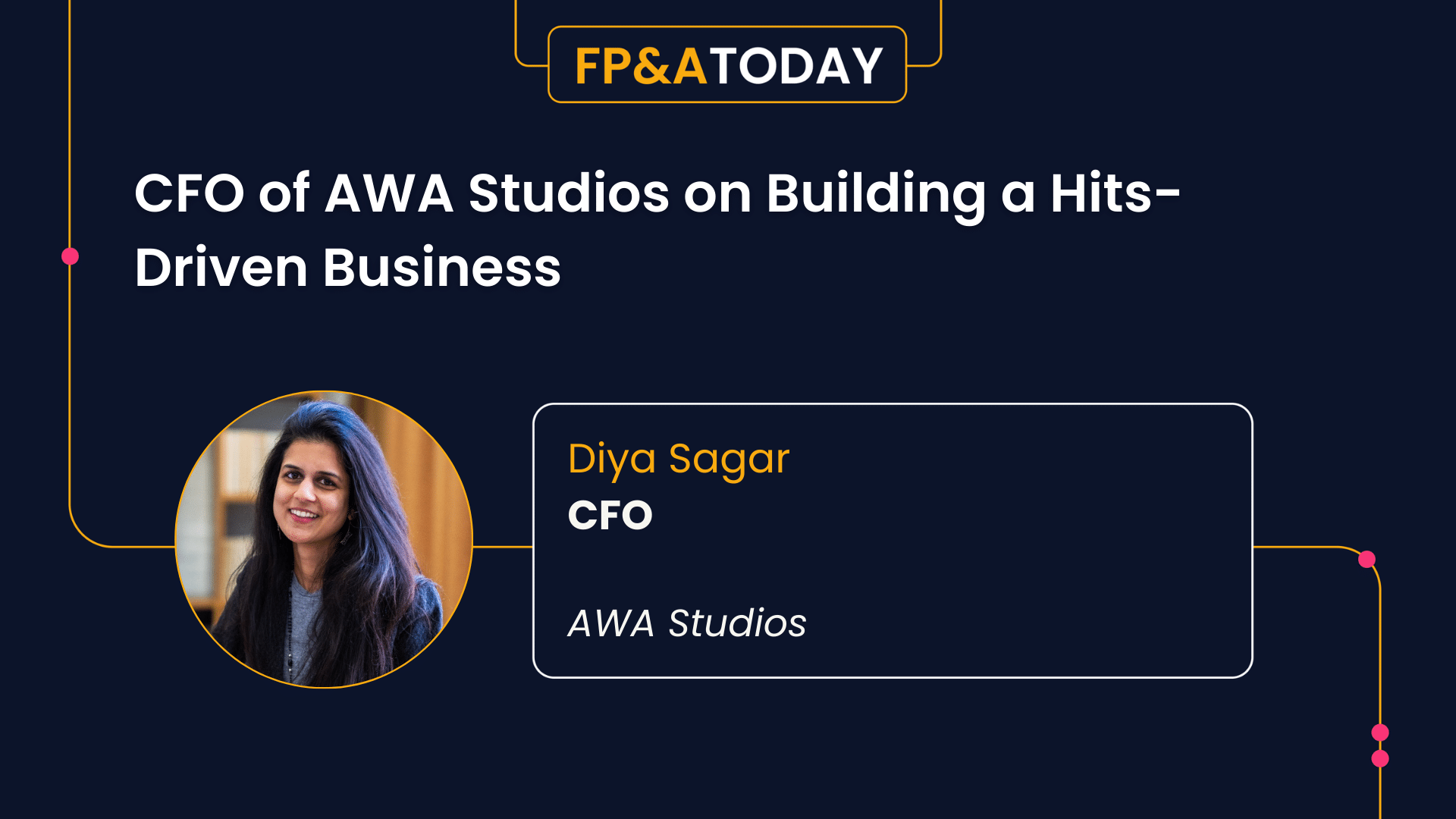
What does it take to be the finance leader behind Hollywood stories? Diya Sagar, CFO of AWA Studios, which produces critically acclaimed, original stories for comics, TV, and movies, joins Glenn Hopper to reveal how she manages the money behind the magic—from funding graphic novels that may not pay off for years to navigating the unpredictable world of film and TV deals.
- How a “creator-first” approach shows up in budgets
- Building a Hits-Driven Portfolio
- Telling the story based on the financial forecast
- The Ultimate Model: From Page to Screen Economics
- The 2-4 year timeline
- What Boards really want in a creative industry
Full transcript
Glenn Hopper:
If you would like to earn CPE credit for listening to the show, visit earmark cpe.com/fpe. Download the app, take a short quiz, and get your CPE certificate. Finally, if you enjoy listening to FPA today, please go to your podcast platform of choice. Click the subscribe button and leave a rating in review of the show. And now onto the show from Data Rails. This is fp NA today. Welcome to fp NA Today,
Glenn Hopper:
I’m your host, Glenn Hopper. Today we’re joined by Diya Sagar, a finance leader with a career that bridges banking, investing and operating in the media world. Dia started in investment banking at Deutsche Bank before moving into corporate development and strategy at Indole Shine Group, Europe’s largest TV production company of that time. From there, she joined James Murdoch’s Lupus Systems, investing in media and technology businesses. After supporting lu’s investment in a WA studios, DIA made the move inside the company and now serves as CFO. She holds an MBA from Yale University and brings a unique perspective on what it takes to manage finance in a hit driven creator first business. Dia, welcome to the show. Thanks
Diya Sagar:
For having me, Glen.
Glenn Hopper:
As a fan of movies and graphic novels, I’m, I’m very excited to have you on today. And I, we talked a bit before the show about your background in the industry, but I’d love it if you could kind of walk our listeners through your background and experience.
Diya Sagar:
So, ever since I was young, I was fascinated by the way stories can impact people and culture. And for that reason, I knew I wanted to work with creative businesses. I’ve now been a finance professional in the media industry my entire career, either on the outside of media companies or on the inside of media companies. I started my career on the outside, I was doing investment banking for media and tech clients. Then I moved into a television company called Endemol Shine Group, where I led corporate development and strategy, then back out again to be an investment professional at Lupa Systems focused on media and tech investments. And now inside as CFO of AWA studios, which is a graphic novel publisher and early stage Hollywood studio, a WA stands for artists, writers, and Artisans.
Glenn Hopper:
I love that journey and I, I love moving from inside to outside. And now you’ve made that deliberate move from investor to operator. Now stepping inside one of the companies that you want to evaluated from the outside. And I’m wondering what’s the draw? What kind of led you to take that leap from the investor side into the operating side? And has it maybe changed the way you think about building businesses?
Diya Sagar:
This was a particular case where in my role as an investor, our firm had invested in a WA from day one, I’d worked on fundraising rounds for the company and I would regularly attend board meetings. So over time, a WA became a portfolio company that I was not only very familiar with, but also deeply understood the challenges that it was facing. As an early stage business, I decided to take the operator role because I wanted to be part of building something from the ground up. I felt that I could use my own experience to really impact the company. And because I knew the business so well, this was a case where I wasn’t going to be surprised by anything. Now that I’m in it, it’s actually changed quite a lot how I think about building businesses as an investor. Numbers are an input and an output. I would use my financial analysis to form a view on how a business was performing and what future expectations should be. As an operator, I realized that I have to be laser focused on the actions necessary to line up numbers with what’s actually achievable by the company. I feel really in some ways, like I’ve moved from abstract into reality.
Glenn Hopper:
It’s funny hearing your take on that because I worked inside private equity backed companies for close to 20 years and then made the jump going over to consulting first as a a fractional CFO and now just doing more AI and and finance consulting. And it’s, for me, it felt like, it’s almost like the grass is, is always greener. When I was inside the company, I felt like, okay, this is great, but how cool would it be to see all the companies and having an impact across all of them. And then when I was outside the company, I would think, I really wanna be building something. So it’s, it’s hard to find that line. If you seeing it on both sides, though, you do get a broader understanding of the finance role and just really all the, all the roles in the company. ’cause you can, you have that meta awareness where you’re more aware of, uh, you know, what you, how the, how the company presents to outside people because you’ve been in their shoes before. And I’m wondering, coming from that investing side, did you have beliefs about, you know, great finance that you kind of carried with you? And were there any that you had to unlearn in your first, first time CFO role? Because it is very different being, you know, on on the other side of it.
Diya Sagar:
Yes, for sure. Being an investment professional, I saw finance as the driving force that the numbers should be used to drive the direction of a company. And that to get to a positive outcome, a company should keep reacting to its own financial results. Whilst I still believe that finance is an essential part of any business, when I became a CFO, I had to unlearn what I call my finance voice, which is to say I, that the vision and dreams of the company have to be tabled first. And the role of finance is to either help make that vision possible or to explain clearly why a particular idea shouldn’t be pursued. So I can now see finance as a driving force, but not the driving force.
Glenn Hopper:
Yeah, and that’s interesting, especially because of the industry that you’re in. And I, I wonder, we all live in the reality where finance and accounting drives decisions, but at the same time, there you are in a creative business. So at a WA, you’ve got that creator first approach, and you as the finance voice, I know there’s an editorial board or, or what, you know, that a group that decides on projects from that perspective. But how does, how does that creator first approach show up in budgets, uh, project approvals, deal structures, and really like melding that that business and creative part together
Diya Sagar:
For a WA creative first means that, first and foremost, we believe that creators need to be rewarded fairly for every idea that they’re involved with. Whether that is writing a story or creating the art for our graphic novels, for budgets and deal structures, that means creators are actually the first input, as in we have to first agree on the amounts that we can compensate every creator and how they can earn a share of royalties in success. And then everything else is constructed around that. If we can’t offer an attractive deal to our creators, we simply can’t proceed with a project. The project approvals, it’s a collaborative approach. Once we’ve agreed on a creative vision upfront, creators then drive the storytelling and we go back and forth with feedback, we found that that process tends to work pretty well.
Glenn Hopper:
Yeah, that makes sense. And I’m, you know, like I said, I know the editorial board makes creative decisions, but since art doesn’t live in a vacuum, I’m thinking of the proc the selection process, um, from a finance perspective, like when you hear a new story idea, you know, is there always a first commercial question you ask when you think when you evaluate markets or whatever the case is, and maybe there’s signals, whether it’s a, a genre or something about the project that makes you lean in. It’s interesting to consider how the financial reality factors into the creative part of the equation. And as someone who’s done creative projects in the past, but primarily been a finance guy, that’s, that’s super interesting to me.
Diya Sagar:
Graphic novels are the way in which we birth new stories. So the first question I ask when I hear about a new idea is perhaps unsurprisingly cost. That immediately gives me an indication of how the creative side of the business is thinking about the opportunity. A higher cost opportunity tends to mean that we, either we want to put more resources behind it or that we are more passionate about pursuing it. So the signal I then look for is anything that makes the idea worth the cost. This could be a creator’s track record in generating sales a’s own sales history with a particular type of story, or how much more investment is needed from a WA, such as marketing spend to deliver commercial success. Because art is so subjective, none of those signals is linear. So at some point I have to get comfortable with de-risking what I can from a finance perspective, but knowing that there will always be uncertainty attached to any idea.
Glenn Hopper:
Yeah, and that’s fascinating to me. ’cause I think when I consider the, the group of projects you’re working on, I feel like it’s gotta be managed kind of in the way that an investment portfolio would. And before the show, you described this, uh, as a hits business and I’m, as you’re looking at that portfolio, you know, you’re taking multiple shots every year and I’m wondering how you sort of justify the shots and how you decide on how many projects to fund at a time and are there factors that, I mean, is it really comparable to an investment portfolio? Like you look at, well, we’re over leveraged in one genre and we need to have a, a more diversification. Like how do you, how do you consider the projects?
Diya Sagar:
I say because we’re still a small company, the interesting part about being a hit-driven business is that one hit can change the trajectory of our company in a drastically positive manner, but multiple ideas that fall flat don’t actually impact us in a negative manner by nearly the same magnitude that gives us the ability to take multiple shots each year. The analogy we often draw is like in sports where it’s always desirable to have more shots, one goal as opposed to fewer. Obviously the major caveat here is that we need to constantly be managing the sunk cost that goes into each idea, but assuming that’s under control, we try to keep publishing a roughly similar number of stories each year. Ultimately, we’re aiming for Hollywood success, but our stories get made into films and TV shows. So the genres we lean into tend to move with those market trends. Right now, horror and crime are being well received by audiences. So we are heavier into those. And another factor we consider is the kinds of characters that we hope to get on screen that could be different ages, different occupations, different genders, heroes or villains.
Glenn Hopper:
Yeah, God, I love hearing the mix just between the, the creative and the, the, the finance side of it. And then we were also talking before the show about how you balance a lot of smaller, lower budget books, and then you’ve got your larger marquee products, and I guess that is for just the divers diversification and you can make smaller bets on, on certain areas. Are those smaller bets? Is it like this is a first time artist or an unknown genre, or just something that you don’t know what the commercial success is gonna be around it? I just like trying to picture, you know, we know the investment fundamentals when we’re evaluating stocks or, or private equities. I’m wondering how do you, how do you size the investment time to feedback from the market and expectations for all of them? And then sort of what you see as the, the lifecycle on a, on a project,
Diya Sagar:
Obviously I’m always thinking about the balance of risk and reward. For our flagship projects, that requires significantly more investment. We need to believe that the reward or payoff is both higher and can get a film or TV deal quicker. For these, we typically involve a celebrity who brings their own existing fandom that we can immediately promote the, the project to. So for example, we have a graphic novel written by the MMA fighter, Rhonda Rousey, who has 30 million social media followers. Alternatively, we can get comfortable with a sizable investment into an iconic property that is already well-known by audiences. An example of that is our most well-known graphic novel is called The Lost Lands of Oz, and it’s actually a sequel to the Wizard of Oz because these fan bases are built in from the start, these books get a market reaction immediately, and Hollywood studios tend to also enter into discussions with us quickly thereafter. So a few of these kinds of projects balanced out by lower budget graphic novels means we can fulfill the objective of both regularly publishing new stories and having patience with original ideas that are relatively unknown.
Glenn Hopper:
That’s really cool. And I guess, I mean, that patience has to be important because we’re talking before about how, you know, with the graphic novel, it may not make money right away, but the value can play out over years, across all the different formats. And I’m, as you think about that, obviously not every project is gonna go across multiple formats, but how do you model that full life cycle? What variables matter the most early, and then kind of what do you see over the long run? And even if something doesn’t, you know, hockey stick growth out of the gates, what do you see in the, uh, in the long term for these projects?
Diya Sagar:
What you’re describing is what we call our ultimate model. Every graphic novel requires an upfront investment to pay the creators and to get the books physically produced and printed, followed by ongoing marketing spent, build audience awareness that investment will always exceed the revenue we can make from book sales. So we then assume that it will take another two to four years to develop the story and to film or TV show and to either sell the license to a Hollywood studio, or we take the decision to raise financing and produce the film ourselves. So we model the various revenue streams, which typically include rights, fees, producer fees, and potentially a share of backend, which in our industry is essentially a profit share of a project is extremely successful in Hollywood. And that’s how our projects will, will really make money, meaning in the ultimate or over the full life cycle. So the most important variables are the all in the, all in development spend needed to get a project off the ground and the level of fees that we’re estimating it will generate several years down the line. And the ROI needs to be sufficient, also cover the losses on projects that don’t make it in Hollywood.
Glenn Hopper:
Yeah, that makes sense. And I, I just, the, uh, for some reason I keep thinking about VC with this because with vc, you know, with with private equity and, and later stage investments, you’re, you’re investing in something that, you know, has a track record. And I guess this is, that’s why there’s so many sequels and in Hollywood and everything, but with the kinds of investments you’re making, you may not know how it’s gonna turn out. And I just in, in the sort of the gut feel that a VC might have around, well, I really like this management team, I really like this founder or whatever. I, I feel like that is probably pretty similar to when you evaluate these projects. There’s a gut there. And so again, I I feel like I, I don’t wanna beat a dead horse, but this is just fascinating to me.
Glenn Hopper:
And so if you have two strong projects, they’re both competing for funding, like how do you weigh sort of near term momentum? Like, okay, true crime is, is huge right now versus long term potential where it’s a really good story, it’s an interesting genre. Maybe there’s market indicators that it’s going, uh, going up and, but all this is, it’s trying to business a five, if that’s a word, the, uh, the creative process, which has to stay a part of it. So again, you know, you’re balancing the, the fiscal realities, but also there has to be that that spark is not gonna come from the greatest fi I mean, obviously the financial management is required to be solvent and know how to, how to, uh, invest, but creative has to fit into the process there. So I’m wondering if you could walk me through that a little bit.
Diya Sagar:
Yeah, so I think when a-list talent or celebrities want to be involved in one of our projects, that’s when the commercial and creative parts of our business are most closely aligned, as both sides will understand the importance of pursuing that project. Decision making ends then relatively straightforward as we know that it gives the company near term momentum and build our brand. If the project involves lesser known creators, or the story idea is more experimental or radical in the way that you’re alluding to, that’s when there’s more of a negotiation within our business. The creative side will want to pursue it. So my aim is to form a view on the probability of the project being a long-term money maker for the company, or alternatively a small bet that won’t overexpose us from a financial perspective in the near term.
Glenn Hopper:
From your perspective, are there warning signs or thresholds that indicate, Hey, it’s, we need to speed this up or slow down or reallocate resources across the portfolio?
Diya Sagar:
It’s usually based on how our stories are resonating, both in the market and with our investors. Because creative ideas are so subjective, we accelerate towards projects that the market seems to like. So that can be shown through positive press, social media feedback and interest from other companies who may want to partner with us to continue building out the IP in other ways. The views are of our investors are also extremely important. They typically don’t judge the quality of our stories, but they provide a solid sense check on the direction we’re taking the business. If they share our belief in hunting down particular opportunities, it gives us a clear mandate to just run in that direction. And conversely, it’s actually very helpful if they give us the opposite kind of feedback because it almost acts as a warning sign to reconsider how we’re allocating capital, our resources or rethink the opportunity.
Glenn Hopper:
And again, that comparison with, uh, <laugh> with vc, but I think of so many businesses that you’re pounding the pavement for opportunities and because of the nature of your business, I picture that you’re nev there’s never a shortage of projects that are coming in. I I, I imagine there’s a desk, or I guess now it’s all digital, a digital slush pile of, of submissions that are, uh, coming into the group. And so there’s plenty to choose from, and you have to have that sort of editorial ability to cut through and find the, the needle in the haystack or the, uh, you know, winning project among so many that are coming in. And, and I’m sure you actively seek out projects as well, but so you have a pipeline of projects that are out there, and I just, because of the nature and the, and the sort of fickleness of the market, how do you evaluate that pipeline and figure out the health of the pipeline balancing across, I don’t know, maybe the horror genre’s big this year, but it’s, there’s signs, it’s fading, you know, but you still, you have to balance that risk, the audience and the timing of everything
Diya Sagar:
For a WA our pipeline is our upcoming lineup of stories, and thankfully that’s one part of our business, but we do have some visibility as we have to start locking in our publishing schedule several months or even a year ahead of when the books are going to be released in bookstores. So when we set budgets, that’s when we decide on the level of spend that is going into each book and by extension the relative risk that we’re willing to take on each one. Um, and each year we try to maintain a balance between big swings and small bets, which is what we consider a healthy mix. Right now we’re highly diversified across genres and the kinds of audience that our stories will appeal to. And until we deliver a big hit, we’ll likely keep spreading our bets this way. Timing is the hardest part for us to anticipate. So while we control the pace which we produce, those graphic novels that pay off from film and TV will come frankly whenever Hollywood decides.
Glenn Hopper:
Yeah. And that timeline is so interesting. I’m, um, I’m writing a book for Wiley Finance right now and I’ll have my part done by January. And, uh, I was just meeting with the editor the other day and she was saying that publication data is the end of September and it’s just crazy to think about how long that pipeline goes. And so the book’s about AI in the CFO’s office and I thought, oh, that’s gonna be too late. But really, I mean, it’s not like AI’s gonna disappear, but it, it’s interesting to think about that pipeline and how long, you know, just for a publication of a book, let alone if you’re doing film production in there. Um, so it, it’s, it is very interesting to think about that pipeline fp and a today is brought to you by Data Rails. The world’s number one fp and a solution Data rails is the artificial intelligence powered financial planning and analysis platform built for Excel users. That’s right, you can stay in Excel, but instead of facing hell for every budget month end close or forecast, you can enjoy a paradise of data consolidation, advanced visualization reporting and AI capabilities, plus game-changing insights, giving you instant answers and your story created in seconds. Find out why more than a thousand finance teams use data rails to uncover their company’s real story. Don’t replace Excel, embrace Excel, learn more@datarails.com.
Glenn Hopper:
So switching gears a little bit, lemme get back to, you’ve been on the investor side and now you’re briefing that same audience and it, I feel like it’s gotta feel in some ways, like you have, uh, <laugh> x-ray vision almost. ’cause you’ve, you’ve sat on the other side, so having what you know, when you talk to ’em now, what could you tell other CFOs and finance leaders, what do boards really want from A CFO in, in, we’ll say in an uncertainty heavy business, but really it could be in any business, but I’m wondering in your case, like how do you tell the story without either over or underselling the upside, just trying to nail the forecast and, and the target of your communication?
Diya Sagar:
So I know the lens through which our board and investors are looking at our business, and I know that they’re constantly looking for certainty from our financial results, which is obviously the one thing I can’t give them. So what I try to do is I tell the story backed by the financial forecast and make it clear what the conditions are to reach that performance. For example, if one of our hits doesn’t land on the timeline, we’re expecting the financial forecast obsolete change, but the long term ambition of the company doesn’t. So I try to be as transparent as possible by sharing them what it takes to grow equity value to an outcome that they want from us, along with the key factors that could result in overall underperformance. My aim is frankly just to maintain a trusting relationship with them because I know that in the short term, our financial forecast may not always reach their expectations, but that over the long term we’re relentlessly reaching for the same goals.
Glenn Hopper:
So day one is a CFO, every CFO role I’ve ever had. It’s, you know, I come in with my a hundred day plan or my 90 day plan, whatever’s in vogue at the moment, <laugh>. But as you came in here, and I’m not sure what stage the, the business was when, when you came in, but what did you build first? And I’m wondering now if you could go back and maybe redo one early decision, is there something that you would’ve changed or done differently?
Diya Sagar:
I rebuilt the accounting function first. I brought in expertise who had worked on early stage businesses before who could clean up all of our data, restate our historical financials, and help me define new and reliable accounting standards for the company going forward. In hindsight, one decision I could have made differently was that during my first few weeks as CFOI couldn’t even trust the company’s financial statements, but I still kept wanting to see financial breakdowns, probably like a typical CFO. So we just spent a lot of time, time creating and reviewing data that wasn’t necessarily accurate. I should honestly have just been more patient at the outset and given ourselves time to first create a single source of truth for our financials before constantly trying to just draw conclusions from the wrong data. Yeah,
Glenn Hopper:
And I think in finance we are like investigative journalists and if we’re, you know, if you don’t have the chart of accounts set up correctly and, and everything’s not, you know, to gap standards, it can be very difficult to sort of piece together that story. So a lot of times when you come in, uh, to early stage businesses, you know, it’s about, okay, we were using the default chart of accounts that came with our GL system, let’s go ahead and make new, a new chart of accounts that matches what we do. And then, oh, look at this weird mess of like blended cash and accrual accounting that didn’t make sense. Like some things were being accrued and amortized and other things were, uh, you know, marked on a cash level and no matching principle going on. And so really getting that all cleaned up, it’s, it’s funny, but I, it it feels almost like that’s the driver and the motivation is <laugh>, I’ve gotta make order out of this chaos. And, you know, the time that it takes to go through and do it, and then you’ve got that clear picture and you can um, you can kind of see the map of the future.
Diya Sagar:
Yeah, it’s like we’re always trying to get everything right before we, before we do anything else. My typical finance brain.
Glenn Hopper:
Yeah, and it’s funny, I mean, I think about that too. You know, I came up through fp and a not through CPA and and accounting and um, I, I’ve had some great controllers and they’ve, they’ve made me a much better CFO because, but they, but they panic in early stage businesses because, you know, account accountants want everything to balance and tie up, whereas finance, you can be okay with being directionally correct. So we can sort of, as we get the books cleaned up and as we sort of get the chart of accounts ready and move in a direction, we start to feel better. But the, that, that accounting brain where everything just has to be spot on, uh, balance sheet balance, that everything makes sense, matching principle gap all applied. It’s, it’s interesting to see that the difference there, but it is, it’s very rewarding. It is like solving a, a mystery when you can get that chart of accounts cleaned up and, and have, you know, going back and fixing the historicals and understanding, okay. And when you can, especially if you can start doing project accounting, the, you know, early stages isn’t just, isn’t gonna exist there and you can start breaking it down and seeing that, and that’s where you start to really see the value
Diya Sagar:
For sure. It’s just such a relief when it’s all, when it’s all cleaned up and it ticks and ties.
Glenn Hopper:
Are there habits or tools that you, that you keep like close to the word without becoming the bottleneck? So it’s, it’s tough, especially in, in early stages of businesses and growing businesses, and I imagine even tougher when creative cycles, you know, it’s not like they necessarily are gonna line up with fiscal calendars. I mean, you can have your production schedule and all that and that’s fine, but I imagine it’s gotta feel like chaos a lot in that situation.
Diya Sagar:
I lean towards over communication. So I have regular meetings with my team who keep me updated on the creative work that they see happening from their purview, and they alert me to anything that may create misalignment with finance. And I also have meetings with the rest of our management team when leaders typically provide more context on any changes or anything unexpected. A good example of this at a WA is when we recognize deferred revenue, we run these kickstart campaigns for some of our graphic novels, but it takes several months for the art to be completed and for the books to be produced, which means there can be a very long lead time before we can fulfill those customer orders that have come through on Kickstarter and actually recognize revenue. So sometimes delays in creative then can mean that the entire timeline is pushed into the next quarter or fiscal year, which essentially then puts our revenue at risk. However, if I know that this is a situation that the company can’t control, I always try to support creative and I let them drive the timeline knowing that a delay in recognizing revenue is simply that and finance will just find a way to communicate our story differently.
Glenn Hopper:
I didn’t think about that, about revenue recognition and, and doing something like that, like receiving the, the funds upfront or pre-orders or, or whatever the case is. So that is an interesting challenge as you’re looking at it, sit on the balance sheet and not recognizing the, uh, revenue on the income statements. So that’s interesting and a, and a part of the business I didn’t really think about. So my, my regular listeners will know, I’ve probably set some kind of record here for 2025. I’ve gone over 25 minutes and haven’t asked you about ai. So <laugh>, I’m, I’ve been biting my tongue the whole time because I wa I am fascinated about about the industry, but I do, I’m asking everyone now, we where AI fits into their business and I, I sort of want to go in two directions with you, but the, the first one I’d love to know on the finance side, are you using generative, you know, or even experimenting with generative AI in areas like forecasting or variance analysis or any kind of reporting or operations. And if so, are, what guardrails do you have in, in place or is are there, you know, controls around versioning and audit ready documentation? And I’m wondering if you, have you seen any results? And I just threw 18 questions at you at once, <laugh>. So first off, are you guys using ai, um, out of the gates? Okay,
Diya Sagar:
So I would say, look, I wish I could give you a more exciting response at this point, but I’d say that we, from a finance perspective, we’re continually experimenting in incremental ways. The challenge we face is that so much of our data is very sensitive. For example, the cost and re royalties that relate to creators, it’s sensitive info and we’re on the, on the hook for protecting it. And because we don’t have an AI system that we feel fully comfortable using yet, and where confidential information is not being used to train the model, we’ve just been treating AI with caution. But overall, I’m really excited to see these tools become more sophisticated and really transform the function. I know that some people are using it in ways that is, that is already transformative, particularly for tasks like reporting and forecasting that are formulaic and AI could thrive with. But for us, I think this is something that we’re, we’re going to get there, but we’re taking it slow and we’re experimenting and we will eventually get there.
Glenn Hopper:
And that makes sense. And I’m really, I’m seeing that a lot and I, I saw something yesterday that was <laugh> really eye-opening for me because I’ve been writing about and talking about AI and finance for so long that I’d, but I’d never seen this comparison. So, you know, the Gartner hype cycle where they’ve got the technology trigger and we’re racing towards the peak of inflated expectation, maybe even some people are kind of going over the other side and down into the, uh, the trough of disillusionment or whatever it’s called. But I, I pictured early on, like as we’re riding that cycle up, that you’d have your, obviously your innovators are in and your early adopters, and as you get towards the top of it, you’ve got your, like early majority of people adopting it. But when I saw this adoption curve laid over the Gartner hype cycle, I’m, I realized for the first time, yes, our innovators are out there and they’re writing that hype cycle up, but maybe there’s, you know, the very front end of those early adopters and then there’s this chasm as everybody bangs through.
Glenn Hopper:
And in, you know, in finance accounting, we are risk averse people. We don’t wanna be on the bleeding edge of gap. You know, it’s like we, we wanna be able to have controls and everything in place, but I think we haven’t even really hit that chasm yet because the only people that I’m seeing really, and there there are more and more that I’m, I’m talking to because I’m in my little positive feedback bubble. But we’re really, it’s just those that kind of front end innovators, there’s gonna be sort of some realization. We’re starting to see the studies now and I think there’s gonna be a little bit of a slowdown and as people figure out the technology and to your point, as they start to understand why things are working and why they’re not, then I think you’re gonna start seeing it pick back up and then we’ll sort of get out of that trough of disillusionment. But that’s, for me, someone who talks about this stuff every day, I really, I think a lot of people already are over that peak of, of inflated expectations. So just my 2 cents on, on AI there. So it makes complete sense. Everything you just set,
Diya Sagar:
I think my expectation is that over time, if as we keep continuing, continuing on this curve that you’ve described, there’ll be some tools that eventually end up dominating the market, even within finance. In the same way that we have QuickBooks and NetSuite today. There’ll be the AI tools that everybody is using, right? So that’s my expectation.
Glenn Hopper:
Absolutely. ’cause there’s gonna be, in the innovators, there’s gonna be people building stuff from scratch, but the people who are really gonna, where you’re really gonna start to see that traction is when one of these SaaS providers, it could be a startup, could be an existing one, you know, you would think that the existing SaaS providers would have the advantage because they’ve got so much data that they can use just to train models and, and position it. But there are so many startups out there. So I know the, with ai, it seems like the timeline is compressed on all this, but it, it could be a couple years really, it could be like a more of a traditional, uh, technology cycle. Um, even though people like me that are out there, you know, fanboy on the, on the front edge of it, that it’s, it’s gonna take a while because in finance and accounting we’re looking for deterministic results and asking the same question twice and getting two different answers doesn’t really match with what we’re trying to do.
Diya Sagar:
Yeah. We can’t afford to make mistakes. The stakes are just too high. Um, but obviously if it makes us more productive and faster for sure, we wanna be leaning in. Yeah.
Glenn Hopper:
Now on the other side, an area that’s probably even more controversial than AI and finance, I’d love to know, and I don’t know if you can talk about it, but I’m, I’m fascinated by the use of AI in the arts. In my last book, all the images except for the ones that were diagrams that I had to create, but all the images in the book were created by ai, my new publisher, they don’t want to use any AI generated images because what works were used to train the model or is there a potential copyright down down the line? So it’s probably sort of that same approach on the creative side, but, um, and I, I’m getting way off into the weeds here. I know this isn’t a finance conversation, but I’d really love to hear how your, how a WA is using AI in the creative and production side and, and are the, you know, where are those kind of red lines? How do you bring artists and writers along get their buy-in, you know, protecting their role and integrating the technology?
Diya Sagar:
As we talked about, creators are at the heart of everything we do. So as far as we’re concerned, it’s completely understandable and justifiable that writers and artists in particular feel hugely threatened by AI that is training off their work and is capable of generating new imagery, videos, and text at tremendous pace and scale. Our red lines include avoiding the use of generative AI art, never training models on our creators, creators work, unless of course they want us to do so or they provide consent and never replacing creators in our creative process. Where we have used AI is in taking some of our 2D characters from our books, animating them using AI tools, and then releasing short videos on social media. This is where we see AI aiding the production process and giving our creators more opportunities for their work to be seen off the comic book page.
Glenn Hopper:
That’s cool. I love that. Okay. Wow, this has flown by. I’ve got two questions that we ask every guest and uh, the first one is, what’s something that not many people know about you, you, something that they couldn’t learn just by looking you up online?
Diya Sagar:
My life has been very international. I’ve lived in six different countries across four different continents. And now that I think about it, it’s funny that I’ve pursued a career in finance, which is essentially a global language that doesn’t really need translation across borders.
Glenn Hopper:
I love it. Yeah, it’s, uh, what is it? Warren Buffet said it’s the language of business and business is done everywhere. <laugh>, with the exception of whatever difference there is between IFRS and Gap, but my
Diya Sagar:
<laugh>. Yeah, exactly. With that obvious caveat, <laugh>
Glenn Hopper:
<laugh>. So, alright, this is everyone’s favorite question. What is your favorite Excel function and why?
Diya Sagar:
Grouping columns and rows. I can make an absolute mess in Excel and then hide the parts that I don’t want others to see. So it looks like a very clean and organized output.
Glenn Hopper:
I love that because <laugh>, I’ve done it so many times where you have hidden under, hidden under and you, you know, you start to see those dots that go on the rows and columns and you start clicking on ’em and you’re like, what is going on here? This spreadsheet is 18 times bigger than I thought, but especially on a, like a cashflow statement, I love just collapsing everything down. It’s like, look, don’t look at all this mess under here. This is what we’re, this is what we’re trying to show you. Yeah.
Diya Sagar:
You’re so much better off not on hiding, right? Yeah.
Glenn Hopper:
Yep. Yeah, exactly. Don’t, don’t look behind that curtain. <laugh>. So well, DIA this was great. I really, uh, really appreciated the peek in inside, uh, your business and industry and, and hearing about your background and, uh, really appreciate you, uh, coming on the show and, and wish you great success.
Diya Sagar:
Thanks so much again for having me.