Click for Takeaways: Finance Operating System
- A finance operating system is a governed data layer that consolidates financial data from across an organization and makes it accessible to any AI tool, model, or workflow in real time
- The category emerged because AI shifted the bottleneck in finance from analytical capability to data infrastructure
- A finance OS is not FP&A software, an EPM module, or an ERP extension; it sits beneath all of them as the data foundation those tools run on
- The core architecture consists of three components: a consolidated data pipeline, a semantic translation layer, and a governance and permissions framework
- AI adoption in finance has stalled not because AI tools are insufficient but because most finance data is not structured, governed, or accessible in a way that allows AI to use it reliably
- The finance OS category is emerging now because MCP (Model Context Protocol) created a standardized way to connect governed financial data to any AI engine without custom integrations
A finance operating system is a governed data infrastructure layer that consolidates financial and operational data from across an organization, applies controls for accuracy, access, and compliance, and exposes that data to AI tools, agents, and workflows through a standardized connection protocol.
It is not a reporting tool, a planning platform, or an analytical application. It is the layer beneath those things: the foundation that determines whether AI-generated financial analysis can be trusted, traced, and acted on.
Why the Finance OS Category is Emerging Now
AI is in the process of commoditizing financial analysis. A well-prompted AI model can build a financial forecast, generate variance commentary, or produce a board presentation in seconds. The analytical layer that once took months to configure inside a dedicated FP&A platform can now be produced on demand by a general-purpose AI tool. What AI cannot do is operate on data it cannot access, verify, or trust, and that is the problem a finance OS exists to solve.
This bottleneck is why AI adoption in corporate finance has stalled. According to Gartner, AI adoption among finance teams rose only one percentage point between 2024 and 2025, while 91 percent of finance teams reported low initial impact from the AI tools they had deployed. In a separate RPG survey, 35 percent of CFOs cited data trust and reliability as their top barrier to AI ROI, with only 10 percent reporting full confidence in their data.
The problem is structural. Finance data is distributed across ERP systems, general ledgers, CRM platforms, HR systems, and dozens of spreadsheet models. It exists in different formats, governed by different permissions, updated on different schedules. When teams attempt to use AI for financial analysis, they typically export data from these systems and upload static files to an AI tool. When data leaves its governed environment, audit trails are lost, permissions disappear, compliance controls are bypassed, and the AI output is only as accurate as the last upload.
A finance operating system solves this problem at the infrastructure level rather than the application level.
How a Finance OS Differs from ERP, FP&A Software, and EPM
The finance OS category is distinct from the software categories that preceded it, and the distinction matters for procurement decisions. A finance OS is not a replacement for any existing layer in the finance stack; it is the governed interface that connects those layers to AI.
FP&A software provides analytical applications: budgeting, forecasting, planning, and reporting tools built on top of a data layer. A finance OS does not replace FP&A workflows. It provides the data infrastructure those workflows run on. As AI tools become capable of performing the analytical functions that FP&A software once monopolized, the data infrastructure layer becomes the strategic asset.
EPM (Enterprise Performance Management) platforms are typically sold as modules within or alongside ERP systems. They are designed for structured reporting and compliance workflows within a defined vendor architecture. A finance OS is model-agnostic and AI-agnostic: it exposes governed data to any tool, not just tools within the same vendor ecosystem.
ERP systems are transactional systems of record. They capture financial events as they happen. A finance OS is not a system of record. It connects to systems of record, consolidates what they contain, and makes that consolidated data accessible to AI in real time. The ERP remains the source; the finance OS is the governed interface between that source and the tools built on top of it.
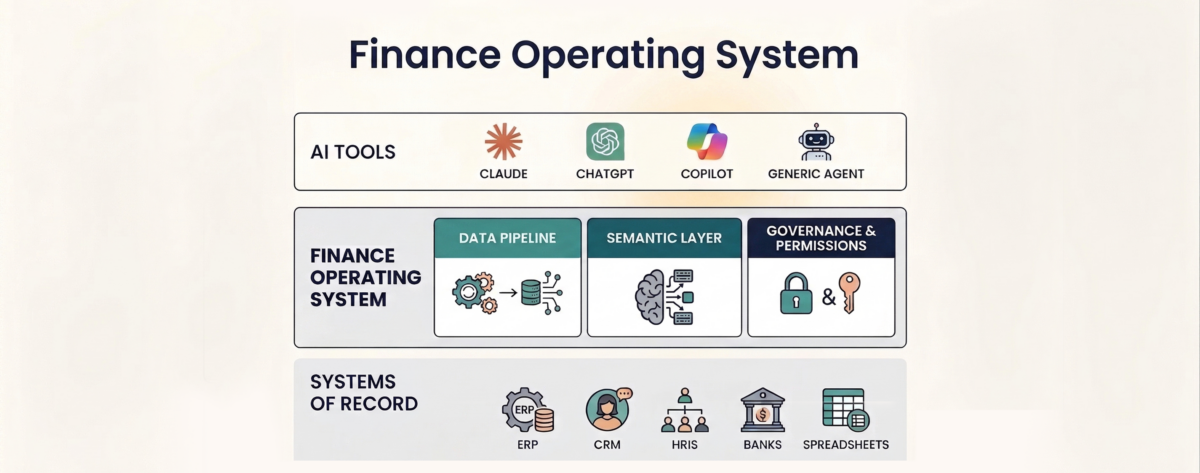
The practical distinction is where each layer sits in the stack. ERP and GL systems sit at the base, capturing transactions. FP&A and EPM tools sit at the top, providing analytical applications. A finance OS sits between them: consolidating what the systems of record contain, governing who and what can access it, and connecting it to the AI tools that generate analysis and drive decisions.
How a Finance OS Differs from Fintech “All-in-One” Platforms
The term “finance operating system” is also used in fintech to describe platforms that consolidate payments, billing, expense management, and accounting into a single product. Stripe, Brex, Ramp, and similar platforms have adopted this framing. It is worth being precise about the distinction, because the two definitions describe fundamentally different problems.
Fintech finance OS platforms are transactional. They consolidate financial operations: moving money, tracking spend, generating invoices, reconciling accounts. The value proposition is replacing multiple point solutions with one unified workflow layer. These platforms are primarily relevant to startups and growth-stage companies that need to streamline how money moves through the business.
A finance operating system in the context of enterprise and midmarket FP&A is infrastructural. It does not process transactions. It consolidates financial data from the systems that do (ERP platforms, general ledgers, CRM, HRIS, banks) and governs how that data is accessed by AI tools, models, and workflows. The value proposition is not fewer tools. It is trusted, governed, AI-ready data.
The distinction matters because the problems are different. A CFO choosing between Stripe and Ramp is solving an operational efficiency problem. A CFO building a finance OS is solving a data infrastructure problem: how to give AI reliable access to consolidated financial data without losing audit trails, permissions, or compliance controls in the process.
As AI becomes central to financial planning and analysis, the infrastructural definition of finance OS is the more consequential one. It addresses the bottleneck that is actually limiting AI adoption in finance, not the fragmentation of financial operations, but the fragmentation of financial data.
The Three-Layer Architecture of a Finance Operating System
A finance operating system is built on three components that work together to transform raw, distributed finance data into what AI engines require: a governed, structured, real-time representation of an organization’s financial position.
The first is the consolidated data pipeline. This layer connects to every financial and operational data source in the organization: ERP systems, general ledgers, CRM platforms, HRIS, billing systems, banks, and spreadsheet models. It pulls data from these sources continuously, normalizes it across different schemas and currencies, handles intercompany eliminations and foreign exchange adjustments, and maintains a single governed repository that reflects the current state of the organization’s finances.
The second is the semantic layer. Raw financial data from ERP tables and database fields is not structured for AI reasoning. A semantic layer translates technical data structures into financial concepts that AI models can understand and query accurately. Instead of referencing a database column, an AI agent can request revenue by region, operating margin by business unit, or cash position across entities. This translation layer is what allows AI tools to generate accurate financial analysis rather than approximate it.
The third is the governance framework. This component applies role-based permissions, maintains audit logs, enforces compliance controls, and ensures that every query made by an AI tool is traceable to a specific user, a specific data source, and a specific timestamp. Governance is what makes AI outputs defensible in an audit, presentable to a board, and compliant with financial regulations.
How Model Context Protocol (MCP) Makes Finance OS Viable at Scale
MCP is the technical development that made the finance OS category commercially practical. Before MCP, connecting financial data to an AI tool required custom integration work for each tool and each data source, and every time an AI platform updated its interface, those integrations had to be rebuilt. The cost and complexity made governed AI access to financial data impractical for most finance teams.
Model Context Protocol (MCP), an open standard introduced by Anthropic in late 2024, standardized this connection. A single MCP server, built on top of a consolidated financial data layer, can expose governed financial data to any AI platform that supports the protocol: Claude, ChatGPT, Microsoft Copilot, and any subsequent model. Finance teams build the data infrastructure once and connect it to the AI ecosystem broadly, rather than maintaining separate integrations for each tool.
This model-agnostic architecture is what makes a finance OS durable. The AI tools sitting on top of it are interchangeable as the landscape evolves. The governed data layer beneath them is the asset that compounds in value over time.
For a deeper technical treatment of how MCP works within a finance data stack, see our guide to MCP for Finance.
What a Finance OS Makes Possible for Finance Teams
The most immediate change a finance OS delivers is access: finance teams can query governed, real-time data through whatever AI tool they are already using, without exporting files or rebuilding integrations for each request.
Urvesh Patel, CFO at La Fosse, a UK-based workforce solutions firm, described the experience of asking why marketing costs had increased. Before a governed AI connection to their financial data existed, answering that question meant pulling numbers from multiple systems, reconciling them, and waiting for someone to piece together an explanation. It took hours and still did not always produce a confident answer. With the FinanceOS AI Connector active, the same question returned a full explanation in under 10 seconds, including an executive summary and an itemized breakdown of the underlying drivers grounded in live data.
The same team used their connected data layer to generate a full quarterly business review presentation through Claude, complete with narrative and structured analysis drawn directly from their live financial outputs. A process that previously took more than a week was completed in a single session.
These are not isolated efficiency gains. They represent a structural shift in what a finance team can do with a given headcount.
Perhaps more significant is the analytical ceiling that lifts when connected data is available. The same team analyzed CRM activity patterns alongside financial performance data to build an attrition risk model for their consultant workforce. In a business where training a new hire takes nine to twelve months, early signals of attrition carry real financial consequences. The model surfaced behavioral patterns and activity trends that no manual analysis would have identified. When cross-referenced against recent departures, the model had flagged several employees who subsequently left.
That kind of analysis was not previously unavailable because the team lacked intelligence or methodology. It was unavailable because the data needed to run it existed across disconnected systems, and assembling it manually was not a realistic use of anyone’s time. A finance operating system made the data accessible. AI made the analysis possible. The combination produced an output that neither could have generated alone.
Board reporting, scenario analysis, anomaly detection, reconciliations, and attrition modeling all become tractable when they share a common data foundation. The finance OS is what creates that foundation.
The Current Market for Finance OS Platforms
Vendors are approaching the finance OS opportunity from different starting points — some from ERP integration, some from FP&A, some from data infrastructure — but the architectural requirements are converging around the same three components: a consolidated data pipeline, a semantic layer, and a governed connection to AI. The category is nascent, but its definition is not.
Datarails, which has built financial data consolidation infrastructure for over a decade, launched FinanceOS in early 2026 as a dedicated finance operating system. The product connects to more than 400 data sources, applies consolidation logic including eliminations, allocations, and FX adjustments, and exposes the resulting governed data layer to AI engines via a finance MCP server. La Fosse had the FinanceOS AI Connector operational within a single session and within weeks was generating quarterly reporting, variance analysis, and predictive models from the same governed data layer.
The organizations that establish governed, AI-ready data infrastructure earliest will face the least disruption as AI continues to change what analytical applications are capable of.
The Strategic Question for CFOs Evaluating Finance Technology
The procurement question has changed. For CFOs evaluating finance technology today, the relevant question is no longer which FP&A platform has the best modeling interface; AI has made that layer a commodity. The question is whether the organization’s financial data is consolidated, governed, and accessible in a form that allows AI to operate on it reliably.
Without that foundation, AI tools will continue to produce outputs that finance leaders cannot trust, trace, or defend. A finance operating system is the answer to that question at the infrastructure level. It is not an analytical tool. It is the layer that makes analytical tools trustworthy.
See how FinanceOS by Datarails connects your financial data to the AI tools your team is already using.
Finance Operating System FAQs
A finance operating system is a governed data infrastructure layer that consolidates financial and operational data, applies controls for accuracy and access, and makes that data available to AI tools and workflows in real time. It sits between systems of record such as ERP platforms and the analytical tools that finance teams use to generate analysis and drive decisions.
ERP systems are transactional systems of record: they capture financial events as they happen. A finance operating system does not replace the ERP; it connects to it, consolidates what it contains, and makes that data accessible to AI in a governed, real-time form. The ERP records the data. The finance OS makes it usable.
The limiting factor has not been AI capability but data infrastructure. Financial data is typically distributed across disconnected systems, inconsistently structured, and not governed in a way that allows AI to query it reliably. Until that changes, AI tools will continue to produce outputs that finance teams cannot fully trust.
Model Context Protocol (MCP) is the standard that allows a governed financial data layer to connect to multiple AI platforms without custom integrations. It enables a finance operating system to expose the same trusted data to tools like Claude, ChatGPT, and Copilot through a single interface, making the model scalable as the AI landscape evolves.