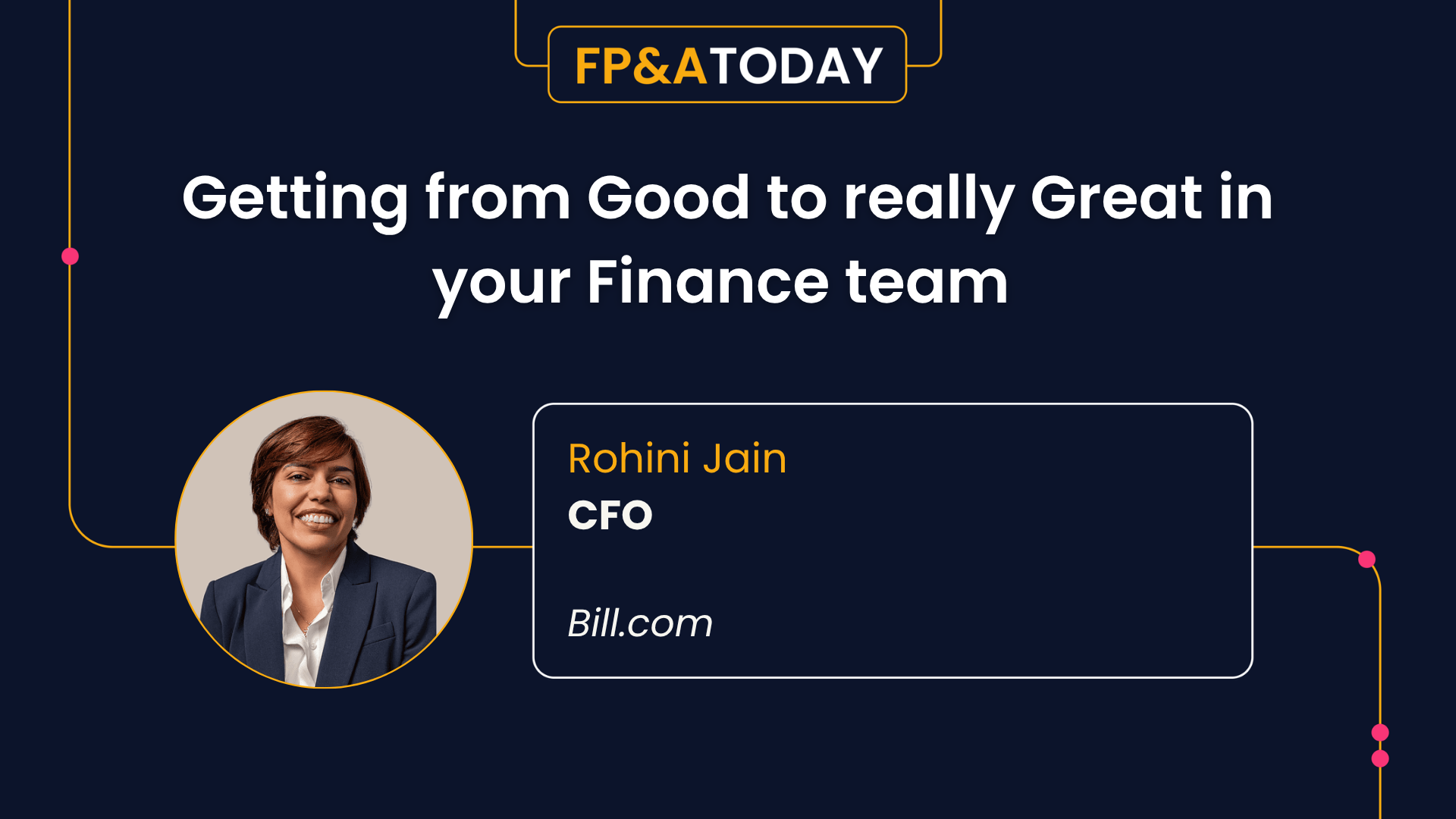
Rohini Jain leads finance strategy at BILL, which delivers strategic finance capabilities in one integrated platform including AP, AR, expenses and procurement. She has more than 20 years of experience shaping and leading finance, product, and operations teams at global fintech, payments, and e-commerce companies including at PayPal, eBay, Walmart and General Electric.
She spoke to us ahead of the earnings release for Bill.com (November 5) which revealed total revenue at $395.7 million, an increase of 10% year-over-year, and core revenue, (subscription and transaction fees) of $358.0 million, an increase of 14% year-over-year. Bill now serves 498,100 businesses as of the end of the first quarter.
In this episode:
- Deciding to choose finance (and disappointing my mother)
- The GE “magic” building the next gen of finance leaders
- Building a diverse skill set in my finance team
- Love for engaging small and medium-sized business
- Challenges and stress of public CFO role
- Building agentic capabilities and finance’s future
- A surprising Excel revelation
Full Transcript
Glenn Hopper:
Welcome to FP&A Today, I’m your host, Glenn Hopper. Today on the show, we’re joined by Rohini Jain who leads finance strategy at Bill, the intelligent finance platform used by nearly half a million businesses to manage, move, and maximize their money. Rohini has more than 20 years of experience shaping and leading finance product and operations teams across some of the world’s biggest names in FinTech payments and e-commerce. Before joining Bill as the company’s chief financial officer, she served as CFO and SVP of PayPal’s, large enterprise and merchant platforms, and previously held senior finance leadership roles at eBay, Walmart, and General Electric. She holds a master’s in finance from the London School of Economics, and is the Chartered Accountant with the Institute of Chartered Accountants of India at Bill rohini is helping redefine what autonomous finance means for small and mid-sized businesses, combining data, technology and AI to eliminate friction and expand opportunity. Rohini, welcome to the show.
Rohini Jain:
Thank you so much. So glad to be here.
Glenn Hopper:
I’m so excited to get to autonomous finance, but I’m gonna, I’m gonna hold my horses on that <laugh>, and we’re gonna walk through, uh, walk through your background a bit and everything because I, you have a fascinating background and I can’t, can’t wait to hear. And for our listeners to hear, um, about some of the, uh, positions and, and roles you’ve had so on that you’ve had a remarkable career. It’s taken you through GE, eBay, PayPal, and now Bill. And I’m wondering, how did you first find your way into finance and what’s kept you hooked on it through all these years?
Rohini Jain:
It’s such an interesting question because, uh, if I really look back on what got me into finance, it was real chance, almost. So I was in this, uh, queue for depositing my fee for my college application. And like any other good Indian kid, I was going to be either an engineer or a doctor. So I was on the science line and I saw this queue next to me depositing fee of all these people who are gonna do commerce, which is the business and what we call it back in India as a, a study stream. And they were all talking about economics and business studies and management accounting. I’m like, oh, that sounds so interesting, and I’m just drawn to change. And I was like, okay, maybe interesting to do that instead of physics, chem and math, which I’ve already done enough of. And I switched the queue and ended up, uh, much to the disappointment of my mother, who to date, regrets that I did not become an engineer, engineer and went in to do commerce and then eventually CPA. It’s been such a fascinating journey. Like I started out my career with GE and, uh, then moved over to eBay and PayPal was briefly at Walmart and then Bill, and every day there’s a new problem to solve, and every day feels like, you know, what is the closest alligator to the boat I need to deal with? It’s, uh, it’s been very fresh, it’s been huge learning every single year, every company. Um, and yeah, I couldn’t do anything else.
Glenn Hopper:
Well, did you tell your mother? You certainly didn’t take the easy path. I’ve heard about the chartered accountant in Institute of Chartered Accountants in India, and that’s not a, that’s a, that’s a tough exam, right?
Rohini Jain:
<laugh>? Yeah. Well, she has three kids. One of them’s a doctor, one’s a lawyer, and I am what I am. She still doesn’t have an engineer and she complains about it. <laugh>
Glenn Hopper:
<laugh>. So I’m on the board at, uh, the School of Accountancy here, here in Memphis, and we actually just got the accounting program approved as a STEM program. And I think it was for that very reason, I think it was. So Indian mothers would feel okay sitting there. <laugh>, <laugh>.
Rohini Jain:
I need to tell her that.
Glenn Hopper:
Yeah.
Rohini Jain:
Right now, <laugh>,
Glenn Hopper:
You had to have picked up so much along the way, and just looking back at across all those stops and now at Bill, are there experiences along the way that stand out, stand out as turning points and that kind of shaped the way you think about finance today?
Rohini Jain:
Yeah, absolutely. I think starting out my career with GE was probably the most defining and the most critical moment in my career because it’s the GE DNA in finance is really strong. You probably see around you, there are so many CFOs that have come from GE and are just great leaders. So what we do there is this, you know, a school you get into, you get into the machine and they churn out people who are deeply rooted into what it means to run a business, not just be a finance partner. So you are along with your CEO or your gm, the only other person who knows everything about what’s happening in the business, irrespective of, you know, portfolios or functions and such. So just for an example, when, uh, one of my early roles in GE Healthcare Factory, when I was doing the factory manager role, a finance manager role, I actually stood in the line to make circuit boards to know how that’s done.
I actually, during the quarter end rush, I would be in the shipping dock helping pack boxes and shipping them out of the door. So the learning about, uh, not only how to get deeper into the operations of the business, build your business acumen, but also how to do it at scale. Like GE has presence in every single country. It has probably teams across multiple continents. So doing all of that at scale, I think that was just a really great, uh, training ground for me. And then every other role and company that I’ve gone to, there’s been at least one or two special things that, uh, I have, I have drawn out of them. So when I went to eBay, not only learning about the tech world and the finance work somewhat differently from a mindset perspective as well in technology, but I did analytics roles there, which, um, you know, exposed me to big data and, uh, the complexity of just how much data there is in transaction businesses, right?
And how to deal with that and how to make very efficient, effective decisions. Uh, with that then moved over to, uh, PayPal, new industry. FinTech. The most exciting thing, almost a turning point in my development as well, was when I, uh, moved out of finance for a couple of years and did a product role, nerve wracking, right? It was really hard to be the person who knows the least in the room after being the expert for several years, uh, when you enter the room, right? So it was really uncomfortable at that stage in my career, but, uh, great learning, and I feel like that was a moment in finance, or not being in finance was when I learned most about finance, because you kind of look at the mirror and you see what you are not doing well. So huge turning point. And then, um, yeah, taking this role at Bill, I mean, talk about an accelerated growth curve and a learning curve. It’s, it’s been all of that. Uh, and working with a wonderful team here has been great.
Glenn Hopper:
That’s amazing. And what I really like, it sounds like the through line in that story is, it’s so easy, and I think that finance has evolved over the years, but I know when, when I, and had you not started it at ge, it may have been similar, but when I started in finance, we were in this ivory tower where everything was theoretical, and we were just in there with our spreadsheets and our models and crunching our number. And it, I, I can remember telling someone when I had a, a career chain, I went to a different company that it, I didn’t care what the widget was, you know, I’m just, I’m just the numbers guy, the bean counter, I guess is what I accidentally called myself. But, and I, I had that mentality early in my career, and maybe at a functional level, you can get by with that, but I think finance has evolved so much now, and you have to, you still have to have all that domain expertise, but you also have to have this breadth of knowledge that I think when I started out in, in finance, you didn’t have to have that.
And I think that GE training and then switching into the product role, I, I know you said on the product role, you kind of see outside in what finance is doing and learn from there. But just by understanding these aren’t just numbers, these are, uh, processes, techniques, people and everything that’s behind it. What did you take away from that?
Rohini Jain:
So many things, right? Uh, one of the thing is it makes you really empathetic to the business. And sometimes I’ve seen finance people come in and say, oh, why are we not meeting the numbers and what’s happening? Rather than trying to get to the root of the problem, you sometimes are just dictating what the outcome needs to be. And that doesn’t help. So simple things like when you’re thinking about, uh, product release and what you need to bake into the next year’s plan from that, now I know that how much time it needs to not only make that product, get it released, start talking to the customers about it, there is a ramp period there, there is this whole cycle that needs to happen. We cannot just as finance people push a higher number and make the business, uh, feel like committed to that, right? So there’s this element of empathy and understanding that you get being outside of finance, which I think is super critical. And then in the end, the impact comes from business results. It doesn’t come from sitting and counting the numbers. So if you want to drive business results, you wanna be a problem solver with them versus stating the problem for the business.
Glenn Hopper:
Yeah, I love that because in, in my CFO roles, I would come in and immediately anger <laugh> the, the COO and the CRO because I would be so interested in what was happening outside of the general ledger, because whether it was to make a better forecast or figure out cash flow or just understand the business, it, you just, you start overreaching and sometimes, you know, it, it can create some friction if, if the company culture isn’t there. But I just think
Rohini Jain:
Yeah,
Glenn Hopper:
Whether you own the numbers or the metrics, being able to understand them makes you better at finance and it makes you able to be more strategic.
Rohini Jain:
Yeah. And, and I’m sure in your experience, you would’ve learned that it’s probably friction for a very short period of time. The moment they realize that you’re there to help them get to their numbers versus just give them a number. I think it really changes the dynamic between the two.
Glenn Hopper:
Yeah. And you’re probably a way better people person than I am. So be <laugh>, they stayed angry at me. That’s,
Rohini Jain:
That’s not what people tell me, but thank you. I take it <laugh>,
Glenn Hopper:
I love having that, that broader view coming into the office of finance, and we’re not just here in our ivory tower, but, and then moving across different big companies like that, you know, every company measures performance a little bit differently. And I’m imagine there are things that you’ve taken from each of ’em, and I know you could be in different industries and it, you know, different things apply. But for you, are there any key metrics that really stand out and really matter to fp and a? I mean, the ones that really drive the story behind the numbers, and this could be from a previous role or, or what you, what’s most important to you at Bill? Whatever’s, you know, makes the most sense.
Rohini Jain:
This is, again, uh, more relevant. As I think about the technology industry that I’ve been a part of for now several years. One of the things that I’ve noticed is that there’s just too many metrics. There’s too many metrics that everybody’s trying to measure and trying to focus on and trying to solve for. So I wouldn’t lend give you one or two metrics. I would just say that the job of the finance and FBNA teams is to really understand what matters most. What are the metrics that matter in this time, uh, in life of the company, in this industry, and where they’re headed and what is really the most important thing to focus on. So, not a list, but a few handful that they can really start to work through with the business teams and their leaders to, uh, make an impact on those. The other thing that I have learned around metrics is, uh, there are several unintended consequences of measuring a metric.
So what’s very important to me as I think about, uh, what really matters and what I wanna measure is what is the control metric that’s associated to it? You know? So if you are trying to maximize your sale, you sales number, you will do a certain type of metrics for sales compensation or whatever else, but you have to have a control metric of profitability around that. If you’re trying to manage your risk basis points of how much risk can you tolerate, you still wanna have the sales metric tied to it that how much friction are you putting on the sales metric? So I think seeing the both sides and trying to figure out what could be the potential unintended consequences of measuring just one metric is really important.
Glenn Hopper:
And identifying which ones are the actual levers, which are exactly, they could be lagging indicators or which ones, if we impact this, we’re actually gonna drive results. Yeah.
Rohini Jain:
They, they need to be leading indicators. They need to be controllable. A lot of companies spend a lot of time trying to constantly measure and look at, keep themselves busy with looking at things that they cannot control. It’s good to know them periodically, but you need to obsess about things you control and things that are leading indicators that drive outcomes.
Glenn Hopper:
Yeah. And there can be so much noise in it. I was in, in private companies, primarily private equity backed, and we’d have our quarterly meetings with the board and um, you know, whoever else was, was in those meetings. And it grew to a point where we had, I mean, it was an 80 page deck, then a 90 page deck, then 120 page deck where it’s, you have all these metrics in there and you’re going through ’em, and, and it can just sound like as you go through the different management reports, like you’re reading a laundry list and it seemed like every board member had certain metrics that they cared about. And then when somebody was talking about metrics they didn’t care about, they would just be off, you know, making notes or, or doing what they did. And if you tried to pull any of them out, yes, somebody has a problem, one member who was interested in Yeah, <laugh>, but it, it’s so hard to filter through that noise. And I think that that’s where we can find, that’s where we’re gonna add value when we know what those key metrics are and when we can tell the story around them. And yes, okay, everybody has their pet metrics that they wanna look at, but being sure that we’re focused on on the right ones. Yeah. And you know, they’re gonna differ by industry, obviously. Like,
Rohini Jain:
And I understand there are a lot of early indicating metrics, and they could be hundreds and thousands. And a large company, this is where I’m super excited about AI as well, where I’ve always had this optimal vision of what I would like to do, is this probably a dashboard or something that’s measuring all the metrics I never have to look at. And there’s some sort of eye in the sky that’s sort of looking at it and saying, okay, these are the five ones that are outside of the control threshold. And you tee those up and you still look at it and say, okay, do you, and you know, these things could generally end up with a lot of noisy fluctuations, but you, we can now leverage AI to build things like that where we are focused on the five or six metrics that are most important for the company, but there’s a tool that’s kind of keeping an eye on everything else.
Glenn Hopper:
You are speaking my language now. And that’s, I mean, to me, that’s the dream because I spent so much time going through data trying to find correlations, maybe even to things that weren’t there. And I know correlation doesn’t mean causation, but to your point, there’s so much data out there, and it’s more than we can ingest and keep up with. Absolutely. Maybe all those metrics are somewhere important, but if you had something running AI in the background that found those correlations and figured out, hey, you know, this is a leading indicator here. If we see this move, we know this is the downstream effect. And that’s, I imagine it, it bill with, with all the data that you have that you’re actually maybe seeing some of that in, in real time.
Rohini Jain:
That’s something that I’m super excited about. Right. I mean, the issue that ends up happening without AI deployment in these things is there are a lot of false positives or false negatives, and you’re then chasing how do we get high quality signals? And the more data that you have, the more scale that you have means more effective ai, right? So you could actually really, um, yeah. So Bill’s just positioned in the right place to do that for our customers.
Glenn Hopper:
So with your finance team there, I’m always curious to hear how different companies, especially companies with a lot of data, how they structure that finance team. And I’m, I’m thinking specific, I mean, we can talk about the broader team as well, because all that’s important, but I’m thinking specifically about the role of data science and how if you have data scientists on your team and or if they work really closely with the data science and BI team, like, like how do you, I’m thinking about the team structure and then the different skills, but also making sure the team stays connected, like you were talking about with the rest of the business, product engineering operations, it’s a big challenge to have, to have this diverse skillset and then to have them all business partnering with the other groups. How do you, how do you approach that at Bill?
Rohini Jain:
That’s actually a really excellent question, right? The way to think about it is, and I talk a little bit about how you just need to build a lot of business acumen to be able to be an effective finance person. The second side of that equation is functional expertise. So, you know, the business, you have the functional expertise, and you have the latest in technology. You have that appetite to learn and grow. You bring all of that together and have the right balance between the two is where the success lies. And one of the key things that I’ve been really thinking about, uh, over the last few years is how do we continue to evolve the skillset of the finance people and the FPNA people? It’s no longer going to be the traditional accounting based teams that are very good at what they do. From a finance ROI type of work, we really start to need, uh, we need to seed our teams with a few people, these young kids who are very exposed to the latest and the greatest tools who are using ai.
And actually, a few years ago, uh, I had some finance people who are doing machine learning and SQL and all of those things to help us. If now that needs to have a step change, right? So even if you are structured to support the business, you have to mirror the org of the CEO you are supporting from a finance perspective, that’s the only way to succeed, right? But within these teams, you need to start to now add a different type of skillset that starts to work together and sort of, uh, you know, with, uh, osmosis or something, everybody starts to grow into that place. And you just need a couple of change drivers. You need a couple of people to be thinking about the processes and such and making these rapid changes.
Glenn Hopper:
And how do you deal with the business partnering? Do you actually have team members that are embedded in other groups? Or how do you handle the sort of the cross-functional reporting for finance? Yeah,
Rohini Jain:
So we have that, and I’ve had that almost always all through my career where, uh, my team is really structured to mirror my CO Renee’s team, and each person is sitting there. And then I have a corporate team that’s adding up all of that work and driving the corporate wide initiatives. So as we think about, uh, streamlining, reporting, dashboarding, introducing AI and all of that stuff, there is a corporate team that just spends time on that and pushes it down.
Glenn Hopper:
I love that. Yeah. And that really, I mean, that level of business partnering, it builds trust. It gives you better insight. And the, the people who are working with those teams have a way better understanding of it. And they like going up and going to the assembly line and, and doing their steps and understand, understanding that. I mean, it’s, it, you know, how, how to report better on, on what that flow is and everything.
Rohini Jain:
Yeah. And those guys spend way more time with their business partners than they do with me, right? That’s, that’s their key stakeholder.
Glenn Hopper:
Yeah, I love that. So looking back at your career, what would you say are the biggest lessons you’ve learned about how to run fp and a Well, I love the business partnering part and then, you know, mixing in the, the new technologies. Would you say there are traits or things you can do that separate a good finance function from a, from a great one? What it takes to get it to that next level?
Rohini Jain:
Yeah. I think there are a few things in my mind that separate, um, great finance functions. The first one is the mindset of not being stuck within your job description is really important. The most exciting times in my career have been where I have done things to solve business problems that have nothing to do with my job. You know, so those, those are the type of people that I wanna always hire that, you know, they have all the finance expertise, but they don’t stick to that job description and go solve for problems. Curiosity. I feel over time, I have learned that people who are curious are the ones that I want in my fp and a teams. You just need to ask questions, not only to learn the business, how to do things best talk industry wide, see what’s happening and all of that, you know, the, the curiosity of a person makes, it, makes him or her a really great asset. And then, uh, people who can work with high velocity, like get stuff done. That, that’s my thing. I just, I, I like high energy people.
Glenn Hopper:
Yeah. And I love that curiosity component, because that goes so far. Because if you have that curiosity, then you’re not gonna be just, I’m just in the finance lane, or I’m just in the accounting lane and it’s, I I always think about fp and a really, in a lot of ways you’re an investigative journalist. It’s one thing to just
Rohini Jain:
Exactly
Glenn Hopper:
Regurgitate numbers, but then exactly ask why. Ask why and dig in. Yeah.
Rohini Jain:
Yes, yes. It could be annoying for everybody else, but <laugh>, it’s, it’s useful. <laugh>,
Glenn Hopper:
Fp and a today is brought to you by Data Rails. The world’s number one fp and a solution Data Rails is the artificial intelligence powered financial planning and analysis platform built for Excel users. That’s right, you can stay in Excel, but instead of facing hell for every budget month-end close or forecast, you can enjoy a paradise of data consolidation, advanced visualization reporting and AI capabilities, plus game changing insights, giving you instant answers and your story created in seconds. Find out why more than a thousand finance teams use data Rails to uncover their company’s real story. Don’t replace Excel, embrace Excel, learn more@datarails.com.
So, loaded question for me, because I have thoughts a, around this with everything that’s going on with generative AI right now. And I understand, you know, for years, people in fp and a have stood out by, if you learned to write a SQL query, and if you learn Python and you can do some cooler things than what your buddies in Excel can do, that’s, that’s great. But I think
Rohini Jain:
Not to undermine Excel for one second there.
Glenn Hopper:
Exactly, yes. Yeah. We love Excel here at Data Rails <laugh>. Yeah. And actually even doing data science projects, I mean, I, I talk to data scientists all the time, and Excel is kind of where you end up to do
Rohini Jain:
Yes.
Glenn Hopper:
Your sort of presentation layer and your
Rohini Jain:
The last mile. Yeah,
Glenn Hopper:
Yeah, yeah. But with generative ai, I always think of it like, okay, we’ve been talking about democratization of data for, I don’t know, what, 20 years now or, or however long <laugh> Yeah. But with generative ai, it’s almost like there’s a democratization of data science right now in that you don’t, that barrier to entry if you can’t write a SQL query or you can sort of write one and you need it to be QA and fixed generative AI can fix that, or it can do crazy forecasting like build a complex, uh, you know, like REMA forecast or something for you. That would be a pain to do in Excel. But I think with generative ai, obviously, you know, there’s a, you hear all the time about glitches where people are using it wrong, but it is going, it’s going to change and, and shape finance for years to come.
And I dunno, I always like to think about if you were talking to someone straight out of college, or this could even be to your team, but if someone wants to level up their impact and career right now, where do you think they should study? And I don’t, it seems like maybe that answer would’ve been different pre generative ai. And I know I’m, I said it was loaded. I’m completely leading you on that path, so don’t, don’t feel like you have to answer just for that. But, you know, and maybe even, maybe there are some, some things beyond that, but people just starting in their careers or, or teams trying to level up, where, what skills should they be building and where should they be focused right now for the future?
Rohini Jain:
Yes. There’s so many dimensions to that question. You know, I, I still think that as your finance is still a technical field, you need to know accounting, you need to know the regulation, and you need to know how to keep the books. So those type of things are still very fundamental. Understanding data structures. And I personally think was very helpful for me to do the analytics stint, because you may not use it today because you have the AI tools to help you. It’s the same thing as calculator, but a leap, leap forward, right? You still wanna know how to do the multiplication even if you don’t do it. So I think having that foundation is really important. So you can smell if there are things that are not outputting appropriately through the ai, right? So I still like the idea of foundational skills that you’re building through education, but more than any kind of education is this.
Uh, and I tell my kids all the time, right? Is the ability to continue to learn this growth mindset piece was never as relevant as it is today. So I don’t care what you studied, as long as you are super curious, high energy in terms of learning new things and evolving your career, I think that’s what we need. Because we don’t know what this gonna, this is gonna look like in five years, or 10 years or 15 years, but I still know that there will be problems that will need to be solved. AI will be an amazing companion to give you data. It’ll be a companion to point you in the right direction, but you still need a human mind to say, okay, we are gonna take this path out of the three that are possibly out there. And honestly, as I look back, there were days and nights.
I mean, I had a small child in a, a bucket seat, and I was in the office rocking her and closing the books over the weekend. You know, what AI could help us do is take out a lot of that manual work that all of us had to do growing up, which, you know, we didn’t love so much, uh, nights that ended at two o’clock or three o’clock because we are doing budget submissions. If all of that gets automated, that’s great. You have more time to then learn about the business and help strategize with your business partners. And this is exactly, I mean, I’m, I’m gonna talk about Bill because this is what makes me excited to be here, is that’s what we are trying to do for smaller companies. Now, big companies can put the resources behind it, all the tools and the infrastructure behind it. But, um, the smaller SMBs, they’re sometimes just a handful of people who’s also the chief marketing officer or the CFO or the strategy guy, or whatever else it might be. So if we were to really help them with the tools and, uh, AI agents that help them do things much faster and take out all the, the grunt work, they can actually focus on growing their business the right way. I know it’s a long-winded a answer over here, but, uh, I, I do feel passionately about that.
Glenn Hopper:
No, your long-winded answer was probably half as long as my question <laugh> <laugh>. So they’ll, they’ll edit me out. They’ll just say, there’s Glenn rambling again. We’ll get <laugh>. So what’s top of mind for you personally these days? I mean, we talked about, you know, where teams and they should be focusing their curiosity, but as someone who I can tell has that curiosity, what are you learning or trying to master in kinda this next chapter of your career? Yeah,
Rohini Jain:
I mean, when I joined BLI did it for a reason, because I wanted to really get deeper into the SMB space, uh, on the B2B side. I’ve worked on B2B side for a long time, but, uh, wanted to really understand what their needs and problems and such were. So that was a part of it. Uh, secondly, from a functional perspective, there’s a business element, always a functional element, right? From a functional perspective. Uh, I worked closely in the past with the IR teams, but not had, uh, investor relations and managed the relationships with the, uh, shareholders and such in the past. So that was one of the things that I wanted to come in and learn, and I’m very focused on that, spending a lot of time there, uh, as well as the capital markets area. That’s something that I’m, um, you know, getting my hands into and wrapping my head around, which is, uh, great learning for me.
But on top of that, on a more personal level, even though I was expecting some of this, getting a public company CFO role, it just takes you by surprise how much time you need to devote to external commitments. Uh, just the, uh, and then, you know, how do you balance what you need to do internally in running the business, building the teams, and investing in talent and all of that. So that’s the balance I’m trying to figure out right now. And, um, secondly, I’m gonna throw it out there because, uh, you know, the stress of this role, it doesn’t switch off.
Glenn Hopper:
Yeah,
Rohini Jain:
It doesn’t switch off. It’s like seven days a week, 24 hours, and how do you manage through that when you have a family, you have other commitments and you have, um, you know, what’s happening at work. So I think on a, a deeper level, those are some of the things that are very top of mind me.
Glenn Hopper:
Yeah, I could see between just between IR and regulatory, you add that <laugh> on top of the already full-time and throw ESG in there too, you know, but that, yes, on top of the regular full-time commitments, it’s doesn’t matter how big of a team you have, if you, if you’re managing all that, that’s a lot of, uh,
Rohini Jain:
The buck stuffs with you in
Glenn Hopper:
The end. Yeah. Yeah. So, and it’s your signature on the, uh, financials, right? <laugh>.
Rohini Jain:
Exactly.
Glenn Hopper:
Yeah.
Rohini Jain:
Yeah. Every time you have to go out and guide, you’re like, few sleep sleepless nights before and after, for sure.
Glenn Hopper:
I love what you said about your interest around SMBs, because I spent a large portion of my career on that side. And even now in consulting, because I’m, I’m so leaned into AI and AI projects, I’m, I’m really focused on enterprise now, maybe more than I ever have been. But I think about this because I still have a lot of contacts in the you in a private equity portfolio company, a smaller business, uh, space, and they don’t have the budget or the resources to really capitalize on where AI is right now. So what Bill’s doing, and, and we’ll talk more about that in, in a few minutes, but I’ve, I’ve thought from the beginning, there’s gonna be someone who is like, what QuickBooks was for small businesses back a million years ago. Yeah. Where now you have an accounting platform that’s affordable, and you don’t have to have the big ERP system and, and all that.
Yeah. And, and, but you think about like all these small businesses, you don’t have big data to benefit from. If you’ve got a dry cleaner that has three or four locations, that’s not big data. And you probably, whatever data you have is not consolidated or aggregated anywhere. So when I hear about, well, your focus there, and I, I know where, where Bill is on that, that’s interesting to see where we’re going in the future. And I think I’m jumping ahead. I do. Well, we’re gonna go ahead and get there, because we’ve waited. I’ve gone 30 minutes into the show now, and I’m just now getting to ai, which <laugh>, everybody who listens to me knows that I’m, I’m chomping at the bed out of the gate too <laugh> to do that. So when most people today, when they hear ai, the first thing they think is generative ai.
But I know Bill’s been an AI powered platform for a decade, you know, classical ai, machine learning. Yes. Um, but I do know that now you’re rolling out some new agent capabilities that I’m super excited, uh, to hear about. So without stealing any of your thunder, I’d love to hear what, what Bill has going on, uh, with AI and the new, what I don’t know, you, you could start telling me kind of, if you want, you can go into how you’ve used AI historically, and then I’d love to hear about some the new products as well. Yeah,
Rohini Jain:
No, I’d love to talk about the new products. It’s exciting moment in our life. So the first thing I mentioned before I get into the agents is that we have invested the time and effort in building out an integrated platform for ai. So we have multiple different products that we serve up for the SMBs, which are helping them on a day-to-day basis to take out a lot of the manual work anyway. But now, you know, with that integrated platform, we wanna have the capability to rapidly release the agents. And the other thing about the agents is that we really wanna first think about the problem that the SMBs have and what are we solving for versus, oh, this agent just looks very cool and we’re gonna roll it out. But we are very deeply thinking about how to prioritize it. And you know, I, I talk about a couple of problems that, uh, we kind of focused on to roll out, uh, solutions for first.
And the first one is, uh, the w nines. I mean, we all love tax, don’t we? <laugh>? So one of the things we hear a lot from the SMBs is that it’s so hard to collect the w nines come tax season, and on an average, it takes them about a week out of their year to just do this collection effort and reconciliation and all of that work. So what we are trying to, we are a two-sided network, which is great. We have the relationship with the suppliers, we have the relationship with the aps or the, uh, the bill, uh, customers. So we have this, this agent coming out that will go do that for you. It’ll take out more than 80% of the manual work required. It’ll get the w nines, it’ll reconcile it automatically, and boom, the work’s done. And I mean, I, I can already see the smiles in people’s faces when this happens because, uh, it’s, it’s really a zero, a zero value added work that they have to do. Yeah. And it’s just back and forth. Um, I don’t know how you feel about, uh, collecting your own tax documents, <laugh> to file your returns <laugh>.
Glenn Hopper:
So I was gonna say, um, I know when at most companies where I was at, at smaller companies, even like not having that process upfront to collect the, you know, if you go through a big company that has a procurement and onboarding process, they’re gonna get the w nines early on and everything. You
Rohini Jain:
Throw the people at it and you’ll figure it out. Yes.
Glenn Hopper:
Yeah. But in small companies, it was always just that scramble. So that’s, that’s significant for a lot of companies out. There’s huge,
Rohini Jain:
Yeah. Super excited about it. But this second one actually, it, it’s personally so exciting for me because I, I am really not good with this. So we all travel for the company and such, and you would have experienced, you know, the s and e card that we have, or the corporate charge card that you guys would use, the effort required in taking pictures of the receipts, trying to keep them safe in a separate pocket of a wallet, and then trying to upload it to your systems and make sure it reconciles. And now there is a $10 error that I don’t know why and what’s happening. So what we are also trying to do for the SNE business is to automate all of that. So there would be automatic collection of the receipts from your emails if you include it and whatnot, and automatically gets into your, uh, you know, SNE card platform and it reconciles it and boom, you’re done. I know my EA will be so excited about it because I never sent her the receipts on time. So <laugh>, it’s, there’s gonna be a boohoo from a lot of people. So this one really resonates personally for me as well. Uh, just to give you the context of the size and scale within Bill SNE platform, we have 70 million receipts that happen. And, um, there’s an interesting stat that I heard is that if you were to line them up around the earth, you would circle the earth three times around the diameter.
Glenn Hopper:
That’s incredible.
Rohini Jain:
That’s <laugh>. Wow. Imagine the amount of work that takes to upload these and reconcile these, uh, and a large portion of that just goes away with the agent we’re releasing. So that’s really exciting.
Glenn Hopper:
That’s so huge. As someone who just filed an expense report this morning and was digging through and like, what can I put here? What, what is this the, I know it’s not your favorite thing to do. Where’s Yeah. <laugh>? Yeah. Oh, that, that is huge. And I think, and it’s what we talked about at the beginning, and this is the part I’ve been really excited to get to. I mean, those are steps towards autonomous finance, thinking about that mindless work that people have had to do, that that kind of work is what got us labeled years ago. And I know we’ve evolved since then, but got finance and accounting labeled as a cost center. And, um, especially in, in the SMB space, where if, like you, you said, if they do have A-A-C-F-O, it’s usually, maybe it’s a, a combo role or something that it’s hard to imagine having time to be strategic and add value when you’re really, you know, a controller with a higher title. But really you’re looking backwards so much and this kind of thing for SMBs just because they don’t have the, the staffing to be able to do this. That could be huge and lead towards, I I, I know it, it sounds like this is, when you talk about autonomous finance, these are steps in that, um, in that progression. So from your perspective, what does that mean? And again, I guess let’s stay especially focused on small and mid-size businesses.
Rohini Jain:
Yeah, no, absolutely. The way I think about autonomous finance, it has to be more than just ai. It cannot just be all about ai. It’s like a whole bunch of things that the SMBs need to make their lives easier. And some of them we have been doing here at Bill already, but just need to continue to do more of. So to me it’s, um, you know, how do you create the most opportunity and have the least amount of friction in anything that you do? And it would be a combination of the tools and resources, which you mentioned. Absolutely. The large companies can throw money at that problem, and SMBs don’t always have that opportunity to do it. So, you know, giving them the right tools, giving them AI agents is a part of that for sure. But not everything, but at the same time, giving them control because everybody doesn’t feel the same way about giving up control to the AI agents, right?
So the way we wanna build some of these is to have the customers have a say in how much they want to give up control. So that’s, uh, on the AI agents. And thirdly, and I think also really important is not to have multiple connection points to all the different systems that you’re using. So how do we start to integrate and solve problems with, uh, our customers, with them just having one entry point to one service provider? So this is, this kind of gets us into what we’ve been trying to do here, uh, at Bill is what we call embed finance. Uh, and what that means is really we are partnering now, we announced that, uh, a few weeks ago with, uh, with both Paychex as well as, um, with NetSuite where we are gonna go meet our customers where they’re at, you know, they will have one connection point, simple integration, and we go and solve their problems across a lot of different things that they need to do. So I think autonomous finance has to just evolve to a bunch of solutions for these SMBs that are just making life easier every day for them.
Glenn Hopper:
That’s so massive because I think about the work that I do with enterprise clients right now, and for, for enterprise level complex, different systems, we have to find something automate, we’re actually building custom automations and everything is sort of bespoke and there’s all the issues that come with that and the time, and that’s not anything that SMBs could ever do on their own, but for you guys to productize it and bring that to ’em and partnering in, connecting to the other, other platforms like NetSuite, I mean, that’s meeting them where they are. And there’s huge, huge value in that.
Rohini Jain:
Exactly. I mean, uh, you don’t want several people to call if something goes wrong or you don’t want to be approached by several people to, oh, now I can do this and I can do this piece of the problem. So I think as much as we can integrate and work together to solve their problems, I think will be so much more effective.
Glenn Hopper:
Yeah. And that, like I was saying earlier, you know, picturing someone that’s gonna come along and be able to really focus on SMBs and I, I think that the amount of data that Bill has and what you guys see, I read the other day, what you guys have processed something like a trillion dollars trillion in payments and over a billion documents. And I think because of that, and it goes to what what you’re saying about the receipts too, but you have all this data that you can get the insights that your clients can’t. So I’m wondering how do you turn that data advantage into whether it’s smarter, more reliable agents, or helping kind of define the product and understand how to have something that’s not that bespoke solution that this will work across, you know, our, our whole spectrum?
Rohini Jain:
Yeah. I mean, we have several examples in our business, um, that talk to that, right? I mean, all of the data that we have, all of the scale that we have is obviously a no-brainer, right? It just leads to smarter agents. And one of the great examples of that would be in the risk space. So a lot of SMBs are cash crunched and we wanna solve some of the cashflow problems for them. And we have some financing solutions like invoice financing and such for them. They don’t have to go through a lot of work to try and, you know, get that financing. We have AI deployed in our risk engines that helps us really very quickly deploy that cash to the right suppliers who are wanting to, um, you know, finance. So there’s a bunch of places which are, um, really going to benefit the SMBs because we now have the data that accr on the both sides. I think the network is really also important in terms of thinking about, uh, you know, we have the supplier data and we have the, the SMB customers data. And as you start to connect, you see the, the payments that happen across one of the best, um, funding sources for you. Should you be paying by a virtual car? Should you be paying for by this or whatever else, right? It, those kind of decisions can be made for them to make it most effective. So we, we’ve been deploying that to get to that outcome rapidly.
Glenn Hopper:
And that’s a, that’s an amazing result to get to, but I still, and I know you’re, you’re facing this too, any sort of process like this, you have to have client trust and the explainability and then keep the human in the loop wherever they want it to be. And I know trust and explainability super hot topics right now, and you know, the, I not that most of your clients are, are public customers, but they could still have audit and they’re still, you know, trying to have gap accounting to what, to whatever extent. But when you build this, I mean, I, I know you have to keep that in mind, so how do you make sure, and that that’s one of the issues, sort of the black box nature of, of agents sometimes, but how do you make sure that the agents act in a way that a controller or auditor could still go through and check and understand and verify what’s happening?
Rohini Jain:
Yeah. And that, that’s a very valid question. And, uh, I’ve spent some time with our CTO here discussing how he’s putting controls. So I think that was why we spent time building the platform, which has the right controls built into the platform itself so that each AI agent doesn’t need to overdo with the controls, right? So if there are controls built in, we are checking the performance, uh, before we release anything ga uh, against the actual processes that exist, whether they’re compliant. Uh, we are in a very regulated industry, so this is super important for us. And the other thing is that we have the scale and trust of the customers. We move that much money. If you, you are letting somebody move that much money, uh, we have that trust. Yeah, I think we need, um, and we are actually making sure that with all of the data that we have, our AI agents are really powerful in terms of, um, you know, solving the customer problems with the right controls built into the platform.
So I think that that’s how we think about it. But as you talk about the audit trail, we are trying to, I’ll take you back to the example of the s and e receipts that I talked about, right? The receipt still exists, it’s all the work to go take it from place A to place B to reconcile it, and all of that goes away, but the receipt doesn’t go away. So the auditability is still fully there and whatever the outcomes and documentation we want will still be there. Uh, but we’re just taking out the manual work, um, and automating the workflows and making the workflows kind of disappear in the background.
Glenn Hopper:
Yeah, I mean, that’s the exciting thing when it’s not a matter of the, just the big players who can afford to build out these massive things, uh, have this capability, but it really goes all the way down to the SMB level. And I know before the show we were talking about, you know, the whole build by or partner on a new capability. And right now just with this kind of nascent stages of where we are with generative AI and, and agents, a lot of it was the, you know, well, if you want it, you have to build it. But I know it sounds like you guys are building a future where it’s just gonna be part of the package and everything. But, and this could be a, this could apply to your clients or to your own decisions, because I know you guys are pushing the edge on how you know AI is used and, and how you can apply it to your customers. So when you’re deciding on that, and whether it’s you or, or customer decision, when you’re deciding on whether to build, buy, or partner on a new capability, what factors kind of tip the scale one way or another?
Rohini Jain:
Yeah, and I’m gonna just zoom out, um, even away from it as just conceptually. Uh, when do you build by or partner is the important third component we used to not talk as much about, I think when the service that you’re pro providing and the business that you do and this thing that you want to do is very core to that, it’s your bread and butter, you should build it. Absolutely. I mean, it’s, it’s a, it should stay in house that’s probably has some IP and whatnot, and you want to control the customer experience for sure. So that’s the build, the buy, and I include acquisitions and all of that stuff in the buy is to me, a little bit of a one-way door when you’re buying a capability when it’s just, you know, let’s say buying the capability of the LLMs, we are not gonna, that’s not core to our business and who we are and what we do.
Somebody else can do a much better job. So we are not gonna start writing our own LLMs, but we are going to go buy that from somebody. But I think the third most important thing is, uh, partner, right? What are the capabilities? And to me, partnerships are great because those are two-way doors that you can walk in and out of. There’s really, um, less stickiness there. Um, you need to build trust, you need to see if it works for, uh, both the parties. And if it does, you go deeper in, right? And we, we are doing a lot of partnerships in our business. It’s less capital outlay. I think it’s a win-win for both the parties. And this is, again, going back to the embed solutions we are doing, you know, we are, um, getting to the customers that otherwise would take us longer to get to through these partners. Those customers are already there and, um, our partners are able to serve their customers with all the needs as well. So I think it, it’s just a great win-win. And I think I see the industry more and more evolved towards partnerships. It’s just, um, uh, the right way to go.
Glenn Hopper:
Yeah, I love that. And, and your, to your point on if it is your core skillset and function and focus, obviously yes, that makes sense. But otherwise, like in, in Bill’s case, other platforms that the same customer base is using, it makes sense for everyone to have <laugh> to, to be in the same protocol, to sing from the same sheet of music and to be able to integrate seamlessly. And it’s just, I think about whether it’s an ERP implementation or anytime you’re making a change in your finance tech stack. Like if it’s, if the switching cost is painful because the two systems don’t play well together, then it just, it makes it harder for everyone. So it really sounds like that whether it’s new features you guys are rolling out or those partnerships that it’s really gonna make, reduce that friction for SMBs and that that’s huge.
Rohini Jain:
Absolutely. Reduce the friction, not only that one time getting started friction, but also every day as you’re operating, you just have one point of connection for everything.
Glenn Hopper:
Yeah. Love it. Well, we are getting to the time of the show. I can’t believe it’s, it’s flown by, um, where we have our two, uh, standard questions that we ask everyone. And, um, the first one is, what is something that not many people know about you? Something that we couldn’t find online?
Rohini Jain:
I do bake a mean bread. Mm-hmm <affirmative>. And why that is important in my current role or any other, uh, role in the past few years is that the more stressful the week before, the more complex the bread over the weekend <laugh>. And I just like to knead it, uh, really well to take out on that inside each works really well. My family loves it. So it’s a, again, a win-win situation.
Glenn Hopper:
I love that. Baking therapy. It’s, yeah,
Rohini Jain:
<laugh>, it’s, it’s more needing therapy, I would say. Yeah.
Glenn Hopper:
Yeah.
Rohini Jain:
Uh, but the outcome is great. What’s your favorite bread?
Glenn Hopper:
Um, you know, I don’t know. I’m, uh,
Rohini Jain:
Don’t tell me your daily or ke keyboard.
Glenn Hopper:
Well, no, I was actually, I was sort of going down that I’m, I’m sort of brainwashed a little bit on this carb stuff, <laugh>. So, um, okay. This one is, uh, I need to start recording these because I love all the answers that I get and there are some consistent ones at the top. But I love asking this to CFOs because, uh, I was a guest on the show before I was the host of it. And it, you, and I know that when, I mean, when you’re an analyst and you’re down in the weeds, you know, all kinds of cool things that Excel can do and you’ve got a, a ready answer for this. But when you know the CFO, yeah, you wanna understand how the models work, but you’re not out there writing complex let statements and using whatever, you know, writing Python in, in Excel and all that. So, and I think someone told me, I dated myself with, with my answer, but <laugh> all that to say, um, I, I think I said send and merge, I was my favorite.
Rohini Jain:
No way. Or
Glenn Hopper:
Just, no, I <laugh>
Rohini Jain:
I do not like merge sales because it kind of messes up the flexibility of your spreadsheet.
Glenn Hopper:
It a hundred percent does. Yes. Yeah. <laugh>. And it makes things even weirder for when you, if you’re trying to do a machine readable spreadsheet too, so,
Rohini Jain:
Yeah. Yeah.
Glenn Hopper:
So with all that, what is your favorite Excel function and why?
Rohini Jain:
Damn, that’s like, uh, asking a mom to choose her favorite child. I, I love Excel. Uh, you know, uh, what I’m gonna say, I’m gonna start with, I’m gonna give you more than one, but I’m gonna start with pivot tables only because, uh, well, I do love them. I love the simplicity elegance and how it’s simply transforms the data. But also, I don’t know if you know our CTO, Ken Moss, he actually, uh, was instrumental in building pivot tables when he was in Microsoft. So he keeps reminding us all the time. <laugh>. So shout out to Ken Moss, uh, for Thank
Glenn Hopper:
You Ken.
Rohini Jain:
It’s great. Exactly. Um, but I’ll tell you that, uh, you know, love the evolution of be lookups into index matches Yeah. And all of that. It’s been fantastic. But, uh, very infrequently used goal seek has saved me in a lot of sticky situations. Yeah. That’s an ingenious, uh, formula. I would, I would say goal seek
Glenn Hopper:
A hundred percent. And I haven’t used it in forever, but I can remember the, the first time I saw that I was like, this is magic.
Rohini Jain:
It’s magic. Yes. You don’t use it, which is good and you shouldn’t be, but when you need it, it’s really helpful. Yeah.
Glenn Hopper:
<laugh>. So my first CFO role I guess was back in 2007 and when I was asked that question, um, my answer was V lookup. Not even a later iteration. Yeah. V lookup is special.
Rohini Jain:
Just V lookup. Yeah, I agree with you. It’s special. It’s, it’s mature. There’s a 2.0 which is index master, a 3.0, yeah. Which is X or something, I dunno what it’s called, even <laugh>. But yeah, I’m probably from your times and we love to, we look up,
Glenn Hopper:
Yeah. And I always say if I’m having to write, uh, make complex spreadsheets right now, then something has gone horribly wrong. <laugh>. So
Rohini Jain:
I like to do that for therapy as well.
Glenn Hopper:
Yeah. <laugh>. That is true. I still do weird things in Excel, like, oh, writing a letter to a family member. Let’s do it in Excel,
Rohini Jain:
<laugh>. Yeah. I take notes in Excel. I still take notes in Excel. Yes.
Glenn Hopper:
Well, Rohini, I really appreciate you coming on the show. This has, this has been fantastic. I loved hearing about your journey and about everything that you’re doing at Bill.
Rohini Jain:
Absolutely. It was a pleasure.
