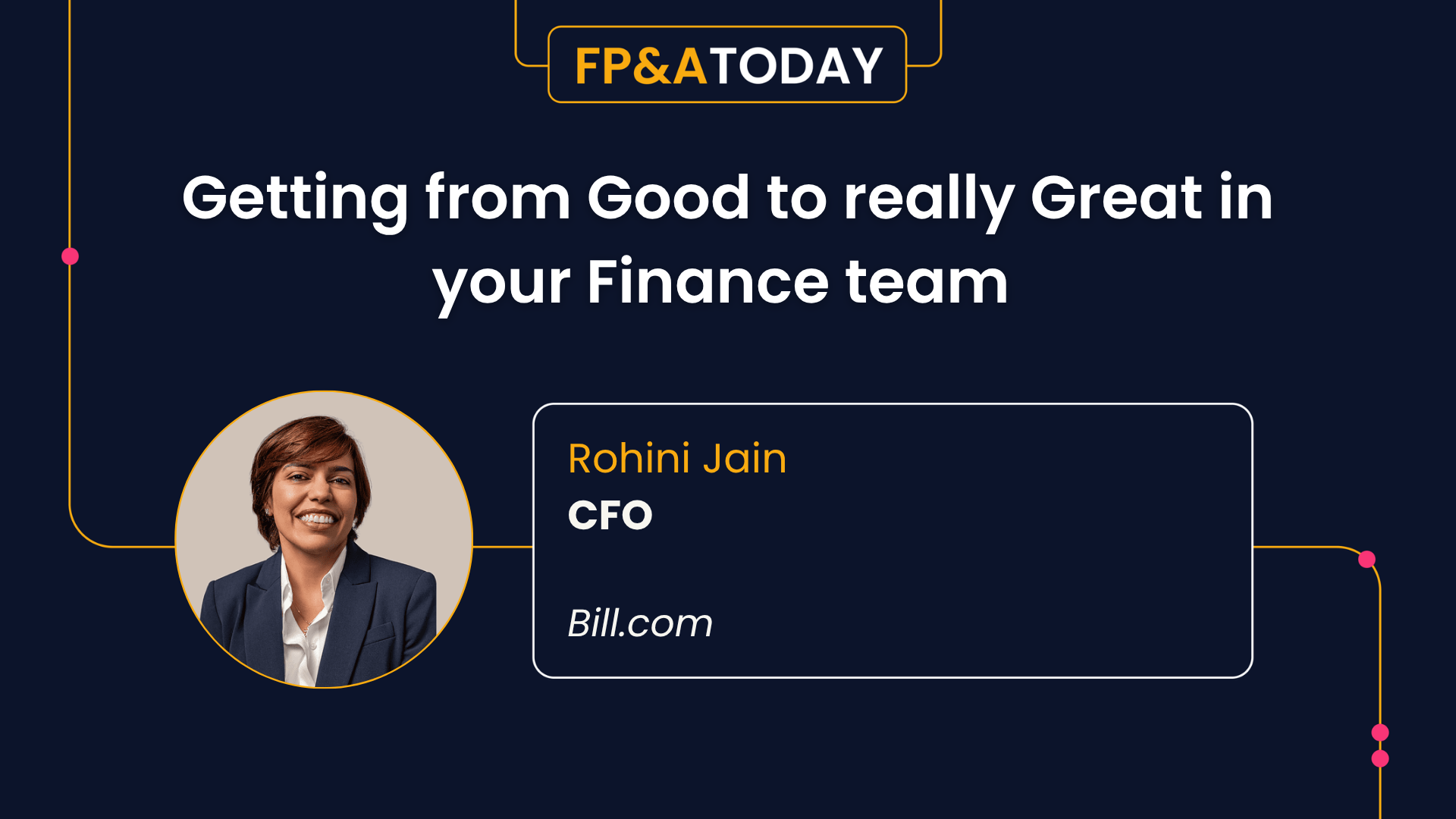
Based on an interview with Rohini Jain, CFO of Bil
Click for Key Takeaways
- The best finance training isn’t in finance: Rohini’s product role at PayPal — where she was the least experienced person in the room — taught her more about finance than years of finance work had. Stepping outside the function forces you to see what you’re not doing well.
- Don’t measure everything. Measure what you can control: Great FP&A teams identify the handful of leading, controllable metrics that actually drive outcomes — and pair each one with a control metric to catch unintended consequences before they compound.
- Autonomous finance for SMBs is more than AI: It’s the right tools, the right finance AI agents, user control over how much to hand off, and a single integration point, so SMBs stop managing platforms and start running their business.
- W-9 collection and expense reconciliation are the first targets: Bill’s W-9 agent eliminates more than 80% of the manual effort from a task that costs the average SMB a full week of calendar time per year. The logic: solve the zero-value-added work first, then free people up for the rest.
- Partnering is an alternative option — and often the right one: Build what’s core to your IP. Buy what others do better (like LLMs). Partner for everything that’s a two-way door: less capital, faster reach, and a genuine win-win.
Rohini Jain didn’t plan to go into finance. She was standing in a college application queue in India — on the science track, headed toward engineering or medicine like most students around her — when she noticed the commerce line next to her. The conversation she overheard about economics, management accounting, and business studies was enough. She switched queues.
Her mother still hasn’t forgiven her.
That instinct toward curiosity and willingness to pivot has defined everything since. Rohini went on to build her career at GE, eBay, PayPal, and Walmart before becoming CFO of Bill, the intelligent finance platform and SMB finance automation tool used by nearly half a million businesses to manage, move, and maximize their money. Along the way she picked up a master’s in finance from the London School of Economics, a Chartered Accountant designation from the Institute of Chartered Accountants of India, and a philosophy about finance that has very little to do with counting.
In a conversation with FP&A Today host Glenn Hopper, Rohini talked about the GE training ground that shaped her approach to business, why leaving finance made her better at it, what it takes to build a truly great FP&A function, and how Bill is using AI agents to bring autonomous finance within reach for small and mid-sized businesses.
The GE School: Finance as a Business Sport
Rohini describes GE as less of an employer and more of an institution — one that produces a disproportionate share of the world’s great CFOs because it refuses to let finance people stay in finance.
“The GE DNA in finance is really strong. They churn out people who are deeply rooted into what it means to run a business, not just be a finance partner. You are, along with your CEO or GM, the only other person who knows everything about what’s happening in the business.”
In practice, that meant getting uncomfortable. As a finance manager at GE Healthcare, Rohini stood on the assembly line to learn how circuit boards were made. At quarter end, she was in the shipping dock helping pack boxes. These weren’t symbolic gestures. They were how she built the business acumen that no spreadsheet can teach.
The lesson carried through every role after. At eBay she went deep into analytics and big data for transaction businesses. At PayPal she did something more radical: she left finance entirely for a product role.
“It was really hard to be the person who knows the least in the room after being the expert for several years. But that was when I learned most about finance, because you kind of look in the mirror and see what you are not doing well.”
The specific insight she brought back was empathy. Finance people, she observed, often show up to business conversations dictating the outcome rather than understanding the problem. The product experience changed that.
“Simple things like when you’re thinking about product release and what you need to bake into next year’s plan — now I know how much time it takes to make the product, get it released, start talking to customers, go through the ramp period. We cannot just as finance people push a higher number and make the business feel committed to that.”
The Metrics Problem: Less Is More, But Smarter
With decades across transaction-heavy businesses, Rohini has seen every version of the metrics proliferation problem: decks that grow from 80 to 120 pages, boards where every member has their favorite KPIs, and finance teams spending most of their energy measuring things they cannot control.
Her answer is not a list of the right metrics. It’s a discipline.
“The job of FP&A teams is to really understand what matters most. What are the metrics that matter in this time, in this stage of the company’s life, in this industry — and what is really the most important thing to focus on.”
Equally important is the concept of control metrics. Every primary metric should have a counterweight — a check that prevents the single-minded optimization of one number from destroying something else.
“If you are trying to maximize your sales number, you have to have a control metric of profitability around that. If you’re trying to manage your risk basis points, you still want a sales metric tied to it to measure how much friction you’re putting on sales. Seeing both sides and figuring out what could be the potential unintended consequences of measuring just one metric — that’s really important.”
And the metrics that warrant obsession? They have to be leading indicators, not lagging ones, the difference between reactive reporting and genuine financial forecasting.
“A lot of companies spend a lot of time looking at things they cannot control. It’s good to know them periodically, but you need to obsess about things you control and things that are leading indicators that drive outcomes.”
Her vision for how AI fits into FP&A best practices: not replacing judgment, but handling the monitoring. An eye in the sky that watches hundreds of metrics in the background and only surfaces the five that are outside their control threshold — freeing humans to focus on what actually moves the business.
Building the Finance Team for What’s Next
When it comes to finance team structure, Rohini’s model is simple: mirror the organization you support.
“My team is really structured to mirror my CEO Renee’s team. Each person is sitting there. And then I have a corporate team that adds up all of that work and drives the corporate-wide initiatives — streamlining reporting, dashboarding, introducing AI.”
The embedded model means her finance people spend more time with their business partners than with her. That’s the point. Proximity builds trust, trust enables honesty, and honesty is where good financial insight comes from.
On skills, she’s clear that the fundamentals haven’t gone away. Accounting, regulation, data structures — the foundation still matters, because you need it to know when AI is outputting something wrong.
“You still want to know how to do the multiplication even if you don’t do it. You can smell if things aren’t outputting appropriately through AI if you have that foundation.”
But above any specific skill, the characteristic she values most is growth mindset.
“The ability to continue to learn was never as relevant as it is today. I don’t care what you studied, as long as you are super curious and high energy in terms of learning new things and evolving your career.”
The traits she builds her FP&A teams around: not staying within the job description, genuine curiosity, and the ability to work at high velocity.
AI Agents at Bill: How Finance AI Agents Are Solving Real Problems for SMBs
Bill processes more than $1 trillion in payments and over a billion documents. That scale isn’t an accident — it’s the foundation that makes smarter, more reliable AI possible. With a two-sided network connecting both SMB customers and their suppliers, Bill sits in a uniquely powerful position to see both ends of the transaction and act intelligently on behalf of both.
Rohini is careful about how that power gets deployed. Before rolling out any agent, the question is always: what problem does the SMB actually have, and are we solving for that?
The first agent to launch targets W-9 collection — one of those tasks that consumes a full week of calendar time per year for the average small business. Bill’s agent collects W-9s from suppliers, reconciles them automatically, and eliminates more than 80% of the manual effort. The second targets expense management. Each manual expense report costs an average of $58 to process, and nearly one in five contains an error that costs another $52 to fix, a quiet drain that better spend control would eliminate. Bill’s agent automatically pulls receipts from email, reconciles them against the corporate card platform, and removes the back-and-forth entirely.
The scale is real: Bill’s S&E platform processes 70 million receipts. Lining them up end to end, Rohini says, would circle the earth three times.
“I can already see the smiles on people’s faces when this happens. It’s really zero value-added work that they have to do.”
Auditability was a deliberate design priority. The receipts still exist — what disappears is the manual workflow of moving them from place to place.
“The auditability is still fully there. Whatever outcomes and documentation we want will still be there. We’re just taking out the manual work and making the workflows disappear in the background.”
Autonomous Finance: More Than an AI Story
When Rohini talks about autonomous finance for SMBs, she’s describing something bigger than deploying AI agents for small business finance. She’s describing the removal of friction — at every layer — from the financial life of a small business.
For enterprise companies, the path is costly and bespoke: hire the talent, build the infrastructure, integrate the systems. SMBs don’t have that option. They often have one person running finance alongside marketing, operations, and strategy. The manual burden alone is significant: finance teams spend up to 520 hours per year on accounts payable tasks alone, time that compounds quickly when there’s no dedicated team to absorb it.
“How do you create the most opportunity and have the least amount of friction in anything that you do? Giving them the right tools and AI agents is part of that for sure. But at the same time, giving them control — because not everybody feels the same way about giving up control to AI agents.”
The third element: eliminating the number of integration points. Bill’s embedded finance partnerships — including recently announced integrations with Paychex and NetSuite — are about meeting customers inside the platforms they already use, rather than asking them to add another window.
“You don’t want several people to call if something goes wrong. As much as we can integrate and work together to solve their problems, that will be so much more effective.”
The data advantage reinforces everything. Having processed over $1 trillion in payments across both sides of the supplier-customer network gives Bill’s risk models, invoice financing decisions, and payment optimization tools a depth that no single SMB could ever build on their own. It also arrives at a moment when SMB appetite for change is high: SMB AI adoption reached 17.7% by the end of 2025, up from just 1.7% in 2019 — a tenfold increase driven almost entirely by the arrival of generative AI.
Build, Buy, or Partner — The Decision Framework
On the question of when to build, buy, or partner, Rohini has a clean framework.
Build what’s core: the things that define your competitive advantage and touch the customer experience your company owns. Buy what others do better: LLMs, for instance, are not core to Bill’s business, and treating them as such would be a waste of resources. Partner for everything in between — and importantly, treat partnerships as two-way doors.
“Partnerships are great because those are two-way doors that you can walk in and out of. Less stickiness. You need to build trust, see if it works for both parties. If it does, you go deeper in. Less capital outlay, a win-win for both parties.”
The embedded finance model with Paychex and NetSuite is exactly this in practice: reaching customers who are already there, letting partners serve their existing base with new capability, and expanding access without building everything from scratch.
“I see the industry more and more evolving towards partnerships. It’s just the right way to go.”
Where Datarails Fits in
The finance function Rohini describes — embedded in the business, tracking the right leading indicators, deploying AI to eliminate the manual work — starts with data that’s consolidated, reliable, and ready to act on. Without that foundation, even the best agents and the best intentions stall.
Datarails is the AI-powered FP&A platform built for Excel users. It connects financial data from ERPs, accounting systems, and spreadsheets using the best financial consolidation tools into a single governed source of truth. Dynamic scenario planning, instant variance analysis, and AI-generated narratives — the work that turns a finance team from a cost center into a strategic one.
For the SMBs Rohini is focused on at Bill, and for the finance teams trying to become the kind of partner she describes, clean data isn’t the goal. It’s the starting line.
To learn more about how Datarails supports FP&A teams at every stage, visit datarails.com.
About Rohini Jain
CFO of Bill, the intelligent finance platform used by nearly half a million businesses to manage, move, and maximize their money. Rohini brings more than 20 years of experience across GE, eBay, PayPal, and Walmart, with deep expertise in FinTech, payments, and e-commerce. She holds a master’s in finance from the London School of Economics and is a Chartered Accountant with the Institute of Chartered Accountants of India. At Bill, she is helping redefine what autonomous finance means for small and mid-sized businesses. Her favorite Excel features include pivot tables and — for the sticky moments — Goal Seek. When the week gets stressful, she bakes bread. The more stressful the week, the more complex the loaf.
Connect with Rohini Jain on LinkedIn.
FAQs
Focus on a small number of leading, controllable indicators rather than tracking everything. Pair each primary metric with a control metric that catches unintended consequences. The goal is to obsess about what you can actually move — not to produce the most comprehensive dashboard.
It’s the combination of the right tools, AI agents, user control over automation, and a single integration point that lets small businesses stop managing platforms and focus on running their business. For SMBs that can’t afford enterprise-grade infrastructure, it’s about democratizing access to capabilities that were previously out of reach.
Build what’s core to your competitive advantage and customer experience. Buy what others do better — like foundation models. Partner for everything that’s a two-way door: it requires less capital, creates mutual value, and gives both parties the flexibility to go deeper or walk away.
The fundamentals still matter — accounting, data structures, regulation. But the most important trait is a growth mindset: the curiosity and energy to keep learning in an environment where the tools, techniques, and expectations are all changing simultaneously. That capacity to evolve is what makes someone valuable regardless of what finance looks like in five or ten years.