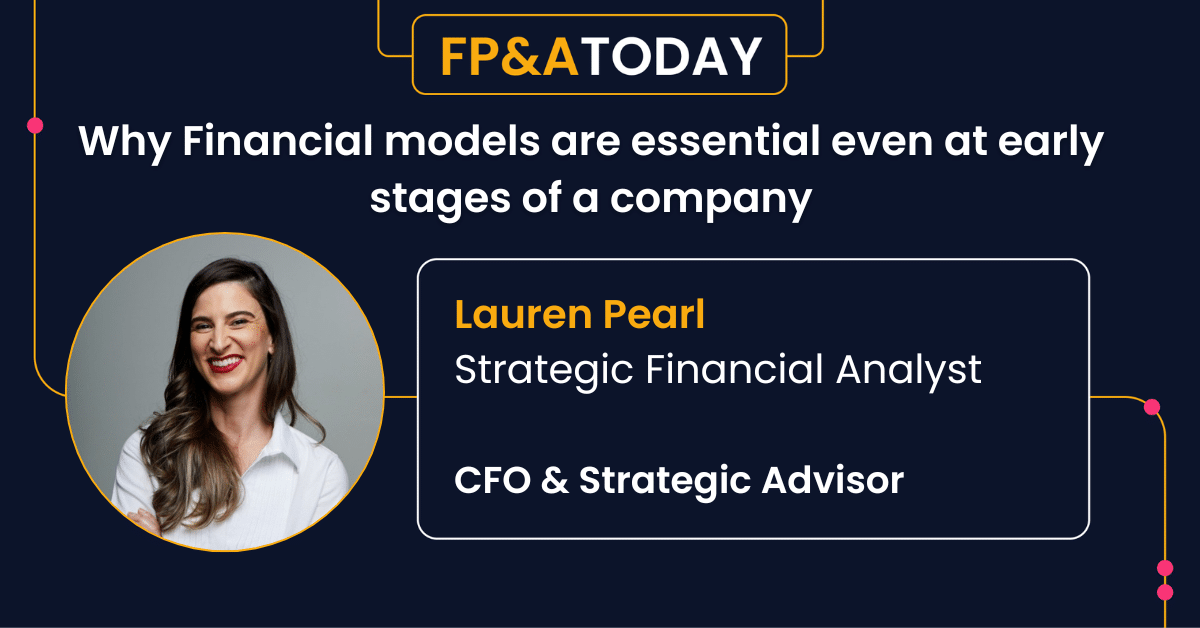
Lauren Pearl is a Business Strategist and CFO Advisor who helps startup teams build data-driven businesses. The 3x founder with over 13 years of startup leadership experience now serves as CFO, advisor, and instructor for over 300 growing companies. She also runs the podcast “Growth Minded CFO” and offers a free course on financial modeling.
In this episode:
- Financial models at startups
- Sniffing out BS at startups
- Storytelling as a pitchdeck
- Getting startups to engage with finance
- Free financial modeling course
- Being a punk band roadie
- Functionality of Excel
Connect with Lauren on LinkedIn: https://www.linkedin.com/in/laurenepearl/
Daily CFO newsletter: https://www.laurenpearlconsulting.com/newsletter
Glenn Hopper:
Welcome to FP&A Today, I’m your host, Glenn Hopper. Joining me today is Lauren Pearl. Lauren is a CFO advisor and business strategist who works with startup teams to build disciplined data informed companies. She’s a three-time founder with a background that spans Deloitte Consulting, tech leadership, and software engineering through her firm LPC, she’s advised more than 300 growing companies on finance, strategy, modeling, and operational planning. Lauren also teaches at NYU’s Berkeley Center where she leads a course on financial modeling for founders. She co-hosts the Growth-minded CFO podcast and was recently featured in X’s CFO Compensation report as a leading expert on the rise of fractional CFOs. Lauren, welcome to the show.
Lauren Pearl:
Thanks so much for having me, Glen. I’m really excited to be here with you.
Glenn Hopper:
Yeah, I think, you know, we were talking before the show and I feel like you and I have so much in common with all the different irons in the fire that we have. Uhhuh. Um, and my listeners have heard my story a million times because, you know, I just wanna keep talking about myself. <laugh>, let’s start with your story and maybe tell me, uh, tell us a bit about your background and the path that led you to become a, a strategic CFO for startups and small businesses. Because similarly, that’s the space I’ve been in and it’s a unique spot for A CFO.
Lauren Pearl:
Yeah, yeah, I know we all kind of have our weird paths into this role. Mine, I would say is maybe a bit non-traditional though. Uh, I think I hear that from a lot of finance leaders that I speak with. So, um, I grew up actually in a family business, a shoe retail company, headquartered in Freeport, Maine. So I kind of grew up running a small business alongside that business. As it grew. After college, I rebelled and went into, uh, programming. I was a developer for a Microsoft partner for a while, but I quickly realized I liked the problem solving of the computer side of things, but I really, really loved working with people. And so I kind of quickly pivoted back into business. I worked as sort of a, like a chief of staff, kind of mixed jack of all trades role for a couple of different startup CEOs.
Lauren Pearl:
And then finally I got tapped to actually run my family’s business. I was the last of five siblings, was the only one that was interested in all, uh, but as I prepared to take the business over, I realized I didn’t really have the tools to be a leader of the company. And things seemed like they were getting a little messy, weren’t going really perfectly. I had had a philosophy and psychology major with a music minor, so I did not feel prepared to take over a whole company. So that’s why I applied to business school. And actually in business school is where I kind of made that transition to the finance field. And it was because of this, because I learned how to read a financial statement in business school. I still remember like the course that I learned how to do it. I was the first in my family to really learn those finance skills before me.
Lauren Pearl:
Most of my family had just run things based on gut instinct. And in the course where I was looking at the financial statement of my family’s business, I looked at the statement and realized, oh my gosh, this business has to close. Right? It had been used losing money for years. It was growing debt, and that was really sad. And the business actually went bankrupt while I was in business school. But out of the status of this story really sparked my understanding of the value of finance in that, in looking at this financial statement for just a couple of minutes, I was able to see something about this company’s future that I couldn’t see from working at the company for 25 years. And so it was sort of that first unlock moment of wow, <laugh> finance is where the information is. Like this financial data is really the language of the business and how it tells you what’s going wrong and what’s going right and what you should do next.
Lauren Pearl:
And so after business school, I really started to head more in that finance direction. I went and did strategy consulting at Deloitte for a couple of years, and I took my first CFO role working in a cybersecurity company, and I helped them grow from a very small company just working on a couple of federal projects into a multimillion dollar, uh, real industry leader in the cybersecurity space, uh, in the commercial, uh, industry as well. And it was after that that I transitioned to working on my own as a fractional CFO when after leaving that startup, you know, I got a couple of different job offers to be a CFO at other organizations. And as you alluded to <laugh>, I’m one of those people that just takes on stuff thing after thing after thing. I kind of get bored easily. And so I just kinda had this curiosity of like, well, if I have three offers, what happens if I say yes to all of them transparently?
Lauren Pearl:
Well, while letting them know I was doing so <laugh>? Uh, but actually it worked out well because, uh, early on in a startup’s journey, the true finance function in the business isn’t necessarily a full-time role. And so I found a way to do it really effectively for multiple companies at once. And that was really just a lifestyle I enjoy. So I’ve been doing that for about five years. The business has grown and changed into more revenue streams, uh, working with a lot of different types of companies. Um, but it’s still really where I, where I’m most passionate about helping companies.
Glenn Hopper:
It’s so interesting when you come into a startup, or a lot of my clients in, in the years since I was in the startup space, were businesses where they were founder led. Yep. Uh, they weren’t, they weren’t the hockey stick startup. Uh, they were maybe thinking, Hey, I’ve grown this business. I want look to sell this now and, and, and get out. Or they were looking to bring on investors or, or raise debt or, or whatever they were that were doing, but they’d never really thought about the finances. And most founders don’t come out of an MBA program and they’re really good engineers or they have a really good idea and that’s where their focus needs to be. But to your point, without that, someone speaking the language of finance, the business, whether you’re in that early stage startup or just a regular small business, if you’re not, if you don’t know the difference between your p and l and your cash flow and the balance sheet means nothing to you, it’s really hard to understand where you are with the business.
Glenn Hopper:
So I, I guess that’s a very common issue. And I, I think that a lot of times, so in the startup, like you said, it’s not a, a full-time job out of the gates, but when do they realize, oh, we need someone that speaks the finance language here because they might have the best product in the world, but then when they go to talk to investors, they’re not speaking, they’re speaking different languages. So what is, what is it that makes them realize, and I think I’m jumping ahead. I think I was planning on <laugh> asking this question. Oh, that’s fine. Jumping ahead. But what is it that makes them realize, Hey, it’s time to talk to someone now and, and bring someone in that it, that speaks the language of finance?
Lauren Pearl:
I think that it happens in a different moment for different companies, but there’s a couple of like common themes of when that moment happens. One moment as you’ve kind of started speaking to is the fundraising conversation. So for startups that are gonna go the venture backed route where they’re going to be funded, um, by investors, they’ll need a financial model and some understanding of kind of the economics of the business before having that conversation. So if they don’t have any modeling experience or finance experience beforehand, it might be the first moment when they think about, oh, I gotta hire someone to build my model <laugh>. And, uh, from that moment I, I take them in, in a certain direction where, uh, that finance person might not be the one that’s building their model, but at least it’s kind of the start of that conversation. For other businesses, it happens at a totally different time.
Lauren Pearl:
Uh, this also can depend a lot on the founder. So when I am trying to talk with peers about like when to refer me, like when can you tell a startup needs me? Often what I’ll say is it’s more of an emotion that they’ll feel like unless they’re doing the fundraising conversation where it’s a very specific need, then sometimes the emotion is this feeling of things are kind of moving with the business. But I just feel disoriented. I feel like I don’t know how to answer the questions I’m coming up that are, that are coming up. I feel like I’m lost, like I’m spinning my wheels. These are all emotions. I think that comes with not having those bearings, like the foundation, what we in the finance function know as metrics to kind of help give you like a north star of like what activities you should be focusing on in the business, right?
Lauren Pearl:
If you have these financial goals, like I wanna hit this much in revenue, or I’m looking to get churned down by this much, or I want this many dollars in cost savings, suddenly like your mission becomes really clear and you kind of have this groundedness and orientation on what you’re doing, but if you don’t have a financial background, those goals might not be as clear. And so that sort of feeling of just being like lost in the woods, not knowing where to go is another moment where, where folks will reach out to me. And especially I can really help companies that are, um, having that feeling despite the fact that they’re growing, right? Because that’s a sign they actually do have money to allocate. They have the opportunity to be strategic about what decisions they’re gonna make next. It’s not just cost savings, but still they need that financial rigor to have this orientation about like what they’re going after and what we’re actually trying to optimize for.
Glenn Hopper:
And thinking about that, that financial rigor and coming in. And we talked a little bit before the show about this, about whatever modeling they’re doing is more gut feel kind of modeling. But I, when I was doing background on you, one of the first things that came up was your stance that financial models are essential even at the earliest stages of a, a startup. And I’m wondering if you can expand on that. Tell us a little bit about what’s behind that conviction and why you think so many founders resist building one.
Lauren Pearl:
Yeah, absolutely. Actually, I think for this stance it’s important to have some context for if you’re not familiar with like the startup world and the popular beliefs in this uh, field. So this belief that that financial model is really important is controversial because there’s kind of two camps to thinking at the startup world on financial models. And the opposite camp is financial models are a waste of time. And the reason behind, uh, that for the people who believe this is, well, early on, especially at seed stage, pre-seed stage, there’s no data to go off of. The business doesn’t exist yet. So if you think about building a model, you need inputs that would be kind of your drivers or the bottoms up data that you’re gonna base your assumptions on,
Glenn Hopper:
Built on hopes and dreams, right? That’s
Lauren Pearl:
<laugh> exactly like that. Oh this is just garbage in, garbage out. You’re modeling based on dreams. There’s some VCs, investors that hold this belief where they’ll say, not only is it a waste of the founder’s time to build this because it’s BS <laugh>, it’s a waste of my time to look at it. ’cause I can’t actually tell anything about this startup’s future by looking at it. So let’s just skip it. My belief is that they are essential and that the folks that say that they are a waste of time are missing the point. The two points of the model I think they’re missing is one, the purpose of this model and what it’s doing as an instrument. So a financial model is useless as a forecast because it’s not a forecast <laugh>, it’s not intended to predict what’s gonna happen in the future. A model for an early stage startup is actually a feasibility study, right?
Lauren Pearl:
It’s closer to like a scenario planning model or like a what if analysis where most of the assumptions are the hypotheticals. But the point is to say, I’m gonna collect some reasonable assumptions based on the best data I have available based on units in my assumptions that feel as guessable as I can get them. And if those things are true or if most of them are true, then it will mean my unit economics will be this, my growth potential will be this, my budget for hiring will be this, right? It’s meant, it’s not meant as a forecast, it’s meant as a, is this a stupid idea filter <laugh>. And so it really is helpful for that purpose to get your hands around what will be going on with this business, giving a couple of reasonable assumptions. And that’s kind of reason number one. Reason number two is especially important for founders who don’t have a financial education or don’t yet feel really comfortable on the financials of the business.
Lauren Pearl:
And it speaks to the point we had earlier, which is that it gives them that sense of orientation. So when a founder is in charge or heavily involved in building a model, they are actually getting to test drive the business. They are forming an opinion on how they think and they view money moving through their future business. And it gives them this opportunity to build a structure in their own head to connect the inputs of what they’re actually gonna do on a day-to-day basis. Going out and getting customers, partnering with vendors, hiring people, connecting those activities to the bottom line, to the financial statements. And when they form that connection, it prevents the issue that happened, for example, in my family’s own business, where things are going wrong for ages, but the founder doesn’t understand the value of the financial statement, so they never see it. So it’s this wonderful opportunity to build that foundation and make that founder a better CEO from day one. So these are the reasons I think <laugh>, that building that model is truly essential and not BS at all
Glenn Hopper:
Having been in the startup space. I, I don’t know if I ever thought of it before, but that’s a pretty big unlock for me to hear that. So the feasibility study, because when we were raising money in the startup world, we just wanted to show that hockey stick so we could get a valuation that made sense or we were trying to do the first Chicago method or what, whatever. And it was just, well, we need to get the cash flow up so that we can bump up our value. But truly, I mean it’s, it’s basic modeling where, okay, these are our fixed costs and this is how much compute we need. This is how much S3 we need based on how many users we get or whatever. And this is the development cost and this is the marketing budget and we try to tie marketing to new installs or, or whatever it is.
Lauren Pearl:
Yeah.
Glenn Hopper:
But you’re so quick to just try to drive that top line up so that you can show that you do have that takeoff velocity in the startup place. But it really, having an understanding, even if you slowly added customers or stayed at a certain level, understanding your cost structure is a, is a big part of it to see if your business even makes sense before you start trying to add hyper scaling to it.
Lauren Pearl:
That’s so right. And I think it also speaks to what makes a strong model for a good investor. And we do sometimes I think first time founders or when you are even a finance person modeling for venture for the first time, your thinking is like, well, I just have to make that hockey stick and I have to make that top line grow and I’m just gonna put in whatever inputs I need to make that happen. But what is true is that most educated investors, when they see that top line, they do believe that’s BS initially. Like that doesn’t impress, and they’re certainly not gonna base their valuation on it, right? Their valuation will be based on external economics that they’re doing internal to their own fund, uh, separate from you, right? There’s not a ton in your model you’re gonna do to change that number.
Lauren Pearl:
But what they will look at in your financial model is if you in your model, expose very transparently and cleanly the underlying assumptions that drove that output, if you can cleanly show, well, this is based on thinking that my churn is gonna be this thinking that it’s going to take this many customer conversations to convert one thinking that, you know, these are the cost drivers and I can actually do this with a pretty tight engineering team that’s not gonna cost too much money. If you can be really transparent about those assumptions, that is this wonderful opportunity for the investor to sit down with you and judge how you made those guesses and actually give you some advice. Like the best models I think are built to be conversation pieces. So where you put all of your assumptions, like in a really clear place, such that you sit down with an investor shoulder by shoulder, you open up the model, you show them the outputs, but then you walk through how you got there and you give them the opportunity to say, well, I have an entire portfolio of startups and I can actually tell you that churn these days is a bit higher than it used to be for B2C businesses.
Lauren Pearl:
I’d recommend bumping that up a percentage point or two because then you get to absorb that into your model and you get a more accurate picture of what’s gonna happen in the future. And that’s also the conversation they wanna have because they get to pressure test your assumptions and see, is this business still good? Is it still worth it? Is it still profitable? So if you build the model that you can be ready to have that conversation confidently and calmly without exploding the model and making it not work anymore, that’s how you make a good, impressive model for fundraising.
Glenn Hopper:
It’s that, I think I told you this story, um, when we were talking before the show <laugh>, but I was at this one startup and um, the CRO had his own model, which is something he downloaded from somewhere. And it was the Andrew Chen from Y Combinator and Andre Horowitz, all that. It was the Chen model mm-hmm <affirmative>. And we were <laugh> meeting with, um, a couple of our investors and our board. And this guy had been running this Chen model and it was just, he’d modified it, so it was, he would tweak the assumptions and you just have this ridiculous exponential growth that no one expected. And we had, he kept saying inflection point, inflection point and chin model <laugh>. And finally one of the, one of the, uh, board members said, if you say chin model one more damn time, I’m gonna throw you out of the window <laugh>, because <laugh>, and it just, it was, and I’m, I’m the CFO and I’ve got, or whatever my head of, you know, head of finance title or whatever I had at this small startup and I had a model, but he insisted he wanted to bring his own model to the all these meetings.
Glenn Hopper:
And it was, it was exactly that. It, it didn’t even, it was just a revenue forecast and it wasn’t based on anything. And so I think having that rigor and being able to, and I love the idea of it’s a feasibility study and that inflection point on top of inflection point and all that was, was a bit maddening, uh, as the finance guy sitting in the room. <laugh>.
Lauren Pearl:
Yeah. I think one of the key sort of red flags on one of those early stage models that you can look out for to sniff that there might be some vs going on is any assumptions about revenue growth directly. So I sometimes will call this, uh, growth without work where you assume, well, top line is just gonna grow 30%, you know, month over month, or we’re assuming that, you know, initially we’ll have 10 customers in the door, but that this is just going to grow by, you know, three x every year. There’s no work in that. Like there’s no assumption in your model that growing the business will consume time or money. And the reality for anyone who’s operated business is it does like a huge amount of time and money, especially for startups, goes into creating that revenue, discovering new customers, getting them to convert.
Lauren Pearl:
This is how you spend like a huge chunk of your time in the business. So in the model, there needs to be some costs there, there needs to be some way in which you express a constraint on that growth based on an activity that you do, that you pay money for, whether that’s salespeople or buying marketing assets or whatever. And if you don’t have that constraint, it’s like a sure sign that, you know, growth should really be an output of, of the model, not an input because you can’t, there’s no fair assumption to make about growth. Growth is defining that you have won, won or lost and you can’t know that yet. So there’s little aspects like this where you can sniff out, like, this isn’t a great feasibility study as we’ve described it, because it makes an assumption about the wrong thing. And that’s, that’s, that’s a huge one.
Glenn Hopper:
And you mentioned something else when, uh, when you were talking about that, the distinction between a model and a forecast and for a going concern business, it’s the distinction between a budget and a forecast where the budget is just, that’s what’s based on Yeah, based on what you know at the time. And then the forecast you update based on it, it’s that Mike Tyson, everybody has a plan until they get punched in the mouth kind of thing, right? But that’s different than, and, and it goes back to your feasibility study. It’s different than a model in a forecast. And, and I, I know you touched on it, but I’d love for you to unpack that a little bit more.
Lauren Pearl:
Definitely. Typically in my world, in startup land model kind of comes first. It’s sort of like the stage zero financial tool that your company has for strategic planning. The way that I think about a model is it’s a tool that exists for the most part before the business is actually up and running. Now, sometimes it’s the case that the, the business in the course of building the model, you actually also are already starting to run the business. So you might start to incorporate some of that business activity in the model, but generally it’s meant to be pretty hypothetical and based on drivers and kind of estimates of your bottoms, ups, uh, uh, inputs versus the forecast, you’re predicting the future. Um, most times at these companies, we start with the model. And the model is not a forecast, but you can transform it into one over time.
Lauren Pearl:
So the company doesn’t exist yet. It’s a feasibility study that has drivers based on assumptions. But then as the business operates, some of these things that you’re predicting actually start to happen. You go from predicting your month one through three revenues to you’ve had one months one through three and you have some revenue or no revenue for those months. And you can start to transform that model into a forecast by starting to input some of that actual and historical data into the model. And for the drivers that are continuing to drive, uh, predictive numbers in the model, you can start to fine tune those drivers based on what actually happened in previous months. So if for example, you’re driving, um, your revenues based on the numbers of, uh, customers you’ve acquired and then you had a certain number of leads that you generated each month, you could update your conversion, uh, assumptions and your lead acquisition assumptions based on what actually happened in the former months and maybe, you know, tempered by how you think that will change over the course of the business as other stuff changes. So as you start to put some actual data, historical data into that model, it can start transforming into a forecast that’s more informed by real data, not just assumptions.
Glenn Hopper:
FP and a today is brought to you by Data Rails. The world’s number one fp and a solution data rails is the artificial intelligence powered financial planning and analysis platform built for Excel users. That’s right, you can stay in Excel, but instead of facing hell for every budget month end close or forecast, you can enjoy a paradise of data consolidation, advanced visualization reporting and AI capabilities, plus game changing insights, giving you instant answers and your story created in seconds. Find out why more than a thousand finance teams use data rails to uncover their company’s real story. Don’t replace Excel, embrace Excel, learn more@datarails.com.
Glenn Hopper:
I think about models and those are so fun. You can, because it’s like you have a slider and you can just go through and you change the assumptions a little bit and you watch the impact and you can see the, you know, you go to the assumptions tab and you change that and you go over to the page and you see what the impact that is and you get excited. And I think years ago, and I need to look up who originally said this quote, but I had a professor tell me that I had a, a bad habit of confusing the map for the terrain. And I think sometimes when you’re <laugh> when you’re in that early stage and you’re, you are the, the finance person that when you look at that model, it’s easy to get really excited because it just seems like a minor tweak. And now look, we’re taking off and it it, but it’s, uh, the map is easy when you’re in the planning phase and if you’re trying to raise and get things started and then the terrain is when you get out there and things are different. Maybe they’re better, maybe they’re worse. But remembering that, that the chin model <laugh> doesn’t work anymore when we’ve burned through, you know, a couple million bucks in the last 12 months or whatever the, the case is. So, um, totally,
Lauren Pearl:
I,
Glenn Hopper:
I really like that that distinction a lot. And thinking about that when founders are there, they’re eternal optimists. They’re looking for this big future, they building the next world dominating app and all that. And I think if you come into a place like that, they have not thought for mostly they have not really thought about the true day-to-day finances and not just the, the finance strategy. They may have an idea of what they wanna do with that, but they’re not thinking about the accounting and it’s, I don’t know what system they’d be on or whatever when you come in, but when, when you are that first finance hire, I don’t know, I don’t know who’s doing the books before you get there, who’s even going through and doing reconciliations and QuickBooks or whatever it is. But if you come in and you’re that startup’s first finance hire, whether it’s as a consultant or or full-time, I’m wondering what you see, what do you inherit and what’s the before and after of what you got when you first came there and by the time that you have everything clean or that you’re ready to move on and they’re hiring a full-time CFO.
Lauren Pearl:
Yeah, so it can really vary. Um, for my clients, I’m lucky enough that I work with startups at a lot of different stages. You know, I work with the earliest of early startups, especially in my courses and in coaching, um, based on course topics. And then on the other end of things I work with startups all the way past series C. And so, you know, for each of those, the status where I meet them is gonna be different. So I like to take an approach that works for nearly all of these folks, which is sort of an initial diagnostic of what’s going on. And what I’m seeking in that process is really getting clear on their goals. Like what are the things that they need to accomplish, want to accomplish in the next three months, in the next year, in the next five years. Thinking about what’s important to them really helps me optimize as a finance professional on where to focus next.
Lauren Pearl:
Because the other aspect of the way I work is it’s not my full-time gig. So we have to be focused and we might not get to absolutely everything that I would do if I were taking on the role full-time soup to nuts. We’re probably gonna need to be targeted. So that’s sort of number one, regardless of what stage they’re at, really listening to where they’re trying to get to. So I can assess as a professional what I can do within my realm of expertise to help them get there. Especially at the earlier stage of the company. It’s really important to recognize as you’re kind of the first finance hire, because I think that’s the unique experience really coming in and having like their, their, you’re their first exposure <laugh> to someone who’s coming in and helping lead from the financial function. I think first understanding that you are not necessarily building a perfect finance function on day one and that’s not your job.
Lauren Pearl:
Like you as a finance professional, creating perfect finance, accounting, treasury, all of that in the organization, that’s probably, unless you’re in a financial company or one that’s going to be audited heavily, uh, that’s likely not your job, right? Like you are not the star of this company and if this company, you know, winds down tomorrow, no one’s gonna be impressed that like, well they made no money but man they had a perfect finance function, like it’s not gonna matter. So I think number one coming is that first finance hire, it’s important to kind of, you have your skills but you sort of have to leave behind what you were optimizing for in your last position and really kind of go lower ego and think about like the star of the business is, um, the business itself. And I am just there to support. So listening to multiple stakeholders, asking what everyone needs, understanding the gaps between where they want to be and where they are today and thinking through how the finance function is going to fill them.
Lauren Pearl:
And the impact can be really, really huge when you take this really targeted focus because you can really meet people at where they wanna make the most progress and then you focus your time there and they will really be thankful and feel the impact and see everything you’re doing right. They’re not gonna notice the perfect books if they don’t look at the books, but they will notice that they feel more oriented because you gave them, for example, a sales target to hit and then they hit it and they know their business is doing well. And so that’s sort of a bit of kind of the, the overarching picture of of coming in as a first time hire and how to treat it differently. But some examples of the kinds of things to expect before and after. Like, um, you know, sometimes I’m brought in to do something very targeted.
Lauren Pearl:
If we’re like going for fundraising, that can be a very, very clear ROI, right <laugh>, they initially start talking to investors, the investors aren’t interested. We put together like what is their clear pitch? We help with the, the pitch deck, we put together a great model and suddenly they can unlock all of this funding and then we can move on to figuring out how to allocate all that capital so they can be the next unicorn, right? Super clear. Uh, but there’s also just smaller accomplishments that will happen. I have one startup where uh, they’re a dominant industry player but had no finance background and they were struggling with profitability. And now after working with them for about a year, their business is doing much better from a profitability perspective. They actually, the founder has built and runs her own profitability by project report, which is very cool. If you’ve ever done cost allocation without any kind of automation, that’s very big accomplishment. Um, and she was just able to give two of her top employees a raise and still be much more profitable than she was before. So that’s just like a wonderful win for a startup, but kind of a little felt a little more nebulous to start and took a while to get to the point where she really feels confident and information formed and is really able to change her business from the ground up.
Glenn Hopper:
It gives you that, that magic look inside the business when you can, especially if you’re talking about cost allocation by project too. That’s mm-hmm <affirmative>. Startups normally aren’t gonna have that because like you said with it, they’re probably in zero or QuickBooks or whatever and they’re not, uh, they don’t have that built in and so you’ve gotta go and jam stuff into Excel and do your allocations manually and all that. So, but I bet they wouldn’t have thought about that if they didn’t have someone come in and kind of mentor them and and walk them through that. So that is a big unlock.
Lauren Pearl:
Yeah, like a founder doing that themselves that formerly had no comfort in Excel. I know finance professionals that can’t do that themselves, but this is kind of the power of, I mean, founders have to be, in order to fund a business, you have to be incredibly talented. It is so hard to get something off the ground. I think as finance pros sometimes we lock in our own expertise a little bit in thinking we’re the only people that can accomplish these things that can build this report that can do this. But I think if you guard that information a little less and are willing to share it more, it’s amazing how much you can change the way that A CEO operates. And honestly then as a finance professional, it is so much more satisfying to work with them ’cause they get it, they see the value and they are excited to continue to dig into the financial data and engage and make things even better, uh, as they scale. So it has huge rewards to do that.
Glenn Hopper:
Another area where you and I have commonality and I’ve done it pro bono kind of in an incubator situation and then a couple of small consulting clients as well, but working with those founders at when they’re so early, they’re still in the blue sky and whiteboard phase of the business, they’re, they’re raising their seed and series A rounds and it’s so funny when they can give you a great elevator pitch, they can have a great presentation on their product, on their go to market and all that. And then you get to the financials page and it’s just, they’ve done something in Excel that looks nothing like a financial statement and they just copy and paste it as an image in the PowerPoint <laugh> and uh, are using that to present with. And it’s, but when you can give them that insight and give them a little bit of structure around it, it feels like an unlock for them. And you can, you can see you can help change their language when they’re um, when they’re talking to potential investors and I don’t know, they know storytelling around product. But when you’re working with companies that early, what kind of financial storytelling are you coaching them through and what are the investors expecting at those early stages and kind of how do you help those founders translate the very messy reality of what they’re dealing with then into something that’s fundable?
Lauren Pearl:
Yeah, so I would say to start that the storytelling of the startup in general really does start at the pitch deck. Like I hate to disappoint <laugh> as a finance professional who wishes the entire story could be told on Excel. But I will say that a lot of the things that that investors really gonna glam onto are things like the market opportunity, the team that they’ve gotten on board, the fact that they’re start solving a really painful problem that feels like a problem, that their customers will say, oh my God, please just take my money, solve this thing for me. That’s the stuff that really matters kind of for that initial hook to get the investor interested. The role of the financial model in the investor’s eyes is really okay now make it make sense. It’s the part that supports the story that the founder has already told and it needs to be compatible with that story.
Lauren Pearl:
And so we’ll do a lot of working with kind of, as we talked about before, like building a model where we’re trying to break it down into assumptions that feel guessable and estimatable so that we can have conversations about those with investors and expose our reasoning, our logic, I’m a huge, huge fan of in that financial model to not just have the numeric assumptions, but to actually have a section that talks through how those assumptions were made. Like what is the source of this guest? What is the benchmark you were using? Who did you talk to that said that this was reasonable? Because it just shows that logic of like, this doesn’t come from nowhere, this isn’t pie in the sky, this is based on, we don’t know exactly, but we tried to get as close as we possibly could and also opens up the discussion to like, and you investor, feel free to make it better.
Lauren Pearl:
Feel free to tell us you think it’s gonna be different and let’s put that in the model and see what happens. The model is also that place where they get the story straight themselves at that early stage, at that idea stage. Especially founders are in this really dreamy state where sometimes it can be almost hard for them to focus on like, well what are you really gonna do? Like what are you gonna do day one? And then what are you gonna unlock in year three and are you really gonna sell all of those skews or are you gonna start with five? So the model is a great chance to get really specific on the plan and make those hard decisions before they’re already operating the business, you know, in terms of breaking it down and helping them build that story. That part I think is really about, and I do this a lot in my courses, breaking down the aspects of the model into building blocks and focusing on one block at a time.
Lauren Pearl:
So in my courses I walk, uh, founders through this exercise of, um, drawing your business and mapping your math. Uh, and the way that we do that, the drawing the business, we answer a series of questions that help reveal kind of the variables of what exists in almost the formula that represents how money moves through your business. And then the mapping your math is actually with a pen and paper writing the equations of how they think about each of the aspects of the business, the revenue, the variable cost, the fixed cost, and ultimately the profitability, how you actually get there using those variables and math. And once they’ve kind of mapped that out, we start going into the model and building each of those blocks, giving using modules. They’ve already kind of started to think because of the equation trees, how these are little kind of like different sections, sort of like different phases of like what’s going on in the business. And so once we get to the Excel model, it becomes really intuitive of like, well this is probably its own sheet, this is probably its own section. Well I need to figure out these aspects of the marketing metrics before I move on to talking about revenue. Um, and those conversations get a lot easier. So it’s a little, a little sneak preview on how <laugh> the magic of how we get founders building models <laugh>.
Glenn Hopper:
I love that. And I, um, I went from earlier in my career working with startups to later going into more turnaround type roles and they were founder led companies that had taken PE money and they were maybe 5, 6, 7 years in and, and not really having the growth and they were just kind of duds and trying to figure out what to do with them. And I’m, you’d go into these founder-led companies at this point and I, I think in a lot of ways, and I don’t, like you said, what founders do is amazing, so I don’t wanna do anything to knock them. But sometimes in these sort of stagnant companies that were just rolling along and they didn’t have the growth and they didn’t have the financial expertise to really even know how to talk about their business, I always, I would picture, uh, what was it, Adam Newman, the, the original WeWork, CEO, that barefoot and long hair and
Lauren Pearl:
Yeah,
Glenn Hopper:
Just dreaming up all the stuff he was doing with WeWork. And I, I would see that’s kind of how I would picture all founders and that just sounds terrible and I apologize to any founders who are listening here, but it was, someone has to be the adult in the room and I always felt like coming in and speaking that financial language, especially when you’ve got some frustrated investors and, and you’re trying to do something with, with the company. Um, but you said it much nicer and I think <laugh> maybe you’re, you’re, you’re you’re younger and, uh, less, uh, jaded than my curmudgeonly ways <laugh>. But you said that being a good CFO in a startup means being a great educator and that really you coming in in that mentor role. And I’m wondering when you have, especially if you come in as a consultant, that’s the expectation, but what are some ways that you, when you come in, you help those non-finance founders and teams engage with data, be drive data-driven decisions, communicate with investors and everything that they need to do to speak the language of the business?
Lauren Pearl:
Yeah, so I think about this in three different ways and one, I think actually I’m gonna take what you said it’ll and kind of reverse it because as an educator I’m trying to help them learn the language of business, but as a their first finance hire, often I actually have to focus on learning their language, right? Because it’s their business. I think there’s a lot of, in my perspective on the finance function, I have my own biases and I think they come from, I’ve been a founder three times, right? And I grew up as an operator, as a chief of staff, as a head of strategy. And so often I feel a little bit like a wolf in sheep’s clothing on the, on the finance side because I have so much empathy for the founder’s perspective. They are doing so, so much, they are switching context.
Lauren Pearl:
So often the success of the startup really sits squarely on their shoulders. And so if we’re gonna pick a language we’re gonna speak in, especially in-house, we’re gonna speak theirs, <laugh>, we’re gonna make whatever makes their life easier happen. Like that’s the way to really truly provide the best service, especially early on. So I would say like number one for being a good educator in this space is to start out really listening and trying to understand before teaching them your business language, what language do they speak? Are they an engineer who speaks like, kind of along the lines of programming stuff? Are they a creative who speaks a lot about like designed kind of thinking language? Are they coming from a different, so trying to build that vocab so that you can start from there and build trust there and communicate there I think is like number one <laugh>.
Lauren Pearl:
Um, it also gives you a lot more credibility when you start veering into business language is you’re, that’s not a conflict. You can start from, you know, this idea of that you have started with empathy. You are willing to work in their mode with their way of thinking and you’re gonna help them translate business language into what they already understand. So I think that’s number one. Number two I would say is finance in general, for a lot of founders who are not familiar with the area can have a lot of negative emotions associated with it. Like whether that emotion is frustration or fear, uh, annoyance, confusion, boredom, <laugh>, there’s often boredom associated with it. And so you can clear a lot of hurdles by starting from a place that the founder’s already interested in. So either listening or asking directly to the founder, like, what do you love most about your business?
Lauren Pearl:
Or what stuff do you worry most about in your business? What on a day-to-day basis are you like wanting to know about your business? And thinking about, okay, where can I find that on a p and l? Where can I find that on a balance sheet? Where can I find that on this report that I have to put out every month? Because if we start from what they care about already, everything else is gonna make a lot more sense because we’re starting in their area of comfort and interest. Um, the kind of third way to think about getting the founder to buy into this whole finance thing is making it matter. So this can take some experimentation and testing on your part as a finance person in an organization, but thinking about like the how the business works on a day-to-day basis, you are making it so that the finance function matters to the organization.
Lauren Pearl:
So maybe that’s a matter of like setting targets and then showing folks how they’re tracking against them that matters. ’cause that’s performance. People care that they’re doing a good job. So if you tell them, I’m giving you a target and then I’m gonna reflect with you on if you’re hitting it, people tend to be interested. They wanna know if it’s like really clear that they’re doing a a good job or a bad job. It’s thinking about things like if we’re gonna put finance uh, out there and reports out there, it might be more effective to think about if you’re gonna pick metrics picking ones that you could share publicly because then you can start a discussion, then people are talking about it, then people see it in their everyday basis. You’re building a language that not only the founder speaks, but everyone else in the organization is starting to speak and get kind of immersed in. So making it matter and finding relevance in the organization is kind of that third aspect. But it really is, I think as that first finance hire, it’s your responsibility, it’s your job to make it interesting, to make it useful, to make it engaging so that the organization starts to inherit it as another language of the business.
Glenn Hopper:
Love it. Listening to all this, I think very few of our listeners are actually in startups because if you’re in a startup, how do you have time to listen to podcasts, get back to work? <laugh>,
Lauren Pearl:
There are a lot of work to do in startups. <laugh>, <laugh>,
Glenn Hopper:
Most of our listeners are at at least mid-size companies, but a lot of them are 10,000 employees or more. But listening to this, the excitement that goes on in a startup space, I think it’s great to have that, that big company experience. But for any of our listeners who are at that big company now, where roles are defined, processes are buttoned up, <laugh>, and then if they came in from something like that, it would be a shock to the system. So,
Lauren Pearl:
Oh yeah,
Glenn Hopper:
If somebody were thinking about, let me jump ship and go join a startup, what are the biggest kind of mindset shifts that they need to make to, to get out of that, the role and mindset they were in at a large company and shift to that very fluid startup mindset.
Lauren Pearl:
Yeah, I can totally talk about a couple of the things that I would think about kind of like in that first 30 days, but first I just wanna give like a huge plug for making the transition because <laugh> we, a way we’ve talked about it has made it sound very scary and maybe like daunting and not doable. And the reality is that like it is very hard. It is a huge transition, but there are so many advantages to going and trying, um, your hand at startups during your career. The podcast that I co-host, uh, with Upflow, the growth me at CFO, we have the opportunity to speak with um, a lot of finance leaders, CFOs of public companies and vast growing organizations. And one of the common threads we’ve noticed is a lot of CFOs have spent a stint in a startup and they attribute it to being one of the biggest learning opportunities of their career that taught them how to be a CFO.
Lauren Pearl:
And so if you are feeling daunted and like you’re never gonna do it, here is your call to actually maybe take the plunge ’cause it is very, very helpful and educational in the course of a career. So that said, if you decide to do it, how are you gonna do it <laugh>? Um, so I think number one we already kind of touched on, which is listening. So, um, in your early days there’s going to be a ton of stuff that’s changing about how you operate in your performer role and how you’re gonna operate in this role. And I think the frame to be thoughtful of from day one is you are listening to figure out what you’re optimizing for. ’cause it’s gonna be different from your last role in big businesses. Um, you know, we’re often optimizing for things like efficiency or time savings or cost savings, um, you know, making perfect reports and making sure that we’re super compliant.
Lauren Pearl:
All of these kinds of things that are typical of a large organization and the finance team and a startup, it’s gonna be completely different. And it’s not consistent from startup to startup, depending on their stage, they could be focused on a myriad of things. So I think the first kind of frame is to approach with curiosity and open ears on what’s important now for this organization, figuring that out as quickly as possible. I think that the action items kind of for those early days are one, listen, having stakeholder conversations, talking with everybody on the team, getting as much time as you can with the leaders of the team to kind of expose what are the goals and what are the gaps. But then also it’s a startup, so there’s not a ton of time to sit around twiddling your thumbs listening, they’re gonna expect action.
Lauren Pearl:
So at the same time as you’re listening, you’re also identifying where are maybe some quick wins. What are some things where I can create an experience for the other people at this company where they’re gonna say, wow, Glen joined this company and it feels like things are just getting better, right? That’s kind of the emotion you wanna create. So you’re looking for these little things you can do, not huge projects, little teensy projects where you can start to create little bits of visible improvement to start to earn trust and to be helpful to be helping the team moving towards the goals before you have full context. I think for big scale projects and big changes, those are the kinds of things that you want to be as patient as you can on, ’cause you want all that context. You gotta know that day one, your instincts are gonna be kind of wrong, right?
Lauren Pearl:
There’s all of these modes to switch. And you know, this is part of why I am, I’m starting to put through some thinking about organizing a course around this is like, there are some themes to it. Like, uh, for example, even how you pick software has to be different. At a small organization, at a large organization, you’re optimizing for scale and rigor and consistency and automation. At a smaller organization, you are not optimizing for those things because you’re optimizing for flexibility and the ability to, if the startup pivots next month, quickly ripping out what you’ve built and putting in something new without disrupting the business. So there’s all these like little things that will be different but without like kind of a exhaustive list, the best thing you can do is kind of be building that big possible project backlog somewhere like kind of the list of like, and you’re kind of assessing for of the things I’m hearing of the stuff that I could accomplish or I could do what feels like it would be the highest best impact and what feels doable, right? And those are kind of your new two metrics of how you’re gauging the enough, the next stuff that you’re gonna tackle with a bias towards doability <laugh> because the impact, it might be great, but you have limited resources now and that’s gotta become kind of a new constraint to all of your planning. So stay tuned for a more exhaustive list of all the things <laugh> thinking about. But those are kind of the top things to keep in mind. I’d say in the early days.
Glenn Hopper:
I love this because this whole podcast has felt like kind of a masterclass on finance for startup. And I know in working with all these early stage companies, you’ve learned a lot about common pitfalls. You, I’m sure you’ve seen, uh, things that start to repeat themselves and how founders approach financial modeling. And I’m guessing they seeing those play out again and and again is what led you to say, Hey, I could teach some courses around this. And I, you talked about it a little bit, uh, but tell me a little bit more about your work in academia. And I I also bet our listeners would love to hear about your new free financial modeling course.
Lauren Pearl:
Yeah, so I have always really, uh, loved teaching in more of like a classroom setting. So I’ve always looked for opportunities to do that more. I was lucky enough to partner with the Berkeley Center at NYU Stern. Um, they have this amazing startup accelerator. They actually have a series of startup accelerator programs. And when I was, um, a recent alum at NYU, I actually went through one of the programs, their summer accelerator with a startup that I started in the sustainable construction industry. And it was a really great experience and kind of initially was just kind of hoping to give back because I didn’t get a lot of financial instruction in that, in that program. And so I reached back out to the, uh, facilitators and said, Hey, would this be helpful? And so I have since become the resident finance expert <laugh> for the Berkeley Center and actually my first financial modeling 1 0 1 course for startups, I built in partnership with that group.
Lauren Pearl:
They had this really interesting kind of challenge for me, which is that they had a bunch of startups that were various stages between pres precede to like going for Series A, but most of them did not have a financial background. They needed to build a financial model rather quickly because they had a fast program and their goal was at the end of the program to have some investor conversations for each of the startups. So they needed to build this model fast. But by the way, I didn’t have multiple courses, so I just had like, the most time they could get me was two and a half hours to teach someone who’s never maybe even opened Excel before, how to build a financial model. And so <laugh>, this was the origin of my financial modeling course. And over the years I worked with the program to refine this course into a workshop that brings startups through a stepwise process so that they are ready to go from just idea stage to having like a full blown model that they can use for fundraising.
Lauren Pearl:
Um, since then I’ve adapted the course for other venues. I’ve also taught it, um, at Boston University Startup Accelerator. And I’ve taught it independently. I offer it online a couple of times a year, which is great. But I recently have been wanting to find a way to get this course kind of in front of more people, um, because I only offer it a couple times a year and I don’t do a ton of marketing around it. We only have about like 30 people that go through the course. I’m thinking the last time I did it for NYU, actually we did it online for NYU and more than a hundred people showed up and it was great. And it kind of unlocked like, oh, I could do this for many more people at once. This, this course doesn’t break down when there’s too many participants. So I’m trying this new thing where I’m doing a bit of a teaser to start just for free to show people what to expect in the course.
Lauren Pearl:
Thinking that even for those who don’t end up taking the full course, I want them to get kind of the key unlock of the course because I think it’ll be very impactful in the industry. And the big unlock I wanna give them in this course is really about how the financial models as your founder, you’re gonna get inundated by financial modeling templates, mostly coming from accounting firms, other fractional CFOs, financial software companies that are trying to sell you their modeling products. They’ll provide you with all these templates that you can use as a foundation for your model. But for the most part, founders will take these templates and they start to use them and they get very lost <laugh>. They get confused, they’re not really helpful and maybe they use it for fundraising. It’s not really strengthening their pitch. And the second the fundraising is done, they throw it away ’cause it’s not useful.
Lauren Pearl:
But the reason that this happens is because finance people build models totally differently from how founders build their own models because they think about the math completely differently. If you’d never taken an accounting course, you would never dream up accounting as being the way that you think about your business. Because think about like business drivers and accounting, they’re so disconnected. That accounting mindset, that p and l mindset, that balance sheet mindset, all of those tools that we as accounting folks find so kind of inherent in our thinking are pretty convoluted. And they’re not the baseline of what you would think about of how a business runs if you were just like never exposed to those things. So helping founders understand that like you’re not crazy, the templates you’re seeing aren’t useful and you’ll make a lot more progress if you start to do this on your own, is kind of the unlock I wanna make because I think that it makes fundraising using financial data, using a model much more accessible to many more founders. So that’s really what I’m kind of dreaming up in this new experiment of doing this little teaser course. So you should check it out. And for finance professionals, I think it’s a good little preview into if you are thinking about working with startups and trying to understand the differences of how they think and what serves them best, it’s a really good taste of how to start switching modes.
Glenn Hopper:
Very cool. And we’ll be sure and uh, put a link to that in the show notes too. So, so this has been great. I’ve gotta wind down with the questions we ask everyone though, so Absolutely. And we are, we’re right at, we’re right at time here. So I wanna, um, try to, uh, let’s do it. If there are, if there are listeners who are sitting in their cars waiting to go into the office, they, they want to know the answers to these next questions before they can go in. So,
Lauren Pearl:
Oh, we must not make them. Wait, Len <laugh> <laugh>, they’re gonna be late for work. <laugh>,
Glenn Hopper:
Does anyone still go to work? I guess more people right now? Yeah. Um, alright, so these are our boilerplate questions, but always fun. What is something our listeners wouldn’t know about you? Maybe something that’s not listed on your website or your LinkedIn profile?
Lauren Pearl:
So one of my first jobs is something I don’t talk about very often because before going into business and before going into software, I was a uh, musician and one of my first jobs was as a roadie for an Israeli punk band named Brutal Koka <laugh>. I helped, that’s awesome. <laugh>. I managed their equipment and their merch table and ensured that the whole band got in the van at the end of the night throughout, uh, Europe for a summer. So <laugh>,
Glenn Hopper:
Okay, so can I find brutal polka on like SoundCloud or, or can I find their music anywhere? ’cause now, now I’ve gotta hear brutal polka punk band. I’ve got
Lauren Pearl:
<laugh>. I think maybe, I think if you search the internet for long enough, there will still be remnants existing somewhere. Those remnants may be in German or in Czech, but <laugh>, but they’re probably around.
Glenn Hopper:
Very cool. Alright, everyone’s favorite question. What is your favorite Excel function and why?
Lauren Pearl:
So I’m gonna give you a frustrating answer <laugh> to this question because as someone who works with founders in Excel and really, really emphasizes that folks simply use the functions that they understand and can trace and feel really clear and comfortable with. I’m gonna say my favorite function in Excel is actually a functionality of Excel, which is the fact that in a cell you can put a number, you can put a formula or you can put words. I think this is probably the key reason that the industry just hasn’t been able to drop Excel. It’s this ability to decide in that cell. Is it important to calculate something? Is it important to put a static variable or is it important to define the thing that you are doing? And that like the words function, the ability to say here is actually the data that is here, here’s the context around the data.
Lauren Pearl:
Here is why it says this. And not that from like my programming background, like the ability to comment anywhere, right? To inject something that’s not going to affect the functionality of the model but is merely human context is so, so, so powerful. Especially when you’re just getting started and you feel like you are not yet skilled up enough to design the model in a way that feels really intuitive. Just write it down. You can just write it down and suddenly the entire model is a lot more, uh, reasonable. It makes sense, anyone can use it. So that ability to write in wherever you want, I think is insanely powerful and sometimes undervalued.
Glenn Hopper:
Love it. That actually is a great answer. I thought you were gonna say merge and center <laugh>.
Lauren Pearl:
Oh my god. No, I’m not crazy <laugh>.
Glenn Hopper:
Alright, finally, how can our leaders connect with you to learn more about your consulting, your courses and and insights?
Lauren Pearl:
Yeah, so the best place to connect would probably be LinkedIn. I do a lot of kind of posting there and I love meeting new folks on that platform. You can also check out more about my work on my website, lauren pearl consulting.com. And if you wanna follow along with the stuff that I’m doing, I write a newsletter called the Daily CFO, which has a lot of kind of tips and tricks both for founders and for the finance folks who work with founders on how to run a business at a small scale and how to grow and think about financial strategy. So those would probably be the best places. Oh, and you should check out my podcast, the Growth Minded CFO, which is sponsored by Upflow, where we speak with finance leaders about the changing role of the CFO function and the finance function in general. It’s a really cool podcast with a lot of amazing guests that we’ve gotten to speak with. So if you wanna know what it’s like to be a CFO of a public company or how to get there or what matters most to them, you should definitely check it out.
Glenn Hopper:
Love it. And we were talking before the show. We’re both out there hustling and grinding. For my listeners, I have a new newsletter. Also subscribe to Lauren’s. I’m Deep Finance dispatch. Subscribe to mine. We’ll, you’ll have reading material all week from those two and <laugh>,
Lauren Pearl:
We’ll set you up with all of the finance reading. You can handle <laugh>. That’s right,
Glenn Hopper:
<laugh>. So the podcast is Growth-Minded CFO. The startup course is available online. She is Lauren Pearl, and this was fp and a today. Lauren, thank you again for coming on the show.
Lauren Pearl:
Thank you so much, Glen. This was awesome. This was so fun.