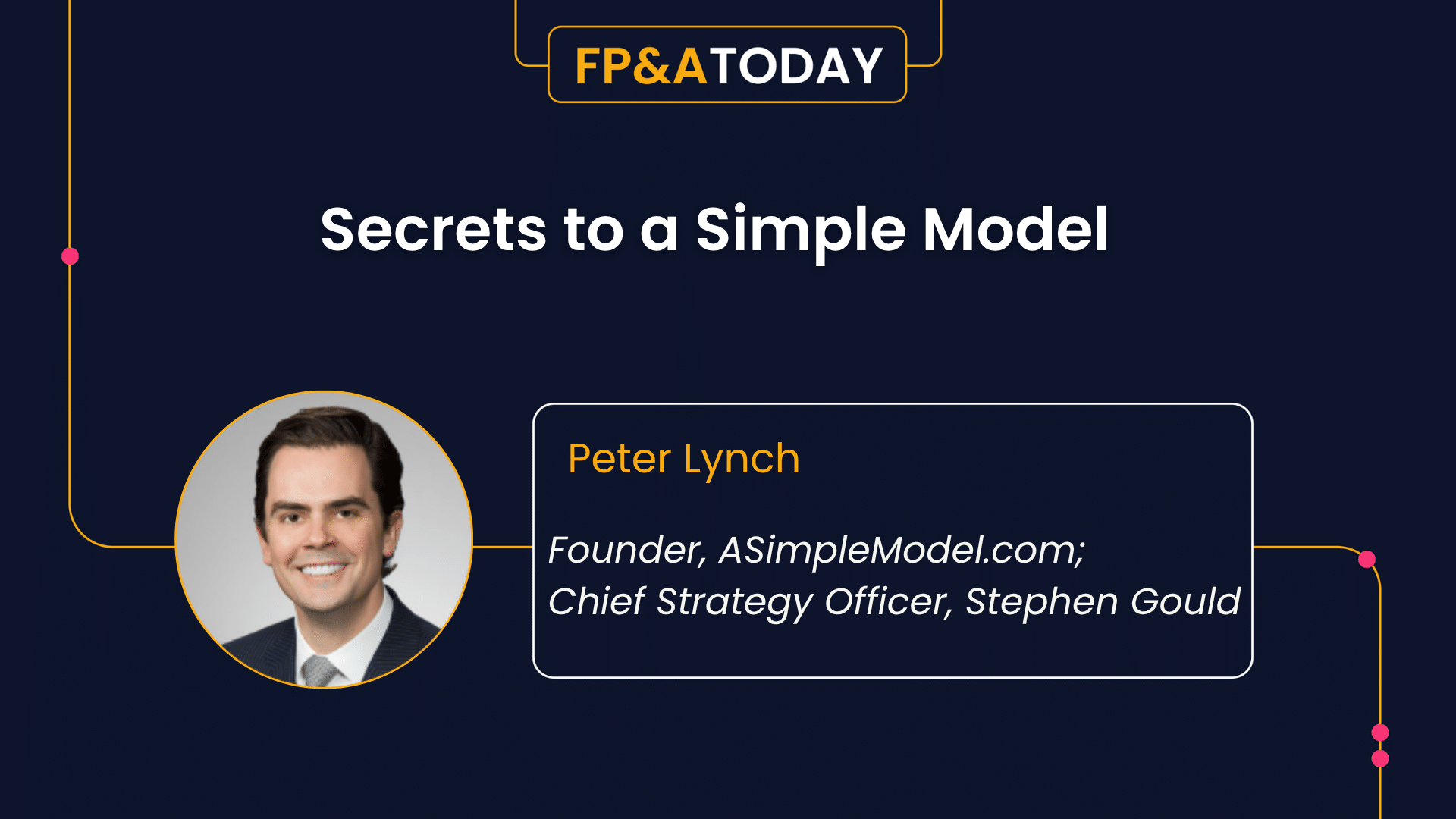
Peter Lynch is the founder of ASimpleModel.com and serves as Chief Strategy Officer at Stephen Gould. He has worked in private equity for most of his professional career at Rabobank, JP Morgan, Argenta Partners and Hilltop Holdings. But he’s perhaps best known for turning complex financial concepts into clear accessible lessons through ASimpleModel.com.
- JP Morgan in Buenos Aires
- Crazy models during the financial crisis
- Capital allocation strategy at Stephen Gould
- How a Simple Model took off
- Most common mistake in building a financial model
- Clarifying private equity
- Incorporating AI into everything I do
Full blog post and transcript
Glenn Hopper:
This is FP&A Today. Welcome to fp NA today, I’m your host, Glenn Hopper. Today’s guest is Peter Lynch, the founder of a simple model.com, and the Chief Strategy Officer at Stephen Gould Corporation. Peter started his career in investment banking and private equity with roles at Rabobank, JP Morgan, Argenta Partners and Hilltop Holdings. But he’s perhaps best known for turning complex financial concepts into clear accessible lessons through his platform. A simple model, what began as a side project in 2013, has become a go-to resource for learning financial modeling and understanding private equity from the inside out. In this episode, we’ll talk about his career, how he teaches finance differently, and what he’s seeing at the intersection of modeling education and real world investing. Peter, welcome to the show.
Peter Lynch:
Thank you, Glenn. I have to say you have a great podcast voice. I hope I can live up to it. I’m just very impressed by that.
Glenn Hopper:
Uh, man, I, I have <laugh> so weirdly that, weirdly you said that you’ve got the nice baritone tones, whereas I’ve just got this, uh, southern sort of slow roll, uh, dip thongs or whatever they call it, where your vowels sort of merge together. <laugh>. Yeah, that’s <laugh>. Maybe we should, uh, I, I know, I know they’ve cut funding, but maybe we should, uh, with our podcast voices, see if we could, uh, get a show on NPR.
Peter Lynch:
Yeah.
Glenn Hopper:
Back and just little people to sleep <laugh>. Well, man, I really appreciate you coming on the show. I really enjoyed our, our conversation ahead of it too. And I, I’ve, I’ve got, I was just telling you before we went live on air, I have way too many questions here, <laugh>, so I’m just gonna go, uh, rapid fire. Not really. I can’t do anything rapid fire, but <laugh>, we’re gonna get through as many of ’em as I can. And, and maybe we’ll do a, uh, a follow up episode or after hours episode to pick up the rapid <laugh>.
Peter Lynch:
Absolutely. I’m ready for the
Glenn Hopper:
Rapid fire fire. Alright, let’s go <laugh>. I love your background and it’s so interesting to me how many finance people I talk to who have taken that finance storytelling. I, it’s the same part of your brain that goes from finance storytelling to sharing your knowledge and, and the way you have at a simple model. And we’re definitely gonna get to a simple model. But I think just to set the foundation and the groundwork, can you kind of walk us through your career path, maybe going all the way back to what initially drew you into, um, investment banking and then private equity? Yeah,
Peter Lynch:
No, absolutely. I’d love to. It’s, it really started early. So my father was an adjunct professor at Harvard while he was teaching, and he taught corporate asset management and, and conglomerates. And he started giving me investor letters very early on, uh, heavily focused on Seth Klarman because that’s a vehicle that came out of that school. And I was trying to read it when I barely understood the content and, you know, just underlining, trying to understand vocabulary. Seth Klarman’s, fortunately a phenomenal writer. I would suggest to anyone go back, read his letters. They’re, they’re great. And I went to college at UPenn and that campus really drives you towards financial services. All my internships were in that space. And I had an internship with Luther King, capital Management, and we made an investment in Buenos Aires. And the guy who came up had so much charisma.
And the business story was so good that I decided as a very young dumb college kid, I was just gonna move to South America. And I made, this is pre LinkedIn. I made 200 phone calls to finally land final rounds with Lorraine Vial, which is a investment bank boutique down there, JP Morgan and the CFO of Maso, which is a large lumber importer. I just wanna say for anyone listening, like these 200 phone calls were wildly awkward. You know, calling someone and saying, I’m in Texas, I want a job in Santiago, Chile. They’re like, okay, I don’t care. <laugh>
Like, um, but I think it’s important, I think it’s like, as it relates to private equity and getting a job, the jobs are similar. Like you really have to hound good investments, keep track of your network and build on it. I went to work for JP Morgan, first and Santiago, and then in Buenos Aires. And it was a very cool experience. I read Monkey Business before I got down there. I thought the hours were gonna be crazy. South America’s a very different profile. It was nine to five, no weekends. I was like, wow, banking’s great. And then, uh, I had, uh, I had an offer to go work for a credit fund in Buenos Aires, um, after that. And when I showed up, I remember they were pulling the servers out and everyone looked a little unsettled and uh, I asked if I still had a job.
And I remember so well, the guy told me, he was like, I was keen to hire you, but we were just on the wrong side of something. You’re gonna hear about everywhere. CDS credit default swaps. He’s like, if you wanna stay in this space, I suggest a one-way ticket to New York. ’cause the financial services sector is about to shrink at the fastest pace you’ve ever seen. And if I’d been smart, I would’ve done something with that information. But instead I was scared and just went to get my next job. And I landed with, uh, Rabobank International and it was an amazing time to write out the Great Recession ’cause they were food and agribusiness focus. So the sponsors swung out, but the strategics came in and we actually had a very busy couple years while I was there. And it was where I really built that Excel skillset. And I was kind of the Excel guy on the team and really enjoyed it, really in intricate models. And they would, they kind of preferred an a one approach, as I call it, start from scratch and build it out. And so I think that was kind of the foundation of my skillset that I then carried with me.
Glenn Hopper:
I guess I, I didn’t realize this when we were talking yesterday, but starting your career and <laugh> really getting going at, at the peak of the global financial crisis. Yeah. That what a wild time. So you were at Rabobank then? Yeah.
Peter Lynch:
To that point, banking felt so cool right up until the crisis. And I remember right, I was across the street when Lehman and Bear Stearns when all of that was happening. And this was back when, uh, uh, blackberries had keys, they had the actual keys. And I remember walking home at like one or 2:00 AM leaving the offices and fe like feeling the crunch of keys underneath my phone or underneath them. ’cause people would spike their blackberries coming outta the office. So many people were getting laid off. It was, it was just a wild thing to see. And it taught me that there’s really no certainty regardless of the scale of the company you’re working for.
Glenn Hopper:
Yeah. Just, just an incredible time. And I guess there were opportunities there, there just was so much uncertainty. It had to be, I mean, talk about cutting your teeth at a tough time with all the uncertainty there. I bet those models got pretty wild and and intricate in that time, right? Or
Peter Lynch:
It was interesting. You know, we would, we were like selling sugar refining capacity to Coca-Cola, or we helped Del Monte buy a large banana and pineapple plantation in Costa Rica. Uh, so that was my first and only actual data room that I saw. Everyone sees data rooms as these digital things Working in Latin America was so interesting ’cause I went down there, they were like, go get the data, come back. I was scheduled for a one day trip and I walked in and it was just boxes of files and they extended it for two weeks. And I 10 keyed data for two consecutive weeks before coming home. I was like, I hope I never see this again. <laugh>
Glenn Hopper:
<laugh>. Oh, that’s so funny. So this, I’m, I’m dating myself here, but my first data room was when I was in telecom. I remember when data rooms were a room. We were in the
Peter Lynch:
Right,
Glenn Hopper:
Uh, executive area of, of the company that I was working for. And it was the, these two SWAT teams from the two companies that were gonna merge. And it was just stacks of boxes. And there was the idea of a digital data room back then was like, what? It’s the worst <laugh>. Okay. So you move on from there and then you’re at, uh, Argenta and Hilltop. So walk us through what were kind of some of the most formative experiences from, from those roles.
Peter Lynch:
Yeah, I think where I felt so fortunate, my father never tried to guide. I have three siblings, never tried to guide any of us on decision one’s in computer science, the other’s in movies, and one’s in fashion. And he approached me at this point about potentially joining him. So Argenta was a hold coast strategy that he ran for 30 years. And the idea was buy anywhere between five to eight companies and then grow through add-ons. And he really said that there were only two reasons to ever sell. It was an unsolicited offer at a fantastic valuation, or your management team got tired. And at the conclusion of his career, he’d managed a 27% IRR that was kind of guided by these two principles. And it was really the importance of investment time horizon and great people. So if you’re solving for long-term cash flow, you have to take care of stakeholders and shareholders.
You kind of have to take care of everyone. You know, you can invest in education programs, you really have to take care of your customer, et cetera. If you’re solving for short-term cash flow, that can have really unfortunate consequences. And I think if you look at it, it’s the compounding in the latter half of any company’s lifecycle where you really create that tremendous equity value. Once you buy something great and you have a great team, you just let compounding do its work. Um, and I really think great people are kind of the secret to work-life balance and financial success. I I really enjoy this one story. So Circuit City under Alan Wetzel outperformed the market by 18.5 times. And at that time they would, their, so all their competitors ran banners on like this discount or, you know, this product. And they only ran banners that said, always looking for great people and they would let the great people do the work.
And I just thought that was awesome. I spent time there until he retired. We sold most of the portfolio and I joined, uh, a longtime friend of mine who had established sort of an investment role at Hilltop. So Hilltop is a phenomenal firm. They’re here in Dallas, they’re a bank acquirer. They had about 15 billion in assets when I joined. We became their non-control non-bank investing arm. And that was sort of a lesson for me in kind of what it takes to build out a sourcing and third party network from scratch. We had a financial, like a phenomenal financial backer, so we didn’t have to worry about raising capital, but kind of reestablishing relationships across all of the various disciplines required for private equity. That was a tremendous amount of work. I actually met my former partner, longtime friend at the airport on day one just to get started. And we were on planes a lot, but it was, it was awesome. And I really learned the value of minority investing. You can really amend an operating agreement for just the right amount of control. And we were doing preferred with warrants attached before it became the most massive mark, you know, before private credit exploded. So we got to have some great early success and, uh, it was, it was just a phenomenal place to be.
Glenn Hopper:
That’s great. So walking through, let me know if I’m skipping anything here that we need to cover, but going from that to now, the Chief Strategy officer at Steven Gould, I guess maybe a little bit of background on what, what Steven Gould does and your role as CSO and kind of how that ties into your, uh, experience in
Peter Lynch:
Vibe. Sure. You know, story for another day, but my father got ill and I really wanted to help my family and that was really the only reason I left Hilltop. When I started out in the industry, I was like, if I ever get an opportunity to be a founding member of a PE vehicle, I made it. I’m, I’m stoked. And so I took a sabbatical, I took some time off to to help my family and in that time I got asked to join the Stephen Gould board. And in a fantastic kind of full round story, Stephen Gould was my first internship ever. And so it was a cool, I stayed in touch with them afterwards and it was just a cool opportunity to revisit what they were doing with my background and I kept seeing opportunities for capital allocation. So eventually they asked like, would I want to come inside, uh, and, and help with that role.
So I, I really view it as this focus on capital allocation strategy and talent acquisition. It feels like the private equity playbook applied internally over a very long term time horizon. And I think people are just so curious about private equity and there are plenty of good and bad examples of firms out there. But I think what’s powerful about it is you work very decisively on strict timelines. When you sign an LOI, you have a few months to make a lot of decisions and then put capital on the line. And I think, you know, that is you then hire the best team and you iterate towards success. And it’s great discipline when done correctly by talented operators. Uh, if you can work towards that culture of aligned changed, I think what people fear is change if they don’t understand the principles that guide it. Creating a culture of aligned change allows you to really make people comfortable with why we’re, why you’re moving forward.
So I think that’s, that’s how I view the role. And then I’ve started to find examples, um, that I find really interesting of what I call platform backed innovation. Uh, we talked previously like Slate Auto, I thought was a startup. This is a company that has created a $25,000 electric vehicle and is making headlines for making such a low cost electric vehicle. And I learned at a conference that it wasn’t a startup, it’s a company called Rebuild and Rebuild took a $10 million design challenge and then once they were done within 18 to 24 months of developing the prototype, spun it out into its own entity and raised $700 million. And it’s just this incredibly accelerated value creation playbook. And so I try to think about how do we apply that in a different industry? It’s Steven Gould, how do we become something that can look at VC and look at PE and, and kind of innovate on that.
Glenn Hopper:
Super interesting. And that, uh, so that company, that’s the one that’s, um, Amazon or Bezos is an investor in Yes. As well. And they’ve got, it’s a modular, you put it together and they’ve got their baseline, but then everything is just a bolt on to the vehicle that you can build up, is that That’s
Peter Lynch:
Right. The model.
Glenn Hopper:
Yeah. One
Peter Lynch:
Of the, one of the brilliant things I, I got to talk to the CEO after the conference and one of the brilliant things about it that they realize in retrospect is because all of the customization takes place in the customer’s control, you don’t have to have a lot with every model and every trim and every color. You need to have a few models on every lot. And that’s it. And you know, they had racked up 140,000 pre-orders when I was at the conference before starting production. So they just have a fantastic PR and marketing effort behind this as well. And I just very impressed by the whole thing.
Glenn Hopper:
Yeah, what an incredible model. So going back to Stephen Gould, so you’re not the typical, uh, pe you know, four to six year time, you’re looking at, you said you’re looking at a longer horizon. So like what would a typical, uh, hold period be for you guys?
Peter Lynch:
I mean, so this entity, there’s no hold period. This is a, they, they have scaled the, the current chairman is such an impressive individual. He scaled the business from 7 million to 1.1 billion, uh, over, over his time there without any capital and without any acquisitions. And what I see is the opportunity to have kind of a, a capital allocation strategy, but internally, and it’s more how do we build moats around some of the like really great businesses that we have internally. But it’s, there’s no exit, there’s no, okay. You know, this is a very tightly controlled family entity. And I would say one thing that I’ve found, so unusual founders who build businesses like this don’t often invite outside perspective. And they have invited an entire board of outsiders. They are building, you know, teams of people that are just, just trying to, trying to build kind of very talented teams. You don’t have to do that if you built a billion dollar company, you know, and they do. So it’s just, it’s cool.
Glenn Hopper:
Yeah, that’s incredible because I’ve, you know, I’ve been on the, uh, on the other side of, of the companies where PE was invested and you’ve got the, the pressures and the, it just, it’s, it can be a really tough place to work when you have those horizons and timelines you’re trying to work toward, especially if you’re in like a turnaround situation and, uh, and, and all that. So it, it very much changes. And then I’ve also been in companies where I’ve come in and they say, um, yeah, we want to, we wanna bring in, um, outside investment, a minority investor here to uh, uh, to be a partner in this so that we can grow more quickly. And then it turns out, yeah, they kinda like their, uh, lifestyle business and, uh, don’t want anybody else coming in and having a seat at the table. So, uh, being able to have an organization like that, that is adding the value and it’s not, it’s for long-term build. That’s a, that’s a really unique opportunity, so. Very cool.
Peter Lynch:
It is fun. It’s fun.
Glenn Hopper:
Yeah. So in the midst of all this, and this is over a decade now, going back to 2013, so at some point in your career you’ve thought, Hey, uh, let me start a, a website that helps, or maybe I’m not gonna even try to put words in your mouth. Tell me like the original idea around a simple model and what you, what you’re thinking was when you started, what publishing around it and, and sort of what got that off the ground.
Peter Lynch:
Yeah, it, it started with no intention to publish. I really hated what it took me to get into investment banking. And then I went through these bootcamps and I just thought there was all this unnecessary complexity. And when I got on the other side of the wall, I realized this is all arithmetic and vocabulary there. It’s, it’s just not as complex. And I think it was that realization and a fascination with understanding it myself. And I really like wrote this when I was at Rabobank in the evenings, you know, sitting in my cubicle, the first few case studies, but they were, for me in one conversation with my father, he was a teacher, he was like, you should share this. And so I went to Best Buy, and I remember it was a $27 microphone and tried to learn how to record videos. The first few were awful and just started posting them.
I thought it would have this like, great reaction for like two years. I was the only website traffic, you know, I was just, just me checking Google Analytics and seeing my own traffic on the site <laugh>. And then someone wrote about it on a Reddit thread and it started to take off. And then I wrote an article that got published in, uh, I think it was Inc. Or Fortune, I can’t quite recall. And it just started to snowball, uh, slowly. And so it’s been a very gradual, you know, we now have a very small team that helps with the site, but it was sort of accidental case study turned accidental, blog turned accidental. Tiny business <laugh>.
Glenn Hopper:
That’s, yeah, so actually I kind of jumped the gun. I’m just assuming that all of our listeners know what a simple model is. So I should have led with tell us about a simple model <laugh>, what <laugh>
Peter Lynch:
The idea was make financial modeling really accessible. The boot camps for me were expensive, so we’ve always charged what it takes to manage the team. We started free and then my hobby was becoming expensive, so I remember my first paywall was $3 and we’ve now worked up to between, uh, $14 and, and $30 based on which curriculum you’re taking. So the website will now take you from never having read a balance sheet all the way through the financial statements, the three statement model, A, D, C, F, and LBO. And then when I took some time off of work, I partnered with a law firm catton, who are, I love working with them, they’re phenomenal. And basically begged them to help me write the entire curriculum on what it takes to buy a business. So how you source it, going through the IOI, the LOI credit agreements, the stock purchase agreement. There are actually very few Excel models in this curriculum. It just explains the process beginning to end. I think in total it’s about four hours of video. And the PDF notes for each video are somewhere between 10 and 20 pages. So you can get pretty deep if you want to, but that’s the part I’m most proud of. I I really like the private equity training curriculum.
Glenn Hopper:
And while you’re building this, I mean, you know about how to build businesses and create value is, and you could have leaned all into this, but I know you keep, you, you referenced it as a hobby, but as you’ve built it out, have you had a long-term strategy with it or is it just been, this is an outlet, I know this is good information for people to have. This is how I wanna put it out. How is the growth, because it, you’ve, you’ve scaled up with, with quite a few users now as, as well, so I’m just wondering.
Peter Lynch:
Yeah. For a website focused on business models, we have a, we have a really bad business model, <laugh>, it’s really been like focused on creative outlet and trying to make this information available. So we’ve now hired a few marketing firms and the first thing they say is, just make your price the market price. And I really want something where I can like share information and share knowledge. And since, uh, it’s not my primary occupation, I don’t take anything out of it, I just really love doing it. And it was the most humbling experience. I, what I find fascinating in private equity is you’ll go in, you’ll do due diligence on a business and you’ll say, wow, this, this marketing department really sucks, you know, or something like that. And then you try and go build a customer base and you’re like, I’m terrible at this. Like, <laugh>, you know, it’s like, I don’t know what a marketing funnel is. I, you know, and in that way it’s, it’s like really helped me understand the entrepreneur better, uh, trying to, trying to be one. And I, I think that is the most humbling experience. The first time there is any kind of transaction or monetary value for something you’ve built is truly like a phenomenal moment. And anyone who’s done it, I think deserves so much credit just for that first step.
Glenn Hopper:
Yeah. And you’re not putting out, uh, the, uh, one page cheat sheets that people throw out on LinkedIn to try to get, uh, more followers or you <laugh> whatever, but you’re actually, you’re genuinely interested in the content and in explaining the content and being this resource. And I think that that’s influenced the, the nature of the content and what the site is and, and the community you have around it. FP and a today is brought to you by Data Rails. The world’s number one fp and a solution Data rails is the artificial intelligence powered financial planning and analysis platform built for Excel users. That’s right, you can stay in Excel, but instead of facing hell for every budget month end close or forecast, you can enjoy a paradise of data consolidation, advanced visualization reporting and AI capabilities, plus game changing insights, giving you instant answers and your story created in seconds. Find out why more than a thousand finance teams use data Rails to uncover their company’s real story. Don’t replace Excel, embrace Excel, learn more@datarails.com.
What would you say about the community around A A SM? I mean, is it, is there a lot of interaction?
Peter Lynch:
I, I would say I get a lot of emails and I, I try to respond to all of the technical questions and more the detail that we have. Someone who helps with email and I, they forward everything. To me, that’s kind of more material and I really enjoy that aspect of it. I have not been able to put myself in a position where I can go to speaking events or, or anything like that. So the community’s sort of all digital. Um, yeah. But I really enjoy the few occasions where I’ve gone to speak to it. I’ve gone to a few universities, uh, I’ve gone to a couple like private equity businesses and talked about it when my schedule permits. And I, I love that aspect. I love getting to engage with everyone. And what’s very entertaining is, uh, the first, so I’m six foot six and when I, they’re accustomed to me being very tiny on a screen <laugh>. So that first introduction is always kind of hilarious. Like what?
Glenn Hopper:
<laugh> Yeah, <laugh>. That is funny. Especially after COVID and everybody went remote. It’s always amazing meeting people, uh, firsthand where, uh, you know, people, you think that person must be five two turns out to be right. Six and I, a lot of it is placement of, uh, where the camera is too. I figured out people just assume that that camera line is their eye line when they’re looking at you
Peter Lynch:
<laugh>. Right? Yeah, that’s a great point. I love that. I hadn’t thought about that, but that’s right. It’s like, yeah, I would be looking down on this tiny human
Glenn Hopper:
<laugh>. Yeah. So yeah, so I think that where your camera line is, that’s like Kevin Durant’s view I guess would be, so your courses, I mean, you obviously, the, the nature of the courses, uh, would be set up well to be presented to firms and go in to the teams and maybe junior analysts and, and all that. But you’re, it seems like you’re really focused on, on the individuals and learning. And, um, so just going through a simple model, I, I know the three statement model, which huge, obviously everybody on fp and a today knows what that is and, and the DCF and and LBO models. And it seems like those are really the, the core of the curriculum. Would you say that’s the case? And if so, um, yeah. You know, um, why, why the focus on those three?
Peter Lynch:
I would say the private equity training content aside as it relates to the financial modeling, we really prioritize the three statement model. So the introduction to financial statements course is one of my favorites. ’cause it introduces the financial segments as they relate to each other, and it very quickly starts demonstrating how they plug into models. So by the time you’re building the three segment model, you kind of have this framework in your head, and I think that’s the most important po uh, the most important process is having that foundational knowledge. You can build complexity off foundational knowledge. The reverse is very difficult. And so when I see a curriculum that starts with a take private of a publicly traded company, I’m like, that’s more focused on mechanical sequence than sort of knowledge base. Um, so that, that’s, I would say the three statement model is the big focus. I think A DCF really trains you on time, value of money. I have not used DCFS very much, um, in, in my personal work. I know that they get used a lot in valuation, but what I find entertaining is the DCF and LBO are the same math just reversed.
Glenn Hopper:
Yeah, yeah.
Peter Lynch:
You know, it’s, it’s, so you gotta understand the math. The DCF helps you with that. And then once you get to the LBO, if you really break it down, it’s just a three statement model adjusted for a transaction and, and your return profile, it’s, it’s the same thing. You just gotta record a transaction. So I, I think they’re all really helpful, but if you get the three statement model and you understand the three financial statements, the, the rest just comes very easy. And that’s
Glenn Hopper:
Like, that’s the muscle memory. It’s like this is the core I if you, and to really like looking at the, even the, the financial statements, looking at them separately, if you haven’t had to go through and, and build that three statement model and put your plugs in and and really tie everything together, I mean, honestly, it’s, it’s that it’s doing the, the plumbing and linking everything together that you really start to understand the value of each of the models and then to your point, rolls into the valuation of the business and understanding that full picture,
Peter Lynch:
I think that’s stated perfectly, but like very tedious, frustrating process of doing this the first few times. It’s what’s cementing that framework and it yeah,
Glenn Hopper:
It
Peter Lynch:
Sucks the first few times.
Glenn Hopper:
Yeah. <laugh>, <laugh> especially trying to figure out that plug to get <laugh> Exactly. To make their exactly wide up in their balance. <laugh>. Yep. <laugh>. And then, you know, with those, and with the, with the other courses there is, you’ve spent your career in this space, but I, I would imagine that a lot of people, it could be straight out of an MBA program or, or, or school or, or maybe junior analysts as they’re coming in or maybe even further along in their career where they want like a, a refresher or a
Peter Lynch:
Yeah,
Glenn Hopper:
A better understanding, especially if they came from a different industry. So it’s, it’s gotta be difficult to balance that technical death that you have, but also still make it accessible for those people early in their careers or at a, a different place. So how do you balance that? Uh, you know, and I guess specifically for people who haven’t worked in investment banking before,
Peter Lynch:
Once you get good at something, it’s hard to remember how you got good at it. And I go back to kind of what I started writing out the first few times and I was like, if I wanna understand this, what does that look like? And I, I really think that’s what helps most, especially with financial models. If you understand the core relationships, the additional complexity is, is more arithmetic and more rows, but you still just need to make things link properly. To your point, how does it balance, you know, if you really understand how one change on any financial statement impacts cash, you can make a model balance. I think the best way to treat financial modeling is to strip it down to its core of those relationships and then explain that complexity is, it’s kind of this illusion of complexity. You’re just adding arithmetic and adding line items.
Um, so that’s what’s helped me the most. That’s how we teach it. And then we have examples of more complex models, but I don’t really do the like, hyper detailed instruction on more complex models. I just make them available so people can understand them. There’s one advanced LBO case study that I, I wrote for, there was basically at hilltop the, this thought was create a case study where if they can ace it, I would hire them on the spot. And so there’s, there’s a live modeling exercise that I do of like, here’s how I would do it. That’s
Glenn Hopper:
Cool. Yeah, I love that. So, because you’ve been in the education space for so long with this, um, and you’re gonna be preaching to the choir here on fp NA today, but, um, from your vantage point, what’s a common mistake that you’ve seen people make when they’re learning or building financial models? So whether it’s a hurdle to overcome or something that is just difficult to grasp or something that people maybe blow by too quickly without giving it thought.
Peter Lynch:
Yeah, I, I would say the first one is you gotta treat this like you’re learning a new language. It all sounds like English, but the vocab is so different. So most of the emails I get are like, I don’t know how to project this line item. And I’m like, it’s because you don’t know what it is. All you project things generally only a handful of ways. And so I think if you really pay attention to vocabulary early, this stuff just starts to accelerate. And then the other is really, people focus on the case study to get the interview and those vary in level of complexity. And I again, just think you have to start with that foundational knowledge and build up. I would generally find that I, I, I felt this way. I don’t know if, if you felt it this way, but I always thought that the best modeler probably wasn’t given a three day case study to get the job. You can kind of tell in the interview how good they are. Um, I, I feel like you may you lose candidates if you put out two greater a hurdle.
Glenn Hopper:
Yeah.
Peter Lynch:
Um, so I understand the case study approach. I just think there’s, there’s problems to it on both sides, both hiring and, and on the learning side.
Glenn Hopper:
Yeah, I can see that. I’m with you. I, I see how someone could make an argument for it, but it’s, I know coders get coding challenges all the time and that’s, uh, and that’s how they’re selected. But I, it just seems like, I don’t know, I, not to knock what coders do, obviously that’s very difficult word, but it’s, it just seems like a different engineering versus what you’re doing, especially in investment banking. It’s obviously modeling is huge, but there’s other components to it too. And laying down that hurdle like that, I don’t know, I’m, I’m, I’m sort of with you on it. Um, and have you had to have gone through a couple of those es especially I, I think, uh, you’re, you’ve already lost me here. Here. I feel <laugh>. Yeah. Like I’m doing, I’m doing
Peter Lynch:
Work for you for free. I dunno, <laugh>, the other funny thing I found about the case study method is the first thing I would do is look at the file and look at who created it. Because all of these files have the creator. And it was frequently not the person emailing it to me. It’s like, God <laugh>. Yeah. So if you’re listening, change who created the file.
Glenn Hopper:
<laugh>. Good, good. Pro tip <laugh>, I’m totally with you on the fundamentals of modeling, but also what I love about the program is you go beyond just the models and, um, you’ve got the sort of beyond the LBO covering, sourcing, sourcing, structuring and closing deals. And I love that. So could you walk me through that kind of content that’s beyond just the, the modeling that you offer?
Peter Lynch:
Yeah, absolutely. So the private equity training material is really focused on private equity. What makes it difficult to understand is there’s so many steps from the time you identify a company to the time you close it individually. They’re not that complicated. But looking at an entire process and trying to understand it is super challenging. So this really breaks it down into like, how do you make a bid? When do you get serious about that bid? How do you validate that what you’re about to buy is the value you think you’re about to receive? What does that due diligence process look like? What third parties are you working with to confirm all of this? When do you bring in lenders? And then, you know, once you transact, now the work starts. So it works through that process. And what I find really interesting in private equity is you can get pretty far along in your career without understanding the documentation process.
And I think if you understand how a stock purchase agreement works, how the credit agreements work, you know, the operating agreement certificate of, uh, of incorporation, if you understand how those things relate to each other, you really have an edge in the space. And so I, I try and encourage that we have a mini course on the stock purchase agreement where we create a skeleton stock purchase agreement and just highlight, here’s the language you actually need to look at. We don’t really talk much about the boilerplate language, but here’s what’s gonna move the needle. I like to tell people if you’re, if you’re early in your career in pe try and find a way in, it’s really protected. But find a partner and ask if they’ll just copy you on red line turns and just read the red lines. Try and understand the logic behind them, and then eventually try and position yourself where you’re, you are the negotiating party. ’cause I think it’s a phenomenal skillset and I think it translates to other spaces. That’s how, you know, equity incentive is created that you, you basically get to define a currency in some sense and all the pieces and how it works. So it’s, it’s a really fantastic principle to understand the framework that guides how the transac how the business is held.
Glenn Hopper:
I wanna get to the negotiating piece in a minute, but you actually keyed into one of my biases. I’ve been on the sell side a lot more frequently than I’ve been on the buy side of transactions. Have you created any content for the sell side? And I’m thinking actually, if I were wanting to learn more and I were on the sell side, taking the buy side course would probably be enough. But have you, have you targeted any, any content towards sell side?
Peter Lynch:
We haven’t as much. And my thought has been sort of that, that you can kind of see it from both sides. You know, if you, if you take the course, but we haven’t gotten specific to the sell side. I think what’s fascinating to me about the sell side is like how many games are played between the parties. And there’s one story that I really love. There’s a guy who found out entrepreneur had built a really amazing business, but the investment banker told him that only one party was interested. And this guy looked at the buyer list and he started flying to all the cities where this, where these potential buyers were. He’d sit in a hotel room, he had nothing to do there ’cause no one else was interested. And he’d sit in a hotel room and he’d wait for them to call his cell and he’d call him back from the hotel room so that they would see the area code <laugh>. And so they thought he was doing a road show and this guy was just sitting in hotel rooms and he used that as leverage to bid up the price. And you know, it’s like, it’s just, so many games are played on that front. It’s, it’s pretty wild
Glenn Hopper:
<laugh>. Wow. That is, that’s brilliant. I love that <laugh> going beyond in, in that the case study model and all, there are the soft skills side of things too. And I love that you hit those as well. Can you walk us through how you teach kind of the, the, I don’t know, the strategic and interpersonal aspects like negotiation that you mentioned or management alignment and I don’t know, do you, does any of your content focus on the integration, post merger, post acquisition? Um,
Peter Lynch:
We don’t, we have no post acquisition work. I, I, I think about that a lot and I think about it a lot more now being in kind of being in an operating business, uh, and, and kind of executing on that private equity long, long, long, long-term private equity playbook internally. But we, we haven’t broached that yet. I don’t know. I think about it.
Glenn Hopper:
Yeah, <laugh>, but it is, I mean, to, to be fair, it is, it’s more of an operator’s dilemma than a, um, than, than on the PE side. It’s certainly a, yeah, I mean if you, yeah,
Peter Lynch:
It’s hard to say this is how it works in every industry. You know, it, there’s different timelines, different perspectives, different perspectives on risk and leverage. Um, there’s just a lot of ways that could go and it’s also not as much of our criteria for the job. And so we try and stay focused on that bottleneck of like, we’re helping people enter the space.
Glenn Hopper:
Yeah. Yeah. And it, it’s just interesting having gone through. Um, I’m sure you’ve done way more deals on, on it than I have, but, um, having gone through a number of deals, you understand how, and I don’t know what the current stats are, but it’s whatever, more than half of of all acquisitions end up destroying value. And, you know, spinoffs have chance of success than a, than an acquisition a lot of times. And it comes down to we modeled out all these synergies that never happen and there’s all these complexities that when you actually, where the rubber meets the road on the integration, it’s a, that’s an interesting time to be. And that’s where it gets to, I guess the, the investor side too, helping sort of drive that, that integration.
Peter Lynch:
Absolutely. I think, I think that’s right. And I, I think we’re seeing an, a massive amount of it right now, this 2022 interest rate hike, which was the, the most aggressive we’ve ever seen. I think you have a lot of good businesses with great operating cash flow that just have broken expectations, uh, you know, like equity incentives, debt profile, everything else. And I think it’ll take some time to, to unwrap that.
Glenn Hopper:
Yeah, it’s funny, I, I keep swaying off of the, uh, the topics here to do more deal talk. Great. I don’t mind at all. <laugh>. Getting back to the, the soft skills, uh, can you walk us through a little bit of, of that side of what you, you cover in the, uh, going back to the negotiation and management alignment and all that in your training?
Peter Lynch:
So it walks you through like the indication of interest is sort of a range evaluation, you know, and then it’ll talk you through the letter of intent, which then gets to a more specific value and you start to outline the things that will be very important in the stock purchase agreement. So one of the things we’ll say, for example, is whatever, whatever your must haves are for a close, make sure you get ’em in the LOI just set that expectation early because closing is a rollercoaster of emotion. You know, we’ve had plenty of deals die in the, in the final hour. So it’s managing expectations through that process at the right time. You, like, you wouldn’t wanna put it in the indication of interest when they have the most people to choose from. Once you get to the LOI, you’re a little further along and it just sort of guides you through when to introduce these variables. And I always like to say that when you get to the stock purchase agreement, have the things you’re willing to give on and the things you must have and present them both equally and just trade <laugh>. You know, people always want to feel that they’re receiving something if you’re getting something. It’s, it’s so much posturing, you know, as, as I mentioned, people are looking for every detail when a transaction’s closing down to the area code you’re calling from.
Glenn Hopper:
Yeah. <laugh>.
Peter Lynch:
So it’s like anything can set off a process.
Glenn Hopper:
Yeah. That’s great. You know, and I, I think a lot about your platform and I think you really are in a unique space and that I could, I could ask you, uh, differentiators in the marketplace between the, the million other, uh, learning platforms that are out there specifically targeting fp and a, but it comes through when talking to you that this is a, this is a passion project for you. And I, I know you’d like to grow the user base and all that, but it’s, I don’t wanna put words in your mouth. Does it feel like though, that this is really, you have a clear focus on what you want to get out there and, and how you’re structuring it, and I don’t, does that even as you’re thinking about what Corporate finance institute or what LinkedIn learning or what data, whatever other platform is out there that people are learning on or the the consultants out there. Are you trying to match that or do things with marketing with it, or is it just focus on the content and stay true? And, and, and that’s sort of the growth and strategy around it.
Peter Lynch:
It’s largely focused on the content, but I’m increasingly thinking about what is the strategy and how do we want to expand on this? ’cause it’s just continued to evolve and we now have some people who, you know, are, are working for the entity and providing content. And so I do feel more increasingly responsible for that. And at some point I think I really would like it to succeed on another level. I just haven’t thought quite through, I’m always torn between, the immediate answer is just raise prices and then compete in the same way. Is there a way to achieve both goals and be the, the really affordable solution? So that’s, that’s what I toy with a
Glenn Hopper:
Lot. Yeah. 2013 tech has changed a lot. These all the different LMS platforms that are out there and, and there’s so many YouTube videos out there. I had, uh, I don’t know if you know Chendu the, uh, Excel guy. Yes, absolutely. Yeah. So he was on the show, uh, a month or so ago and, uh, I talked to a lot of people who are in this, in this training space. And I’m wondering just because I mean, you’re kind of an OG in this now, <laugh> being around since, uh, 2013, have you seen, and I know you started, you talked about getting the, the mic and doing the, I mean, I’m guessing it was just screen share and talk over it and, and, uh, you know, present the topics, the way that the way people learn about finance. Obviously there’s, you know, school and, and, and the traditional routes, but so many people are leaning into these certificate programs and credential programs and, and all and just, but the technology that’s out there. Have you seen or changed the way that you create content and put it out there based on how it’s changed?
Peter Lynch:
I have, you know, I used to never put my face in anything and the first time I did, like, it was really challenging. But I do think people want to relate to someone, and I really, I think the biggest challenge we have if we think about competition is in-person instruction is hard to beat. I think, you know, we lost a lot in sort of that COVID era. I remember being in a cubicle and having a VP or associate or managing director looking over my shoulder, and it just really accelerates learning. I think the challenge is trying to figure out how to do that if you don’t have the environment, the online tutorials are great, but you kind of have to force it on yourself. Um, and there’s just a lot of options out there, right. You know, we find that a lot of people are, um, signed up for multiple platforms and kind of going through the process to help. I think it helps like the more you can see different approaches in different, in different, uh, uh, abstract. Like you have these abstract concepts and the more you can see it in a different con uh, context, the more it’s gonna cement itself. And so I I think having such a broad array of options actually helps if you take advantage of it.
Glenn Hopper:
Yeah, and that’s true. I mean, it’s all, it’s not, it’s not a zero sum game in the competition there. It’s, it’s if people are continuous learners, going to a different platform, getting a different insight, getting a slightly different feel, it’s just, it’s the same thing we do when we’re learning on the job and talking to other analysts and, and talking to other Excel Absolutely. And all that. Yeah. And it’s funny when you were talking about putting your face out there, the first time I, I go back to, I think I mentioned, we were talking before the show. I was a journalist before I went to business school and uh, I, I felt from very early on that I had a face for radio <laugh> and a voice for print, <laugh> <laugh>. So I was a print journalist in my earlier days. And since then, you know, the first time you hear your voice on a tape recorder or whatever, I’m tape recorder talk about dating myself. Yeah.
Peter Lynch:
The
Glenn Hopper:
First first time you <laugh> on a reel or Yeah, at this point I’m just, uh, I’m just like, yeah, I know that jerk. I know <laugh>, I almost dropped. In other words, I think it’s okay with, I don’t, uh, but I, I’m, I’m gonna keep this family friendy pg I start bringing it home. We’re actually, we’re doing good on time. I think I am gonna get through most of these questions. So that <laugh> phenomenal. That’s great. We’ll call this the, the advice corner of the show. If someone is just starting out in corporate finance or if, if we do have listeners in private equity, if we have listeners in private equity, you guys speak up out there now because, uh, you know, we’re, we’re, we are fp and a today, but we, we feel aligned with our, uh, analyst brethren and, and PE <laugh>. So <laugh>. But if you’re given, if kind of looking at the path you went through, and I know it, it wasn’t, uh, what, what most of our listeners are in in corporate finance, but someone just starting out today, and the reason I guess I’m asking this question is I think back to, to business school a million years ago when <laugh> when, um, I was there and I wasn’t really prepared for corporate finance because it was all case studies, case studies, case studies, and then getting in and doing the actual work.
And I would imagine it’s the same whether you’re coming into investment banking, PE or, or wherever you’re starting out, there is a knowledge gap of just what it’s like maybe a little bit less time on case studies and more time on being able to maneuver excel or, um, and I don’t know, maybe, maybe that’s not really where you would go, but for someone just starting out in in PE or corporate finance today, what, what would one piece of advice you’d have for MB?
Peter Lynch:
Yeah, absolutely. I think the most powerful thing you can do, and the thing that will accelerate your career the most is the network you manage to build while you’re building this technical skillset. Like you, you really gotta hammer the technical skillset. But in terms of being able to move to new interesting firms or do, uh, you know, if you’re in private equity or in you’re in corporate finance, corporate finance, the opportunities will start to find you. If your network is vast private equity, you get hired based on your technical skillset and promoted based on your ability to create agency. So I just think find ways to network, find the ways that are comfortable for you. I really like, there’s a story about the greatest car salesman ever Sky Joe Gerard. What he would do is if you ever bought a car from him, you are on a permanent mailing list.
He would mail you a card and you’d open it every holiday once a month. It would just say, I like you <laugh>. That’s it. And he got to the point where, I can’t remember the number, but he was sending hundreds of thousands of letters per month and he just, he sold an amazing number of cars per day. I, I can’t remember the number. And it’s funny how this works. There’s a study I read recently that they were trying to understand popularity and what makes someone popular in school. And the number one correlating variable is the number of people that the individual likes. The more people you like, the more popular you will become, the more people like you back. And so it’s just, you know, I think building your network is really a fantastic thing to do. If I’m reaching out to someone new without a warm introduction, I’ll reach out five times and in each email provide a very cordial, like, I will stop if you don’t want me to reach out again. And, uh, I think it’s important to remember that the most important email you draft on any given day is very likely to be the least important email in your recipient’s inbox. So just don’t take it personally, and eventually you’ll find people who admire persistence,
Glenn Hopper:
<laugh> love that. Obviously you’re not just teaching this stuff, but I can tell just by the, the context and, and everything you talk about, you’re clearly, uh, one of those lifelong learners who’s always curious and, and going after new things. I’m wondering for you right now, is there anything that has your interest that you’re, some new area that you’re studying or are looking to improve in or expand your knowledge in? I would
Peter Lynch:
Say the two are ai, of course, just like <laugh>, it’s wild, what’s happening. And then the psychology of leadership, I think are the two. Uh, I really think about a lot. AI really has me absolutely fascinated, and I’m trying to incorporate it into everything that I do. If I used to do something one way, I ask myself, I, if I can accelerate it with ai, and then I’m also trying to be careful about the things I don’t use it for. So writing, which you were talking about being, I don’t ever ask it to write something for me. I will write the entire draft and then upload it and use it as an editor, but I don’t want to lose that skillset internally or my command of language. So it’s, it’s just an interesting thing to start absorbing as as much as you can and then be aware of the pitfalls of it.
Glenn Hopper:
Yeah. It’s obviously with, uh, anyone who follows my, my content in my show, I’m, I’m clearly an evangelist on ai, but man, there are so many people out there just generating so much garbage content and it’s so, it’s so obvious when something is written by ai, they’ve got, it’s, it’s simultaneously access. Is this excessively superlative, if that makes sense. Yeah. And then, but also anodyne at the same time, it’s just so washed over. And if you think about how it’s created, I mean, it is giving you the most statistically probable next word. So of course it’s gonna just manufacture cliches, but there’s so many things, the biggest one, so m dashes obviously are a big thing in, in reading. Uh, you can, you know, people using m dashes in every paragraph, uh mm-hmm <affirmative>. Yes. Uh, that’s a, that’s a tell for, for ai. But
Peter Lynch:
The most immediate tell, I think right now, absolutely
Glenn Hopper:
<laugh>. But second to that would be, it’s not just X, it’s y like a, I don’t know what it is. All Claude does it, Chad, GPT does it. And, um, I’ve got a, I’m working on a, a new book right now. And I would love it if I could outsource some of my write writing to ai, but it was, it, no matter how you prompt it or what you tell it, uh, it’s so cringey. But to your point, it is really good at organizing. So if I have just rambling, like a free write of thoughts. Yeah. And then getting AI to structure that into something that makes sense. Just gimme an outline. I’ll go write it myself. But yeah,
Peter Lynch:
I think that’s exactly right. I, I think you’re gonna lose your voice entirely if you use it. And, and I can read it, I can tell entirely when I’m getting AI generated emails, AI generated text. It is using Yeah. Statistical probability is you’re gonna work towards what everyone would write and uh, I think you lose voice.
Glenn Hopper:
Yeah. And, uh, <laugh>, it’s, when you were talking about, uh, the psychology of leadership, my, I immediately went to, I wonder if that includes the psychology of leadership of bots. So you <laugh>, once we get, once we get ag agentic ai, you need to know how to, you know, wrangle the bots and keep ’em in line. <laugh> <laugh>, what motivates ’em.
Peter Lynch:
You’re you’re way ahead of me. I have, I’ve not gotten there. I hadn’t even thought about it until you just said it. So <laugh>. Yeah,
Glenn Hopper:
I mean, I guess beyond that, uh, what’s next for you? Anything exciting come up, coming up with either the platform or, or it’s Stephen Gold.
Peter Lynch:
You know, I’m really excited about the role. I think it’s my first time in a true leadership role and really dealing with the day, the day-to-day of a mu a much larger organization. I’m really used to working with lean teams and I think there is something really fascinating about it. And I, I, this group is doing such a good job with it. They’ve brought in a kind of team of exec, uh, of executive coaches. I meet with someone every two weeks. They go through strengths, weaknesses, they bring us together to find better ways to work together. And we talk about kind of the organization and, and what the future looks like. And so it’s just been, for me, it’s just been a fun new role. I’ve, I’ve been in it for two and a half years now and find myself really enjoying it. It’s very different from private equity, but the knowledge base transfers very well. So it’s, that’s, that’s probably what I’ve been really focused on is how do I excel in this role and, and really influence change where it matters. That’s
Glenn Hopper:
Great. And that’s a, that’s a big part of leadership and I think <laugh>, I, I used to think that this was like went hand in hand with being an analyst. You, you know, you move up in your career and you get further and further away from the spreadsheet, but I, I feel like inherently you want to hang on to, I just wanna build something. It’s just, it’s something like with engineers too, but hearing you, the fact that you’re teaching on the fundamentals and the basics and sort of whether it’s the Excel or just how the model works in general, but also the soft skills. But now at this point in your career, also leaning into the management style and everything, I, it feels like it’s almost two different skill sets and it draws from a different place. But I will say, I talked to a lot of people who are like, no, you’re just a, a curmudgeon <laugh>. You need to get used to get better at talking to people. But that is, I don’t know, was that a hard shift from you going from doing those from early career, doing the modeling? I mean, was that a happy place for you or were you always thinking that same network and more about people and, and all that?
Peter Lynch:
No, massively these were huge shifts, like huge shifts. I would say that today, you know, there was a point where I was so accustomed to, if we can’t make a decision on something, the answer is more analysis. And you just keep kind of recutting the data you’re looking at and you, you’ve realized like the best data comes after execution. You don’t really know the model’s static. You’re gonna influence change. You’re gonna see that change and then you have to be able to adapt very quickly to whether or not you were right or wrong. And so I I really think more about like, what is, what is the psychology of hesitation? What biases do we have? And how do you get the team to kind of raise those so you can address that and get out of this sober sort of over analysis paralysis problem. Um, they’re, they’re very different. They’re very different skills and they’re both equally powerful. But you gotta know when to, when to push the accelerator on which one or you’re gonna get stuck in one of those two spots and, and you won’t be able to move forward.
Glenn Hopper:
Yeah. And I’ll put you on the spot here too, digging into leadership psychology. Are there any, uh, any authors or, uh, sources or, or, or, or books that you’d recommend for our listeners?
Peter Lynch:
Yeah, I actually, I love Good To Great. It’s a phenomenal book. I think everyone should read it. A lesser known book is necessary endings. It really talks about how pruning allows organizations to thrive. You know, it’s like kind of building that team. It talks about, uh, a few case study examples of how businesses scaled by having a consistent approach to always be focused on the right talent and then be focused the right people are with you. I’d have to think more about the rest of the list. I’ll get back to you on that.
Glenn Hopper:
Yeah. All right. Yeah, we got, I mean, we got two good recommendations there, so that’s great. Yeah, <laugh>. Alright, well now we’re gonna bring it home with our standard questions that we ask everyone. So the first is, what is something that not many people know about you? Something we couldn’t learn from a simple model or your LinkedIn profile or whatever.
Peter Lynch:
Yeah, that’s, it’s a fun question. It’s like very easily how difficult it is for me to post. I struggle with it immensely just to get comfortable with it. I would walk around just talking into my iPhone on random topics. Talking to someone versus a camera is just weird. And then thinking that you have some authority that people should listen to you is just more odd. So it’s like, I, like I will, I used to post and go to the gym or like go on a run. I had to get away from it. I like couldn’t see the likes or dislikes or comments. Um, I’ve certainly moved past that some, but I still carry that. It’s, it’s difficult. What I have learned is that trolls should be ignored or entertained. So people will post brutal comments sometimes and now I entertain ’em. I’m like, go on. What, what else? <laugh>. <laugh>. Yeah.
Glenn Hopper:
So, well, I have to say, I wish more people had your apprehension around posting because I think we’re seeing, especially with AI generated content, we’re seeing Dunning Kruger in full effect
Peter Lynch:
Every day. I agree entirely.
Glenn Hopper:
<laugh>. All right. And I’m, I’m looking forward to this, this one as well because as someone who’s done as much modeling as you have, it’s always fun to see, especially because you’ve been in it for so long. What is your favorite Excel function and why?
Peter Lynch:
Yeah, I like this question. It changes randomly based on what I’m doing, but right now I would say it’s the combination of the sort and filter function attached to a table. I don’t really love pivot tables. I like the ability to create kind of any aesthetic you want or any style or any layout you want. And that combination of sort and filter can look at a data table and you can kind of recreate anything you want. Um, and so it’s just a powerful way to display data as a communication tool. Like if you’re trying to impress upon anyone something, I think people like just good looking data. It’s more convincing, bizarrely. Um, yeah, those two right now, I really enjoy using together. So, uh, embedded filter in, in a sort function. I love it. I was hoping you were gonna say merge and
Glenn Hopper:
Center. I dunno, <laugh>. Well Peter, this has been great. I really appreciate you, uh, coming on the show and sharing your insights and we’ll, we’ll link to a simple model.com and everything in the show notes, but, uh, that URL is pretty easy to remember, so I bet you weren’t in there <laugh>, you get some traffic over to you. So I, I appreciate
Peter Lynch:
It. I came up with the name before I understood anything about SEO, but fortunately we do okay on SEO now <laugh>. It’s good. Good. So, alright man, well thanks again. Thank you so much. Really appreciate the time.