Click for Takeaways
- AI handles the preparation and review cycle around the close. Accrual decisions, materiality calls, and sign-off stay with people, and auditors expect them to.
- Variance commentary is only as good as the drilldown beneath it. Account-level detail explains what moved; transaction-level detail explains why.
- Extracting contract terms is a solved problem. The value sits in joining those terms to ledger spend to test whether billing matches the agreement.
Most writing on AI in FP&A is either a demo video or a forecast about 2030, and neither helps a controller deciding what to try this quarter. The narrower question is what finance teams are running in production now, where it holds up under review, and where it still needs a person in the loop. The line moves, and it moves faster in some areas than others, so treat the boundaries below as the current ones rather than the permanent ones.
Can AI just do my month-end close?
Not end to end. Meaningful parts, yes: reconciliation matching, flagging unusual entries, drafting variance commentary, assembling the reporting pack. Judgment steps such as accrual decisions, materiality calls, and sign-off stay with people, and auditors expect them to. The teams seeing real gains automate the preparation and review cycle around the close, not the close itself.
Can AI flag and explain budget variances?
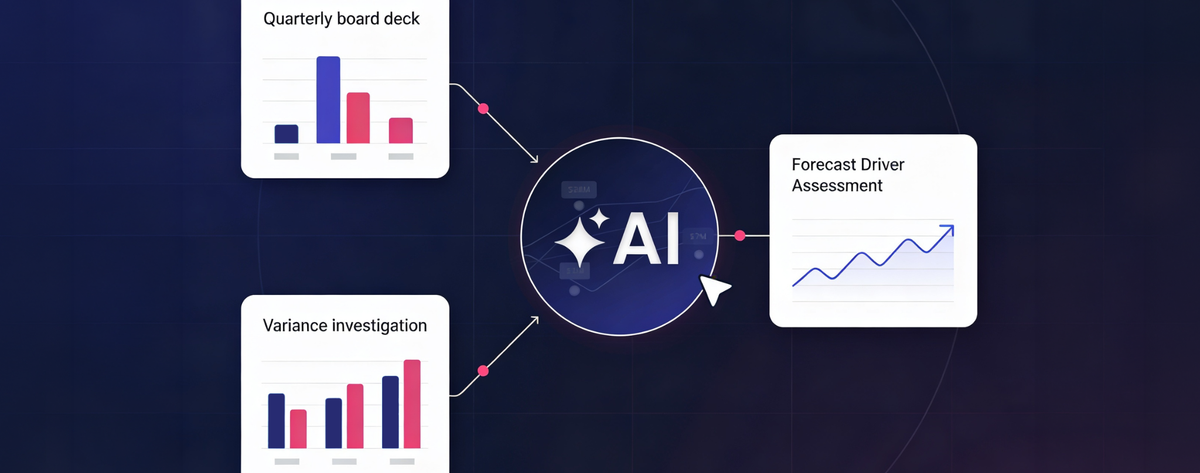
Yes, and it is one of the most reliable current applications. AI identifies variances against thresholds, traces them to the contributing accounts or departments, and drafts commentary in your reporting language. Quality turns on drilldown depth. An explanation that stops at account level tells you what moved. Only transaction-level detail tells you why.
Can AI read and query my vendor contracts?
Yes. Pulling renewal dates, notice periods, price escalators, and committed minimums out of PDF contracts sits well inside current capability, and the output holds up when spot-checked. The step that creates real value is joining that extracted data to actual ledger spend, which turns a contract repository into an answer about whether you are being billed correctly.
Which parts of FP&A still need a person in the loop?
Anything involving judgment, assumption-setting, or accountability. Choosing forecast drivers. Sanity-checking output against what you know about the business. Deciding what a variance means rather than what it is. Every number carrying a signature. AI is strong at preparation and pattern-finding, and it is not accountable, which is the reason review stays human. The pattern holds in the adoption data. Gartner’s 2025 survey of 183 CFOs puts the most common finance use cases at knowledge management 49%, AP automation 37%, and error and anomaly detection 34%, all preparation rather than judgment.
The question our customers’ auditors ask is never whether AI was involved. It is whether the number can be traced. That is why we treat preparation and judgment as separate problems: AI assembles, a person concludes, and every figure keeps its lineage back to the transaction that produced it.
What has to be in place before AI can work on my own financial data?
Four things: consolidated data across your systems, metric definitions the model can read, a persistent structure so outputs repeat month to month, and permissions and logging that apply to AI queries exactly as they apply to people. Without these, AI still produces answers — the same four preconditions covered in what has to be true before you can trust AI with financial data. Only 7% of finance organizations report high or very high impact from AI, and foundations are the usual explanation.
How does Datarails supply the four preconditions AI needs?
Datarails FinanceOS® supplies those four preconditions as infrastructure: 600+ connected sources, a semantic layer holding your metric definitions, drilldown from any figure to the source transaction, and role-based access that applies to AI queries. Your AI tool does the work; FinanceOS makes the work trustworthy.
What decides how far AI can go in finance?
What bounds the list above is data rather than model quality, which is why it reads shorter than the demo videos suggest. AI already handles reconciliation matching, variance tracing, contract extraction and pack assembly. It stops at the point where it needs consolidated data, a stored definition of your metrics, an output structure that survives to next month, and permissions it cannot talk its way around. Supply those four and the same tools go considerably further, with the judgment calls still sitting where your auditors expect to find them, whether those tools are embedded in your FP&A platform or brought in from outside.
A FinanceOS demo shows what that looks like running against real financials instead of sample data.