Click for Takeaways
- Finance Falls Short When It Stays in the Tower: The biggest gap in sales-finance alignment isn’t tools or data — it’s visibility. Finance that doesn’t understand the deal cycle, the buying environment, or how the sales process actually works will build forecasts that don’t reflect reality. Sales teams that don’t understand what finance needs will never close the right deals.
- Optimism Is a Feature, Not a Bug: Sales teams are supposed to be ambitious. Finance exists to bring structure to that ambition — not to kill it. The right model separates aspiration from commitment and uses scenario planning to let both coexist. Companies with strong cross-functional alignment and finance business partnering average 20% annual revenue growth — those without it tend to see revenue decline.
- 79% of Sales Organizations Miss Their Forecast by More Than 10%: Forecast accuracy isn’t just a finance problem — it affects hiring, resource allocation, and cash planning across the entire business. The commit-and-upside model, paired with tight deal qualification criteria and daily pipeline reviews near quarter end, closes the gap between pipeline optimism and operational reality.
- The Budget Is a Strategic Alignment Exercise, Not a Finance Deliverable: When every department understands the common objective — the foundation of sound FP&A best practices — downstream conversations about headcount, investment, and product strategy become dramatically easier. Finance’s job is to build that shared clarity, not just to hand down a number.
- Yes, And — Not No, But: The improv principle of building on an idea rather than shutting it down is one of the most practical frameworks for finance business partnering. When finance leads with curiosity — asking what would need to be true to make this work — partnerships strengthen, and ideas that initially don’t pencil out often find a path forward.
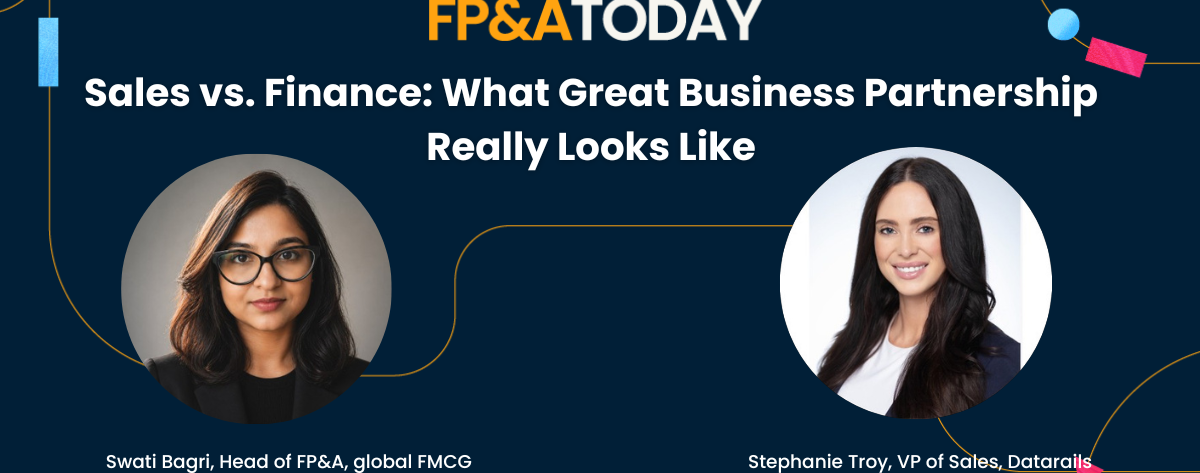
Based on a conversation between Stephanie Troy, VP of Sales at Datarails, and Swati Bagri, Head of FP&A for a global FMCG company
The finance business partnering label has become one of the most overused phrases in the profession — and understanding what is FP&A in its most strategic form is the first step to practicing it genuinely. Everyone claims it. Far fewer organizations actually practice it.
For this episode of FP&A Today, host Glenn Hopper brought together two people who experience the sales-finance relationship from opposite sides every day. Stephanie Troy is VP of Sales at Datarails, having worked her way up from senior account executive over four years. She talks to her CFO daily, sells to CFOs for a living, and knows exactly where the partnership breaks down. Swati Bagri is Head of FP&A for a major global FMCG company covering the Middle East and Africa — a region where hyperinflation, currency volatility, supply chain disruption, and geopolitical instability are not exceptional circumstances but operational constants.
What follows is a conversation about what the partnership actually looks like when it works, what goes wrong when it doesn’t, and what each side would tell the other if they had a chance to speak frankly.
What Sales Actually Needs from Finance
Stephanie opened the conversation with a list that any finance leader should write down: revenue visibility, deal economics, strategic guardrails, and a shared forecast model. These are not abstract concepts. They are the specific outputs that determine whether a sales team is operating with a clear picture of the business or flying blind.
“Revenue visibility means clear insight into the economics of the business — customer acquisition costs, payback, LTV by segment. Deal economics means understanding which deals drive long-term success versus short-term revenue. It’s super easy to bring in a quick sale, but if that quick sale isn’t what’s best for the company, then it’s obviously not something we want to be selling.”
The breakdown, in her experience, almost always comes back to isolation. Finance stays in its lane. Sales stays in its lane. Neither understands what the other is actually dealing with day to day.
“A lot of the time it’s lack of visibility — finance having a grasp on what a deal cycle looks like for that company, what the economic situation for buying is right now. And the inverse is true for sales too: lack of visibility into what finance wants.”
For Swati, the shift she has witnessed over her 14 years in finance is the entire premise of business partnering: moving from scorekeeper to co-pilot. Earlier in her career, a managing director told her plainly that finance either serves sales or it helps sales. She initially found it a strange thing to say to someone in a finance role.
“Over time I realized what he meant was that every function in the company ultimately exists to support growth. As a finance business partner, it means moving from being a gatekeeper to being a co-pilot — the shift that defines modern FP&A trends across every industry. It’s not just about reporting numbers — it’s about understanding how the business actually makes money, and then supporting the sales team to be able to make money.”
The Pipeline Problem: Optimism vs. Structure
Every conversation about sales-finance alignment eventually arrives at the same place: the forecast. Sales comes in with ambition. Finance needs a number operations can plan around. The tension is structural, and both guests have developed distinct frameworks for navigating it.
Swati’s view is that sales optimism is not the problem — it is the point.
“Sales teams are naturally optimistic because their job is to pursue opportunity and push growth. If everyone in the room is very conservative, companies would never take risks, we wouldn’t grow, we wouldn’t innovate. Finance comes in to bring structure to that optimism — not stop it.”
Her tool of choice is scenario planning — one of the most powerful financial forecasting methods available to FP&A teams navigating commercial uncertainty. Rather than debating whether a forecast is too optimistic, her team builds multiple scenarios so the business can pursue its ambition while supply chain, operations, and production have a base case they can actually rely on.
“Ambition will build the pipeline, but assumptions will build the forecast. So instead of arguing whether the forecast is optimistic, we build multiple scenarios. That’s the way the business can responsibly drive innovation and growth without losing the ambition.”
Stephanie’s approach on the SaaS side starts from a fundamentally different cycle rhythm — deals that can appear and close within 20 to 60 days, with a meaningful portion of any given quarter’s revenue not even existing in the pipeline at the start of the month. Her response is to focus on pipeline quality rather than pipeline size, and to separate commits — deals she would stake her credibility on — from upside.
“I focus on deal quality rather than pipeline size. Commit means it’s coming in. My team can count on me for that, my leadership team, my CFO. And then we factor in a percent of that upside — out of the deals that have a shot, historically, what percent closes? I’d rather under-promise and over-deliver than count everything.”
The daily cadence near quarter end matters as much as the model. In the final two to three weeks of a quarter, she collects daily commitment-and-upside updates from her directors, who are collecting from their AEs. The point is not bureaucracy; it is that momentum shifts quickly enough that weekly visibility is too slow.
Research on sales forecasting accuracy puts a number on the scale of this problem: 79% of sales organizations miss their forecast by more than 10%, and the downstream effects ripple into hiring decisions, cash flow forecasting, and resource allocation across the business. The forecasting discipline both guests describe — structured scenarios, strict commit criteria, historical base rates, and frequent recalibration — is what separates organizations that can plan confidently from those perpetually reconciling actuals to expectations.
Communicating Risk Without Blocking Growth
Swati’s region — Middle East and Africa — makes the risk communication challenge more acute than most. Currency moves, supply chain disruptions, hyperinflationary markets like Egypt, and geopolitical uncertainty are not theoretical risks to model but active variables in every forecast cycle.
The trap finance falls into, she explained, is framing risk as a reason not to proceed. The more useful approach is to translate risk into something the sales team can act on.
“Instead of ‘this is risky, so we shouldn’t do it,’ I would say: if currency moves by 10%, this is what happens to the margin. We have guardrails that say our margin needs to be X percent. What are the things you can do — plan A, plan B, plan C — to ensure we stay on margin through sound spend control and pricing discipline? Could we adjust pricing? Could we think of an alternative source? Could we rethink the launch timeline?”
The framing shifts from gatekeeping to problem-solving in partnership. Finance is not closing the road — it is helping the sales team see the corners.
On the SaaS side, Stephanie faces a version of this when deals require exceptions: below-threshold pricing, aggressive discounts, large logos that might lose money in the short term. Her approach is to bring the data and the risk assessment to the CFO rather than either avoiding the conversation or presenting it as a fait accompli.
“For deals that are a little unhealthy, I meet with my CFO and discuss: is this worth the risk? Maybe it’s a big logo, maybe we’ll lose money on it, but is that going to help us grow long-term? Finance comes in on the margin impact, what my discount thresholds can be. We do quarterly list pricing and I give my director team what they can approve discount-wise.”
The discount threshold framework is an example of spend control enabling speed rather than slowing it down — a guardrail set in advance so that individual deals don’t require individual escalations.
Healthy Deals vs. Just Closing
One of the most useful concepts in the conversation is Stephanie’s framework for what makes a deal healthy: right customer profile, clear business value, sustainable pricing, expansion potential, and low risk relative to return. It sounds like a checklist, but in practice it is the filter that separates revenue that compounds from revenue that creates problems downstream.
The deeper point is that this conversation has to happen at the top.
“This is what the VP of sales should really be doing — doing what’s best for the company while bringing in as much revenue as possible. When you’re starting out as an AE, you don’t care what you’re selling, you want to get deals on the board. But as you go up the ladder, healthy deals become one of my main conversations with my CFO. I don’t always know what’s best for the company in that sense. I know what a good client looks like. But the economics and the stickiness of that client — that’s really where I need the CFO’s advice.”
The relationship she describes with her CFO is daily: not just deal escalations or commission approvals, but an ongoing conversation about the quality of what is being built. That level of integration is, by any measure, unusual. Research shows that highly aligned companies are 72% more profitable than their misaligned counterparts — and the sales-finance relationship is one of the highest-leverage places to close that gap.
The Budget as Strategic Alignment, Not Finance Deliverable
The conversation around annual planning and FP&A best practices produced one of its sharpest observations. Swati put it plainly:
“Budgets are traditionally considered to be a finance activity, but they’re not really a finance exercise. A budget is more of a strategic alignment exercise. If we treat it like that, it becomes really easy and everybody plays a part to achieve that budget.”
Stephanie described what this looks like in practice at Datarails: a leadership offsite at director level and above in November, where the C-suite presented the company’s 2026 goals and each VP came back with their department’s plan for getting there. Finance presented their plan to sales. Sales presented their plan to finance. The comparison revealed both alignment and gaps.
“Finance presented their plan to me and said, ‘This is how we thought you’d get to your goal.’ And then I presented how I planned to get there. It helps us show alignment and also understand how each other thinks. Finance brains and sales brains are very different — but it’s really interesting to see where numbers meet creativity and come together.”
Swati took the idea further: she presented the budget to functions like R&D and HR that often have no visibility into the company’s plan for the year. The payoff is that downstream conversations — about new product development, headcount, cost pressure — are easier when everyone understands the common objective. The data bears this out: companies with strong cross-functional alignment average 20% annual revenue growth, compared to revenue declines at organizations where teams operate in silos.
“A lot of discussions that we wanted to have later in the year become really easy when everybody understands the common purpose we are trying to achieve. If we want to have a new go-to-market strategy and we’ll need more people, HR shouldn’t say we can’t hire because of budget constraints — they should already understand what we’re trying to do.”
Improv, EQ, and the “Yes, And” Mindset
One of the more unexpected turns in the conversation was Swati’s account of taking improv classes and what it has changed about how she shows up as a finance partner.
The core improv principle — yes, and — is a direct antidote to the default finance posture of pointing out what is wrong with an idea, and one of the most underrated FP&A trends reshaping how finance teams build influence.
“I realized working so many years in finance, we default to pointing out what’s wrong with an idea, and it creates natural friction when you shut it down. But when you start the conversation with curiosity — yes, and how can we make this work — the whole dynamic changes. You feel like you’re on the same team.”
The practical upshot goes beyond communication style. Improv trains comfort with uncertainty, thinking on your feet, and making decisions without a complete script. These are exactly the conditions under which finance business partners operate: incomplete information, moving targets, and commercial decisions that cannot wait for perfect data.
“Analysis alone isn’t enough. Finance professionals also need to be good communicators. If I cannot explain insights in a way that resonates with the sales team, the numbers are really not going to influence any decision.”
Stephanie’s equivalent is what she calls sales EQ — understanding what will speak to the person across the table before you walk into the room.
“When I’m talking to finance, it’s really about presenting risk. What is the risk in this? Why do we want this? What are the numbers, what is the margin? And then letting them make their decision and respecting it. If I don’t agree, pushing back respectfully. One thing I always do is give them the respect and the opportunity to make their decision and talk it through with me.”
The symmetry is notable: Swati learning to sell ideas the way sales would, Stephanie learning to present risk the way finance would. Each is adapting to the other’s decision-making language, which is the practical definition of partnership.
What Each Side Would Tell the Other
At the close of the conversation, both guests offered direct advice across the table.
Swati’s message to sales:
“Bring finance into the conversation early. Sometimes finance gets involved once the decisions are made and the strategy is defined. At that stage, our role gets limited to reviewing numbers or challenging assumptions — it doesn’t help either party, it creates friction. When finance is involved earlier, we can often help strengthen the idea through pricing, cost structure, scenario planning. The best partnerships happen when sales and finance are aligned around the same goals — not just to close, but to build profitable, sustainable growth.”
Stephanie’s message to finance:
“Take a genuine curiosity in the sales team’s sales process. Listen to calls. Send your finance team a call where there was a ton of friction but you still won the deal — or maybe you lost it. Give them examples of what hard and true deal cycles look like. When finance can actually have visibility into the sales process, they’ll understand. They can start suggesting more meaningful things to change in the budget rather than just making assumptions based on numbers that don’t reflect what’s going on in the market.”
Both pieces of advice converge on the same point: get into each other’s world before you need to make a decision together.
Where Datarails Fits In
The conversation Stephanie and Swati describe — daily dialogue between sales and finance, shared forecasting models, scenario planning that runs on real commercial assumptions — requires a foundation of reliable, consolidated financial data. Without it, the conversations become debates about which number is right rather than decisions about what to do.
Datarails is the AI-powered FP&A platform built for Excel users. It consolidates financial data from ERPs, accounting systems, and spreadsheets into a single governed source of truth, without requiring finance teams to abandon the workflows they already know. From that foundation, it enables real-time variance analysis, dynamic financial forecasting and scenario planning, and narrative generation — the forward-looking, decision-support work that defines effective FP&A.
When finance spends less time chasing data, it spends more time doing what Swati and Stephanie describe: sitting inside the business, understanding the deals, and bringing the kind of grounded finance business partnering perspective that makes the partnership real.
To learn more about how Datarails supports FP&A teams at every stage, visit datarails.com.
About the Guests
Stephanie Troy
VP of Sales at Datarails, where she joined four years ago as a senior account executive and progressed through team lead, sales manager, and director roles before stepping into the VP position in 2026. She sells exclusively to CFOs and finance leaders, giving her an unusual vantage point on the sales-finance relationship: she lives it internally every day and hears the CFO’s perspective from the market constantly. She is known for her commit-and-upside forecasting discipline and her emphasis on deal health over pipeline size.
Connect with Stephanie on LinkedIn.
Swati Bagri
Head of FP&A for a major global FMCG company, covering the Middle East and Africa region. A chartered accountant with 14 years of experience across some of the largest names in consumer goods, Swati has built her practice in environments where geopolitical instability, hyperinflation, and supply chain disruption are routine operating conditions. She is a returning guest on FP&A Today and has previously spoken on zero-based budgeting and commercial finance strategy. She recently completed a beginner’s course in improv and is applying the “yes, and” principle directly to how she partners with commercial teams.
Connect with Swati on LinkedIn.
FAQs
Revenue visibility (CAC, payback, LTV by segment), deal economics (which deals drive long-term vs. short-term value), strategic guardrails around discount thresholds and deal health, and a shared forecast model that reflects what is actually happening in the market.
By treating optimism as information rather than a problem to correct. The goal is to separate ambition from commitment — using financial forecasting methods and scenario planning to let the business pursue its growth aspirations while giving operations, supply chain, and finance a base case they can plan around.
Right customer profile, clear business value, sustainable pricing, expansion potential, and a favorable risk-return ratio. Unhealthy deals — aggressive discounts, high-risk logos — are not necessarily off the table, but they require explicit CFO sign-off with a shared understanding of the trade-off.
As early as possible. Finance brought in after the strategy is defined can only review numbers or challenge assumptions. Finance brought in during the idea phase can help shape the commercial structure, pricing, and go-to-market approach in ways that improve the probability of success.