Click for Takeaways
- Revenue Without Cash Is a Warning Sign: When a fast-growing law firm tripled in size, the first thing that broke was the link between revenue and cash — one of the most common working capital management failures during rapid growth. Roughly seven in ten companies experience DSO extending beyond 46 days, with cash flow disruption identified as the primary consequence — a risk that compounds sharply during rapid growth.
- Collections Is a Commercial Problem, Not a Finance Problem: Getting cash in requires partner involvement in client negotiations, not just finance chasing invoices. When clients understand the numbers, collection becomes a conversation rather than a confrontation.
- Attendance Is the Heartbeat, But Guest Spend Is the Pulse: In attractions, attendance drives everything — but short-term decisions that cut costs at the expense of guest experience erode the repeat visitation that sustains the business in the long term. The global attractions industry, projected to double in value by 2034, is built on that repeat relationship.
- Forecast as a Decision Document: Whether at a law firm or a theme park, the forecast built on sound financial forecasting methods is not a historical record or a compliance document. It is a living tool for trade-off analysis, updated as conditions change — daily, in the case of attendance-driven seasonal businesses.
- Finance Business Partnering Runs on Trust: Consistency, curiosity, and transparency — not reports — are what earn finance a seat at the decision-making table early. Research consistently shows that fewer than a quarter of CFOs have the timely data access they need for true finance business partnering; closing that gap starts with the relationship, not the dashboard.
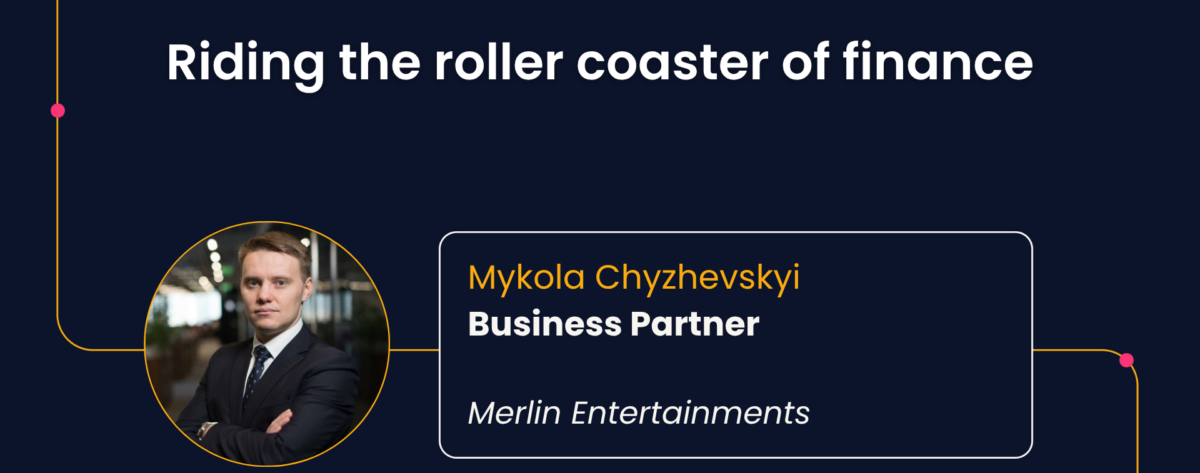
Based on an interview with Mykola Chyzhevskyi, Finance Business Partner at Merlin Entertainments.
Mykola Chyzhevskyi has managed cash during a war. He has built an AR discipline inside a law firm that tripled in size in a few years. And he now forecasts daily attendance at one of the world’s largest global attractions businesses — a company whose parks welcome more than 62 million guests a year across more than 20 countries.
As Finance Business Partner at Merlin Entertainments — the group behind LEGOLAND Resorts, Thorpe Park, and Alton Towers — Mykola works at the intersection of operational complexity and financial discipline. In a conversation with FP&A Today host Glenn Hopper, he traced the through-line of a career that moved deliberately from technical accounting to strategic decision support, and unpacked what that shift actually requires — in a fast-growing law firm, in a war zone, and on the floor of a seasonal entertainment business.
From Technical Finance to Decision-Focused Finance
Mykola’s career path is one that finance leaders increasingly recognize as the right sequence, even if it isn’t always the instinctive one. He started in treasury, IFRS reporting, and audit environments — the part of finance that is fundamentally about accuracy, structure, and control.
“It’s about moving from technical finance to decision-focused finance. Initially, I started my career in finance, treasury, IFRS, and audit environment, and that gave me more technical knowledge about cash flow, balance sheet, P&L, how it’s structured and how control is built.”
The move to a fast-growing law firm was deliberate. Not just a career step, but a conscious decision to take on the weight of strategy.
“In the law firm, I could make an impact on strategy and on destination — where we go and what we want to develop. When you move from technical finance to a more strategic level, you find different areas: pricing, clients, diversification of clients, how we get our sales, cost control — all this stuff.”
The willingness to carry that weight — and the credibility earned by doing the technical work first — is what separates a scorekeeper from a business partner.
What Breaks First When a Law Firm Triples in Size
The firm Mykola joined wasn’t a stable, mature legal practice. It was growing fast — tripling in size over a few years, through a combination of organic growth and acquisition. That growth rate exposed structural gaps in the finance function almost immediately.
“The main is about visibility because the company wasn’t structured and built in finance to support this growth. We got revenue, but cash didn’t come and didn’t convert — it wasn’t following. The forecast and analysis was more backward-looking instead of shaping decisions.”
The priority was the basics: receivables control, bad debt management, and clear ownership of numbers. Not the strategic work — the foundation that makes strategic work possible.
The challenge he was managing is well-documented. Around 70% of companies report days sales outstanding extending beyond 46 days — a working capital management failure that causes severe cash flow disruption as the primary consequence. In a professional services environment with variable billing cycles and partner-driven client relationships, the risk is structural — and it compounds fast when the firm is scaling.
Mykola’s fix was two-part. First, he rebuilt the invoicing process around sound FP&A best practices: proper milestones, clear responsibilities across the legal and finance teams, a defined billing cadence.
“Without that, it’s impossible to build correctly and to deal on time with billing.”
Second, and less obviously, he pulled the partners in.
“Finance collection is not about a financial issue. It’s about enrollment of partners in negotiation with clients, because when clients have a clear picture, and they understand numbers, finance just supports mainly in the process of collection of receivables.”
This reframe — from finance chasing invoices to partners owning the commercial relationship — is one of the most overlooked FP&A best practices in professional services cash flow management.
Forecasting Revenue You Can’t Predict
Law firm revenue is notoriously hard to forecast. Cases change in scope and timeline. Partners bring different portfolio mixes. Only a small portion of revenue comes from predictable, contracted sources like service level agreements. The temptation is to build a sophisticated model that creates the illusion of precision.
Mykola went the other direction.
“We accepted this issue, and we didn’t want to build something artificial. Instead, we made it simple but with certainty. We took the current year forecast, added 10% for inflation and expected growth, landed that with each partner for their review, and aligned with them on their portfolio and realistic estimation of risks.”
The power of the approach was in the alignment it created. When partners validated the numbers and accepted the revenue targets, they owned them — and ownership produced commitment in a way that top-down targets rarely do.
“When they accept it, it really gives them the view and willingness to achieve that budget.”
And the forecast, built on realistic financial forecasting methods, was never intended to be a fixed document.
“It was more a decision document that helped us, in progress, to adapt and to make correct decisions — to understand our trade-off risks and where we were moving.”
Managing Finance Through a War
In early 2022, Mykola was Finance Director at the firm — and based in Kyiv. As the buildup to the Russian invasion became visible in the macro data, the finance function began preparing.
“Before the war started, we identified macro risks that could impact our continuity: mainly liquidity, treasury risk, and operational risk.”
The actions that followed were measured, methodical, and taken before the crisis arrived:
- Cash reporting was moved from weekly to daily — effectively implementing a 13-week cash flow discipline at an accelerated pace
- Collections policy was reviewed and accelerated for domestic clients
- Free cash was moved to international banking structures with on-demand access
- International clients were given negotiated payment flexibility to preserve long-term relationships
- Salaries were switched to weekly payment to give employees financial stability in a turbulent period
“The task wasn’t to get cash quickly — the task was to build the possibility to be stable and to work for a long time.”
The people dimension of the response — paying salaries weekly, ensuring employees felt supported — was not a finance decision in the traditional sense. But it was the right one.
“The experience really reinforced for me about situation adaptability: how it is to do everything in advance early, to stay calm under pressure, and that people really matter.”
The Business of Merlin Entertainment
Merlin Entertainments is one of the world’s largest visitor attraction operators. Its portfolio spans LEGOLAND Resorts, Thorpe Park, Alton Towers, Madame Tussauds, and a wide range of other themed experiences across more than 20 countries. The global attractions industry — valued at $69.2 billion in 2023 and projected to reach $138.7 billion by 2034 — is built on the logic of repeat visitation, and Merlin is one of its largest players.
As Finance Business Partner, Mykola’s day-to-day work is built around supporting the leadership team across budgeting, forecasting, and cost management — and working closely with procurement on cost validation and savings sustainability.
“A big part of my role is about working with the procurement team — cost optimization, savings validation, building it for a growing future. We can understand that it is not a short-term decision, but it gives us the possibility for stable growth and sustainability.”
The Metrics That Matter
In the attractions business, performance is driven by three interconnected levers: demand, guest experience, and operational excellence.
“Attendance is clearly the main one, but it is not the only one. Guest spend, promotions — those are the revenue part. Staffing level, operational cost — that’s the other part. And we always have to balance between decisions we can actually impact quickly and keeping in mind that short-term decisions shouldn’t damage guest experience — because guest experience is the driver that gives us repetitive visitation.”
The tension Mykola describes is one that every CFO in a consumer-facing business recognizes: the short-term pressure to cut costs, and the long-term reality that guest experience is what drives the repeat revenue that makes the model work.
Forecasting Daily at a Seasonal Business
Forecasting at Merlin operates at a level of granularity that would feel foreign to most FP&A teams. The business is seasonal — holiday patterns, school terms, bank holidays, and weekday versus weekend demand all shape the expected curve. The base model is built on those patterns. But the real work happens in-season.
“Our forecast is attendance-driven, using financial forecasting methods built around daily visitation and revenue rather than monthly or quarterly cycles. It depends on holidays, school holidays, and bank holidays. The weather is difficult to predict, but based on yearly patterns, we build our budget. Within the active season, it moves closer to the current trend.”
The philosophy is the same one Mykola applied at the law firm: the forecast is a decision tool, not a compliance document.
“It is used more as a decision support document that helps to action and to get something, instead of looking backwards and explaining deviations.”
The Business Partnering Formula
Throughout the conversation, Mykola returns consistently to a small set of principles that he says define what makes finance business partnering actually work — in a law firm, in a crisis, and at a global attractions group.
“It comes from consistency and curiosity — understanding the business, listening before challenging, and being transparent when you have trade-offs with the business. That’s when businesses can trust finance and involve them early. And this is when the actual value is built.”
This is worth holding up against the data. Only 21% of CFOs report having timely access to the quality financial and non-financial data they need for genuine finance business partnering and strategic decision-making.The gap isn’t only a systems problem — it’s a trust and relationship problem. Finance teams that haven’t built credibility with the business to be involved early won’t get the data that makes strategic analysis possible.
The formula Mykola offers — consistency, curiosity, transparency — is the prerequisite to solving that data access problem from the ground up.
Where Datarails Fits In
The challenges Mykola describes throughout this conversation are the daily reality of FP&A teams everywhere: revenue that doesn’t convert to cash fast enough, forecasts that become stale the moment they’re published, seasonal businesses that need daily granularity, and a business partnering mandate that requires finance to be a strategic voice rather than a reporting function.
Datarails is the AI-powered FP&A platform built for Excel users. It consolidates financial data from ERPs, accounting systems, and spreadsheets into a single source of truth — without requiring finance teams to abandon the tools they already know. From that foundation, it enables real-time variance analysis, dynamic forecasting, and narrative generation: the forward-looking, decision-support work that defines effective business partnering.
For a finance team managing an attendance-driven seasonal business, Datarails brings the kind of cash flow management software capability that makes it possible to update forecasts as trends shift rather than waiting for the month-end cycle. For a team managing through rapid growth, it tightens the connection between revenue and cash flow management visibility. For a business partner trying to earn a seat at the strategic table, it removes the manual work that keeps finance in the weeds and makes time for the conversations that build trust.
The goal Mykola describes — finance that shapes decisions rather than just explains them — is what Datarails is built to enable.
To learn more about how Datarails supports FP&A teams at every stage, visit datarails.com.
About Mykola Chyzhevskyi
Mykola Chyzhevskyi is Finance Business Partner at Merlin Entertainments, supporting budgeting, forecasting, and cost management across a global attractions portfolio including LEGOLAND, Thorpe Park, Alton Towers, and Madame Tussauds. He was previously Finance Director at a fast-growing law firm in Ukraine, leading the finance function through rapid tripling in size and the onset of the Russian invasion. His earlier career spanned consolidation, treasury, IFRS reporting, and ERP implementations across multi-entity environments. Outside of work, he practices martial arts.
FAQs
Finance business partnering means working alongside operational and commercial leaders on decision-making, forecasting, and strategy — understanding what is FP&A in its most strategic form — rather than reporting and compliance. Technical credibility is the entry ticket; the ability to speak the business’s language is the job.
Cash conversion, forecasting discipline, and ownership of numbers. Fix the basics first: AR process, invoicing milestones, clear accountability. Strategic work follows from that foundation.
At the law firm: cash, aged debt, utilisation and recovery. At Merlin: attendance, guest spend, and staffing cost, balanced against long-term guest experience.
Keep it simple but certain — the core of sound financial forecasting methods. Combine a top-down growth assumption with bottom-up partner validation. Treat the output as a living decision document, not a fixed target.