
Click for Quick Takeaways
- 58% of treasurers identified visibility into global operations and cash as a critical challenge.
- When finance teams operate on 2-3 day old data, they’re forced into reactive mode, scrambling to address liquidity gaps after they’ve materialized.
- 38-52% of organizations still manually collect and consolidate forecasting data, making real-time liquidity scenario modeling virtually impossible.
- 72% of companies missed their cash flow targets by more than 10%. Companies were 30% more likely to underperform cash flow forecasts than revenue guidance.
- Treasury departments at the highest maturity level employ automation for over half of their liquidity forecasting processes, powering faster, more accurate cash visibility.
On Monday morning, your cash forecast shows a comfortable runway for the quarter. But by Thursday afternoon, you’re staring at a significant liquidity gap. It’s not because anything fundamental changed. It’s because you just found out about developments from a few days ago:
- A major customer pushed their payment date (they notified AR on Tuesday)
- Three invoices got held up in AP approval (sitting in someone’s inbox since Monday)
- A large check cleared earlier than forecasted (went out Wednesday morning)
- FX movement shifted the value of international receivables (happened overnight)
None of these are surprises to your systems; they’re only surprises to you. The cash movement happened in real-time. Your visibility lagged by 72 hours.
This is the cash visibility problem: by the time finance sees the full picture, it’s too late to prevent a shortfall.
Most finance teams manage cash on a 2–3 day lag, working off yesterday’s data instead of today’s reality. CFOs find themselves asking, “When did that payment clear? Why are we just now seeing this delay? How much cash is actually available right now?”
They end up scrambling to cover cash deficits instead of confident, proactive planning.
Cash visibility remains treasury’s most critical challenge. Deloitte’s 2024 Global Corporate Treasury Survey found that 58% of treasurers identified visibility into global operations and cash as one of their most critical challenges, despite widespread technology adoption. This visibility gap creates the “blind spot” problem where finance teams discover cash movements days after they occur rather than managing them in real time.
The solution is to shift from after-the-fact monitoring to real-time control with modern cash flow management software that centralizes all your cash inflows and outflows into one live system.
The 72-hour visibility lag isn’t just inconvenient; it’s strategically limiting. When finance teams operate on 2-3 day old data, they’re forced into reactive mode, scrambling to address liquidity gaps after they’ve already materialized. Modern cash flow management software eliminates this lag by providing continuous, real-time updates across all cash sources.
Rather than juggling spreadsheets and waiting on reconciliations, finance leaders get an up-to-the-minute view of liquidity.
They can spot changes as they happen, model “what-if” scenarios on the go, and make decisions before a cash crunch hits.
Below, you’ll discover the core functions, pros, and cons of 12 top cash flow management tools, as well as must-have features when you’re choosing a system and other factors to consider.
Core Capabilities of Cash Flow Management Software
What separates the best modern cash flow management software from the rest? Most finance teams would say it’s defined by the value a solution brings to an organization and how intuitive and effortless it is to use.
Cash flow management software needs to serve as a dynamic command center for liquidity rather than a static forecasting tool.
To do so, it must include a number of core capabilities:
1. Centralized Cash Data Ingestion
Connecting all your financial accounts and systems (banks, ERP, AR/AP, payroll) into one platform automatically consolidates your data, giving you a holistic, up-to-the-minute picture of cash movements.
2. Real-Time Cash Positioning
Real-time dashboards show current balances, recent transactions, and intraday cash flows.
This continuous visibility means no waiting for end-of-day or weekly reports to know where you stand.
3. Short-Term and Rolling Cash Forecasts
Generating 13-week cash forecasts and rolling projections that update as new actuals come in streamlines short-term liquidity planning since forecasts automatically refresh with the latest data.
You can extend forecasts forward, based on the latest numbers, instead of guessing what might happen later.
4. Scenario Modeling and Stress Testing
“What if?” questions often need immediate answers. State-of-the-art cash flow software lets you model scenarios like a revenue dip, a big late payment, or a change in payables schedule.
It also allows you to stress-test your cash reserves under different conditions (e.g., “What if these three large receivables slip by two weeks?”) and prepare contingency plans. The ability to run scenarios on demand is a fundamental part of proactive cash management.
5. Variance Detection and Alerts
Cash management software flags when reality starts diverging from your forecast. For example, if an expected payment hasn’t arrived or an actual expense hits earlier than projected, you get an alert enabling you to react immediately, rather than finding out days later during reconciliation.
6. Integration with FP&A Workflows
Effective cash management tools don’t operate in isolation. Instead, they must integrate with your broader financial planning process.
So look for solutions that embed cash insights into your FP&A dashboards and reports.
When you adjust your budgeting and forecasting models or update your financial plans, the cash flow impact is automatically reflected. Tying cash forecasts into overall FP&A ensures liquidity is considered in every planning decision.
Learn about AI in FP&A and how modern FP&A software integrates cash flow forecasting.
Key Use Cases for Cash Flow Management Software
Now let’s consider some of the specific use cases for modern cash flow management software.
Short-Term Liquidity Management
One of the primary uses of cash flow management tools is maintaining short-term liquidity. This usually means managing not only daily cash needs but also the classic 13-week cash forecast.
Businesses use these tools to monitor daily cash positions and see exactly how much cash is available each day across accounts.
The software tells them whether they’ll have enough to cover obligations in the coming weeks, giving them opportunities to take action.
Working Capital Optimization
Cash flow software also plays a key role in optimizing working capital management.
These tools unify accounts receivable and accounts payable data, providing insight into the timing of inflows and outflows.
This identifies opportunities to speed up collections or strategically slow down certain payments to improve cash on hand.
For example, you might spot a batch of customer invoices coming due and decide to send gentle reminders or offer a small discount for early payment, pulling that cash in sooner.
On the flip side, you could see that delaying a vendor payment by a few days (within agreed terms) would keep cash in the bank longer.
Modern tools integrate directly with procurement and spend control systems, so you can model how adjusting inventory purchases or expenses would impact cash.
The result is data-driven working capital management: you’re optimizing receivables, payables, and inventory levels using real-time information rather than guesswork.
Forecasting and Scenario Planning
Another essential use case is running scenarios to support strategic decision-making. Since cash flow management solutions continuously update forecasts, finance teams can easily model different hypotheticals.
Most organizations cannot confidently model liquidity scenarios, limiting strategic agility. PwC’s 2025 Global Treasury Survey found that between 38% and 52% of organizations still manually collect and consolidate forecasting data, making real-time liquidity scenario modeling virtually impossible. When treasury teams operate on manual processes, they’re forced into reactive mode, unable to quickly assess the impact of delayed receivables, FX swings, or sudden payment timing shifts.
What if sales drop 10% next quarter? What if that big project is delayed and the related cash inflows shift out by a month? It’s a lot easier to answer questions like these accurately with the right cash flow management software.
You can adjust drivers or timings in your cash flow model and immediately see the impact on future cash balances.
And because these forecasts draw from integrated data such as sales pipelines and billing schedules, the outputs are much more reliable than manually piecing together a projection from disparate spreadsheets.
Unreliable cash forecasts carry substantial financial costs. An EY-Parthenon analysis of 2,400 of the largest global companies found that only 28% of companies’ cash forecasts were within 10% of their annual free cash flow targets, meaning 72% missed by more than 10%. Companies were 30% more likely to underperform their cash flow forecast targets (47%) than revenue guidance targets (36%). Inaccurate cash flow forecasts cause unexpected cash shortages, leading to missed payments or higher-cost sources of emergency borrowing, making accuracy not just an operational issue, but a significant financial risk.
Executive and Board Reporting
Cash flow management software shines during executive and board reporting by turning raw data into easily digestible reports and dashboards.
Instead of frantically toggling through spreadsheet tabs, you get a clear narrative. For instance, a chart showing projected cash runway under base-case and worst-case scenarios, or a waterfall graph explaining the change in cash this quarter.
Having a single source of truth for cash also means you can answer on-the-spot questions in meetings without having to say that you’ll report back later.
How AI Is Transforming Cash Flow Management
Automation maturity directly correlates with forecasting effectiveness. The 2025 AFP Treasury Benchmarking Survey (conducted by AFP and sponsored by Wells Fargo in late 2024) reveals that treasury departments at the highest maturity level, characterized as “strategic/optimized,” employ automation for over half of their liquidity forecasting processes, significantly outpacing less mature departments. This automation gap translates directly into faster, more accurate cash visibility.
AI and machine learning capabilities enhance traditional cash flow tools in a number of ways.
Predictive Inflows and Outflows
AI models can analyze historical patterns (like customer payment behaviors or seasonal expense trends) to predict future cash movements with greater accuracy.
Instead of relying purely on manual forecasts, finance teams get AI-generated projections that adjust as new data comes in. Your forecasting software learns from trends and improves over time, so you can anticipate cash needs earlier.
Automated Variance Explanations
Cash flow will almost certainly deviate from your forecast to some degree, and AI can pinpoint the likely causes.
If a forecast was off because a particular client unexpectedly paid late or because FX rates showed high volatility due to a geopolitical black swan, an AI-driven system can instantly flag, and even weigh, those causes.
Intelligent Alerts
Advanced cash flow analysis software is beginning to use AI for smarter alerts. Rather than simple threshold-based notifications, AI can identify unusual patterns or emerging risks.
It might alert you, for instance, if your projected month-end cash is trending below a safe threshold, jeopardizing your close target.
Top Cash Flow Management Solutions
Now let’s move on to assessing 12 leading cash flow management solutions you may be considering for your organization.
1. Datarails
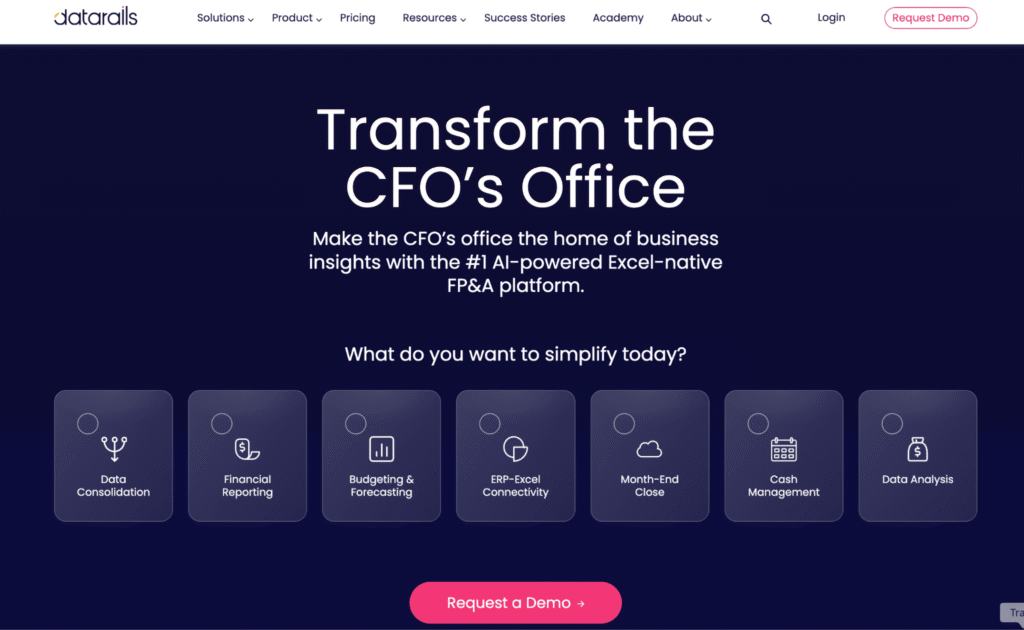
Best for: FP&A integration and real-time visibility
Datarails is an AI-centric finance platform that automates cash flow management, among other capabilities. The Excel-native offering connects to your ERP, bank accounts, HRIS system, and Excel models to provide granular liquidity insights.
Pros:
- Integrates directly with Excel for easy adoption
- Live cash visibility across accounts and currencies
- Scenario modeling and forecasting built into FP&A workflows
Cons:
- Best suited for finance teams already relying on Excel
- Full feature set requires proper initial configuration
2. Agicap
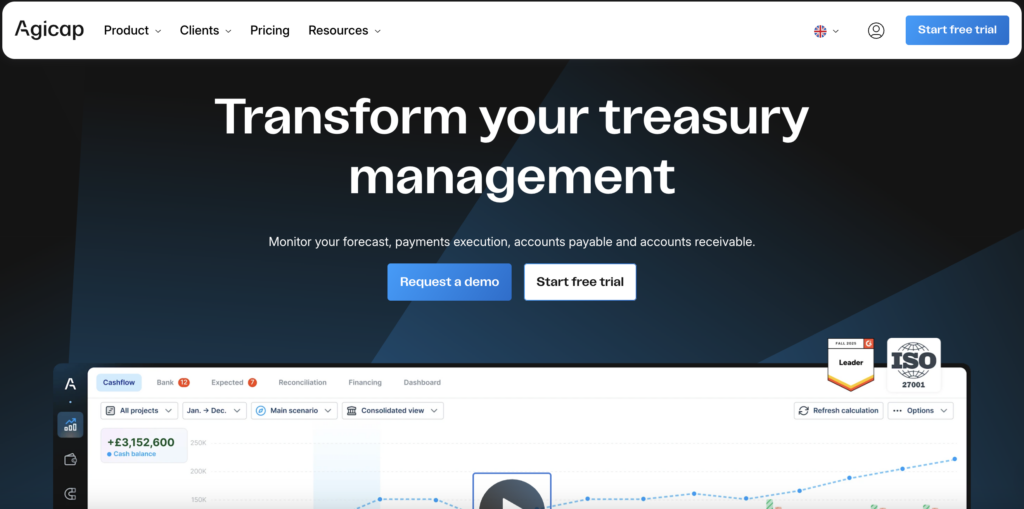
Best for: SMBs needing simple cash management
Agicap offers a user-friendly interface that works well for small and mid-sized businesses. It supports multi-currency cash management for companies with international operations.
Pros:
- Easy to set up and use
- Clear, visual dashboard with real-time cash tracking
- Supports multiple currencies
Cons:
- Limited functionality for larger companies
- May require manual adjustments for custom forecasting
3. HighRadius
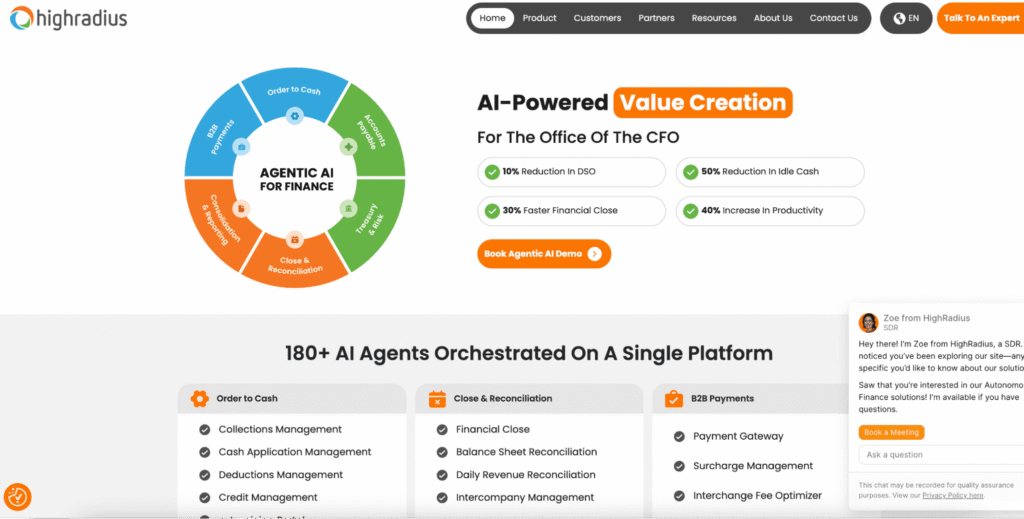
Best for: Large enterprises with complex cash operations
With over 180 AI agents in one platform, HighRadius offers powerful AI-driven treasury automation tools. Its features are focused on automating forecasting, real-time positioning, and ERP integration.
Pros:
- Strong ERP and bank integrations
- AI-powered forecasting and automation
- Built for enterprise-level complexity
Cons:
- Long implementation timeline
- May be too complex for smaller teams
4. Cube
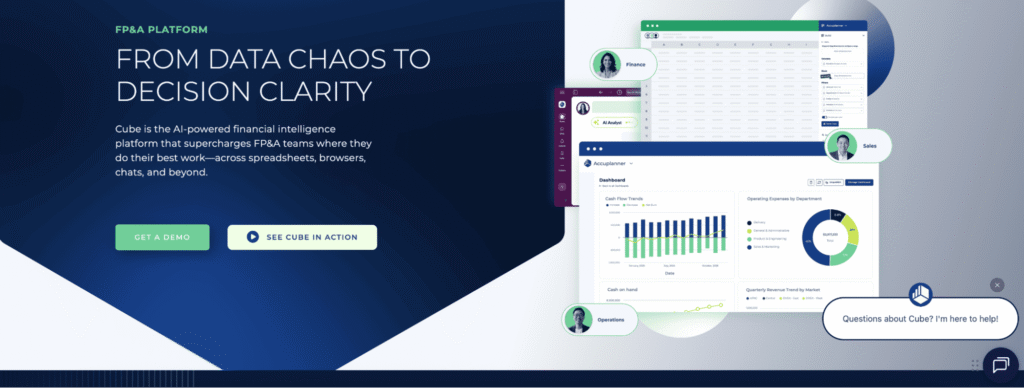
Best for: Flexibility for both Google Sheets and Excel
Cube brings real-time automation to Excel and Google Sheets by syncing financial data from accounting systems for live forecasting and analysis. Its “FP&AI” suite is claimed to offer exceptionally accurate data insights.
Pros:
- Works inside Excel and Google Sheets
- Real-time data updates
- Good for mid-market teams
Cons:
- Limited functionality beyond planning and forecasting
- Less visual reporting than other platforms
5. Vena Solutions

Best for: Excel-based forecasting with control
Vena adds a centralized database and workflow engine behind Excel models to enhance budgeting, forecasting, and cash flow analysis. Some companies have reported 66% faster planning cycles with its help.
Pros:
- Excel front-end with centralized version control
- Built-in workflow and approvals
- Flexible cash forecasting templates
Cons:
- Learning curve for advanced features
- Requires discipline in model structure
6. Anaplan
Best for: Connected planning in enterprises
Anaplan is an enterprise planning platform that links financial, sales, and operational models, including cash flow, across departments. One study found that eliminating data silos with Anaplan boosted shareholder return by 14%.
Pros:
- End-to-end planning connectivity
- Customizable cash flow modeling
- Scales across global teams
Cons:
- Requires expert implementation
- Less accessible for smaller companies
7. Workday Adaptive Planning

Best for: Rolling forecasts for mid-sized firms
Workday Adaptive Planning helps organizations with dynamic forecasting and financial modeling, including rolling cash flow projections that update with actuals. Its next-gen AI platform is known as Workday Illuminate™, and some teams report 50% increased productivity with its help.
Pros:
- User-friendly interface
- Strong dashboard and reporting tools
- Cloud-native and integrates with major systems
Cons:
- Limited customization beyond default templates
- Forecasting depth may be limited for complex cases
8. Planful

Best for: All-in-one FP&A and cash planning
Planful combines budgeting, reporting, and cash forecasting in a unified FP&A suite designed for collaboration and automation.
Pros:
- Supports collaboration across finance teams
- Automated actuals updates
- Easy scenario planning
Cons:
- Interface less intuitive than newer tools
- May require external support for setup
9. Tesorio
Best for: Accelerating accounts receivable
Tesorio is a “finance operations AI agent studio” that focuses on automating AR collections. With the help of artificial intelligence, it forecasts payment behavior and streamlines receivables tracking.
Pros:
- AI predicts payment delays
- Strong AR and collections management tools
- Helps reduce Days Sales Outstanding
Cons:
- Narrow focus on receivables
- Limited forecasting outside AR
10. Float
Best for: Simple forecasting for small businesses
Float connects to tools like QuickBooks to generate easy, visual forecasts for startups and small companies.
Pros:
- Very easy to set up
- Clear cash flow timeline
- Integrates with Xero, QuickBooks, and NetSuite
- Can reconcile USD and CAD in the same platform
Cons:
- Limited multi-entity support
- Basic forecasting tools only
11. Cash Flow Frog
Best for: Visual scenario planning
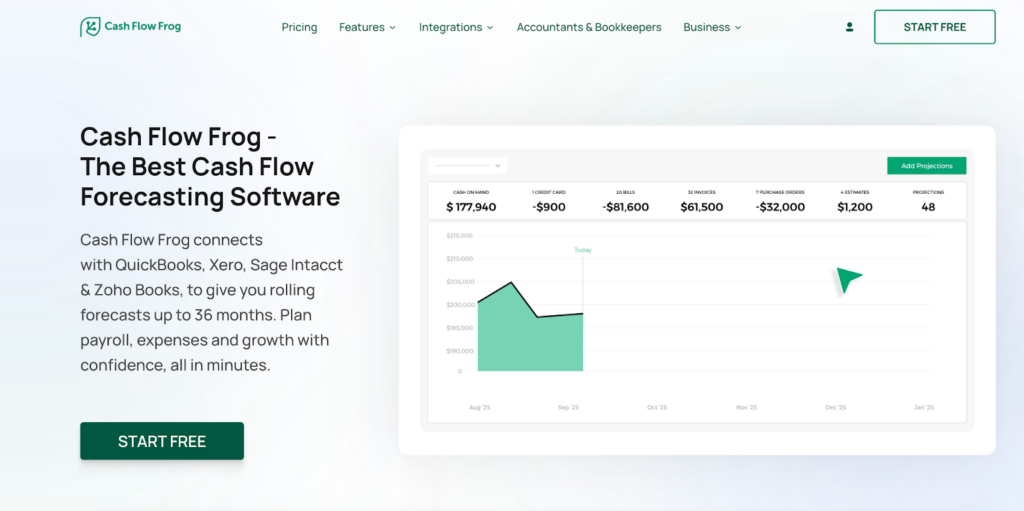
Cash Flow Frog is an app that offers a user-friendly way to model cash flow scenarios and visualize how different outcomes affect your cash runway. Its rolling cashflow forecasts give you 36-month visibility.
Pros:
- Intuitive interface
- Real-time updates from accounting software
- Multi-scenario comparison
Cons:
- Fewer advanced planning tools
- Better suited to simpler operations
12. Kyriba

Best for: Global treasury operations
Kyriba is a treasury management system with a focus on multinationals with complex banking structures and risk management needs.
Pros:
- Real-time global cash view
- Extensive bank connectivity
- Strong compliance and risk tools
- Various currencies supported
Cons:
- Expensive and complex to deploy
- Requires dedicated treasury staff
Conclusion: Proactive Cash Flow Management Starts Now
Cash flow is too important to rely on manual management.
That’s why finance leaders are increasingly making the move from static spreadsheets to real-time cash flow management software that gives them up-to-the-minute data.
Instead of reacting after a crisis, they can anticipate issues and make timely decisions that ensure liquidity.
Don’t let a 72-hour visibility gap put your company at risk. If you’re ready to eliminate blind spots and embrace proactive cash management, , consider what a solution like Datarails can do for you.
FAQs
It’s a digital tool that helps businesses track, analyze, and forecast cash inflows and outflows in real time.
Good software automatically consolidates data from your bank accounts, accounts receivable, accounts payable, and other sources into a single live system.
This gives finance teams a continuously updated view of liquidity: how much cash is on hand, what’s coming in, and what’s going out.
It works by integrating with your financial systems to automatically pull data. The software might connect to your accounting platform and bank feeds to continuously update your cash position and projections.
It uses things like invoice due dates, upcoming bills, and historical trends to forecast your cash flow.
Any organization that wants better control over its liquidity can benefit. CFOs, finance VPs, treasurers, and even small business owners use this software; it’s not reserved for any one position or industry.
Your chosen software should address several pain points, including:
– Visibility lag
– Errors due to manual work
– Poor planning
– Time spent on unnecessary manual work
Spreadsheets and basic accounting systems provide static, historical views, whereas cash flow tracking software gives you a live, continuously updated picture.
With spreadsheets, someone has to manually update figures, and the moment you do, they start getting outdated.
In contrast, dedicated software automates data gathering and refreshes your forecast in real time.
Each tool offers slightly different things, but some of the key features to look for are:
– Integration with banks and accounting/ERP systems (for automatic data updates).
– Real-time dashboard showing current cash balances across accounts.
– Forecasting module for short-term (weekly/13-week) and long-term cash projections.
– Scenario planning tools to test different assumptions
– Alerts and notifications for variances or low-cash situations.
– Reporting and visualization tools to create cash flow statements and charts easily (for presentations).
– Multi-currency support, if needed
Cash flow management software gives you an at-a-glance window into your liquidity. When you operate without this information, you might only truly know your cash status after doing reconciliations or running monthly reports.
Yes. A core purpose of this software is to let you perform “what-if” analysis on your cash. It’s easy to adjust assumptions, like what if sales drop next quarter, or a big payment is delayed, and see how it changes your cash outlook.
Cash flow management pulls actuals from accounting or ERP systems, much the same way FP&A tools do. In turn, it feeds the latest cash data into your financial models.