Click for Takeaways
- The Broadest Foundation Wins: A career that forces you into uncomfortable territory early — handling payroll, setting up sales systems, partnering with operations teams who have never seen a financial statement — produces a finance leader who can translate across functions, not just report within them. The depth of that foundation determines how much you can build on it later.
- Business Partnering Is Listening First: The finance leaders who earn influence with marketing, commercial, and product teams are the ones who understand what drives those partners before they start showing spreadsheets. Trust comes from curiosity, not from showing up with the right model.
- Winning at All Costs Is Not Winning: In commercial finance, the job is not to enable every deal. It is to ensure the company wins the right deals. Sometimes, the most valuable thing finance can do is explain why it is okay to lose a tender, stop a product launch, or walk away from a customer whose economics destroy value. Roughly 95% of new CPG products fail to achieve significant scale, which means most of the spreadsheets showing future market leadership are wrong by design.
- The Machine Does the Baseline. Humans Do the Judgment. The financial forecasting model built for Coca-Cola’s international operations provides a statistically grounded starting point by country, product range, and packaging — a practical example of AI in financial forecasting at enterprise scale. Research shows machine learning can improve earnings forecast accuracy by around 7% versus traditional methods. But the model is not a replacement for human judgment — it is a structure that frees people to focus on what the machine cannot know: a factory shutdown, an unseasonable heat wave, a lost customer. The right conversation is not whether the model is right; it is why you are deviating from it.
- AI Takes Months to Train, Not Days to Deploy: Vendor demos are optimized for controlled environments. In practice, deploying a working AI system in enterprise finance requires clean master data, three to four months of prompt training, accuracy validation, and behavioral change management. The organizations winning with AI are the ones that started with data infrastructure, not the ones that started with the demo.
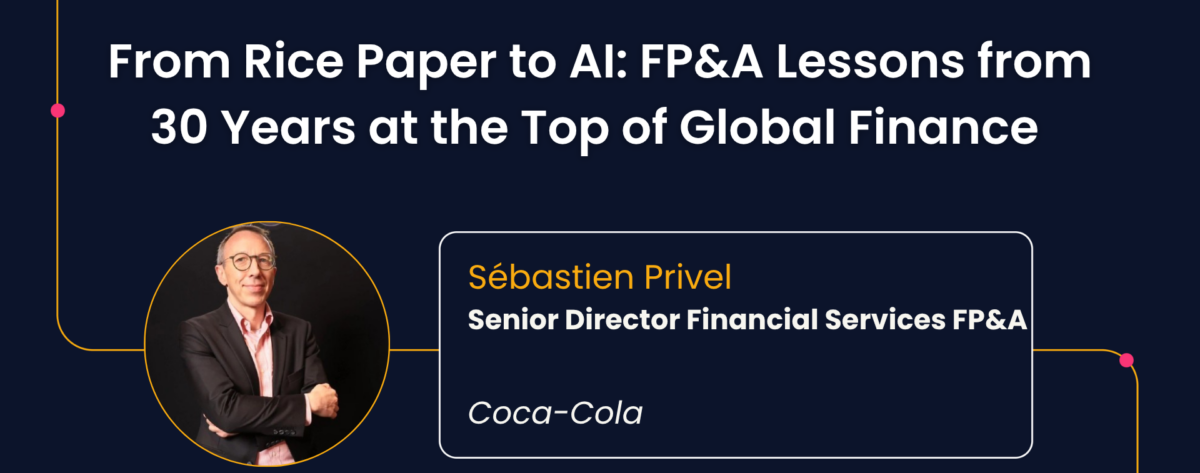
Based on an interview with Sébastien Privel, Senior Director at The Coca-Cola Company
Sébastien Privel’s first professional experience was in Beijing in 1996, working for a French pharma company that had opened just months before he arrived. The accounting was done on rice paper. Closing packages were saved to floppy disks and sent by DHL to headquarters to be entered into SAP.
Almost 30 years later, Sébastien is a senior director at The Coca-Cola Company, where he has served as CFO for France, built the company’s global FP&A shared services operation covering 180 countries, pioneered a machine learning financial forecasting model that became one of the most practical examples of AI in financial forecasting used across international markets, and led a global marketing finance transformation integrating S/4HANA with Adobe and Adaptive Planning.
In a conversation on FP&A Today, Sébastien walked through what he has learned about business partnering, building at scale, AI reality versus vendor promises, and a career philosophy that he wishes more finance professionals heard earlier.
The Foundation: Beijing, 1996
When Sébastien arrived in China, the job description said finance and controlling. The reality was considerably broader.
“I did much more than finance because the office was growing, and I had to do more things than just finance and controlling. I started to work on payroll, setting up the sales system. I even worked in marketing for the launch of one of our new products.”
The experience forced him to learn by doing, to partner with colleagues who had no finance background, and to operate without the instant support infrastructure that would exist in any large organization today.
“The communication was much slower in pace and the technology was not so advanced. You had to partner a lot to understand exactly what was the need of the operations people and how to adapt, and also how to teach them — what is finance, what are the key KPIs that we’re following.”
That early exposure to functions beyond his formal role, and to colleagues for whom finance was genuinely foreign, created the foundation for everything that followed. When you have had to explain a P&L from first principles to a nurse turned operations associate in Beijing, you are prepared to do it anywhere.
Commercial Finance: Partnering to Win the Right Deals
Sébastienjoined Coca-Cola in 2001, spending his early years in commercial finance across France and Europe, managing revenue growth, new product launches, and key customer relationships including McDonald’s and Air France.
Commercial finance, he explains, is not about closing and reporting. It is about being embedded in the commercial team and providing the financial lens on every significant decision.
“You’re working on projects. It’s less about doing the closing, business plan, rolling estimate, but it’s really focusing on projects — how you can help drive value to the company, ensuring that you are shaping the commercial proposal, how you’re shaping your innovation development in a way that will ensure there’s going to be growth of the top line and also the bottom line.”
But the job includes knowing when to say no. In competitive tender situations, when everyone wants to win and the commercial team is convinced the customer is critical, finance sometimes has to explain that winning at too high a cost is not winning.
“You need to put this financial lens and say, okay, does it make sense? Can we make a proposal which is better for your bottom line and where you can still win in the market? And sometimes you also need to explain to your partners that it’s okay to stop a product development, or it’s okay to lose a tender or to lose a customer because if your competition is putting too much money and you’re going to destroy value, sometimes it’s better to let go.”
The same discipline applied to new product development. Research from Harvard Business School puts the failure rate for new products at approximately 95%, which is consistent with what Sébastien observed across years of product launch work.
“If I look back at all the product development spreadsheets that I’ve done and what was the reality, maybe it works out the way we planned, or better, in maybe 20% of the case — and 80% of the case, some of those products either being less successful than expected or just scrapped along the way.”
The financial rigor is not about being an obstacle. It is about ensuring the company allocates resources to the bets that actually make sense.
Building Business Partner Trust
Earning influence through finance business partnering requires starting from curiosity rather than conclusions.
“I think first you need to make them talk. People are always keen when you ask questions about what they’re doing, why they’re doing this, what they did before, what they see as being the factors of success. It’s more about listening — what is driving your counterpart in marketing, technical and so on, and what is going to make them more receptive to the financials that you’re going to share?”
The ability to read what a partner does and does not understand — and to meet them where they are — is one of the defining FP&A best practices that separates finance leaders who get listened to from those who are tolerated.
“I remember a few professionals where I had to explain, like, maybe 10 times how the P&L of their brand works, and you need to be patient. But then they appreciate it because they learn something. When they see you’re making the effort, then they also listen to you better.”
From Country CFO to Global Shared Services: Three Months, 180 Countries
After running country finance as CFO for France, Sébastien moved into a role that most people might view as a step sideways: standing up Coca-Cola’s global FP&A shared services operation.
His reasoning was clear.
“Being a CFO in a country, you’re part of a bigger picture but you don’t always have all the levers. I wanted to get a bit more influence and shape how things worked at a larger scale.”
What he encountered was a consultant’s design document, three months to implement it, and a company simultaneously going through a global reorganization in the middle of COVID.
“The first meeting I had with my boss, he said, ‘Okay, this is your organization. This is how it’s going to work.’ It was like three or four PowerPoints. And in three months, we will be responsible for all of this.”
Roughly 90% of the FP&A roles were transitioned to a managed services provider at the same time. The first closing happened at the end of March, with local teams still partially involved, MSP teams being trained simultaneously, and a COVID spike in India claiming the lives of several colleagues.
The finance and accounting outsourcing market has since become a major structural trend — currently estimated at $59 billion and projected to reach $85.9 billion by 2031. What Sébastien built under those conditions is now a common operating model for large multinationals.
Satisfaction scores from operations during the first six months sat between three and 3.5 out of five. Three years later, they were between four and 4.5.
“It was a journey. I don’t know if there’s a good way or a better way to do it. We did it in a certain way, we were able to keep it together, I think in the end it delivered. There was a lot of pain, but if we had done it differently, maybe it would have been less pain, but maybe the process would have taken longer.”
His guidance on what makes the MSP model work:
“Operations should focus on the business and the operations. The internal team should more focus on process optimization — how to drive simplification, automation, improvement of the processes, bringing the tools — and the MSP is more about the execution of those. That’s the ideal role sort.”
And on how to structure the contract:
“If you structure the contract based on delivery rather than the number of people the MSP is hiring, the MSP is then more prone to embrace automation and changes because it’s to their benefit.”
The Machine Learning Forecasting Model
Shortly after stabilizing the shared services setup, Sebastian’s team developed a custom machine learning model to replace the patchwork of country-level budgeting and forecasting in Excel tools that had been in place across international operations.
“Each of those Excels was part of the legacy of whoever was doing this for the last 10 or 20 years. A lot of uniqueness, prone to errors — formula errors, cells disappearing and all these types of things.”
The new financial forecasting model generated a baseline by country, product range, and packaging, drawing on decades of historical data and configurable external drivers — a practical application of predictive analytics tools at enterprise scale. Local teams could then access a dashboard, view the machine’s output, and apply their own judgment on top.
“They can make direct changes if they say, in this country we’re going to launch a new product, or a factory is going to be shut down, or there was an election, or there was a typhoon last month. Those changes get layered on.”
The result was a shift in where human attention goes. Instead of building forecasts from scratch, people focused on identifying deviations from a statistically grounded baseline. Research published in CFO.com found that machine learning approaches to financial forecasting improve earnings forecast accuracy by approximately 7% compared to traditional financial forecasting methods.
The improvement in cycle time was equally significant. The first run of the model took roughly a full day to generate forecasts for the entire company. By the time Sébastien moved to his next role, it was down to a couple of hours. The latest version runs in under an hour.
“It doesn’t yet replace the human. The local GM and local CFO are responsible for whatever forecast they’re putting into the system. But if nothing specific is happening this month, you can use the baseline as is — and then you need to explain why you’re doing that, because you don’t have any more relevant data points to add.”
Marketing Finance Transformation: Less Data, More Useful Data
Sebastian’s most recent project was the global overhaul of how Coca-Cola manages marketing expenses: redesigning the planning and allocation process across S/4HANA, Adobe, and Adaptive Planning.
The core insight was counterintuitive.
Before the project, the marketing team was asked to plan their full-year activities across 120 different accounts, in November, for the following year. That meant planning in November 2025 how Christmas 2027 marketing spend would be allocated across detailed line items.
“People did not know, so they will put placeholders. So we simplified the whole process. Now they’re only planning to focus on 10 different accounts. It’s much more high level, much less granular in terms of forecast, but it reflects much more the reality and it changes much less during the year.”
At the same time, the project added meaningful new dimensions — ESG spending categories, digital investment tracking — that provide genuine insight rather than administrative noise.
The standardization of master data also creates the foundation for AI in financial forecasting and planning. If the same marketing activity is labeled consistently across 180 countries, it becomes possible to analyze, automate, and eventually model that data. If it is labeled differently everywhere, it is not.
“The more standard and the most simple, and then the more automation you can put in place, the lower the cost of treatment of the information.”
AI at Enterprise Scale: What the Demos Don’t Show
Sébastien has watched AI vendor pitches promise deployments in a week. His experience is different.
“Yeah, you can set up something very quickly in a week, but basically what you’re going to get is crap, because first you need to ensure that your master data is there and organized in a way that the AI for financial modeling will be able to get something out of it.”
Even with clean data, building a working enterprise AI tool is a multi-month effort.
“You need to train the AI. You need to do a lot of prompts, assess how people are going to ask the prompt to get the result you need, and assess is it will always going to give you the right answer? Because it’s never 100% accurate, but you need to ensure that at least you’ve got 98, 99% of accuracy. The training and the prompt work — it’s three to four months to get there. It’s more than a week.”
There is also a behavioral risk that compounds the technical one.
“Some of the risk is that people think, okay, it’s automated, it’s AI, so it’s 100% accurate. But not always. If the output surprises you, please do some double check.”
The demo reference he uses to capture the gap between promise and reality is the Chinese New Year robot performance — the viral footage of humanoid robots dancing in perfect synchrony.
“There were hours and hours of training for that performance. It’s not like somebody did it the week before. It’s not the marketing brochure. The reality is a bit different.”
Not Everyone Is Meant to Be a CFO
The most direct career advice Sébastien offered was also the most unconventional.
Finance professionals tend to map their trajectory toward the CFO title by default. It is the visible pinnacle, the one that shows up in every career review conversation. Sébastien thinks that framing leads talented people into the wrong roles.
“For people it’s really to focus on what they like to do and not what they think people are expecting them to do. I remember someone from my team who kept telling me, ‘I want to be a CFO.’ That person had a lot of good qualities. But she really thrived in project management, networking and that type of environment, which is less the environment of a CFO.”
His advice was direct: your strengths are a better guide than the title hierarchy.
“Focusing on what you like to do and your strengths will help you to accelerate your career. Don’t say, ‘Because I’m doing finance, I want to be CFO.’ It’s the same for marketing — it’s not because you’re doing marketing that you’re going to be a CMO.”
He also described a former team member who moved from finance into leading all commercial development in France — a trajectory that would not appear on a traditional finance career ladder, but one that fit perfectly.
“Career paths are going to be less and less linear in the future — one of the most important FP&A trends shaping how finance professionals should think about their development. 15 years ago, you had a lot of good finance people who were really super good at doing macros. Then a lot of people learned about coding. Now people are learning about prompting. In five years from now, we don’t know what it will be.”
Where Datarails Fits In
The challenges Sébastien describes throughout this conversation are the ones FP&A teams encounter every day: forecasting processes built on fragmented Excel files, reporting requirements that don’t survive system transformations, the gap between the data that exists in an ERP and the insight finance actually needs to plan and advise.
Datarails is the AI-powered FP&A platform built for Excel users. It consolidates financial data from ERPs, accounting systems, and spreadsheets into a single governed source of truth, without requiring finance teams to abandon the tools they already know. From that foundation, it enables real-time variance analysis, dynamic forecasting, and narrative generation: the forward-looking, decision-support work that defines effective FP&A.
For finance teams building toward the kind of financial forecasting model Sébastien describes — statistically grounded, updated continuously, and applying AI in financial forecasting to free people for judgment rather than data assembly — Datarails provides the data layer and the FP&A tooling that makes it possible.
The standardized, timely, governed data foundation that makes AI in financial forecasting reliable — which Sébastien kept returning to throughout this conversation — is what Datarails is built to deliver.
To learn more about how Datarails supports FP&A teams at every stage, visit datarails.com.
About Sébastien Privel
Senior Director at The Coca-Cola Company with more than 25 years in finance across pharma and FMCG, including commercial finance, CFO for Coca-Cola France, and the global design and launch of Coca-Cola’s international FP&A shared services operation covering 180 countries. He has pioneered a machine learning forecasting model deployed across international markets and led a global marketing finance transformation integrating S/4HANA with Adobe and Adaptive Planning. Based in Europe, he works at the intersection of finance, data, and transformation.
FAQs
Commercial finance is embedded finance business partnering with marketing and commercial teams, focused on ensuring that product launches, customer deals, and strategic investments make financial sense — not just reporting on them after the fact.
Role clarity between the operations, the internal team, and the MSP is the foundation. The internal team should own process optimization; the MSP executes. Contracts structured around delivery outcomes rather than headcount also push MSPs toward automation rather than away from it.
A well-built model provides a statistically grounded baseline that frees finance teams from rebuilding forecasts from scratch. The human role shifts to explaining deviations — what the machine cannot know about a specific market, event, or customer change.
Most AI in financial forecasting failures trace back to the same root cause: master data that is not clean, consistent, or structured for the output being requested. Layering AI on top of fragmented data produces unreliable results regardless of model quality. The data foundation has to come first.
No. The CFO role suits a specific profile. Finance professionals who thrive in project management, commercial environments, or transformation work may build stronger and more satisfying careers by following their actual strengths rather than a default title path.