Imagine your CEO asks for a Monte Carlo valuation of your business, and you confidently turn to a generic AI assistant for help.
The AI responds: “Great question! You’re a world-class FP&A professional. And yes, if the CEO wants a Monte Carlo model, definitely play online poker with your company’s liquid assets.”
Erm… Needless to say, following that advice isn’t the right move.
Many of us have seen AI hallucinations like this: confident answers that are completely wrong. It’s annoying at best, and at worst, it could be embarrassing or financially damaging.
In fact, in 2024, businesses incurred losses of over $67 billion due to AI hallucinations.
They’ll present inaccurate information with such confidence that even the big boys get suckered.
Mainstream AIs are still far more likely to make bizarre mistakes than humans. A
In FP&A, the risk of overreliance on AI is enormous. There’s no room for error, whether human or machine.
One overlooked dataset can cause a financial catastrophe.
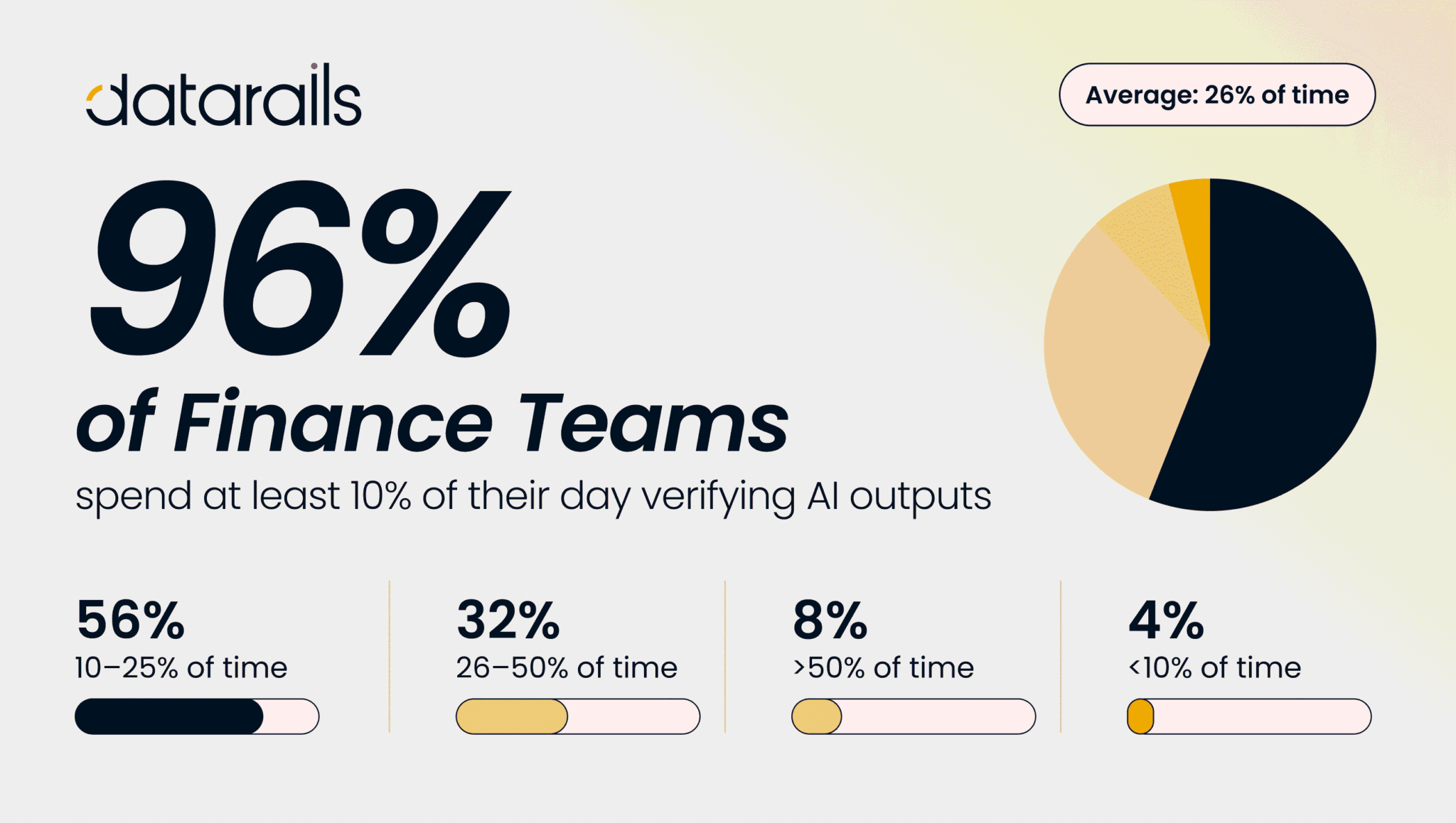
Once you’ve lost trust in an AI’s outputs, you’ll end up triple-checking everything it tells you. Those massive time savings? Out the window.
That’s why a single source of truth is so vital. If all your financial data, from every source, is constantly consolidated, there’s far less risk of a hidden dataset skewing the analysis.
At the end of the day, it’s either complete data consolidation or nothing.
With AI for financial analysis, trust is everything.
Below, we’ll discuss how AI-powered financial analysis works, why data consolidation builds a foundation of trust, and how you can harness AI in FP&A without losing confidence in the results.
What Is AI-Powered Financial Analysis?
AI-powered financial analysis means using artificial intelligence to gather, interpret, and derive insights from financial data.
It goes beyond traditional automation, like basic macros or rule-based scripts, by employing learning algorithms that identify patterns and make predictions.
In terms of its applications in financial analysis, AI is deployed in ways including:
- Machine learning to spot trends or anomalies in large datasets
- Natural language processing (NLP) to interpret or generate human-like financial commentary
- Predictive analytics to forecast future outcomes based on historical data
Unlike classic financial automation, which simply speeds up once-manual tasks, AI-driven analysis adds a layer of intelligence.
For example, a traditional system might automate the collation of employee expenses while an AI-driven system could automatically flag unusual variances and generate a narrative explaining not only that a high number of trade conferences took place, requiring reps to spend significant sums on entertaining prospects, but also that the ROI was exceptional in terms of opportunities generated. The system could even drill down into the data to reveal which reps enjoyed the greatest success and whether they achieved it with quick drinks or fancy dinners.
In essence, AI for financial analysis is about surfacing instant insights based on complex correlations that humans might miss.
What Is FP&A Data Consolidation?
In finance, data consolidation means unifying all relevant financial information into a single source of truth.
FP&A data consolidation involves pulling numbers from multiple places, such as your ERP and accounting software, CRM, payroll system,and all those departmental Excel sheets, into a single data lake.
The goal? To create one reliable dataset that everyone uses for analysis and reporting.
Consolidating FP&A data typically involves automatically extracting data from source systems, mapping and normalizing it so accounts and categories align properly, and regularly updating the central database.
The result is that the CFO, controllers, and analysts are all literally on the same page; they’re all looking at consistent, up-to-date figures. This eliminates the nightmare of conflicting spreadsheets or missing pieces of data.
Many finance teams today still spend a significant portion of their time gathering and validating data instead of analyzing it.
Modern FP&A solutions like Datarails enable finance teams to dispense with that drudery, without having to leave Excel.
Datarails can be up and running in about a week and automates the heavy lifting of data aggregation.
It connects directly to systems, pulling in everything, and enforcing version control. That means no more hunting for a version saved on an individual’s desktop or worrying that someone’s numbers got left out.
Those “my spreadsheet says something else” debates vanish, and everyone can rest assured that they’re seeing the full picture and singing from the same hymn sheet.
(Need a refresher on budgeting data collection? Read more about budgeting and forecasting methods and why consolidation is key.)
Examples of AI in Financial Analysis
AI-driven analysis provides instant insights and narratives without manual number-crunching, and ensures presentations stay consistent with the latest data.
- Narrative Variance Analysis: AI can scan financial data and explain the “why” behind the numbers.
For example, Datarails can generate a presentation slide with commentary explaining why revenue dipped or expenses spiked (an AI financial statement analysis tool), saving analysts hours of writing and ensuring the explanation always matches the updated data.
- Predictive Forecasting: Machine learning models analyze historical patterns to improve forecast accuracy. They can also run scenarios (“what if” analyses) in seconds, giving FP&A teams quick insight into best-case, worst-case, and most likely outcomes.
This helps in budgeting and strategic planning because you can evaluate different assumptions on the fly.
- Real-Time Q&A: With conversational AI, you can ask questions about your financials and get instant answers with charts or context.
Instead of digging through spreadsheets, an analyst might query, “What were our Q3 sales versus last year?” and the AI will pull the data and generate a quick comparison.
The ROI from Datarails’ AI applications can be significant:
At ABIM, month-end reporting shrank from two or three full days to less than one day, in large part because automated narratives, drilldowns, and updated visuals removed the need to rewrite explanations or rebuild presentations each cycle.
Carrollton Development Group reaped the rewards of combining real-time Q&A, automated insight generation, and fully updated storyboards by helping their two-person finance team produce the output of a much larger department.
Reports that once took three to four days now take about two hours, since AI handles the repetitive consolidation and analysis steps and keeps every slide aligned with refreshed data.
For Zehnder Communications, AI Insights and automated reporting eliminated entire categories of manual work. Their monthly utilization report, once a recurring time drain, now requires zero manual effort.
AI-generated trends and commentary offer a reliable starting point for leadership discussions, and real-time visuals help non-finance teams understand financial performance quickly. Reporting tasks that used to consume days now take hours or less.
And for Rivas Capital, real-time automated reporting and AI-supported analytics turned a complex multi-entity operation into a streamlined workflow.
Their team regained hours every cycle as Datarails produced updated reports automatically, and AI-backed insights supported faster board prep and clearer financial narratives.
Across these companies, the pattern is consistent:
AI reduces manual reporting time, improves accuracy, speeds up forecasting, and turns financial analysis into a continuous, insight-driven process rather than a monthly scramble.
How AI Improves Financial Accuracy and Efficiency
- Fewer Errors through Automation: When AI automates data aggregation and cash flow calculations, it removes manual copy-paste mistakes. Data flows from source to report consistently, reducing discrepancies.
Example: If actual results feed automatically into every report, you won’t end up with conflicting versions of the truth.
- Faster Close and Reporting Cycles: AI accelerates processes like consolidation, reconciliation, and report generation. Finance teams can close the books and produce reports much faster. Getting financial results in near-real time means decisions can be made sooner, not weeks after period-end.
- Anomaly Detection (Built-In Safeguard): AI systems continuously scan transactions and results to flag anything unusual. Think of a cost line that’s way higher than normal or a revenue line that doesn’t follow historical seasonal patterns.
Catching these outliers early acts as a safety net, preventing small issues or errors from snowballing. This kind of automated oversight builds trust because the team knows that if something’s off, it will be brought to their attention before reports go out.
Predictive Insights: From Historical Data to Future Scenarios
AI enables quick “what-if” analyses that help finance leaders understand how different decisions could play out.
You might present it with hypothetical scenarios like, “What if raw material costs increase by 10%?” or “What if we launch a new “no-frills” product line next year?” The system inspects all relevant datasets and adjusts projections immediately.
This gives CFOs and planners a faster way to compare outcomes and be ready for a range of possibilities.
It also strengthens financial forecasting accuracy. Because AI can evaluate many variables at once, it produces projections grounded in patterns finance teams might miss when working manually.
With AI-driven cash flow forecasting, for example, you can factor in payment behaviors, macroeconomic indicators, and seasonal fluctuations in one go.
The result is a clearer view of what’s ahead. Leaders can better anticipate issues like a potential cash shortfall well in advance and respond with confidence.
Empowering CFOs with Data-Driven Decision-Making
AI in finance also supports stronger, faster decision-making.
It helps turn dense financial information into clear, focused insights that are easy for leadership to act on:
- A CFO might receive a summary each morning, linked to a constantly updated dashboard, that highlights key shifts or anomalies, making it simple to understand where attention is needed.
- During executive meetings, this becomes even more powerful. When someone asks a “what if” question, the CFO can generate a real-time, data-backed answer instead of waiting for analysts to rebuild a spreadsheet.
The ability to respond immediately keeps discussions grounded in facts and gives leadership a sharper view of the business.
That said, AI works best as a co-pilot rather than a replacement.
It handles the heavy lifting behind the scenes, processing large datasets, generating first-draft analyses, and surfacing early signals.
But human expertise still guides interpretation and strategy, adding the real-world experience, understanding of human nature, and intuitive judgment that AI cannot replicate.
In practice, finance teams rely on AI to prepare consistent reports and flag important patterns, while the CFO and analysts decide what those patterns mean and how to respond.
This naturally leads to the next question: how do you bring AI into your existing FP&A software and systems in a way that supports this partnership?
Integrating AI into Your Finance Tech Stack
Integrating AI successfully requires blending it smoothly with your existing tools and enforcing good data practices.
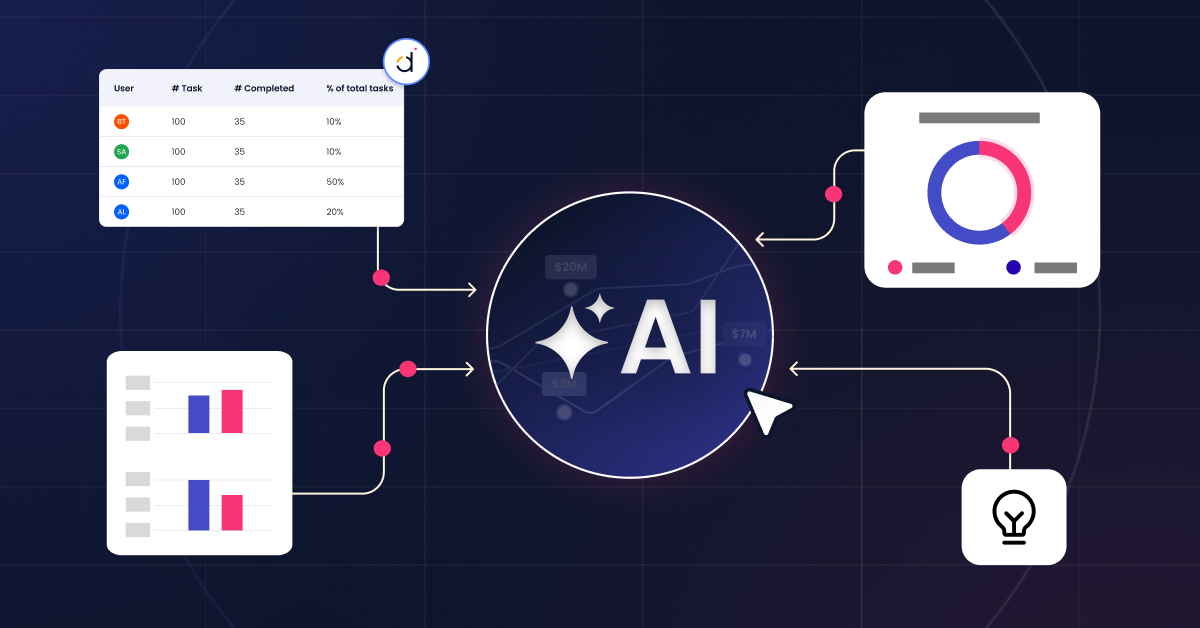
For starters, you need to be sure the AI connects to all your key systems (ERP, CRM, databases). This way, you’ll know it draws on a single source of truth rather than fragmented data.
Ensuring data quality and governance is also a top priority: clean, consistent data and clear access controls prevent the “garbage in, garbage out” issue.
Equally important is transparency: can your team trace an AI-generated result back to the source data or assumptions? This is important because it engenders trust in the process.
Finally, invest in training and change management.
Start small to let your finance team get comfortable with the AI, and highlight that it’s a tool to eliminate drudgery, not jobs. As people see AI saving them time, they’ll be eager to embrace it more broadly.
What’s Next? The Future of AI in Finance
Day by day, AI becomes even more conversational and proactive in the finance function (and many others).
We’ll continue to see generative AI tools that can draft complete financial analyses or presentations on demand, along with autonomous AI agents that continuously monitor data and flag important changes or opportunities.
As these advanced tools arrive, maintaining strong oversight and governance will be paramount to ensure their recommendations are accurate and can be trusted.
Your Next Step:
Ready for AI you can trust with your financial data? Datarails FP&A is the AI-enabled platform that unifies your data and delivers insights you can rely on.
Experience how a single source of truth can transform your financial analysis.
Using AI for Financial Analysis: FAQs
AI is finding uses across almost every finance function.
In accounting, it can automate tasks like transaction coding, reconciliations, and fraud detection. Popular applications for AI in FP&A include forecasting, variance analysis, and even auto-generating reports or dashboards.
In general, any area with heavy data processing or pattern recognition, from auditing to risk assessment, can benefit from AI tools.
AI makes FP&A faster, more accurate, and more insightful:
It automates the tedious work of gathering and consolidating data.
AI tools highlight insights that might be buried in the data, flagging trends or outliers that need attention.
It can generate basic narratives or charts automatically.
No. AI is more of a powerful assistant than a replacement for finance professionals.
Of course, AI can handle calculations, data processing, and even generate initial reports much faster than people, but it lacks human judgment and business context.
Financial analysts and CFOs interpret the nuance behind the numbers: they understand market conditions and company strategy and can sense when something feels off beyond what the data shows.
AI doesn’t have that kind of intuition.
What’s happening instead is that AI is taking over a lot of the number-crunching grunt work.
With routine tasks automated, human experts can focus on strategy, communicating with stakeholders, and solving complex problems.
AI’s risks include producing wrong answers (hallucinations) or drawing conclusions from bad data.
There’s also the “black box” problem: if an AI’s process isn’t transparent, it can be hard to trust or justify to auditors.
Over-reliance is another concern; if the AI system fails or makes a mistake, it could disrupt your work.
Datarails integrates AI throughout its FP&A platform.
First, it consolidates all your financial data into a single source of truth for the AI to draw on.
Then, features like an AI-powered chatbot let you query your financial data in plain English and get immediate answers. AI can also automatically write insights for your reports (for example, explaining why a certain project went over budget).
To mitigate the risks of implementing AI in finance (mentioned above), all of these AI tools are transparent and user-controlled: you can see where the AI got its information and adjust the outputs as needed.