For decades, organizations have fought to break silos: not just the departmental kind, but the invisible, technological walls between finance, operations, and strategy. The endless email chains, the disconnected spreadsheets, the version-control wars. And the CFO was usually the one dealing with the fallout.
Ironically, as technology got smarter, the silos only multiplied. Automation made individual processes faster, but couldn’t get them to talk to one another. Reporting tools did their thing. Forecasting models did theirs. Strategy lived somewhere else entirely.
Now, a new kind of intelligence is changing the equation: AI agents in finance. And the real story isn’t automation; it’s collaboration. For the first time, digital agents can speak to each other and coordinate decisions, all working from a shared, single source of truth.
What Are AI Agents for Finance Teams?
If traditional automation tools were like assembly-line robots performing repetitive motions with precision, AI agents for finance are like coworkers who can think, reason, and adapt.
They interpret goals, not just rules. They connect dots, not just crunch numbers.
AI agents in finance combine machine learning, data modeling, and natural language understanding to perform financial tasks autonomously, from reconciling accounts to generating rolling forecasts. The most powerful ones don’t work in isolation; they collaborate across systems, departments, and data sources.
Each agent learns, improves, and shares what they know.
AI Agents vs. Traditional Automation
Automation runs scripts; AI agents make decisions. Automation is linear: pulling, processing, and posting. Agents are dynamic: observing, learning, adapting, and collaborating.
That’s why forward-thinking CFOs are moving beyond RPA toward a new finance operating model, one where AI agents don’t just automate tasks but work together to elevate strategy.
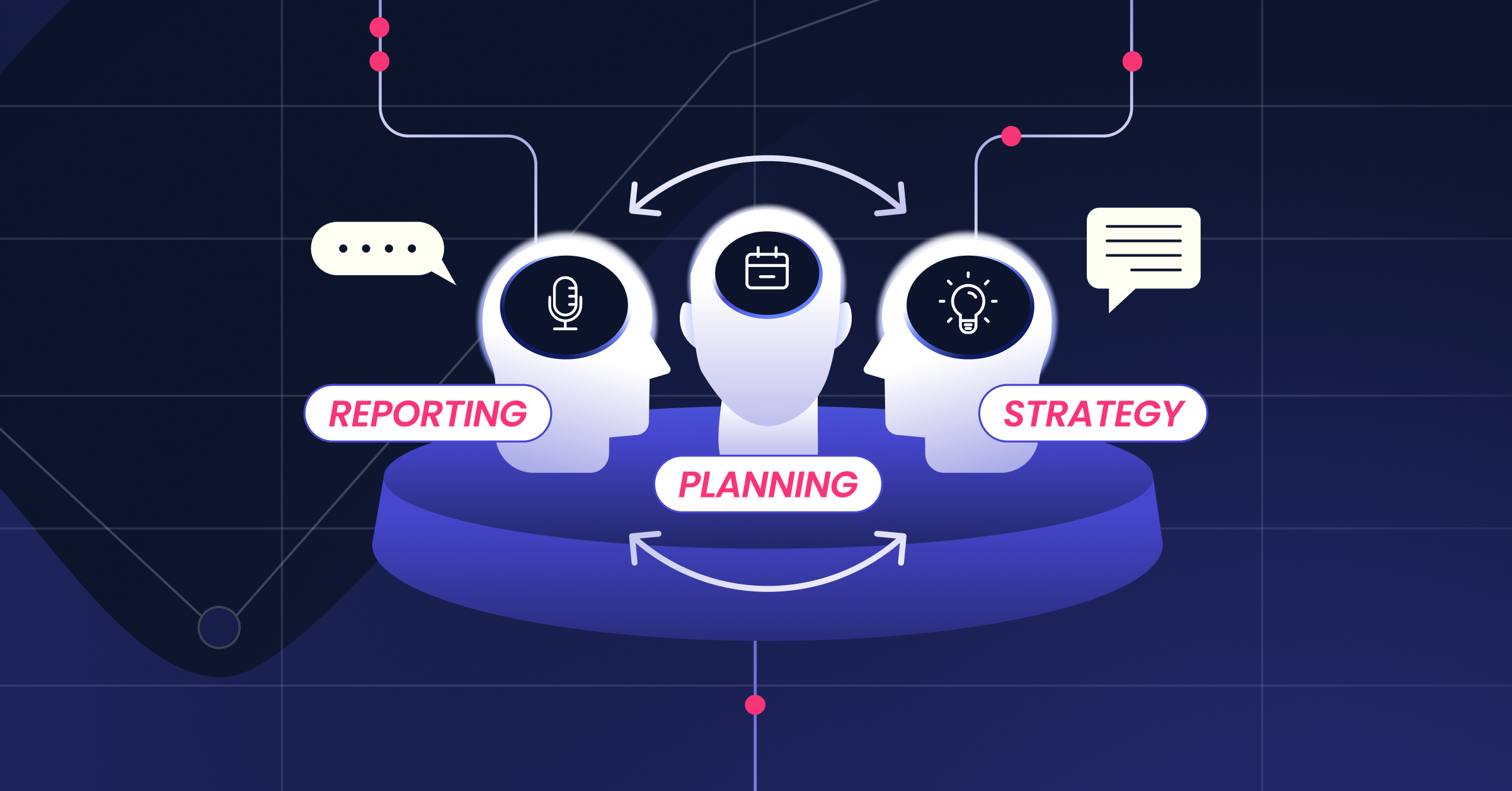
Imagine this: your reporting agent notices a variance between actuals and budget. It pings your planning agent, which recalculates scenarios. Then your strategy agent analyzes how that change might affect margins next quarter. All of this happens in seconds.
That’s coordination, not just automation.
Core Capabilities of Top AI Agents in Finance
The best AI agents for finance share several key traits:
- Autonomy: Executing tasks without waiting for commands
- Continuous Learning: Improving accuracy as new data flows in
- Real-Time Awareness: Analyzing transactions and forecasts instantly
- Integration: Connecting with ERP, CRM, and accounting systems for seamless data flow
- Transparency: Explaining every decision, essential for audit and compliance
The real differentiator is interoperability. Great agents don’t just automate tasks; they share one model, one memory, and coordinate across the entire finance function.
How AI Agents Are Transforming Finance
AI agents are already reshaping the daily rhythm of finance teams.
According to PwC, over a third of companies now use AI agents in finance and accounting, handling tasks that once occupied entire teams. These agents clean data, prepare disclosures, reconcile transactions, and assist with audits, compressing week-long cycles into hours.
When connected, top-rated AI agents for finance can handle the entire data lifecycle, from ingestion to insight. They pull numbers from ERPs, validate accuracy, track compliance, and generate forecasts without human prompting. They learn from every interaction, refining their predictions over time.
The result is a finance operating model where agents collaborate like highly connected departments, only faster and without forgetting to update the spreadsheet.
AI Agents in FP&A: From Spreadsheet Sprawl to Real-Time Insight
Financial planning and analysis (FP&A) is all too often trapped in a cycle of spreadsheet sprawl. Teams spent weeks collecting data, checking formulas, and updating assumptions, only to deliver forecasts that were obsolete by the time they reached the CFO’s inbox.
Now imagine asking your generative AI assistant:“What’s our projected revenue if we freeze hiring next quarter?”
Within seconds, you get something like this:
Revenue Impact: -2.3% (Current trajectory: $47M → Hiring freeze scenario: $46M)
Cost Savings: $890K in salaries and benefits, but productivity gap of $1.2M from understaffed customer success and sales development teams.
Margin Analysis: EBITDA improves 1.8 points short-term, but customer churn risk increases 12% without additional support capacity.
Strategic Trade-off: Save $890K now, potentially sacrifice $2.1M in expansion revenue over the next two quarters.
Your reporting agent pulled the latest numbers. Your planning agent recalculated workforce costs and productivity impact. Your strategy agent identified the margin trade-offs and growth risks. All of it visualized and ready to discuss.
Leading AI finance agents run scenario modeling, predict outcomes, and alert teams to risks long before they become visible in the P&L. They bridge the gap between numbers and narratives, helping CFOs move from hindsight to foresight.
How to Build an AI-Powered, Silo-Free Finance Function
Building an AI-powered finance function means orchestrating a network of agents that handle specific responsibilities and communicate across boundaries.
1. Establish a Unified Data Foundation
AI is only as smart as the data it feeds on. Before bringing in agents, unify your financial data. When every system speaks the same language, agents can act on consistent, reliable inputs. Even the best AI agents for finance will stumble if they’re working from scattered sources.
This isn’t optional—data quality issues will undermine every other benefit. If your data layer has gaps, duplicates, or inconsistencies, pause and fix that first.
2. Build in Modular Steps
Start small: automate reconciliations or purchase order matching. Each success creates a framework for the next agent to plug into. That’s how you evolve from automation to collaboration.
3. Connect Your Agents
A single agent can execute a task, but connected agents can run entire processes. Let one agent monitor vendor risk, another track payments, and another flag anomalies. Then let them talk to each other.
4. Prepare Your People
No matter how advanced AI becomes, finance still runs on trust. Train your team to manage and interpret agent insights. The advantage isn’t human versus machine; it’s human with machine.
Real-World Applications: Where AI Agents Deliver Impact
Planning & Forecasting
Agents consolidate inputs from sales, production, and payroll to produce real-time forecasts. When market conditions change, the forecast adjusts automatically. They run instant what-if simulations for pricing, hiring, or supply changes, showing how each scenario affects performance.
Impact: Accurate, always-current budgets and faster strategic decisions
Risk & Compliance
Machine learning-driven agents flag anomalies in transaction patterns, monitor currency shifts, market exposure, and contract clauses in real time. They validate data, reconcile accounts, and log every action, creating instant audit trails.
Impact: Early fraud detection, proactive compliance, faster closes, and cleaner reviews
Operations & Efficiency
Agents match receipts to invoices, spot errors, process claims autonomously, and prepare financial statements. Procurement-focused agents evaluate supplier stability and recommend alternatives.
Impact: Shorter month-ends, lower error rates, fewer supply disruptions, and audit-ready accuracy
Treasury & Cash Management
Agents track inflows, outflows, and balances, forecasting liquidity weeks ahead. They identify optimal payment timing, flag concentration risks, and recommend hedging strategies based on real-time market conditions.
Impact: Stronger cash positioning, reduced financing costs, and proactive liquidity management
Challenges to Address
Three factors will determine whether AI agents become colleagues or expensive novelties:
Data Quality: Agents are only as good as the data they process. A unified data layer is non-negotiable.
Transparency: Agents must be explainable, especially in audit and compliance contexts. If your team can’t trace how an agent reached a conclusion, it’s not ready for production.
Culture: AI changes workflows and mindsets. Finance leaders must train teams to collaborate with digital counterparts, not compete with them or blindly trust their outputs.
Connected Data, Connected Agents
AI agents in finance need to be integral parts of one living ecosystem, not standalone automations. When they collaborate across one data model, finance teams will be able to move from fragmented tools to connected intelligence.
Integrating ERPs, CRMs, and accounting systems already eliminates manual consolidation. And AI agents will soon be able to learn from shared data, flag anomalies, and deliver unified insights in real time, all through the Excel interface finance teams already trust.
The future of FP&A isn’t faster spreadsheets. It’s smarter conversations.
Ready to discuss how AI can help your finance team get there?
FAQs
They’re intelligent digital coworkers that analyze data, make decisions, and collaborate with other agents to automate and optimize financial processes.
RPA follows static rules; AI agents learn and adapt. When connected, they collaborate to create a smarter, unified finance operating model.
Forecasting, reconciliations, risk management, compliance monitoring, and financial reporting, all accelerated and connected across systems.
By consolidating data in real time, simulating scenarios, and collaborating with reporting and strategy agents to give CFOs instant, contextual insights.
AI agents will evolve from digital assistants to strategic partners, working together to create a finance function that’s fast, intelligent, and free from silos.