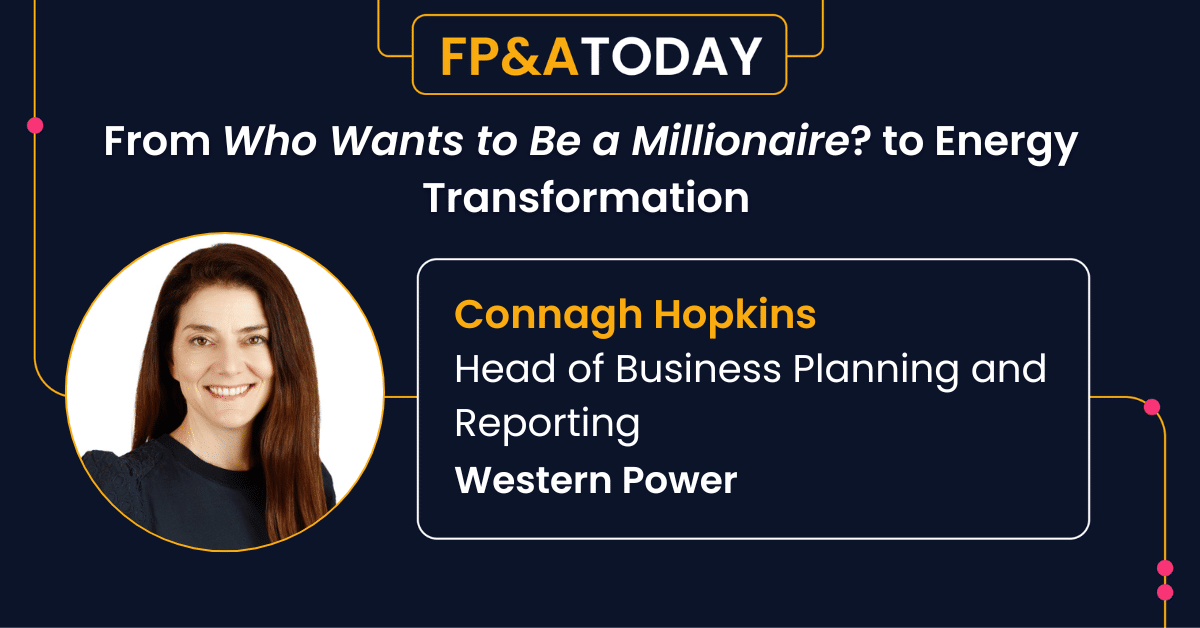
Connagh Hopkins is Head of Business Planning and Reporting at Western Power, one of Australia’s largest electricity network operators. Connagh shares her fascinating and unconventional journey from working on the global licensing for “Who Wants to Be a Millionaire? to navigating Australia’s energy transformation.
In this episode:
- Who Wants To be a Millionaire success (powered by Lotus123)
- The Consolidated 10 year plan at Western Power
- Scenario planning and Inflation challenges in utilities
- How we are stacked: 65 person finance team at Western Power
- The power and challenge of AI in finance
Connect with Connagh Hopkins: https://www.linkedin.com/in/connagh-hopkins-a9b3871/
Connagh Hopkins is Head of Business Planning and Reporting at Western Power, where she oversees the FP&A function for one of Australia’s largest electricity network operators. With more than two decades of experience across utilities, property development, not-for-profit, retail, fuel, and media sectors in both the UK and Australia, she’s known for her focus on commercial strategy, cross-functional collaboration, and building high-performance finance teams.
Full Transcript
Glenn Hopper:
If you would like to earn CPE credit for listening to the show, visit earmark cpe.com/fpe. Download the app, take a short quiz, and get your CPE certificate. Finally, if you enjoy listening to FPA today, please go to your podcast platform of choice. Click the subscribe button and leave a rating in review of the show. And now onto the show
from Data Rails. This is fp NA today. Welcome to fp NA today, I’m your host, Glenn Hopper. Today we’re excited to welcome Kana Hopkins. Kana is the head of business planning and reporting at Western Power, where she leads the fp and a function for one of Australia’s largest electricity network operators. She brings more than two decades of experience across sectors, including utilities, property development, not-for-profit, retail, fuel and media, both in the UK and Australia. KANA is known for her focus on commercial strategy, cross-functional collaboration, and building high performance finance teams. Kana, welcome to the show.
Connagh Hopkins:
Thank you Glenn. Great to be here.
Glenn Hopper:
Yeah, we were saying before the show, we’re on complete opposite ends of the clock right now. So, uh, 7:00 PM in central US and 8:00 AM I guess in, uh, in Perth now.
Connagh Hopkins:
Yeah, very chilly Perth as well. It’s cold
Glenn Hopper:
<laugh>. Yes, true. There were opposite ends of the globe and or of the clock and the calendar.
Connagh Hopkins:
Yep, yep.
Glenn Hopper:
Yeah, it’s about, uh, 95 degrees Fahrenheit here right now. So I don’t know what that is in Celsius because American <laugh>,
Connagh Hopkins:
The, in the, in the phase, well, it, it’s, it’s three degrees Celsius here, so,
Glenn Hopper:
Okay. Wow. Figure
Connagh Hopkins:
That one out.
Glenn Hopper:
<laugh>. I can figure that one out because I know zero degrees Celsius. <laugh>. Well, I guess let’s dive in here. Let’s start with your story. Walk us through your career journey, how you found your way to fp and a and eventually to, uh, your, your current role at Western Power.
Connagh Hopkins:
Yeah, we’ll, we’ll strap yourself in. I guess it goes back away, but I didn’t intend to do this. I wasn’t meant to be an accountant. Well, that wasn’t my plan. My plan was actually to be a graphic designer when I left school. But yeah, my, my linear, it wouldn’t be linear. My approach to this, and I guess the job that I say is to blame goes right back to the late nineties. I was working in London at London Weekend and Television, which is a television, or they may, they produce television programs. Um, and I found myself as a temp, but in a role as the personal assistant to the head of rights and royalties. So that’s where they looked after all the contracts for the artists, the writers, the musicians. And somehow I ended up getting involved with the contracts and then understanding, uh, the payments to the artists. And when they on sold the programs, so they’d often sell to secondary television back then, which was growing. Uh, they needed to know how much they needed to pay the artists and whether they’re gonna get any money out of selling it. So that is actually the genesis of how I found myself into accounting. And fp and a, believe it or not,
Glenn Hopper:
It weighed yourself into Excel trying to figure that out. And from there, the, it was off to the races.
Connagh Hopkins:
Well, no, it wasn’t Excel, it was Lotus 1, 2, 3. Oh,
Glenn Hopper:
That’s <laugh>,
Connagh Hopkins:
Believe it or not. So yeah, I found myself out as small independent production television production company in Covent Garden in London. And the first thing I was asked was to audit, uh, one of the, the companies that was, uh, buying some of their programs, uh, they felt that they weren’t getting all the royalties. So I had a big, big file locked in front of me with all of the contracts and said, figure it out. And that’s when I kind of realized I needed something to track it all. And then, uh, at that time, they had a little program that was getting a lot of attention. It was, who Wants to Be a Millionaire? And so they owned the rights to that and they were starting to broadcast and sell it across the world. And there was me, the, the royalty accountant in inverted commerce, trying to track all the sales in what became 50 countries. And it wasn’t just the program they licensed everything, gains, board games, tie-ins, chocolate games, books, you name it, they licensed it. So it was a great introduction into to royalties, uh, and not just the, the ip, it was music as well, but all driven by Lotus 1, 2, 3, <laugh>.
And then obviously, ’cause they were growing a lot, they, they branched out and created another arm, which was their international arm, which I went into. And they employed someone to help me out. And she was a management accountant. And, uh, that was Janet Oaks, and she was probably my first mentor and, and encouraged me to get qualified. She said, you’re doing the job. Um, but particularly in the UK at the time, unless you’re qualified, you, your salary was very capped. And so I chose cma, the Chartered Institute of Management Accountants. And I think the reason for that is I, I looked at all of them, the CA and the A CCA and the real financial accounting and the accounting standards and auditing didn’t really appeal to me. It was what I was doing and doing with Janet, which was working in the business and understanding where the money was coming from and what it meant next.
And her knowledge of her and her prior work she’d, she’d worked at Seger games and she brought a lot of that knowledge into the business. And, and when our marketing and salespeople were projecting all these crazy sales of PC games and they were getting really excited ’cause it was going so gangbusters, she actually was able to condition them a little bit and said, that’s not how PC markets work. That’s not how the PC game market works. The first one’s always big, the second one, not so big third one, very small sales. And it gave me that insight into what this job could do as far as you’ve got the knowledge, you know, the business and you know the industry, you can help and advise. That’s what I liked about it. So that’s what, um, I suppose encouraged me to get qualified, but also chose the mole management accounting business, uh, commerce support.
And that’s the fp and a angle as well as I understand it. So yeah, that fast forward from there. ’cause this could take forever. Um, <laugh>, I ended up back in Australia in Darwin, in Northern Territory, um, running my parents’ real estate business. So I got, um, I was a registered agent for a bit. We sold that, rolled that into their superannuation and their pension. I then worked for the Red Cross in the Northern Territory division as finance and administration manager. Worked for also in Darwin, a cartage cartage or fuel cartage organization that’s big trucks carting petrol around the states. And then we’d relocated to Perth. I spent some time in a property development company as a, a project, uh, accountant, sort of financial controller as well. Moved back into fuel retail. I was a finance manager there for all the, the shops and the, the forecourt, the fuel sales and the forecourt sales. Um, and then yeah, found myself at Western Power where I’ve been for the past 12 years. That’s the potted history. <laugh>
Glenn Hopper:
<laugh>. And you’ve had roles in, in controllership and on the fp and a side. And I think those two obviously very complimentary, um, to each other and probably gives you great insight sort of being, uh, on both sides of it. But now, as I know you’ve had several roles, um, at Western, but what is your position look like today? How is your fp and a team structured and where now is most of your time and energy focused?
Connagh Hopkins:
Yeah, the team is growing. Got about 65 people, 65 positions. My function is part of the broader finance and, and regulatory business unit in Western Power. So we’ve got, uh, four functions that report through to the CFO. So it’s the finance and revenue, which is the more traditional corporate finance, financial accounting, and all of our billing and our revenues, our regulatory investment assurance function, because we’re heavily regulated and we’ve got our commercial and supply chain function. And then there’s myself and we are called business planning and reporting. But essentially we’ve got three areas in my function, which is the partners, we call it the partners in performance. So your finance partnering arm, our business planning and analysis arm for all of our forecasting and looks after all the systems and end-to-end cost build estimations through to all the forecasting assumptions. So I’ve got a team of estimators who are actually engineers in that team.
And then we have another area that’s dedicated to our data and information and visualization. So we’ve got reporting people who are non-accountants, but they can talk with our tech guys and know how to get data outta the warehouse, which is really important for us, obviously. So we, yeah, we’ve got three, three areas. And that’s broadly how, it’s, how it’s structured at the moment and like at the moment. ’cause we have to keep figuring out what’s the best way to do it. We’re in a interesting situation ’cause we’re transmission, so we’re a utility organization. We’re transmission and distribution. So where the poles and wires and transmission as it is across the world is evolving a lot because of the changing generation or the type of electricity generation from traditional synchronous coal-fired gas, nuclear, we don’t have nuclear, but a lot of, a lot of countries do. So we’re going into wind and solar and that changes things drastically. So the focus for us a lot is understanding what that means, uh, scenarios, forecasting and the growth of what we’re required to do. The, the build of the network and the transmission network is, is nothing like we’ve had since the sixties, the 1960s. So it, it’s a a huge focus for us at the moment. Yeah,
Glenn Hopper:
And it’s so, I mean, having the transmission as well, it’s such a capital intensive place to be in, in a highly regulated environment. And I, I think for a lot of our listeners, just trying to picture what fp and a looks like in, in a space like that. And I know you’ve been at Western Power a while, but did a lot before that. From your point of view, how is fp and a work in the utilities sector different from, you know, uh, uh, the other industries you’ve been a part of?
Connagh Hopkins:
I don’t think it’s that much different. When I came to Western Power, it’s actually for a six week contract, and it was to understand some estimates and, and why it was changing when they, when they estimated the project and to the actual completion of the project. And that’s basic variance analysis. You, you’ve got a plan, you’ve built up the, the cost basis and it didn’t turn out that way. Why? Whether it’s looking at fuel stocks or whether it’s looking at, you know, constructing distribution line or, or whether it’s a, a funding, um, application that you’re quitting to the, to a government. It’s the same principle. It’s understanding the information, figuring out what’s changed and explaining it. So obviously it does help to understand the nuances of the data coming in where it’s coming and, and I suppose the, the nature of the business can help you get there quicker, but the basics are the same. I don’t see it too much different. And I, and I, I, maybe that’s because I have been through different organizations and I’ve been able to adapt what I know to those situations, but I think that’s the beauty of the profession. It’s like once you got the basics, it’s it’s the same stuff. You just adapt it to the situation you are in.
Glenn Hopper:
Yeah. It’s the Rosetta Stone of business. So from your nonprofit media, property, utilities, it’s ev you know Sure. Different KPIs by industries, but the, the role in what you’re trying to do for the company doesn’t change.
Connagh Hopkins:
Yeah. And I think, well, your cost drivers are gonna be different or you might be more revenue driven than cost driven depending on your industry and who and your ownership structure. But you know, that the basics are, for me, are the same and, and just have your your core foundational things to fall back on to when you, when you have to question it. It’s like, what would I have done there? And how does that relate back? And, and then you work it through stock systems the same anywhere as well. And ERPs are the same. They, they’re based on the same principles.
Glenn Hopper:
I like your title now because it’s more indicative of what we do head of business planning and reporting. Because I think the same kind of thinking that gets finance and accounting labeled a cost center, that is, you know, that’s maybe the old fashioned way to look at it of, oh, we’re just reporting historical, but business planning and reporting that in the title suggests strategy and what the real role is. We’re not just running reports. Uh, so you can, you know, know if you’ve got your quarterly bonus or whatever we’re, it’s strategic, the nature of our, of our planning. Could could you maybe walk us through, I know you went through the divisions, but like the, the tasks, the kinds of work you’re doing, the projects and skills that you’re on in, in this role. Because I think in really thinking about the value adds that you bring to the company, that’s not just, okay, we’ve compiled this quarterly report and so on <laugh>.
Connagh Hopkins:
Yeah, yeah, no, sure. Well, the first one I think I mentioned earlier was the scenarios. So a couple of years ago we were asked, can we look at scenarios of what this might mean when we have a whole lot of new customers coming on new load, um, because they wanna decarbonize and they want to connect to a grid that’s got renewables on it. What would that look like? How much of the network would we need to build out? What’s the kind of quantum of cost or a load will that that lead to, and what kind of generation would we need to be connecting to satisfy it? So we did some scenarios, and that was very strategic in nature and they weren’t particularly complex or sophisticated. It was, they were just designed to see this is the potential customer pipeline, this is what it could look like.
Ended up in a three pager to the board, but so strategic and so useful in driving good conversations at the executive and the board to really start testing. What does it mean? It wasn’t about providing a perfect answer or a perf a perfect outcome. It was just actually to prompt the discussions and do we have the capacity and the capability to do it? Or what, what do we need to change or think about from a regulatory point of view, from stakeholder point of view. All those things came up and it’s, it’s a preparational thing. The other thing, yeah, obviously we do the usual budgets, the rolling forecast. We’ve also got a consolidated 10 year plan process that we facilitate across the business. I suppose it’s more tactical in nature. That’s what it’s trying to look at or trying to, it does give an indication of what is our ability to deliver all the things that we need to do, that we want to do, that we think we need to do, that we’ve actually got the resources to do.
And that over 10 year outlook, um, provides that ability to change direction if we need to. But the really, really excellent benefit of that process is how we were able to bring a whole lot of different functions in the organization together, which in my experience, when I started it five years ago, when I inherited the process that was so hard, really, really difficult <laugh> to talk about that one for, for a long time. But that’s where the, our function and the planning, so we’re, we are not the network planners. We’ve got engineers who plan the capacity on the network, but where the business planners, we bring it all together, including our property division, our IT division, and of course all the support functions that go with it. So we are looking at that and, and we do the strategic workforce plan as well. Now, um, a team of team have got all the assumptions for that. So it’s a big thing, but it’s a great thing to be part of. And the discussions that it, that it kicks off.
Glenn Hopper:
Yeah, I was talking to another guest recently about, you know, finance is the only group in the business where you can get into sales and marketing operations. You, you have visibility into the full business. And, um, before, you know, you and I have both been doing this a while before we started talking about business partnering there, a lot of people would get their feelings hurt when you would come in, uh, into their group and try to report on, on what they were doing and feel like you’re stepping on their turf and, uh, gonna, you know, shine a bad light or expose something that they didn’t want to get exposed. But I do think that that business partnering is part of this shift in fp and a that we’ve seen in recent years, and you mentioning directly while the teams working together. I think that’s indicative of the view of our role and how we’ve been in fp and a empowered to to do more and to bring those teams together. I think 15, 20 years ago, it would’ve been very hard to bring <laugh> the different groups together to work on a project like that.
Connagh Hopkins:
Yeah. It goes to a lot from or from my experience where they do perceive you as the accountant and why would you be doing this? Why are you coming out, why are you interested in the capacity of the network? And you know, this is extra work for us. Why, why are you asking us this? And it’s, I think it’s taken that long for them to see the, the benefit of it when you see it together and, and the conversations that it’s driving and the, it it is collaboration. Is it perfect? Nope. <laugh>, it’s an ongoing thing. Yep. But we’re in a much better place than, than we’ve been as far as understanding if you, if you need that asset management strategy to come to fruition, how are we gonna deliver it? There’s actually a, a joined up view of it forming, which is gold.
Glenn Hopper:
And I think, and the other thing, thinking about scenario planning in a 10 year plan, since you mentioned earlier how much the industry is changing from, uh, fossil fuels to renewable and, and different storage and distribution and all that around it, it’s gotta be an interesting time to be planning for that. And I guess the shift has been happening for a, a while, but if there’s you, you try to put a date of we’re gonna reach x amount of energy created by alternative or whatever, you know, whatever those goals are, there are so many unknowns in that forecast and what you’re doing and, and in what everyone does in FP it often involves navigating incomplete data, shifting expectations, just like what you were going through. I wonder if with this, how you approach that and, and how you, I mean, I, I mean I’m just picturing your drivers and assumptions tabs in your, uh, in your spreadsheets, how much those might change as you’re going through building out these long range models.
Connagh Hopkins:
Um, they change a lot. I think what’s impacted us the most is the inflation. That’s, it’s impacted everyone, but I think in this industry we’ve got a different type of structural inflation that’s occurring because everyone’s doing it at the same time. So we’ve created a shortage of people, really, the, the, this, the electrical engineers, um, are in such huge demand construction people, the steel, the, the, the transformers, all of the, the kit that goes with it, everybody wants at once. And in Western Australia where we’re kind of isolated, we’re the most isolated city in the world where we are. Getting those resources to come over and develop those markets in the state is a bit of a challenge as well. And we’re not interconnected as a grid. AB should have mentioned that the Swiss, the Southwest system where we’re islanded, so unlike other, um, and the rest of Australia, they’re interconnected with other states and other generation sources and other customers to offload to we’re not.
And so that, that adds another challenge. So, so you, you’re right, the the assumptions underneath it, which our team own when we build it out, are really important. And they do get questioned quite a bit, particularly on the cost inflation part of it and trying to manage that. Um, our unit rates and our estimations have never been under so much scrutiny from the business, which is a good thing, but it can be a little bit, it, it’s difficult sometimes to keep up with the demand of requests that and, and asks for what, why has this changed and, and how are we going to build in the, the contingency for what may or may not happen?
Glenn Hopper:
Yeah. Fp and a today is brought to you by Data Rails. The world’s number one fp and a solution data rails is the artificial intelligence powered financial planning and analysis platform built for Excel users. That’s right. You can stay in Excel, but instead of facing hell for every budget month end close or forecast, you can enjoy a paradise of data consolidation, advanced visualization reporting and AI capabilities, plus game changing insights, giving you instant answers and your story created in seconds. Find out why more than a thousand finance teams use data rails to uncover their company’s real story. Don’t replace Excel, embrace Excel, learn more@datarails.com in all of that too, in being in the isolated part of the world too.
So you’re leading this team in a very complex organization with a lot of variables and a lot of change. And you’re doing the business partnering, you’re getting the company to, to collaborate across functions and what doesn’t kill you makes you stronger, maybe <laugh>. But I’m wondering, uh, what have you learned about building a, a strong fp and a function that balances, you know, the, the technical skills and the business partnership and having the right team that can ’cause you mentioned with the three functions that you have, you know, some of them, there’s a maybe not a lot of crossover in what they’re doing. How do you balance and structure the team and get everybody working together?
Connagh Hopkins:
It’s an ongoing process. Call it. It’s, we did a change to the, the structure a bit about 12 months ago to realign the skillsets for a couple of reasons. We felt that we just weren’t adding enough value as we could with, with the skills we had. We were getting a bit of crossover and overlap within the teams, particularly with the analysis. And then actually started getting little silos within the function as well. Because you get the, the data analyst who thought that this is the most important thing. We’ve got an operational request and this is really important for the field. They need to understand their productivity and efficiency. We’re gonna focus here on this one. And then you’d get partners saying, no, I need to go out and work with these people. Whereas if they actually came together, they’d get a much better result. So I started looking at, well, how should I set this up?
And I looked at mini centers of excellence within the function. So let’s put all of the partnering skillset together. Let’s put all of the analysis and financial planning type skillset together with the estimations and our standard costing and then the, the data experts together. Because I thought that was going to help also with their understanding of their career development and their pathway. And by also bringing in those skills together, will you get, you know, the sum of the great is greater than this individual parts. And so it’s worked to an extent, but we’re still figuring it out. I know that a lot of people have talked about the purple people who are able to do the storytelling, the influencing. They’ve got the partnering, but they can get into the data and they can pull that out and they can build all of that. You really can’t.
I think that’s what we found as we were developing or wanting to develop the business partners who could do all of that. But what we found, and they were getting frustrated is that, that we’re still getting dragged back into transactional things and figuring out data and cleaning the data, assembling it all the time, building reports and putting it into PowerPoint or doing this or redesigning for a particular head of function. He wanted it this way or that way. So they weren’t really partnering and they weren’t developing their story. You know, what is the story here? Because they kept getting dragged back into the transactional thing. So that’s what I’m working on at the moment is how do I decouple that? How do I create the roles that are very focused on the month end transactional, let’s get the data right versus the ones who can really go out and partner with the business and you, we wanna be that what’s next?
How are we gonna guide you? What does it mean? And do the ad hoc analysis around, we’ve seen some interesting trends. We wanna run that to ground and figure it out. So the, I I’m not really answering your question ’cause I haven’t come across the great structure yet. It keeps evolving and even yesterday I was talking to one of my area managers about, you know, maybe we need to think about another tweak <laugh> to how we’re structured and how we’ve got our people sitting in their different teams just to get a greater output and greater value, um, and less frustration for them in the business as well.
Glenn Hopper:
Yeah. And it’s, I I think you’re spot on with it’s, it, it’s the rare unicorn that has every component that we need to do in, in fp and a. And then I think another thing we see a lot is just because you’re great at at forecasting and modeling or storytelling or any component of it, doesn’t mean you’re gonna be great at at managing people to do that. And sort of having to, it’s a big ask to having gone through and, and do all the the individual contributor principle type components and then, okay, now lead a team to do it. And I know you’ve done a lot of education and program around it. Yana, you, you served as a CPA WA committee member and you did the G-A-I-C-D program and I’m wondering how those experiences maybe influenced your leadership style and truly your approach to strategic planning and thinking about organizing the team and doing this more long-term planning and, and and focus as well
Connagh Hopkins:
The professional bodies. Um, definitely in CPA and CMA as well, they’ve got some great competency frameworks and I’ve, I’ve used used that in the past to help look at what’s the best way to structure the job jobs, the job descriptions, get some role clarity, particularly with the future of finance. Um, publications that have quite a few of them have done because they can see it coming and they’ve seen it coming for quite some time that the demands for our skillset is just growing because we tend to have the people that understand both data, how to extract it out. ’cause most accountants have always been there and certainly my crew is based on you need to know how to get hold of the information, get it quickly and make sense of it. Whether that’s SQL, dragging it straight out of systems. And I’ve been very dangerous with systems when I’ve dragged data out and stopped servers working <laugh> and had it call me and say, Connor, what are you doing <laugh>? It’s like
Glenn Hopper:
When misplaced comma and it <laugh>.
Connagh Hopkins:
Yeah. Um, so from a leadership point of view, yes, that they’ve helped me because they’ve made me think strategically about what’s the best way to do this. And there’s no right or wrong way, but it’s helped test it out and get access to other networks and people where you can test out your thought processes as well. So from that point of view, hugely helpful. But, um, the CPA committee is a great one. If you are, if you want to understand how committees work and get into a structured committee that has a president and it’s all very well, um, run and that helps you if you get in a role that has exposure to a board or a committee. We have treasury committees and lots of other committees that work and you can see how good ones run and how not so good ones run when you’re on those committees, it’s about really learning how to ask the right question and listening. It’s not knowing and not dominating. Um, and that for me is a really important thing that I’ve learned with my leadership too, is let go of needing to be the one who knows everything and be the one who asked the really good insightful questions,
Glenn Hopper:
Which is what you expect from your finance folks, right? That’s what we’re there for
Connagh Hopkins:
<laugh>. Yeah. But I will admit it was hard ’cause I was an individual contributor for quite some time and, and I don’t know if it comes with the role where the expectation is for you to have the answer or you feel you need an answer to be the one with the answer and you feel you’ve failed if you don’t. So then, then to switch that into being the one to prompt for the answer and not have it was quite difficult for me. It was part of, that’s been part of my leadership development over the past 10, 15 years. Definitely.
Glenn Hopper:
That’s great. Yeah. You mentioned, and I, I kind of hung up on this as having been through some of those data nightmares, but when you mentioned pulling, pulling data from disparate systems and all that, I’m wondering what tools or technologies are you using to support FPNA today? And are there, is there something you’re using that’s kind of helped improve your planning or reporting or, or business insights or, or getting more real-time information? What’s your tech stack look like?
Connagh Hopkins:
Well, we’ve got a lot of legacy enterprise systems at Western Power, but as our tech stack is a bit varied, but it comes down to our ERP, which is ellipse, which is a typical asset management system. We have, you know, for our planners, we’ve got Primavera six, our investment tools, uh, ProSight, and we’ve got everything going into a data warehouse, most importantly. So that is our major, I’ll call it a tool as well. And then we extract using Excel <laugh>. Um, but our main visualization tool is, is Clicksense. So that’s how we map it all together. We do have planning analytics for our, our planning tool. Everything’s on-prem, so unfortunately we don’t have access to the smarts that are in the cloud and the predictive yet. But that, that is essentially our, our tech stack and it’s all ties together in the warehouse. So I can’t stress that is the most important thing for me is that central source where it all flows, flows through to,
Glenn Hopper:
And I would imagine with that, if I, I can’t, I, well, I can’t imagine the amount of data. I worked in a, a small telecom company for a number of years and I was blown away by the amount of data that we had. But to be a full utility covering that, and I, I would imagine that that data warehouse is quite large. I’m wondering, do you have, in the data warehouse, do you feel like there’s a good sort of data dictionary and lexicon and are you using, like, is it set up like a self-serve data mart kind of thing? Do people know to pull consistently that for the same source of truth and, and all the data problems that we run into all the time?
Connagh Hopkins:
<laugh>, yes, I’ll attempt to explain. ’cause I know I, I mix up my, my technical terms a bit here, but we’ve got the warehouse, but, and we also have access to a Azure, so we don’t directly, that’s for the big, big kids in our, in our tech area. And for all of our asset management and data, what we’ve done is built very strong relationships with our data architects who sit in our tech functions, and we’ve got people in our function who understand it and the databases. We’ve built our own little mini warehouse within the warehouse for our financial data so that we can access it when we need to. And we’ve got the ETL, the extract transform loads and all the rules around that. And our tech people trust us because we’ve, uh, we’ve built the right kind of business rules and they’re all documented so they know what it is and what it means, and other people can understand it.
There is a glossary and we’ve got all the data governance and everything that’s, that’s run by our tech functions, which we work with them on as well. So we’ve got experts who will have an opinion and they, they feed it back, but it is structured and there is some science and methodology behind it. Having said that, it’s, I know it’s not perfect and it has grown so much over the years that things fall over and break. And we only had it this month where something didn’t build properly and now one of our main tools didn’t work, but it was one of my team that helped fix it. But yeah, we, we do have that. Do we still have issues with incomplete data misinterpretations? Yes, we do. Yeah.
Glenn Hopper:
I have yet to meet a company that, uh, if they were being honest, wouldn’t say the exact same thing. I mean, it doesn’t matter how big the team is or how, uh, mature the company is or how long they’ve been working on it, it’s just, I, I think it’s the amount of data and, and how much change there’s been and the different types of data from structured unstructured coming in, in so many ways. It’s such a moving target. I, I don’t, I mean, <laugh> keeps a lot of people employed, I guess, but, uh, <laugh>, I, I’ve never known anyone to say, yep, we got everything locked down. Our data is perfectly set up and no questions, no issues.
Connagh Hopkins:
<laugh>. Yeah, it, it’s constantly changing. And like you said, there’s new stuff coming in all the time. What I would say, and something I’ve really learned in this role, and it could be the size of the organization, is the importance we play in helping that data get better. So by visualizing it, bringing it out, by trying to interpret it, that’s the first start of actually getting to the cause of why you might have incomplete data or issues at the start. Because it’s the process that data is only as good as the processes in the business that are supporting it. So if the processes aren’t working quite well or if it’s broken, then that’s you, you’re gonna get incomplete information. So one of the really important roles of, of I believe fp and a is to actually be the ones who flag it, but also help their partners in the business understand how to fix it.
Glenn Hopper:
Yeah, I love that. I have to ask ’cause I ask all my guests just because it’s, it’s really interesting to see the way different industries and, and different companies and different size companies are all, all dealing with this, but of course everybody’s talking about AI and automation and finance and as you were walking through the legacy systems that you’re using, it sounds like you guys have a great data program, but I’m wondering what you guys are doing right now, if anything, on AI and automation and what sort of the zeitgeist around it is. Are there any, any AI tools that you’re using or is there a, like a digital transformation wing that’s, that’s looking at, at doing stuff with ai
Connagh Hopkins:
Y Yeah, it’s, it’s exciting actually that we do. We’ve just started a pilot of co-pilot in the organization. Um, I’m on the AI governance council and we’ve had just had our second, second meeting. So it’s all starting to ramp up and I think, you know, you you could say we’re a bit slower than others, but it’s critical infrastructure and we have to ensure that everything’s absolutely locked down and safe. And I totally understand our cyber guise of, of why they’ve been very careful with this. So I’m talking the copilot type ai. To be fair, we’ve had machine learning for quite some time. The, the smart kids as I call them in, in our, in our data centers and, and the, the data analytics, we’ve had that for a while for all of our, uh, demand forecasting where they’ve tried to predict. Yeah,
Glenn Hopper:
Because you’ve had so much good data there and, and I’m sure that there’s models are very good with the amount of data that you’ve
Connagh Hopkins:
Had. Well, very, very, very good. And the asset management data as well and the condition of the assets. Th they’ve had that for quite some time where I’ve been very jealous and started to be much more vocal as we’ve got a great use case as well. They forget about us because yeah, they’re distracted by all the other excellent shiny stuff that we can do with that data and our metering data as well. Um, that’s huge as well. Um, and they forget about we can do some predictive forecasting and we’ve got a nice little contained warehouse now of our 10 years of information. It’s ripe, come on, <laugh>. So I’m finally getting some, some traction where we can save, there’s an agreement that this is a safe place where we can put some algorithms and machine landing on it. It’s just a matter of now of what sort and what type to get the, the predictive going.
Glenn Hopper:
Do you have members on your team who could do that now or would you’d have to bring, you’d have to get the resources. They could build machine learning algorithms now
Connagh Hopkins:
We’ve got people on the team who would be absolutely trumping at the bit to have a go and learn it. Yeah.
Um, we would have to bring in some skill sets to do it and, um, I, I have actually got a new person starting who I hope will be bringing some of that to us as well and continuing to build on the relationships with our IT function to, to ensure that they, they see us as the, the next cab off the rank, if you will, of, of bringing it in. We are, I, I’m learning how to use copilot. Um, and, and so from a point of view of how that can help us in the future, I can see it doing a lot as far as compiling the basic month end reports and in a, in the PowerPoints and cutting and pasting things out where I send email off to executive, just giving them summarizing of the numbers. I can get that to update it for me now automatically, which is, it’s a little thing, but when you’re manually cutting and pasting numbers, it sounds crazy, but I think a lot of us are still doing it. But it does save that time and, and I think it’ll save a lot of time building together reports, the board reports. I’m looking forward to, to learning how to prompt it better. At the moment, it’s given me really good summaries of my, my week in comedy roast style, but I need to get a <laugh>, which is good at the end of the week when you feel it’s been a bit much and it just replays it back to you, it’s, yeah, okay. It wasn’t that bad
Glenn Hopper:
<laugh>. Okay. That’s pretty funny. I like that use case. I’m gonna have to try that out now too. <laugh>, that’s great to hear that you guys are focused on that transformation and, and have committees looking at it and even understanding the risks, but still also knowing it’s not going anywhere. You dig, you can bury your head in the sand, but that’s, uh, you know, probably long term the bad play. So it’s cool to, it’s cool to hear that you guys are doing that. And I’m wondering just the transition and the changes that you’ve seen over your career and sort of reading the writing on the wall. And I ask every, I ask so many people this question too, because it is interesting to get the different viewpoints and feedback on it, but if we end up automating more of the kind of the lower level data entry type tasks and even some basic model building, and I’m seeing new tools every day that’ll, it’s basically like chat GPT integrated into Excel, kind of what I know Microsoft is ultimately trying to do with copilot. They’re not there yet, but what do you see, how it changing and kind of where opportunities are for fp and a folks in that kind of environment?
Connagh Hopkins:
I see there’s a lot for that at the moment with what I’ve seen with our version of copilot. I’m not worried <laugh>, I asked it to do some stuff and it came back with some very weird looking things. Um, but I’ve, I’ve been telling my teams for a while now, and particularly the the partners, it’s like you really need to move away from thinking that the report is your purpose, just producing the report and sending it out. Um, this is coming and, and not, it was really a few years ago I was gonna be a bit cynical and say, you know, all this stuff about ai, isn’t that what RPA was five years ago when everyone was getting all excited about it? Same, same but different. Um, and we were told it’s going to transform all your transactional finance and you are not gonna have to do it.
And we’ve got a little bit of RPA, we’ve done a little bit than some journals. I think it’s helped a lot more in our transactional finance team, our colleagues over there. But really it was a bit disappointing because when all the experts came in, they said, actually, you’re not big enough. You haven’t got enough use cases and you and your information’s not standard enough, not worth it. So disappointing <laugh>. And I’m really hoping that some of these things with AI is not gonna be the same where we get sold all this excitement and here’s your bright, shiny new thing, and when it actually comes down to it, we are not gonna have as much we can do with it as we thought. Whether it’s because we haven’t got enough standardized data or it’s not ready enough or it’s not in the right environment. I’m not sure what it would be, but I’m a little bit worried that that’s what it’s gonna end up as. So yeah, I hope not. Free me wrongly
Glenn Hopper:
<laugh>. Yeah, so as someone who messes with this stuff every day, I mean, I think, and, and having gone through several RPA projects, which were just a nightmare, super cool when they were done and you know, they still didn’t catch everything and I don’t think AI will either. But the difference that I’m seeing and, and you know, UiPath is putting, and, and the other big, uh, RPA companies out there are putting a lot of money into doing, you know, RPA version two, which I think with generative ai, which you get is contextually aware, RPA, where if you think about how you had to manually go through and identify every grid on a invoice or whatever, you know, every, whatever you were automating you had, it was very, very specific. Whereas with generative ai, ’cause right, so right as we speak, I had this spreadsheet with a bunch of upcoming speaking and, uh, event dates coming up and I hadn’t put ’em in my calendar. So in the background right now for me, uh, operator from OpenAI and it’s been taking forever, but what do I care? I’m not doing <laugh>, it’s going through the spreadsheet and adding them to my Google calendar. And to me that’s like personal RPA, but I didn’t have to go through and do all the training. I just logged in to my Gmail through the operator and it’s, it’s going through, I can check now and see if it’s done, but it, there are probably 20 different events on that. I should check it now <laugh>.
But, um, to me when I do that, that’s a, a toy use case, but I think about reconciliations or any sort of process if we, when the technology gets good enough, if it does, and it gets into the hands of individuals. If everybody had their own RPA that worked and that didn’t take as long to set up as and didn’t re wasn’t as fussy maybe as RPA was. That’s sort of the promise that I’m leaning in on. But you’re right, I mean we were promised a lot with RPA and it, it didn’t quite get there because it was so difficult to set up. I think. Yeah,
Connagh Hopkins:
I I think it’s a set up. I, I do feel, you know, fast forward five years from now, I’d see my function as being very different again in the three areas. I think there’ll be a different balance of skill sets in sofar and I think there’ll be some gun finance partners who go out to the business, but there’ll be a group of people who are actually spend more time understanding how to prompt the large language models or the la the, the little language models as you wanna call them. And they will be, their skills will be learning how to do that as an expertise rather than the journals and the transactional accounting. There will be different job description, if you will, sitting in there doing that. And, and that’s kind of what we’ve, we thought would happen with the RPA people that would have people who were just sitting there managing the r the the bots, tweaking the bots and when the structure of the business changes and all that responsibility code changes, they’re going into change the code to make sure it knows what it’s doing. I, I think that’s what it’s gonna be in the future, is people who are experts at, at prompting the generative models.
Glenn Hopper:
Yeah. And okay, now is a great time for your, uh, public service announcement, um, <laugh> <laugh>. So thinking about that and seeing the changes that you’ve made and kind of reading the writing on the wall, if, and maybe this is, maybe you have some junior members on your team that this would apply to, but if someone were just starting out an fp and a today and thinking about where we’re gonna be if <laugh>, if we hit this promised land, where we’re gonna be with automation and, and so much of that lower level work being done, what skills or habits do you think that someone in their early career, because even if it doesn’t happen in five years, even if it doesn’t happen in 10 years, you know, if you’re just starting out looking 20 years down the road, what does an fp a job look like then? So if you’re advising someone on a junior person on your team or or one of our listeners, what do you tell them to focus on and get really good at? I know you just said the prompting, but uh, outside of that, the, the true finance function that’s gonna survive when all the cool model building and all that stuff that we did goes away.
Connagh Hopkins:
I think we’re gonna have a rule shortage of people who actually know the basics of accounting and double entry and how it works through systems. So I say learn the basics, know that really, really well, um, and understand how the data flows through the systems. If you know that that, and you conquer that, you’ll be the one who was fixing all the bots and all the, the models that have gone wrong and you will be in great demand. That, that’s my prediction, Glen, is that we, we, people are gonna get so used to just asking for things and just it appearing that we’re gonna lose people who’ve had to think through how did it get there in the first place. It’s a concern of mine actually. I really truly believe we, we are losing and I’m starting to see it come through now that people don’t understand how the data got there in the first place. And if you don’t understand that, I’m worried you don’t know whether it’s gonna be right or wrong.
Glenn Hopper:
That’s such an interesting way to look at it too, because I think if you picture classical accountant, paper ledger going through doing your debits and credits, um, as you, as you work through and make the entry, who cares where the data goes? But that’s not the world we live in, obviously. And that’s the oldest man or the most old man thing I, I think I’ve said in a year, but <laugh>. But it’s, I mean, but it’s not, oh, that’s someone else’s problem, I just make the entries. Well I think the entries are gonna be automated, but getting understanding that data universe and what can happen with it and where to go for it, I, I think you’re spot on there that that is going to be very important. And I, I keep telling people, learn data science. You don’t have to be a machine learning engineer because you’re gonna be able to do that, have generative AI write the code for you. But if you understand sort of the, you know, proper regression that you can do with machine learning or, or clustering or classification and, and sort of understand how the models work and understand some basic data science principles, you’re gonna know how to interact with the models and if you understand that data flow and how to interact and what to ask for and you have the domain expertise of accounting, then that’s what’s valuable.
Connagh Hopkins:
Yeah, if I was starting out now, that’s what I’d be learning as well. I sort of probably too late to really get into the, the, the I python and, um, proper SQL uh, know enough to be dangerous but not and enough to, you know, it’s a bit like macros in in Excel. I could yeah, read enough to know where the mistake was, but don’t ask me to write it from scratch. Yeah, I agree. I think that’s something that you, you need to have that in your toolkit. Definitely.
Glenn Hopper:
Alright, we are to everybody’s favorite part of the show where we have our final two boilerplate questions for everyone. And the first one, I don’t know how this showed up, but we ask everybody so I’m gonna <laugh> throw it out there. I know how the second one showed up and it is my favorite, but the first one <laugh>, uh, and I think we spent so much time talking about all the, uh, all the professional stuff and what we’re doing that we do try to humanize it at the end. So what is something that not many people know about you?
Connagh Hopkins:
Well, probably the, the reason why I was in London or those years ago is that I was determined to be a sound engineer. So my first uh, <laugh> career was actually as a sound engineer. I worked in recording studios in the sort of between 93 and nine seven. So yeah, I, I was deep in the, the sound studios of London.
Glenn Hopper:
Oh, very cool. That had to be a cool scene too then <laugh>
Connagh Hopkins:
<laugh>. Yeah. Yeah, it was actually, yeah. Yeah. Very long hours, very bad pay, which is what spun me out of it. Yeah, yeah, yeah. It was very impacted by technology. You know, we’re talking about technology now for finance professionals, music, music and that, that was hit very quickly and studios went outta business because, well, as you know though, I’ve got my phone here somewhere. There it is. Everything that was in those studios sits in here now.
Glenn Hopper:
Crazy. Yep. Alright, now everybody’s favorite question. What is your favorite Excel function and why?
Connagh Hopkins:
Not Sure if it’s a function, but it’s the first thing I always put in my shortcuts toolbar, select visible cells.
Glenn Hopper:
<laugh>. Yes. Okay. I I get that when you’re sorting and filtering and you need to move it around. Yep. I I totally get that. Yeah.
Connagh Hopkins:
Yeah. It’s, it’s probably tells my vintage and there’s probably much better ways of, of doing it now, but I, I’ve made a lot of friends telling them about that button, um, because of when you’re filtering and cleaning your data and it used to overwrite if everything of your hidden cells, but that one, that one stops at overriding everything. So yeah, that was my favorite.
Glenn Hopper:
Perfect. So, well, Kana, this has been a lot of fun. I really, uh, appreciate you, uh, uh, taking time. I know you’re, uh, uh, not in the office today ’cause you’re, you’re, you stayed home a a little bit later to do the, the podcast and I appreciate you coordinating the, uh, time on the opposite end of the world from us and, uh, but really, really enjoyed your insights and thank you so much for coming on the show.
Connagh Hopkins:
No worries, Glen. That was a lot of fun for me too. Yep. But a better but a hot tail into work now. <laugh>.