Click for Takeaways: Operational FP&A Metrics
- Operational metrics displacement: At Lyft, operational FP&A metrics including active riders, driver availability, mode mix, and rider cohorts have displaced traditional financial metrics as the primary drivers of planning and investor communications — yet a 2024 FP&A Trends survey found only 35% of FP&A professionals’ time currently goes to high-value insight work, with the rest consumed by data collection and validation
- Machine learning in forecasting: All operational drivers at Lyft are forecasted through ML processes built by the revenue operations team with data scientists, then translated into financial projections by FP&A — teams that have made this shift achieve 25% higher forecast accuracy than those still on legacy systems, per a 2024 EY Trends Survey
- Hybrid team structure: The future of FP&A is a hybrid between finance professionals and data scientists, with Nolf expecting data scientists to join his team within years as SQL fluency becomes table stakes
- FP&A and investor relations under one roof: Combining both functions eliminates the telephone game between internal forecasts and external guidance — only 20% of S&P 500 companies now provide regular earnings guidance (down from 50% in 2004), making precision and internal alignment more critical than ever for the companies that do
- AI for analyst coverage: Lyft processes 47 analyst reports through AI in minutes to surface summaries, risks, and opportunities for investor relations finance work
- Career trajectory: Communication skills and business acumen, not technical prowess, determine who advances and who plateaus in modern FP&A careers
The spreadsheet nerds aren’t going to make it.
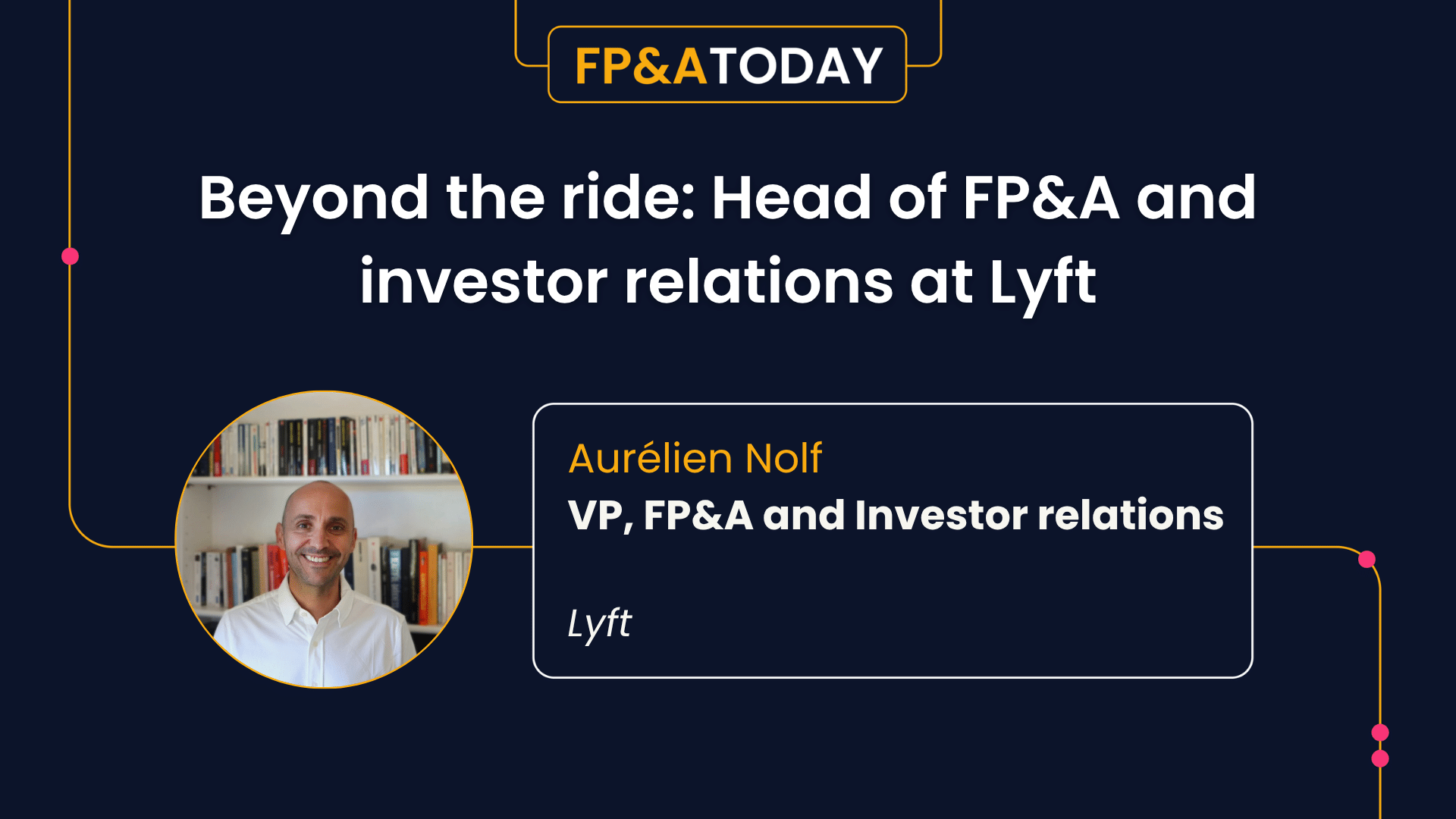
That’s the blunt opening from Aurélien Nolf, VP of FP&A and Investor Relations at Lyft, who leads a 60-person team managing billions of data points across one of the world’s most recognized mobility platforms. After more than 15 years at Electronic Arts and now guiding FP&A strategy at Lyft through profitability and growth, Nolf has watched the finance function transform from backward-looking number-crunchers to forward-looking business strategists.
The winners in that transformation? Finance professionals who understand that operational FP&A metrics aren’t decorative context for a P&L slide. They are the story.
In a recent episode of Datarails’ FP&A Today podcast, Nolf explained why operational metrics have overtaken financial metrics as the north star for modern FP&A teams, how machine learning has changed who builds forecasts and who interprets them, and what separates finance leaders who earn a seat at the strategy table from those who remain trapped in reporting roles.
The Shift That Changes Everything
The irony of modern FP&A: the more data-driven the function gets, the more the accounting fundamentals matter for knowing when the data is lying.
“The P&L is the scoreboard. Operational metrics are the game film.”
At Lyft, this distinction drives everything. The company tracks active riders, frequency, driver availability, mode mix, regional variations, and rider cohorts. These operational FP&A metrics form the foundation of both internal planning and external guidance to investors. Traditional P&L figures serve as validation of the operational story rather than the headline.
“We try to start with what creates the value for the company, for the business,” Nolf explains. “In the Lyft example, that would be active rider or frequency or margin. And then depending on the audience, you’re gonna go very deep or not very deep.”
The real estate these metrics occupy in monthly reporting has grown substantially. When Lyft closes its books, operational metrics dominate the narrative. “We look at the riders, their frequency, the number of drivers. We look region by region, we look more and more at rider cohorts and how they behave and how they spend money and how we retain them,” Nolf says. “When we do that, not only are we able to explain our financials, but we are also able to guide the business and help them make better business decisions.”
This shift is industry-wide, not just a Lyft idiosyncrasy. According to a 2024 survey by the FP&A Trends Group, only 35% of FP&A professionals’ time is spent on high-value activities like generating insights, with the majority still consumed by data collection and validation. The operational metrics model that Nolf describes inverts that ratio by making forecasting driver-based rather than output-based.
Why Financial Systems Weren’t Built for This
The infrastructure challenge is real. Traditional financial systems, ERPs, planning platforms, and the broader ecosystem were designed for a simpler time when finance tracked what accounting captured.
Operational FP&A metrics don’t live in those systems. They live in data warehouses, SQL databases, and custom analytics platforms maintained by data science teams. Getting to them requires finance professionals who can bridge both worlds.
“Pretty much everything that is driving our business and helps us tell a story is not available in our financial systems,” Nolf explains. “You can download all the information from our ERP or our forecasting system, you’re not gonna be able to tell a story. And so we have to go to the data science teams, to their SQL models and all those things to be able to craft a narrative and really understand what’s going on.”
This creates both an opportunity and a necessity. Finance teams must evolve beyond their traditional toolsets or cede relevance in business conversations where operational data speaks first.
The Hybrid Future of FP&A
“SQL fluency is no longer a bonus skill for FP&A. It’s becoming the price of admission to the conversations that matter.”
Nolf is direct about where the function is headed: machine learning models forecast all operational drivers at Lyft. The revenue operations team, staffed heavily with data scientists, builds complex forecasts using ML. The FP&A team then translates those operational predictions into financial projections, with both teams actively challenging each other’s assumptions.
This is not finance becoming data science. It is finance learning to operate at the intersection: understanding enough about both domains to ask the right questions and validate the answers.
Currently, Nolf’s team is composed mostly of traditional finance professionals. But many are learning SQL, querying complex databases directly, and partnering more closely with data science counterparts. Some are writing their own queries to extract insights that would have required a data science ticket in the past.
“I don’t have data scientists today on the team, although I think it’s coming,” Nolf says. “But I’m fairly sure that if you and I are discussing it in a couple years, we will have more data scientists on the team.”
A 2024 EY Trends Survey supports the urgency of that move: FP&A teams that have adopted AI achieve 25% higher forecast accuracy than teams still relying on legacy systems, according to research cited by Datarails. The gap between ML-enabled and traditional forecasting approaches is no longer marginal.
The team also hosts internal finance hackathons where FP&A and accounting professionals develop new automation and analytical capabilities. Nolf’s view is that the best ideas come from practitioners doing the work, not from executives mandating tools from above. “Our challenge as leaders is to empower our teams and foster a culture where they’re gonna try and test things,” he notes. “The best ideas we had over the last two years are coming from that specific event.”
The Structural Advantage of Combining FP&A and IR
Nolf holds an unusual dual role: leading both financial planning and investor relations at a public company. That structure eliminates the telephone game between internal forecasts and external guidance.
“When FP&A and IR sit in separate rooms, the story changes in translation. When they share a team, the story stays true.”
“I know exactly what’s included in the forecast that has been used to create guidance,” he explains. “Having both under the same team, it kind of eliminates the telephone game.”
The challenge is partitioning information appropriately. The internal team knows things months before they become public. They model scenarios and review granular details that never reach external audiences. When Lyft announced its major partnership with Waymo for autonomous vehicles, Nolf’s FP&A team had already been modeling the impact for months. When investors asked about it on calls before the announcement, his response was simple: “I don’t know what you’re talking about.”
“You have to really be able to separate the two,” he acknowledges. “But the key is consistency. As a company, we want to be very transparent and guide investors the right way. And so everything we say is the truth. It’s just a different level of detail.”
The structural importance of investor relations finance is growing in public company FP&A precisely because getting guidance right has become harder. According to FCLTGlobal data cited by Kiplinger, only about 20% of S&P 500 companies now provide regular performance projections to Wall Street, down from 50% in 2004. The companies that do provide guidance, like Lyft, face heightened investor scrutiny when they miss. That raises the stakes for having FP&A and IR aligned at the source rather than coordinating after the fact.
Practical AI Applications in FP&A Metrics Work
Lyft uses AI across multiple FP&A workflows, consistently focused on augmentation rather than replacement.
For variance analysis, the team feeds entire models into AI systems for first-pass explanations. “It’s very helpful because it helps you get to this first pass, which saves a lot of time,” Nolf says, while cautioning that AI output still requires expert review before it feeds into decisions.
For investor relations finance, AI synthesizes the 47 analyst reports covering Lyft’s stock. “We now dump all those reports into an AI model and ask for summaries, the risks, the opportunities, highlight the issues, highlight everything we need to know,” Nolf explains. “And in three minutes you get a very robust summary. AI is really, really good with those reports.”
“AI compresses hours of analyst synthesis into minutes. What it can’t do is tell you which three findings actually matter to your business.”
Nolf is emphatic that AI capability without domain expertise is a liability, not an advantage. “People that are using those tools need to be the experts in their field and domain first. You have to learn the basics because you have to be able to spot the issue in whatever the AI tool is spitting back at you.”
The productivity gains are real, but the function will grow rather than shrink. “Over time, we’re gonna cut the processing time in half,” Nolf predicts. “We are gonna do a better job at detecting patterns earlier and bring that insight to the business teams. But I think it’s just gonna grow the business as opposed to just shrinking the teams.”
What Actually Matters in Modern FP&A Careers
“Finance has promoted spreadsheet operators for decades. The next generation of FP&A leaders will be promoted for their ability to make a CFO rethink a decision.”
When Nolf hires for a four-person FP&A role, he looks for curiosity above technical skill. “We really look for curious people that are gonna be able to adapt and that are gonna surface the problem pretty early,” he says.
He has watched technically brilliant colleagues plateau because they couldn’t connect with business leaders or translate insights into decisions that actually moved things. “I’ve seen so many of my colleagues when I was more junior, they were like spreadsheet nerds, and they could do all those very complex formulas without even looking at their keyboard and everything moves on the screen and it looks super cool, and you’re like, oh, am I behind?”
The answer, Nolf says, is no. “That’s not very important. What’s really important is your ability to connect with the business teams, understand what they’re doing, what’s important to them, how you can help them grow their business, and then how you can communicate those challenges and those opportunities.”
His first piece of career advice: “Number one, focus on your communication skills. How do you interact with leaders? That’s number one.”
The Accounting Foundation That Still Matters
Despite the shift toward operational metrics and data science fluency, Nolf remains emphatic about accounting fundamentals. He began his career at PwC in audit, learning to verify numbers and trace them to their source.
“Accounting is still serving me daily,” he says. “It’s making sure all our forecasts are grounded in reality, that all the assumptions are defensible. And knowing about how a transaction is gonna flow through a balance sheet and then your statement of cash flow is super important for FP&A people as well.”
The interesting paradox for public company FP&A: the function is moving toward data science and operational metrics, but the foundation still requires deep accounting knowledge. Understanding cash flow mechanics, transaction flows, and balance sheet dynamics remains non-negotiable for validating the outputs of automated forecasting and catching errors before they reach a board deck or an earnings call.
The Bottom Line for FP&A Leaders
The finance function is dividing into two groups: those who understand the business deeply enough to use operational FP&A metrics predictively, and those who remain trapped in backward-looking reporting roles.
The leaders who thrive will master the operational metrics that predict business outcomes rather than confirm past performance, build fluency at the intersection of finance and data science without abandoning accounting fundamentals, use AI to eliminate processing time rather than replace judgment in investor relations finance and planning work, develop communication skills that earn access to strategy conversations, and foster team cultures where experimentation with new tools is expected rather than exceptional.
The ones who perfect complex Excel formulas while ignoring business context will become increasingly irrelevant. The ones who trust AI outputs without deep domain expertise will make errors that compound at the worst possible moment.
The opportunity is visible and the timeline is compressing. Operational FP&A metrics that matter aren’t sitting in the general ledger. They are in data warehouses, customer behavior patterns, and ML forecasting models built by people who used to work in a different department. Getting there requires curiosity, technical adaptability, and the communication skills to turn what those models surface into decisions that change outcomes.
That combination is what makes modern FP&A leadership irreplaceable.
Datarails is the FP&A platform that lets finance teams build on Excel rather than abandon it. From automated consolidation and real-time variance analysis to AI Agents purpose-built for the Office of the CFO, Datarails gives finance teams the infrastructure to move from data preparation to strategic analysis. Learn more at datarails.com/datarails-ai.
This article is based on Aurélien Nolf’s appearance on the FP&A Today podcast.
Aurélien Nolf is VP of FP&A and Investor Relations at Lyft, where he leads a 60-person team managing financial planning and investor communications for the mobility platform. Previously, he spent more than 15 years at Electronic Arts across controllership and FP&A leadership roles. He began his career at PwC in audit.