Renewal is a useful time to compare Vena alternatives, particularly when costs or planning requirements have changed.
Vena earned its place by keeping finance teams in Excel, and that Excel connection remains relevant when evaluating a switch. It is also why the switch is harder to think through than it looks, because nearly every serious alternative now claims to work with Excel too.
The difference that matters is narrower and more practical: which parts of your existing models can be retained and which need adaptation. Here are seven platforms worth a place on the shortlist, and how that question sorts them.
Why finance teams look for Vena alternatives
Vena's strengths are worth stating first. It runs planning inside Excel on top of a central database, with workflow, version control, and audit trails that turn loose spreadsheets into a governed process. It integrates tightly with Microsoft 365 and Power BI, and its 2026 releases added Planning and Reporting agents through Vena Copilot and a native financial consolidation product covering intercompany eliminations and FX translation.
Teams evaluating alternatives should compare three areas in particular.
Year-one cost runs well past the subscription. Vena does not publish pricing. Independent research from CFO Shortlist puts the subscription at $50,000 to $150,000 a year for 50 to 200 users, and year one at $75,000 to $225,000 once implementation and training are added.
Implementation estimates depend on scope. The same firm's implementation benchmarks put standard mid-market Vena projects at 14 to 30 weeks, largely because templates and contributor workflows take time to design.
Existing models need mapping and configuration. Vena supports importing existing Excel models, but teams still need to configure data mappings, templates, and contributor workflows, and reviewers on Capterra mention performance slowing on large data volumes and complex reports, with some relying on support or consultants for template changes.
None of that makes Vena a poor choice. It makes renewal a sensible moment to price the alternatives, especially for teams whose models work fine as they are and who mainly want the data underneath them automated.
What are the best alternatives to Vena Solutions?
The strongest Vena alternatives are Datarails, Prophix, Planful, Cube, Workday Adaptive Planning, Anaplan, and Jedox. They sort into four groups, depending on how much of the current Excel workflow needs to survive and how far planning reaches beyond finance.
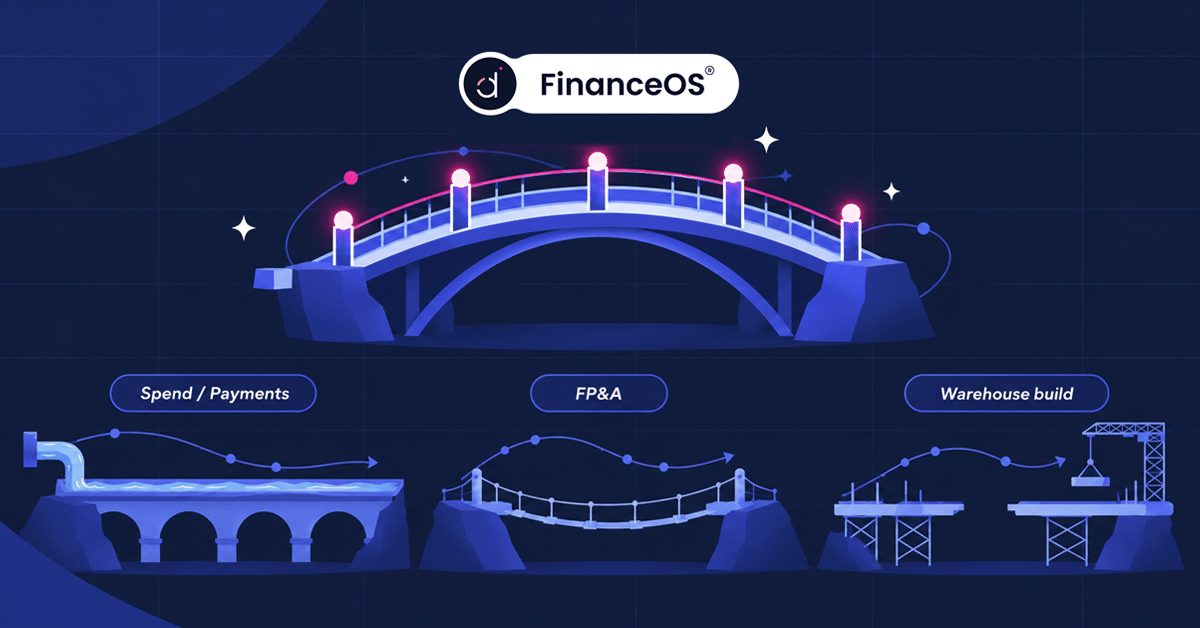
- Keep your existing models: Datarails FP&A, built on FinanceOS, is Excel-connected. Teams keep their own workbooks in Excel or Google Sheets, while FinanceOS consolidates and governs the data feeding them. Datarails reports that most FP&A implementations go live in 4 to 6 weeks.
- Planning and close in one suite: Prophix and Planful bring budgeting, consolidation, and close together, with modeling inside the platform rather than in your workbooks.
- Lean and spreadsheet-first: Cube suits smaller finance teams that want a fast start in Excel or Google Sheets.
- Ecosystem or enterprise scope: Workday Adaptive Planning fits organizations already on Workday, while Anaplan and Jedox serve cross-functional planning across sales, supply chain, and workforce.
Teams that chose Vena for Excel should start by testing how each alternative handles their existing workbooks. For a detailed comparison, read Datarails vs. Vena.
Vena vs. alternatives at a glance
| Platform | Implementation time | Pricing | Excel approach | Planning scope | Best for |
|---|---|---|---|---|---|
| Vena | 14 to 30 weeks | $50K to $150K/year for 50 to 200 users; year 1 about $75K to $225K | Excel-native templates on Vena's cube | Finance-first, plus close and consolidation | Mid-market teams in the Microsoft ecosystem |
| Datarails | 4 to 6 weeks (Datarails FP&A) | Mid-market typically $35K to $80K/year; enterprise from $100K/year; plus a one-time onboarding fee | Excel-connected. Existing models stay in Excel or Google Sheets, plus a web app | Finance-led, across the office of the CFO | Mid-market and enterprise finance teams, including multi-entity groups |
| Prophix | About 8 weeks (standard mid-market scope) | About $65K/year typical; $50K to $200K range; implementation $5K to $50K+ | Modeling happens in the platform | Planning, close, and consolidation | Mid-market teams consolidating planning and close |
| Planful | 8 to 12 weeks (vendor-claimed) | $80K to $250K/year software | Excel add-in for reporting. Modeling happens in the platform | Planning, consolidation, close, and reporting | Finance teams where multi-entity consolidation is a firm requirement |
| Cube | 4 to 8 weeks (vendor-reported) | Not published | Spreadsheet-native in Excel and Google Sheets | Core FP&A | Smaller finance teams that want a fast start |
| Workday Adaptive Planning | 6 to 16 weeks | $80K to $300K/year for 200 to 500 users | Office Connect for Excel and PowerPoint reporting | Finance plus workforce | Organizations running Workday HCM or Financials |
| Anaplan | 4 to 12 months | $150K to $1M+/year typical enterprise | Models rebuilt in Hyperblock | Cross-functional connected planning | Large enterprises planning across finance, sales, supply chain, and workforce |
| Jedox | Varies by scope | Not published | Excel add-in front end | Finance, sales, supply chain, and workforce | Mid-market teams needing multidimensional modeling |
Third-party pricing and timeline estimates come from CFO Shortlist's 2026 pricing and implementation research; Cube's timeline is vendor-reported via Eightx. Datarails figures come from Datarails. These estimates cover different project scopes; request scoped proposals to compare timelines and total costs.
The best Vena alternatives for finance teams
1. Datarails
Datarails FP&A, built on FinanceOS, is an option for teams that chose Vena to stay in Excel. It automates planning, reporting, and analysis without asking finance to give up the workbooks it already trusts.
Datarails connects to the models finance already uses. Finance teams keep their existing Excel models, formulas, and reporting templates exactly as they are, and can also work in Google Sheets or the Datarails web app. Nothing is rebuilt as a vendor template. Datarails automates the data feeding those models, and FinanceOS connects to 600+ data sources spanning ERPs, accounting systems, CRMs, HRIS platforms, billing tools, and banks.
FinanceOS is where the governance lives, and that is the architectural difference. Compare how each platform handles a new entity, a remapped account, or a revised allocation rule, and how much workbook maintenance each change requires. In FinanceOS, those rules sit once in the data layer underneath every workbook. Its semantic layer defines each metric a single time, so revenue or gross margin means the same thing in every model and report. Consolidation logic, including currency translation, intercompany eliminations, and multiple charts of accounts, is applied before the data reaches the workbook. Permissions govern access to data and reports, while lineage supports tracing reported figures to their source data.
Both platforms now ship AI agents, and some share names, so the useful comparison is what each one reads. Vena's agents work on Vena's cube. The Reporting, Planning, and Strategy Agents in Datarails AI use governed financial data available through FinanceOS. The scope of an answer depends on the connected data and the user's permissions. Finance should review generated outputs before using them in reports or decisions. Insights delivers scheduled summaries of the metrics a team tracks, Storyboards turns them into management-ready presentations, and the FinanceOS AI Connector brings the same governed data into Claude, ChatGPT, and other AI tools.
Breadth is the other difference. On the Expert plan, Datarails FP&A runs alongside Datarails Spend, Datarails Cash, Datarails Month-End Close, Datarails Receivables, and Datarails Desk, all reading the same FinanceOS data. Connected cash positions and closed actuals can inform forecasts through FinanceOS. Adding an application lets finance reuse existing mappings and definitions, with any additional data connections configured for its scope.
Implementation scope is another practical consideration. Datarails FP&A typically goes live in 4 to 6 weeks, delivered by Datarails' own implementation team for a one-time onboarding fee, and because teams keep their own workbooks, training time stays low. The trade-off is philosophy. Teams that want a locked, templated contributor process imposed on every budget owner, tightly wrapped in Power BI and Microsoft Teams, may find Vena's structure closer to how they want to run planning.
| Best for | Pricing |
|---|---|
| Mid-market and enterprise finance teams, including multi-entity groups, that want to keep their own Excel models and run planning, consolidation, the close, and cash on one governed foundation | Mid-market teams typically invest $35,000 to $80,000 per year, and enterprise plans start at $100,000. Every plan carries a one-time onboarding fee. The Expert plan includes Datarails FP&A, Spend, Cash, Month-End Close, Receivables, and Desk, with 15 users, 50 viewers, three integrations, and premium support. See the Datarails pricing guide for typical ranges and the pricing page for plan details. |
Why finance teams switch from Vena to Datarails
Three differences are worth testing during evaluation.
- The models stay theirs. Existing workbooks keep working, so the institutional logic in them can remain in place while the underlying data connections are configured.
- Compare time to value. Datarails FP&A typically goes live in 4 to 6 weeks, against 14 to 30 weeks for a standard mid-market Vena implementation.
- The scope reaches past FP&A. Spend, cash, the close, receivables, and AI all run on the same FinanceOS data, with data consolidation and budgeting & forecasting working from the same numbers.
See for yourself why finance teams switch from Vena to Datarails.
2. Prophix

Prophix One is a financial performance platform that brings budgeting, forecasting, reporting, close, and consolidation into one subscription. Its AI layer includes agents for model building and consolidation and a Copilot for Microsoft Teams.
Its case against Vena is price-to-scope. CFO Shortlist puts a typical mid-market deployment at about $65,000 a year, inside a $50,000 to $200,000 range, with implementation quoted separately at $5,000 to $50,000 or more. Standard mid-market projects reach production in about 8 weeks, stretched mainly by entity count and consolidation scope.
The trade-off is Excel. Prophix models live in the platform, so teams that chose Vena to keep working in their own spreadsheets will be changing how they work, not just the vendor.
| Best for | Pricing |
|---|---|
| Mid-market teams that want planning, close, and consolidation in one suite | Not published. About $65,000 a year typical, in a $50,000 to $200,000 range, plus implementation. |
3. Planful
Planful is a financial performance management platform covering planning, consolidation, close, and reporting, positioned between the mid-market and the enterprise tier.
Its strength is balance. Multi-entity consolidation is capable, structured planning workflows are mature, and Planful Predict adds machine learning to forecasting and anomaly detection. For teams whose main frustration with Vena is consolidation depth, it is a credible step across.
Planful puts core implementation at 8 to 12 weeks, with the close module often phased in second, and services typically add $40,000 to $120,000. Modeling happens in the platform, with Excel used mainly for reporting, and multi-year contracts are common.
| Best for | Pricing |
|---|---|
| Mid-market and enterprise finance teams where multi-entity consolidation is a firm requirement | Not published. Software commonly runs $80,000 to $250,000 a year, with multi-year commitments common. |
4. Cube
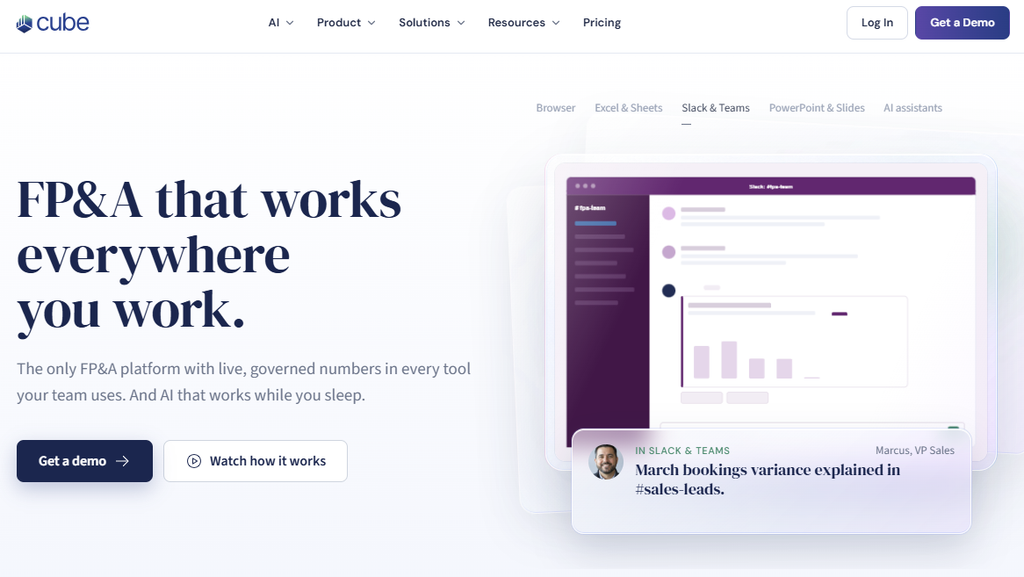
Cube is a spreadsheet-native FP&A tool that works inside Excel and Google Sheets, built for teams that prioritize a fast start over deep configuration.
Cube is worth evaluating for teams that want a spreadsheet-based FP&A workflow. Implementations commonly run 4 to 8 weeks for a core P&L and headcount model, by Cube's own reporting, and the learning curve is short because teams stay in the spreadsheets they know.
Test consolidation and contributor workflows against your actual requirements. For multi-entity groups, ask Cube to demonstrate intercompany eliminations, currency translation, permissions, and performance with your expected data volumes and user count.
| Best for | Pricing |
|---|---|
| Smaller finance teams, including mixed Excel and Google Sheets environments, that want a quick implementation | Not published; quoted by scope. |
5. Workday Adaptive Planning
Workday Adaptive Planning is a planning platform covering budgeting, forecasting, workforce planning, and reporting, with native ties to Workday HCM and Financials.
Its clearest advantage is that connection. Native Workday connections can simplify bringing headcount and compensation data into planning models. Confirm the mappings, refresh schedules, and setup required for your systems. Office Connect brings reporting into Excel and PowerPoint, though modeling happens inside the platform.
Implementation typically runs 6 to 16 weeks, with Workday customers landing near the fast end, and services generally cost 1 to 2 times the annual subscription. Teams using other ERP or HR systems should assess its integration and modeling fit; Workday HCM is not a prerequisite.
| Best for | Pricing |
|---|---|
| Upper mid-market and enterprise organizations already running Workday HCM or Financials | Not published. Deployments of 200 to 500 users commonly run $80,000 to $300,000 a year. |
6. Anaplan
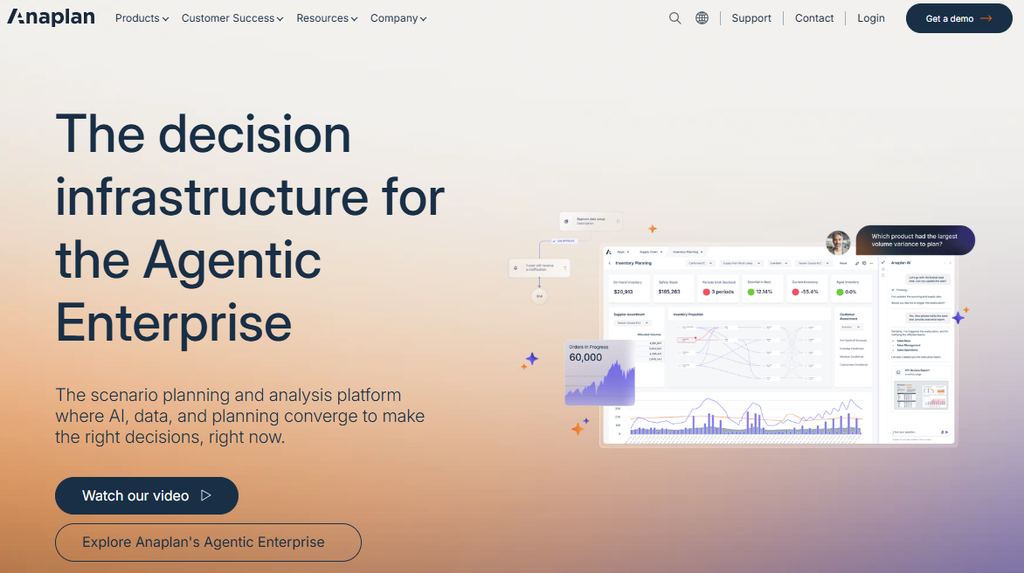
Anaplan is an enterprise planning platform built on its Hyperblock engine, supporting connected planning across finance, sales, supply chain, and workforce on a single data model.
It belongs on the shortlist when planning spans functions beyond finance. Test its dimensional model, data volumes, and performance alongside the resources required to maintain it.
That scale carries enterprise costs. Implementation runs 4 to 12 months, typical enterprise deployments cost $150,000 to $1 million or more a year, and integrator fees of 1.5 to 3 times the license push first-year cost higher still. Models are rebuilt in Hyperblock, so the Excel continuity that drew teams to Vena does not carry over.
| Best for | Pricing |
|---|---|
| Large enterprises with cross-functional planning and dedicated model-builder resources | Not published. Typical enterprise deployments run $150,000 to $1 million or more a year, before services. |
7. Jedox

Jedox is a performance management platform built on an in-memory multidimensional database, with an Excel add-in front end and modeling that reaches beyond finance.
It is an option for teams that need multidimensional modeling and cross-functional planning. Compare a scoped proposal before drawing conclusions about cost. Jedox supports finance, sales, supply chain, and workforce planning, and Gartner includes it in the Magic Quadrant for Financial Planning Software.
The cost of that reach is complexity. Modeling in Jedox sits closer to building cubes than to configuring templates, and advanced use cases typically need technical or partner support.
| Best for | Pricing |
|---|---|
| Mid-market teams that need multidimensional and cross-functional modeling | Not published; request a quote for the required users, models, integrations, and support. |
How to choose a Vena alternative for your team
Use these four questions to narrow your shortlist.
Where do your models need to live?
Compare what each platform requires you to change in your existing Excel models. Ask vendors to demonstrate which workbooks, formulas, and allocation rules can be retained, which need adaptation, and where the resulting models will be maintained.
If that logic took years to build and nobody documented it, keeping it in place is worth more than any feature comparison. Mapping which data analysis tools in Excel the team leans on today is a useful first inventory.
What is the total cost, including people?
The subscription is only one part of the total cost. Add implementation services, training, the administrator or partner time that template changes require, and the users who join at each renewal.
A platform that starts cheaper can end up costing more by year three. Use the criteria in our guide on how to choose the best FP&A software to compare total cost of ownership.
Who owns changes after go-live?
Ask every vendor how long implementation will take with your actual data, and then ask the more revealing question: who makes changes once it is live? A new department, a reorganized chart of accounts, or a revised allocation rule should be something finance can handle without opening a services ticket.
How far beyond FP&A does the platform reach?
Planning rarely stays on its own for long. Consider whether the platform covers the close, cash, and spend on the same data, and whether its AI works on governed, consolidated numbers rather than a copy of last month's report. The complete guide to AI in FP&A covers what to look for.
Make the right choice between Vena competitors
Vena remains a strong fit for teams that want a governed, templated planning process inside the Microsoft ecosystem, and its 2026 releases expanded its AI and consolidation capabilities.
Compare alternatives on cost, implementation scope, and how your existing models will be maintained. For teams that want planning and close in one suite, Prophix and Planful are the natural next look. For teams whose planning now spans the whole business, Anaplan, Workday Adaptive Planning, and Jedox are built for that scope.
For teams that chose Vena to stay in Excel and still want to, Datarails FP&A, built on FinanceOS, keeps their models in place, governs the data underneath them. Datarails reports 4 to 6 weeks for most FP&A implementations.
Keep your models. Lose the rebuild.
See why finance teams switch from Vena to Datarails, and how FinanceOS consolidates your ERP, CRM, HRIS, and banking data under the workbooks your team already trusts.
FAQs
What are the best alternatives to Vena Solutions?
The strongest Vena alternatives are Datarails, Prophix, Planful, Cube, Workday Adaptive Planning, Anaplan, and Jedox. Datarails is worth evaluating if retaining existing Excel models is a priority. Prophix and Planful combine planning and close in one suite, Cube suits smaller teams, and Workday Adaptive Planning, Anaplan, and Jedox serve ecosystem or cross-functional needs.
Why do finance teams switch away from Vena?
The common reasons are cost, implementation length, and template overhead. Year one commonly lands between $75,000 and $225,000 with implementation and training, standard mid-market projects run 14 to 30 weeks, and existing workbooks need to be mapped into Vena's governed environment.
Is Datarails cheaper than Vena?
Compare quotes for the same users, modules, and implementation scope. The Datarails figures below are annual subscriptions, while the Vena figure is a first-year estimate including implementation and training. Mid-market Datarails customers typically invest $35,000 to $80,000 per year, and enterprise plans start at $100,000, with a one-time onboarding fee. Vena's first year commonly runs $75,000 to $225,000 including implementation and training.
What's the easiest Vena alternative to implement?
Datarails FP&A typically goes live in 4 to 6 weeks, and Cube reports 4 to 8 weeks for a core model. Prophix averages about 8 weeks for standard mid-market scope and Planful claims 8 to 12 weeks, against 14 to 30 weeks for a standard Vena implementation.
Is there an Excel-native alternative to Vena?
The alternatives use different Excel workflows. Datarails is Excel-connected: teams keep their own models and formulas in Excel or Google Sheets, with FinanceOS governing the data underneath. Cube is spreadsheet-native in Excel and Google Sheets, while Jedox uses an Excel add-in on top of its own database.
How does Datarails compare to Vena?
Both keep finance working in Excel, but in different ways. Vena maps Excel models and templates to its central database, while Datarails FP&A keeps existing models in place and runs them on FinanceOS, which consolidates and governs the data. Datarails reports 4 to 6 weeks for most FP&A implementations. Its Spend, Cash, and Month-End Close applications share the same FinanceOS foundation.
What's the best Vena alternative for a mid-market company vs. an enterprise?
Mid-market teams that want to stay in their own spreadsheets usually fit best with Datarails, while those wanting planning and close in one suite look at Prophix or Planful, and smaller teams at Cube. Enterprises with finance-led planning can run Datarails on the Expert plan or a custom Enterprise plan, while those with cross-functional scope look at Workday Adaptive Planning, Anaplan, or Jedox.