Click for Takeaways: Financial Data Security
- Two different risks: “Can I trust AI with financial data” is a financial data security question with two parts: exposure (does the vendor retain or train on it) and permissions (can everyone using the AI see everything).
- The shadow AI problem: 31% of employees have already shared financial information or confidential company documents with public AI tools, often through personal accounts nobody in IT knows about.
- The permission gap: Even a sanctioned, enterprise-tier AI tool can expose more than intended if it isn’t wired to the same role-based access controls that already govern who sees what in the source systems.
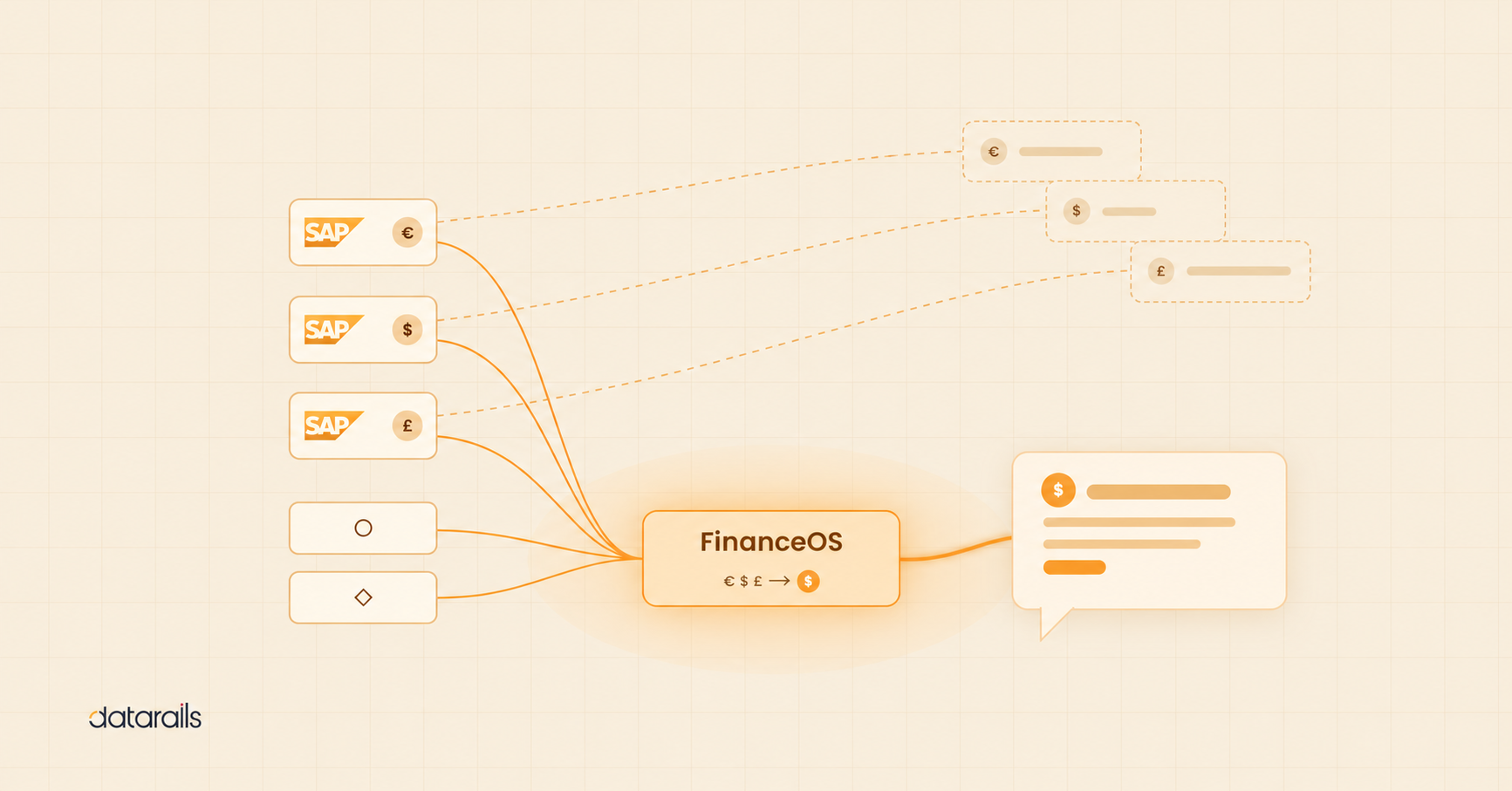
- Where FinanceOS fits: Datarails FinanceOS sits between financial systems and any AI tool, enforcing per-user permissions and logging every query, so AI usage becomes sanctioned and visible instead of invisible and unrestricted.
The pressure on finance leaders to fully implement AI FP&A tools is intense, but their reservations aren’t only about confidently wrong outputs. The bigger issue is arguably financial data security: whether your numbers should touch AI at all and who can see them once they do..
Once a number leaves your systems and becomes part of a prompt, what happens to it on the vendor’s side? And within your own company, does everyone using that AI tool see only what they’re supposed to, or does the AI quietly flatten every permission your company already has in place?
The Real Risk is the Account Type
Not all AI tool usage carries the same risk, because the AI vendors themselves don’t treat all their accounts the same way. OpenAI states plainly that it does not use data from ChatGPT Enterprise, Business, or its API for training by default. Anthropic’s enterprise and API agreements carry the same commitment, with retention windows measured in days rather than years and zero-retention options available for regulated customers.
Consumer accounts are a different story. Since August 2025, Anthropic’s free, Pro, and Max tiers use conversations to train future models by default unless a person actively opts out, with data retained for up to five years for those who don’t. Free and Plus ChatGPT accounts have similar defaults. The gap between “AI is unsafe for financial data” and “AI is unsafe for financial data on a personal login” is enormous, and almost nobody frames it that way.
Which is exactly why this isn’t a hypothetical. A 2026 PagerDuty survey of 1,250 office professionals at companies with $500 million or more in revenue found that 31% had shared financial information or confidential company documents and strategies with public AI tools, and 66% had used an AI tool at work despite believing it wasn’t permitted. Most of that usage happens on personal accounts, the exact tier with the weakest data handling, entirely outside any policy or visibility IT has.
Even Sanctioned AI Needs to Respect Who’s Allowed to See What
Solving the vendor-side problem, moving everyone onto an enterprise or API agreement, only closes half the gap. The other half is internal, and it’s the one most companies haven’t thought through at all: if you connect an AI tool to your consolidated financial data so it can answer questions, does it inherit the same permissions your ERP and payroll systems already enforce, or does it flatten them?
Most AI integrations built quickly don’t carry permissions over. If a junior analyst can open the company’s sanctioned AI assistant and ask about executive compensation, board compensation, or an unannounced acquisition, and the assistant answers, the AI hasn’t created a new risk so much as it’s silently deleted an old control. The access boundaries that took years to configure in the underlying systems don’t automatically travel with the data when AI is layered on top; someone has to design that in on purpose.
What Actually Determines Financial Data Security
Three things have to be true before financial data security and AI can coexist safely, and none of them is “pick the right chatbot.”
1. An enterprise or API agreement with the AI vendor, so retention and training are contractually excluded rather than left to a consumer default nobody checked.
2. Permission-aware access at the point the AI queries data, backed by the same data encryption and access controls finance teams already rely on, so the AI can only surface what the person asking is already authorized to see, not the entire consolidated dataset behind it.
3. A logged, auditable trail of every AI query, so “who asked AI what, and what did it see” is answerable after the fact instead of invisible by default.
How Datarails FinanceOS Fits
Datarails FinanceOS is built to sit between a company’s financial systems and whichever AI tool a team is already using, through a finance MCP server. Rather than employees exporting spreadsheets into a personal AI account or IT standing up a single shared connection that treats every user identically, FinanceOS enforces role-based permissions at the point of query: an analyst’s questions are scoped to what that analyst can already see, not to the full consolidated environment.
Every query is logged, what was asked, which sources it touched, what was returned, giving finance and security teams the visibility that disappears the moment someone pastes numbers into a private chat window.
It doesn’t replace the need for an enterprise agreement with the AI vendor itself; that contractual layer still matters and is outside what any data platform controls. What it changes is the layer underneath: instead of AI use being invisible, unsanctioned, and unrestricted, it becomes sanctioned, permissioned, and visible, which is the real difference between confidential data being at risk and being governed.
| Layer | Who handles it | What it controls |
| Vendor data handling | AI vendor’s enterprise/API agreement | Whether prompts are retained or used for training |
| Internal permissions | Governed data layer (e.g. FinanceOS) | Who can see which numbers through the AI |
| Visibility and audit | Query logging at the data layer | Whether usage is traceable after the fact |
Practical Takeaways
Don’t evaluate whether AI is safe for financial data by which model your team prefers. Start by confirming every AI account touching company data is on an enterprise or API tier, not a personal login. Then check whether the AI’s access to data mirrors the permissions that already exist in your source systems, or quietly bypasses them. If nobody can answer who asked AI what last month, that’s the gap to close first, before adding another use case on top of it.
Ready to find out more?
Financial Data Security and AI FAQs
It means two things are true: the AI vendor’s account tier contractually excludes your data from retention or training, and your existing role-based permissions carry over so the AI can’t surface more than the person asking is already authorized to see. Model choice isn’t part of the definition.
Rarely. Leaks typically trace back to which account tier was used (a personal login instead of an enterprise agreement) or to an internal integration that didn’t carry over existing role-based permissions, not to the underlying model.
Not by default on enterprise, business, or API tiers, both OpenAI and Anthropic state this explicitly. Consumer tiers (Free, Plus, Pro, Max) are a different story: Anthropic’s consumer tier trains on conversations by default since August 2025 unless a user opts out, and free ChatGPT accounts carry similar defaults.
Shadow AI is employee use of AI tools outside IT’s knowledge or approval, often personal accounts. A 2026 PagerDuty survey found 31% of office professionals had already shared financial information or confidential company documents with public AI tools this way, with no logging or oversight.
No. That contractual layer, covering data retention and training, sits with the AI vendor and still needs to be in place. FinanceOS governs the layer underneath it: enforcing who can see which numbers through the AI and logging every query.