
Modern FP&A tools infused with artificial intelligence are transforming the entire financial planning process as we know it.
Financial Planning and Analysis (FP&A) has evolved from pencil-and-paper bookkeeping to Excel spreadsheets, and now to AI-driven software. Just as the introduction of spreadsheet software in the 1980s revolutionized finance, AI is the next game-changer.
In the words of one finance leader and influencer, Nicolas Boucher: “AI is here to stay and ignoring it would be like ignoring Excel when it was released 40 years ago.”
AI FP&A tools can help your finance team consolidate data, integrate disparate sources, and generate insights with unprecedented speed and accuracy.
In other words, these Top AI FP&A tools of 2026 empower finance teams to spend less time on manual tasks and more on strategic financial analysis and decision-making.
Before diving into the detailed reviews, the comparison table below provides a snapshot of the top 10 AI FP&A tools in 2026, including their standout AI-driven features and who they’re ideal for.
The top AI FP&A tools in 2026 are Datarails AI, Planful Predict, Workday Adaptive Planning, Anaplan PlanIQ, Cube, Pigment, Vena, Jirav, Fluence, and SAP Analytics Cloud — each suited to different team sizes, data environments, and AI maturity levels.
Comparison of Top AI FP&A Tools (2026)
| Tool | Key AI-Driven Features | Standout Capabilities | Ideal For |
| Datarails AI | Chat-based analytics, AI-generated dashboards & reports, AI Agents (Strategy, Planning, Reporting), FinanceOS governed data layer | Conversational AI on real company data; instant variance insights | Excel-centric finance teams needing AI within spreadsheets, and teams wanting a governed, AI-ready data layer across their finance stack |
| Planful (Planful Predict) | Predict: Signals (error/anomaly detection); Predict: Projections (AI forecasting) | Automated error checking and unbiased forecasts from historical data; seamless integration into planning workflows | Mid-size to enterprise orgs seeking accuracy and integrity in forecasts |
| Workday Adaptive Planning | Embedded machine learning; Generative AI (Workday Assistant); Predictive analytics | ML built into core data engine for faster modeling; AI-driven variance analysis with explanations | Large enterprises (often Workday users) needing scalable, AI-enhanced planning |
| Anaplan PlanIQ | Statistical time-series forecasting, Amazon ML engine; New CoPlanner AI assistant | Handles multiple data types for more accurate forecasts; Conversational insights and recommendations via generative AI | Enterprises with complex, multi-dimensional planning across business units |
| Cube | Agentic AI for forecasts & scenarios; Excel/Sheets integration | AI-assisted forecasts, scenario modeling, and variance explanations in a familiar spreadsheet interface | Small to mid-sized businesses relying on Excel who want to automate and speed up FP&A |
| Pigment | “Analyst,” “Planner,” and “Modeler” AI agents; a collaborative planning platform | Proactive AI agents find trends and anomalies, suggest plans, and update models autonomously | Mid-large organizations seeking a modern, integrated business planning platform with cutting-edge AI assistants |
| Vena | Vena Copilot (natural language assistant); MS Excel & Power BI integration; AI-powered insights | Chatbot-style FP&A assistant for data queries, report generation, and trend analysis; Tailored generative AI models that learn from your data | Finance teams in Excel/Microsoft ecosystems wanting AI insights without leaving familiar tools |
| Jirav | Jirav “Autoforecast” (Intelligent Forecasting); driver-based models; templates | One-click AI-generated forecasts based on historical financial data; Quick implementation for budgeting, reporting, and dashboards | Small and mid-size businesses, accounting firms, and CFO advisors needing fast, high-quality forecasts and easy planning |
| Fluence | AI-automated financial consolidation; Excel-linked reporting; disclosure management | Automates data consolidation and close processes, freeing analysts for value-add work; Rapid deployment (live in weeks) and Excel-friendly interface | Mid-market companies with complex consolidation needs (multi-entity financial reporting) looking to streamline the close process |
| SAP Analytics Cloud (SAC) | Smart Predict (forecasting); Smart Insights (auto analysis); “Search to Insight” natural language queries; Joule AI assistant (planned) | Machine learning finds hidden patterns and drivers in data; Users ask questions in plain language and get instant analytics answers; integrates planning with business intelligence in one platform | Enterprises (especially SAP users) needing unified planning & analytics with robust AI for data analysis, forecasting, and visualization |
10 AI-Powered FP&A Tools Detailed Review
Below, we explore each tool in depth, highlighting how they leverage AI to enhance financial planning, forecasting, and analysis.
Each section covers what the software does, its standout AI features, and the benefits for finance teams.
1) Datarails AI
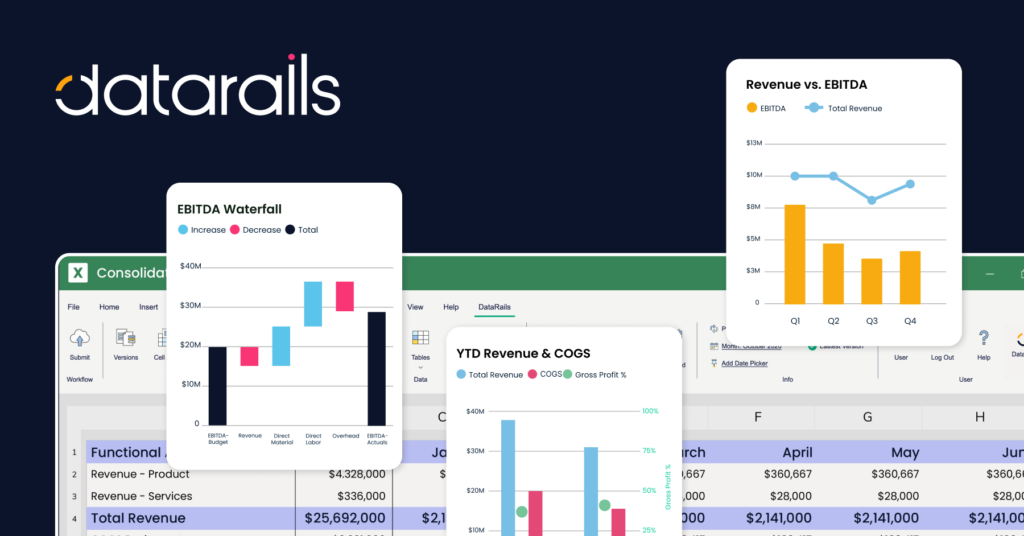
Since 2015, Datarails software has allowed FP&A departments to keep using the Excel spreadsheets they’ve been working with for years, while empowering them with all the features modern financial professionals need.
In March 2023, Datarails announced its breakthrough into the world of AI with Datarails AI, and since then, it has become an entire set of AI tools that transform the way finance teams work. This suite has quickly positioned Datarails as a leader in AI-driven FP&A.
AI Features:
Datarails AI offers multiple AI capabilities. The first is a ChatGPT-style chatbot that lets users ask questions in plain English and get instant answers based exclusively on their company’s financial data.
This conversational interface can explain variances, fetch specific metrics, or provide narrative analysis on the fly, saving CFOs and analysts from manual data searches.
The second feature is Storyboards. This AI feature produces dashboards and visuals based on the inputs, so with just two clicks, you can pull up real-time data visuals, even if you are in the middle of a meeting.
Most impressively, Datarails launched Reports by DataRails AI. It lets you input any Key Performance Indicators (KPIs) that drive your business, alongside your preferences for the type of report executives would like to receive, including trend identification, variance analysis, predictions, and budget vs actual (BvA).
The AI generates instant reports in any format and can surface the “what”, “why”, and “what’s next” in its analysis.
With the addition of Datarails AI Agents, Strategy, Planning, and Reporting, Datarails has moved beyond chat-based Q&A into agents that actively generate board-ready outputs, cementing itself as a leader in AI among FP&A software.
In 2026, Datarails also introduced FinanceOS, repositioning the platform as a governed, AI-ready data layer that connects an organization’s financial data to any AI tool — not just Datarails’ own chat and agent features.
Benefits:
- Formatted and actionable data: These reports are generated instantly, can be in any form, including monthly, quarterly, or ad hoc reporting, and are available in any format, including PDFs. They are also created with AI-generated graphs and powerful insights, such as variances, and the reasons they occurred, leading to a concrete recommendation for action.
- Conversational interface: Datarails AI ability to directly interpret questions means the CFO can get answers faster than ever before – no manual manipulation required.
- Security: Data used by Datarails AI is always secure, and external data is pulled strictly from trusted sources.
2) Planful Predict
Planful is a cloud-based FP&A platform designed to help organizations streamline their financial processes and drive better decision-making. In 2021, they announced the first tool in their Predict suite of AI programs: Predict: Signals. In 2022, they augmented their AI offerings with the introduction of Predict: Projections.
AI Features:
- Predict: Signals–Planful’s first AI program is intended to spot mistakes in data, formulas, and financial predictions. It flags these errors for FP&A team members to check and fix, helping to eliminate the possibility of human error in projections and reports.
- Predict: Projections–Projections is the next step in Planful’s adoption of AI. It takes Predict’s functionality a step further by creating forecasts informed by historical data. This allows the projections to be unbiased and informed solely by the data and the AI’s understanding of the variables affecting a firm.
Benefits:
- Error detection: Predicts signal anomalies in data, formulas, and projections to help teams catch mistakes early and improve reporting integrity.
- Bias-free forecasting: Predict’s projections use historical data to create accurate, objective forecasts that reflect real trends and not just human assumptions.
- Integrated insights: AI-driven insights and workflows are embedded directly into planning activities, helping finance teams act faster with contextualized intelligence.
https://www.youtube.com/watch?v=9wTnUa_3v-8
3) Workday Adaptive Planning
Workday has been serving the business world since 2005. The business and technology landscape today is almost unrecognizable compared to what it was in 2005, so it’s no surprise that Workday prioritizes adaptation.
In their effort to evolve alongside the market, Workday emerged as an early adopter of AI functionality, and given the space’s current popularity, they only plan to grow their offerings.
AI Features:
- Anonymous Neural Network Analysis: Workday offers an opt-in program that analyzes users’ actions. Millions of users have signed on, which means Workday AI gets to train and grow using lots of real-world data points.
- Built-In Machine Learning: Most other companies keep their data storage and machine learning models separate, requiring an occasional lengthy data transfer. Workday, however, embeds machine learning into the data store itself, providing for faster and more adaptive modeling.
Benefits:
- Conversational access: Users can interact with planning data using natural language queries to surface answers and receive executive-ready insights quickly.
- Embedded AI architecture: Machine learning is built into the platform’s core data engine, allowing for faster and more responsive forecasting and modeling.
- Personalized variance analysis: Intelligent variance detection highlights anomalies and provides contextual narrative explanations automatically.
4) Anaplan PlanIQ
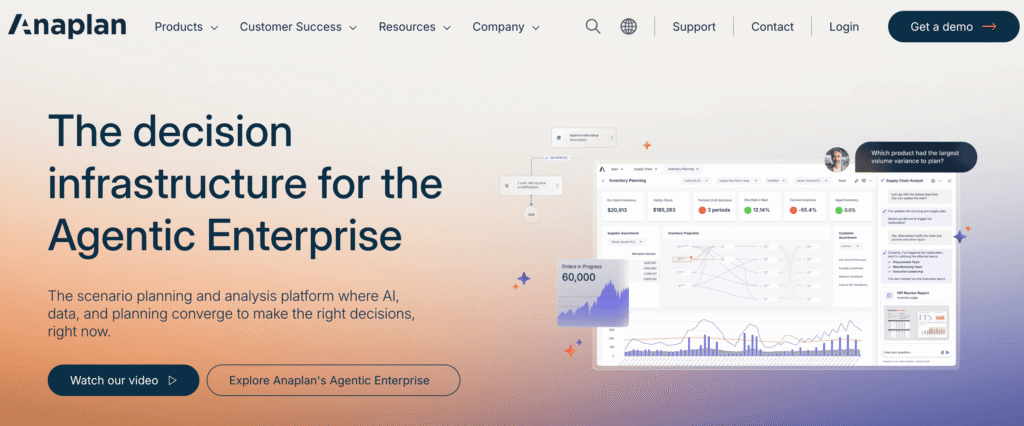
Anaplan is an enterprise data platform that specializes in business planning. Their recent venture into AI comes in the form of their PlanIQ, which is a paid add-on to the basic Anaplan software.
As is their expertise, PlanIQ is designed to help alleviate some of the pain points that come with traditional forecasting, like difficulties in adapting to rapidly changing market data.
AI Features:
- PlanIQ is Anaplan’s flagship AI feature for predictive forecasting. It uses advanced time-series forecasting techniques to churn through your historical data and generate highly accurate predictions for financial and operational metrics.
- Under the hood, PlanIQ integrates with Amazon’s machine learning engine (Amazon Forecast), leveraging AWS’s AI expertise to enhance its predictive power. This means users benefit from algorithms that have been trained on vast amounts of time series data.
Benefits:
- Data flexibility: PlanIQ can analyze up to three types of data at once, improving its forecast accuracy and relevance.
- Amazon Integration: PlanIQ uses Amazon’s intelligent forecasting engine, which is backed by its vast machine learning capabilities.
- Adjusting forecasts: The intelligent engine continuously updates users’ forecasts, helping them keep up with market trends without a long re-forecasting process.
5) Cube
Next, we have Cube, an FP&A software that automatically syncs your financial data to your spreadsheets. It also offers features like customizable dashboards, one-click drill-down, report templates, source systems integrations, and automated workflows.
AI Features:
Cube’s new AI capabilities are described as “Agentic A,” meaning the AI works proactively alongside the user. In practice, Cube can now generate AI-assisted forecasts, model flexible scenarios, and explain key variances automatically.
For example, instead of spending days tweaking spreadsheets for a forecast, a Cube user can have the system suggest a forecast for them based on historical financial data and trends. The AI will populate the spreadsheet model with projected values that your finance team can then review and refine.
Benefits:
- Unifies all your data in one place on the Cube dashboard
- Can cut planning cycle time in half: Save time on this task so you can devote it to other tasks that can’t be automated.
- Automates repetitive tasks: Again, this gives you more time to focus on tasks that AI has yet to master.
6. Pigment
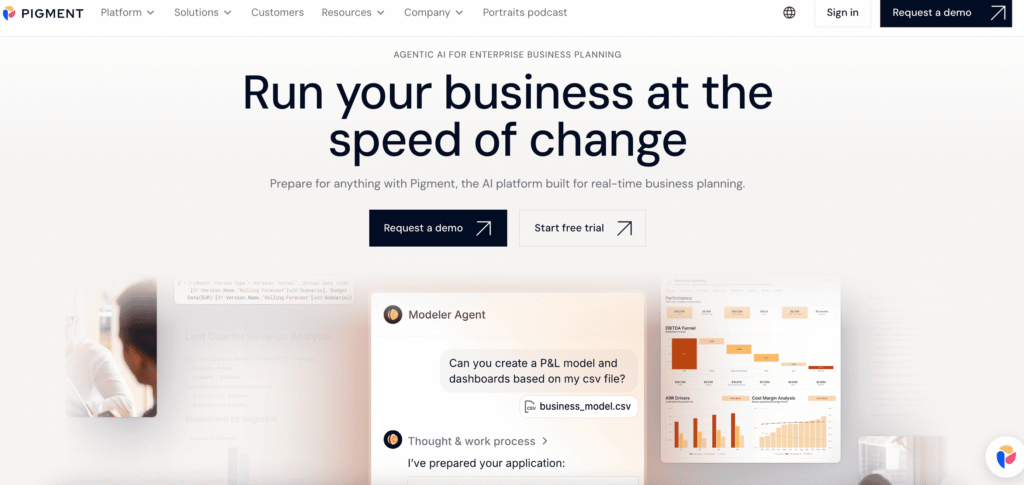
Pigment is a modern business planning platform designed for finance, HR, and operations teams. In 2025, Pigment introduced its suite of AI agents: Analyst, Planner, and Modeler. Each agent is purpose-built to support real-time decision-making and scenario planning.
AI Features:
- Analyst Agent: This AI analyst reviews internal and external data to detect trends, highlight anomalies, and generate visuals and written summaries.
- Planner Agent: Acts on those insights by automatically suggesting revised plans or forecasts, and continuously runs new scenarios based on updated assumptions.
- Modeler Agent: Maintains and updates models as the business changes, such as when a new product line is added or when organizational structures shift.
Benefits:
- Collaborative AI agents: Analyst, Planner, and Modeler agents work together to uncover insights, suggest plans, and update models.
- Proactive recommendations: The Planner agent proposes updated forecasts or strategies based on real-time performance data.
- Continuous model maintenance: The Modeler agent ensures your planning environment stays current and clean, reducing time spent on upkeep.
7. Vena
Vena is a Complete Planning platform that integrates tightly with Microsoft Excel and Power BI. In 2024, Vena launched Copilot, an AI assistant powered by Azure OpenAI.
AI Features:
- Copilot: A natural language interface that allows users to ask financial questions and generate reports in real time.
- Custom AI training: Businesses can tailor Copilot to learn from their historical data, improving results over time.
- Microsoft integration: Copilot works within Excel and PowerPoint, making planning, reporting, and presentations more efficient.
Benefits:
- Natural language queries: Vena Copilot lets you request financial data or generate reports using conversational prompts.
- Excel-friendly workflow: Copilot integrates seamlessly into Microsoft 365 tools like Excel and PowerPoint, streamlining reporting and presentations.
- Custom-trained models: AI adapts over time by learning from your business’s financial history, improving accuracy and relevance with each use.
8. Jirav
Jirav is an FP&A and reporting platform built for startups, SMBs, and accountants. Its Autoforecast feature provides smart forecasting without complex setup.
AI Features:
- Jirav’s Autoforecast capability automatically generates detailed financial forecasts for you based on historical performance.
- It analyzes trends in revenue, expenses, and headcount, then uses those drivers to project future results. The process requires minimal setup and can be completed with a single click, making forecasting accessible even for smaller teams.
- The AI also enables dynamic modeling, linking key drivers and creating dashboards that are ideal for internal use or client-facing presentations.
Benefits:
- One-click forecasts: The Autoforecast tool instantly creates financial projections using historical performance and smart assumptions.
- Driver-based modeling: Jirav automatically identifies business drivers and links them to key financial outcomes.
- Advisory-ready insights: Accounting and CFO firms can deliver immediate value to clients with high-quality, AI-driven forecasts and plans.
9. Fluence (An Anaplan Company)

Fluence focuses on financial consolidation and reporting for mid-sized companies. Following its acquisition by Anaplan in 2025, Fluence is enhancing how it automates multi-entity consolidation.
AI Features:
- Fluence automates the entire consolidation process by collecting and validating data from multiple systems. It applies consolidation rules, performs intercompany eliminations, and produces financial statements without relying on manual spreadsheets.
- The platform’s tight integration with Excel allows finance teams to work within a familiar interface while ensuring consistency and compliance. Real-time validations catch errors early, reducing the risk of delays or restatements.
Benefits:
- Accelerated close process: Automates multi-entity consolidations and eliminates manual reconciliation tasks.
- Excel integration: Financial statements and reports can be created or edited directly within Excel while remaining connected to source data.
- Real-time validations: Built-in checks ensure data integrity and flag errors before final reporting, minimizing compliance risk.
10. SAP Analytics Cloud (SAC)

SAP Analytics Cloud is a planning and business intelligence platform that combines predictive analytics, data visualization, and AI-driven planning in one solution.
AI Features:
- SAC includes Smart Insights, which automatically explains spikes or anomalies in data by identifying their underlying drivers. Smart Predict allows users to build predictive models using built-in ML algorithms, helping finance teams forecast revenue, costs, and cash flow with accuracy.
- Just Ask and Joule bring conversational capabilities to the platform, helping users ask complex financial questions and receive instant visualizations and narrative answers, without needing to manually dig into reports.
Benefits:
- Narrative explanations: Smart Insights reveals the “why” behind numbers without complex manual analysis.
- Forecast-ready modeling: Smart Predict enables fast time-series forecasts that feed directly into planning workflows.
- Conversational interaction: Natural language tools like Just Ask and Joule allow users to ask complex questions and receive instant visual and written answers.
Conclusion
As AI becomes more ubiquitous in the business world, 2026 is shaping up to be the most exciting time to work in FP&A since the advent of spreadsheet software.
The 10 AI FP&A tools listed here represent the best of this new movement and can help FP&A departments of any size or industry work smarter and more efficiently.
FAQs: The Top 10 AI FP&A Tools in 2026
Standout AI FP&A tools excel in three areas: integration, intelligence, and usability. Integration means the tool connects easily with ERP, CRM, and spreadsheet data to build one unified dataset. Intelligence is the depth of the AI itself — whether it just forecasts, or also explains variances, detects anomalies, and recommends action.
Usability matters most in practice: a tool with an intuitive interface, often conversational or spreadsheet-native, gets adopted; one that’s powerful but hard to use won’t deliver results.
AI-based FP&A tools protect data through several layers: encryption in transit and at rest, strict access controls and user permissions, and data isolation between customers even on shared infrastructure. Reputable vendors also don’t use customer data to train shared models, hold compliance certifications like SOC 2, and log every change through audit trails.
Datarails, for example, connects to ERP and CRM systems through FinanceOS with SOC 2 Type II, GDPR, and ISO 27001 compliance built in, and enforces the initiating user’s existing permissions on every AI query rather than granting broader access.
AI enhances FP&A analysis by automating tasks that used to require manual digging: flagging anomalies, generating forecasts from historical data, and answering plain-English questions instead of requiring a built report. It also goes a step further than traditional automation by explaining why a number changed, not just that it did, and by letting teams model multiple scenarios side by side.
Start by identifying your specific use cases — forecasting, variance analysis, or reporting — since tools specialize differently. Then weigh three things: how well it fits your existing data and systems, whether its AI depth matches what your team actually needs (versus paying for capability you won’t use), and whether it scales to your team size. Always test on your own data with a trial or demo before committing — that’s the only real test of fit.
Yes — AI FP&A tools typically start with industry-general models, then adjust as they’re fed your company’s actuals across multiple cycles. The more actual-vs-forecast data available, the more the AI picks up on your business’s specific seasonality and cost drivers, so a tenth forecast is usually meaningfully better than the first.
Traditional FP&A software automates data consolidation and reporting, but analysts still build forecasts and interpret variances manually. AI FP&A tools add a layer on top — generating forecasts, flagging anomalies, and answering questions in plain language — turning analysis that used to take days into minutes.
Reputable finance AI chatbots encrypt data in transit and at rest, enforce the same access permissions a human analyst would have, and avoid using customer data to train shared models. Look for vendors with recognized compliance certifications like SOC 2 — Datarails AI, for instance, operates within FinanceOS’s governed data layer, which applies role-based access controls and logs every query in a unified audit trail. For a closer look at how finance AI chatbots specifically handle security, see how finance AI chatbots handle data security.