Key Takeaways: Finance Operating System Definition
- Infrastructure, not software: A finance operating system sits beneath your ERP, your FP&A tools, and your AI, governing the data layer that all of them depend on.
- It’s all about trust: 61% of finance professionals cite unreliable data as their single biggest barrier to effective analysis — one of the defining AI trends in finance that a finance operating system is built to solve.
- File uploads are not a data strategy: The moment a spreadsheet leaves a governed environment, consolidation logic, version history, and access controls go with it, and no amount of prompting gets them back.
- Turning pilots into production: 60% of AI agents in finance projects will be abandoned through 2026 if they aren’t supported by AI-ready data, and 63% of organizations either don’t have or aren’t sure they have the right data management practices in place.
- Governance is not optional: A variance narrative built on unreconciled data, a forecast reflecting a stale assumption, a scenario model with no audit trail aren’t edge cases. They are the ordinary failure modes of AI applied to ungoverned financial data.
The Problem that FP&A Software Does not Solve
Traditional FP&A systems gave finance teams better modeling environments. What it did not do was fix the underlying data problem. A planning tool that pulls from five different ERP instances, two consolidation spreadsheets, and a manually maintained headcount file is only as good as the integrity of those sources.
AI makes that problem more consequential. When AI applications in finance generate a board narrative or run a scenario, they work with whatever data they are given. If that data is inconsistent, ungoverned, or untraceable, the output is worse than useless. It’s confidently wrong.
61% of finance teams cite unreliable data as their single biggest barrier to getting finance data AI ready and effective analysis, according to the AFP’s 2025 FP&A Benchmarking Survey, and 60% flag inaccessible data as a close second.
FP&A software was designed to help analysts plan and report. It wasn’t designed to govern data at the source, manage access controls across entities, or expose financial information securely to external AI tools. That’s a different engineering problem, and it requires a different category of solution.
What a Finance Operating System Does
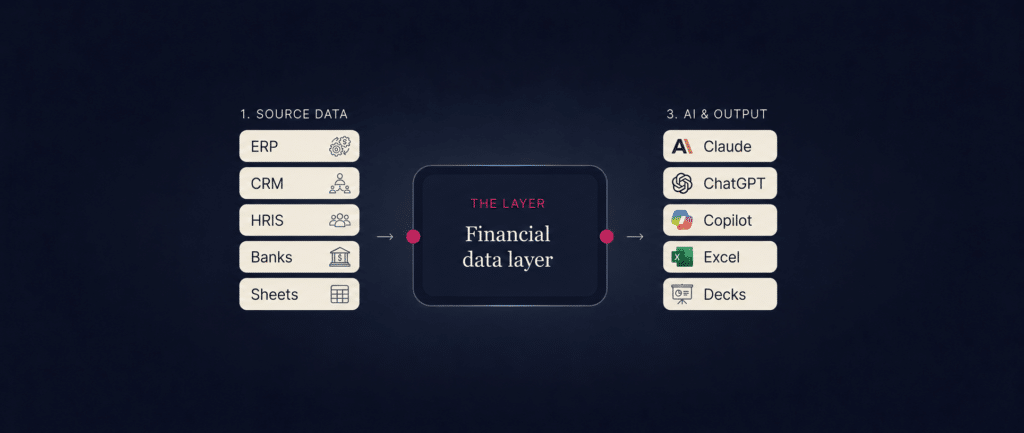
A good finance operating system definition is as follows: a governed data infrastructure layer — the foundation for getting finance data AI-ready — that consolidates financial and operational data from across an organization, applies controls for accuracy, access, and compliance, and exposes the resulting governed data layer to AI agents in finance via an MCP for finance server.
The architecture has three components.
The first is the consolidated data pipeline, which connects ERP, CRM, HRIS, banking feeds, and spreadsheets into a single governed environment. This is where consolidation logic — eliminations, FX, allocations — is applied once and maintained centrally.
The second is a semantic layer, which translates raw database fields into the financial concepts that AI applications in finance can reason about: revenue by region, margin by business unit, cash by legal entity. Without this, an AI may misread account hierarchies, conflate gross and contribution margin, or fail to understand that “revenue” means different things across business units.
The third is a governance framework: role-based permissions, audit logs, and compliance controls that make every AI query traceable back to a verified source.
What this produces is not a planning application. It is the data layer beneath planning applications: the infrastructure that makes AI-generated financial analysis trustworthy enough to act on.
How it Differs from Adjacent Categories
The confusion in the market is understandable because several different product types use similar language. The distinctions matter.
ERP systems record transactions. A finance operating system governs and exposes what those transactions mean, applying consolidation logic, FX adjustments, and intercompany eliminations, and makes the resulting data available to AI. FP&A software provides analytical applications.
FP&A systems provide analytical applications. A finance operating system provides the data infrastructure those applications run on. EPM platforms are typically tied to a specific vendor ecosystem. A finance operating system is model-agnostic. It works with whatever AI tools a finance team chooses to use.
The fintech distinction deserves particular attention. Platforms such as Stripe, Brex, and Ramp are often described as “finance operating systems” in the sense that they consolidate financial operations: payments, expenses, billing. That is a coherent finance operating system definition for a different problem.
Datarails FinanceOS addresses a different challenge entirely: governing financial data and getting finance data AI ready for agents and tools.
Where a Finance OS Sits in the Stack
| Layer | What It Does | Example |
| Transaction recording | Captures financial events | ERP (NetSuite, SAP) |
| Financial operations | Manages payments, expenses, billing | Fintech platforms (Stripe, Brex) |
| Finance operating system | Governs data; exposes it to AI | Datarails FinanceOS |
| Planning applications | Modeling, budgeting, reporting | FP&A software |
| AI tools and agents | Analyzes and generates outputs | Claude, ChatGPT, Copilot |
Datarails FinanceOS connects to more than 600 data sources through purpose-built financial consolidation tools, applying logic including eliminations, allocations, and FX adjustment, and exposes the resulting governed data layer to AI engines via a finance MCP server.
It works with Claude, ChatGPT, Microsoft Copilot, and other leading AI platforms. The key design principle is that the AI tools remain interchangeable. Finance teams are not locked into a single model. The governed data layer is what persists.
What CFOs Should Evaluate
The buying question for a finance operating system is not which features are included. It is whether the solution solves the data trust problem at the source.
There are four core criteria to assess in any evaluation.
First, source connectivity: does the solution connect directly to your specific ERPs, banking providers, and HRIS systems, or does it require manual data preparation upstream?
Second, consolidation logic: does it handle intercompany eliminations, currency adjustments, and entity-level permissions automatically, or do those still require manual intervention?
Third, auditability: can every number that an AI tool surfaces be traced back to a verified source transaction?
Fourth, AI interoperability: does the solution expose data through a standardized finance AI workflow protocol that works with multiple AI tools, or does it lock you into a single vendor’s model?
Those four questions separate solutions that govern financial data from solutions that simply aggregate it.
The Governance Question is not Optional
One reason AI adoption in finance has moved more slowly than in other functions is that finance leaders understand the cost of a confident error. Gartner predicts that through 2026, organizations will abandon 60% of AI projects that aren’t supported by AI-ready data, and 63% of organizations either don’t have or aren’t sure they have the right data management practices in place.
A variance narrative that misattributes a revenue decline, a board forecast that reflects a stale assumption, a scenario model built on an unreconciled source aren’t edge cases. They are the ordinary failure modes of AI applied to ungoverned financial data.
PwC’s guidance on responsible AI notes that without strong governance frameworks, AI systems may produce unreliable results and increase organizational risk, a concern that is especially acute in finance, where traceability is a regulatory requirement, not a preference. A finance operating system is the mechanism by which CFOs establish that AI in finance outputs are trustworthy enough to rely on. That’s a governance requirement.
Finance Operating System Definition FAQs
A finance operating system is a governed data infrastructure layer that consolidates financial and operational data from across an organization, applies controls for accuracy, access, and compliance, and exposes that data to AI tools and agents through a standardized connection protocol.
It is the layer beneath FP&A systems and ERP systems; not a replacement for either, but the infrastructure that makes AI-generated financial analysis trustworthy and auditable.
FP&A systems provide modeling, planning, and reporting applications. A finance operating system provides the governed data layer those applications run on. The distinction is infrastructure versus application. FP&A software helps analysts build models; a finance OS ensures the data feeding those models is accurate, consolidated, and traceable.
MCP stands for Model Context Protocol, a standardized connection protocol that allows AI tools to query data sources in a structured, governed way. An MCP for finance server exposes a governed financial data layer to AI agents in finance such as Claude or ChatGPT, ensuring that those tools work with verified, role-appropriate data rather than raw exports or uploaded files.
No. An ERP records transactions. A finance operating system sits above the ERP, applies consolidation and governance logic to what the ERP records, and makes the resulting data available to AI. The two are complementary: a finance OS typically connects to ERPs as one of its primary data sources.
Organizations with multiple entities, multiple ERP instances, or complex consolidation requirements benefit most immediately. So do finance teams actively deploying AI applications in finance who need a governed data layer those tools can reliably query.