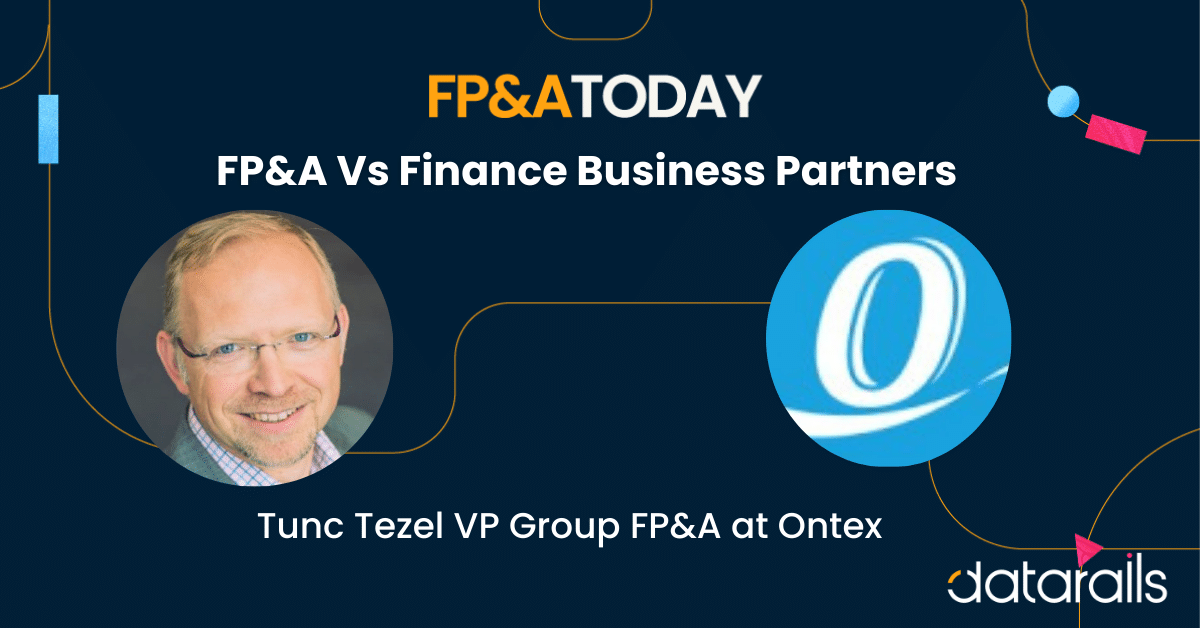
Based on an interview with Tunc Tezel, VP of Group FP&A at Ontex
Click for Quick Takeaways
- Partnering Is a Mindset, Not a Title: More than half of finance leaders say conflicting departmental priorities are the biggest barrier to acting as a true strategic partner. Structure and title alone don’t fix that — only showing up, listening, and proving relevance over time does. Finance that positions itself as a controller will always be the outsider.
- The Co-Pilot Only Works If the Driver Trusts You: Finance adds value when the business leader treats financial guidance the way a rally driver treats the co-pilot’s call — as essential input at speed, not interference to be filtered. That trust is not given; it is built through demonstrated usefulness over time.
- Cash Is Reality, Everything Else Is Context: A single day of improvement in days sales outstanding can unlock tens of millions in free cash flow. Inventory, DSO, factoring costs — when finance makes these connections visible to operations and sales as shared problems rather than audit findings, business decisions improve immediately.
- AI Will Change the Talent Pipeline Before It Changes FP&A Strategy: Finance professionals using AI are already reallocating meaningful time from routine work to higher-value tasks — but the entry-level roles being compressed are the ones that have always trained future leaders. The short-term savings are real; the talent gap is the risk most organizations aren’t yet pricing in.
- Curiosity Is the Core Competency: The finance professionals who become genuine business partners spend time in warehouses, on trade visits, and inside marketing reviews — not because someone made them, but because they wanted to understand how the business actually runs. That cannot be automated or outsourced.
Tunc Tezel has spent 30 years doing what most finance professionals only talk about: actually sitting inside the business.
As head of marketing finance at British American Tobacco, he reported directly to the marketing VP and earned his place in the room by making himself indispensable — not by presenting reports, but by helping the team see where the money was going and what they could do about it. He has since partnered with sales organizations, supply chain teams, procurement departments, and customer CFOs across 11 countries, and he currently serves as VP of Group FP&A at Ontex, a global private-label manufacturer whose products line the shelves at Walmart, Aldi, Tesco, and many others.
In a return visit to FP&A Today, Tunc covered the mechanics of real finance business partnering: what makes it work, what makes it fail, how to handle working capital conversations with people who have never thought about DSO, and what AI’s rise means for the next generation of finance professionals.
What Finance Business Partnering Actually Means
The title debate — FP&A manager versus commercial business partner — is not trivial. Tunc has had it directly with his own leadership, and his position has not changed: the name signals the intent, and the intent shapes the behavior.
“FP&A — yes, we do financial planning and analysis. That’s what we do. But when you get into the details of that, it’s all about sitting next to your sales guy, your marketing guy, your supply chain guy, talking to them, and then making the business decisions together. That’s why I call it partnering. It’s teamwork.”
The distinction he draws is between controlling and genuine finance business partnering. Finance has a controlling function — compliance, accuracy, governance — but that is not what creates value in the business relationship. Value comes from the willingness to engage, to challenge constructively, and to bring FP&A best practices to problems the business is already trying to solve.
The posture matters as much as the analysis. A finance person who walks in with the answer is less effective than one who walks in with the question.
“I’ll always say: let me have a look at it. Let me see if we can make it happen. But then if I cannot, I’ll go back with the explanation, with the analysis. Yes, we can do this, but it’s gonna cost us this much. Is it worth doing it? Can we do it in a different way?”
The result is a genuine dialogue. The business brings back alternative proposals. The company gets better options. That is the mechanism that makes partnering more valuable than reporting.
The Co-Pilot Analogy
Tunc has used the rally car co-pilot framework for years, and it holds up precisely because it captures the mutual dependency that makes finance partnering work.
In a rally car, the driver is going 100 miles an hour through a forest. The co-pilot calls the turns. The driver does not debate or slow down to verify — they act on the information because the relationship has been built on trust and shared stakes. If that trust breaks down, someone gets hurt.
“When you talk to your CEO, marketing director, whoever you report to — you help them with facts and the data and give it in front of them that, okay, this is what we should be doing. And then you discuss. Maybe there’s another way. But at least you need to put it so that you can sell it to the board to improve the shareholder value at the end. One cannot only drive the car without the co-pilot. If somebody tells you there is a tree after that corner, he listens and maneuvers accordingly.”
Building that level of trust is one of the defining FP&A trends separating high-performing finance teams from those still perceived as controllers.e Tunc references Morgan Freeman’s version of a principle he has carried through his career: God gave us two ears and one mouth, and there’s a reason for that. Finance professionals who dominate the meeting they were invited to observe tend not to get invited back. The ones who listen first, absorb the real constraints and pressures the business is facing, and then respond with relevant analysis are the ones who get treated as co-pilots rather than auditors.
The cultural obstacle to this is real. In many organizations, finance is still perceived as a surveillance function — there to find mistakes and report them upward. Overcoming that perception requires a combination of personal consistency and demonstrated restraint: using sensitive information to help the business, not to expose it.
When Business Partnering Breaks Down
Tunc is direct about the conditions under which partnering fails. Most of them come down to information hoarding and cultural defensiveness.
“Sometimes it’s a bit cultural — they see finance as kind of a police. They hold onto information. They see that information is key, and if they share it, they’re gonna lose that privilege. And there you end up with bad results, obviously, because with a few people owning that information, they can only make an impact that much.”
The remedy is not structural — you cannot reorganize your way out of a trust deficit. It is personal. It requires building the relationship at an individual level, explaining what you are there to do and demonstrating it repeatedly until the other side starts sharing the information that actually matters.
Another failure mode is the external partner trap. Tunc describes a promotional effectiveness project at Gillette — cross-functional, internally driven, real belief in the analysis — that produced excellent results because everyone in the room had skin in the game. A later version of the same project, led by external consultants, produced acceptable results but fell short because the team had not owned the process.
“It wasn’t like that family. You had externals in it. They weren’t as open and they weren’t collaborating as much and they didn’t believe in the result.”
Ownership of the analysis drives belief in the conclusion. Belief in the conclusion drives action on the recommendation. That chain only functions when the people doing the work are also the people who have to live with the outcome.
Working Capital: Finance as the Link Between Functions
Tunc’s account of supply chain and procurement partnering is where the financial translation function becomes most concrete.
Every function has its own natural bias around cash flow management. Operations wants full shelves so they never miss a customer order. Sales wants inventory on hand to say yes to every call. Procurement wants to extend payment terms as far as possible. None of these functions, left to their own devices, will optimize for the company’s free cash flow. That is what finance brings.
“Sales is vanity, profit is sanity, and cash is reality at the end. If you explain that to them and put it into their objective so that everybody has a common objective — we need to deliver free cash flow to the company, part of that is working capital — then they understand.”
His preferred teaching method is not a presentation. It is a question. When a sales leader describes a customer as highly profitable, Tunc asks: how many days of stock do you carry for them? How many days does it take to collect the cash?
“Oh, 70 days of stock and 90 days to collect. Okay, so we’re talking about 160 days of money tied up. They’re like, ‘Oh, okay. Something is not right there.'”
According to research on DSO optimization, a single day of improvement in days sales outstanding is one of the fastest ways to improve working capital — unlocking tens of millions of dollars in free cash flow for large organizations — a figure that makes even modest DSO reductions strategically significant. Finance is usually the only function in the building doing that math, and the value of business partnering is making that math visible to the people who can act on it.
The same logic applies to factoring. Some sales leaders, hearing the DSO concern, respond that the company does factoring anyway, so the receivables are covered. Tunc’s reply is immediate: factoring has an interest cost. The sooner cash comes in, the less that cost is. The conversation compounds.
He took this thinking all the way to the customer’s CFO, turning what began as a cash management conversation into a negotiation over payment terms that both sides could benefit from. The logic landed because it was expressed in terms the customer’s own finance team understood — shared working capital pressure, not commercial leverage.
The Procurement Partnership
Procurement is the function Tunc describes with the most admiration. Results-driven, detail-oriented, willing to go wherever the analysis points, and permanently focused on the next round of savings.
His key insight is that cost reduction through supplier negotiation has a natural ceiling. You can negotiate price reductions in year one, year two, and maybe year three. By year four, the supplier has nothing left to give. At that point, the only path forward is product-level change: simplification, standardization, portfolio rationalization, and consolidation of volume to drive economies of scale.
“If I were buying 100 from three different suppliers, but now I’m consolidating everything — what do you say if I bring the 300 to you? Then you get a higher discount with the growth and everything, rather than splitting into three.”
At Ontex, this logic extends into customer conversations. Private label manufacturing produces a proliferation of SKUs — different products for different customers, each with its own specification. Convincing customers to select from a standardized catalog rather than requesting bespoke items allows procurement to consolidate volume, improve supplier terms, and share the savings. The customer benefits. The company benefits. The supplier relationship deepens.
The metric Tunc cites for the current program: approximately €60 to 65 million in annual savings — the compounded result of working capital management, procurement discipline, and SKU rationalization. That figure is the output of continuous, compounding collaboration between finance, operations, and procurement — not a one-time negotiation win.
Central vs. Embedded: Not an Either/Or
Tunc now operates at the group FP&A level, which means his primary lens is portfolio management — allocating capital across markets and functions to maximize returns at the enterprise level. That vantage point is only possible because he spent years embedded in the operations themselves.
The two models are not in competition. Embedded finance partners execute at the front line — attending customer meetings, working through trade visits, and understanding what the warehouse constraints actually are. Central finance integrates those inputs, compares them across geographies and business units, and makes the resource allocation decisions that no individual embedded partner has the view to make.
“When you look at it from a group perspective, you see that you have hundreds of marketing investments that you need to allocate. It’s easy to say 10 each, done. Whereas if you try to explain, ‘I’m gonna give you 50, because I believe that you’re gonna massively grow the business’ — but then it’s at the expense of the others. That’s where it becomes tricky.”
The political management required at that level — convincing the general managers who are not receiving incremental funding that the allocation serves the broader company interest — is only possible when everyone’s objectives are genuinely aligned. Tunc describes it as a chess game: competitive pressure in one market forces a competitor to allocate resources there, freeing up space in others. That strategic view is not available to the embedded partner. It requires the altitude of the central function.
According to a SAP Concur survey of finance leaders, 58% of CFOs cite conflicting departmental priorities as the biggest barrier to acting as a strategic partner across the business — exactly the tension that the central/embedded model, when it functions well, is designed to resolve.
AI and the Entry-Level Pipeline Problem
Tunc is candid about AI’s trajectory. The tools are improving fast. The meeting summarization he experienced — three hours of brainstorming distilled to five action points, more useful than his own handwritten notes — is a preview of how quickly AI is compressing work that used to take significant time.
“It’s getting there. When you give it numbers, presentations and such, they do the skimming, come up with an executive summary, the real key points highlighted. It’s great. We need to use it.”
But the concern that sits alongside the efficiency gains is the talent pipeline. The entry-level roles being automated first are the ones that have historically served as the training ground for finance leaders. Tunc’s son is graduating into a market where those roles are shrinking. The short-term calculus makes sense for companies; the long-term consequence is less clear.
“You need to have those university grads coming in so that you kind of mold them into how you want them to think, for your company, they’re part of the culture, and then they grow with you. If you replace this with AI, okay, you’re gonna have some savings. But in five years’ time, they will say, ‘Oh, we don’t have the talent.’ We need to find the balance there somehow.”
Research published in 2025 by Stanford and MIT, based on 277 accountants, found that professionals using AI applications in finance experienced a 55% increase in weekly client support capacity and were able to reallocate approximately 8.5% of their time from routine data entry to higher-value work. The productivity case is real. Whether organizations reinvest that capacity into developing junior talent or simply reduce headcount is the strategic question that will define the next decade of the profession.
The human element, in Tunc’s framing, is not going away — and no amount of AI in finance changes the fact that finance ultimately presents to people, advises people, and influences decisions made by people. AI can prepare the analysis. It cannot build a relationship.
Advice for Early-Career Finance Professionals
For those starting out, Tunc’s advice is consistent with everything else he describes: go toward the business, not away from it.
“Don’t limit yourself. Go and trade with the sales guys. Understand how customers are buying. Go and see shopper behavior. Go to the supply chain, go and work in the warehouse for a couple of days. Understand what these guys are doing, what the bottlenecks are. You’re starting your career, you don’t have any baggage — you are just open to learning, you’re like a sponge. Whatever they give you is gonna stick there.”
Curiosity is the word he returns to. Not technical skill, not certification, not domain expertise — curiosity. The willingness to spend time somewhere unfamiliar and absorb what is actually happening. That exposure is what transforms financial outputs from numbers into stories, and stories are what move people.
The cautionary example comes from his time in the Middle East. A marketing director based in London kept issuing 20% growth targets for a personal care category in Saudi Arabia — a market where the sales team was working 10-hour days in plus-50-degree Celsius heat, covering a limited number of physical shop locations. When Tunc arranged for the director to accompany the sales rep on a trade visit, the targets were never issued the same way again.
Boots on the ground is not a soft skill. It is the information infrastructure that keeps planning connected to reality.
Where Datarails Fits in
The work Tunc describes — translating volumes into values, linking the plans of marketing, sales, supply chain, and procurement into a coherent P&L view — is exactly the function FP&A exists to perform. And it is exactly where most finance teams lose the most time.
Datarails is the AI-powered FP&A platform built for Excel users. It consolidates financial data from ERPs, accounting systems, and and spreadsheets using purpose-built financial consolidation tools into a single governed source of truth, without requiring teams to abandon the workflows they already know. From that foundation, it enables real-time variance analysis, dynamic financial forecasting, and narrative generation — the forward-looking, decision-support work that defines effective FP&A.
When finance teams spend less time gathering and reconciling data, they spend more time doing what Tunc describes: sitting next to the business, asking the questions that surface the real constraints, and turning financial insight into the kind of operational action that defines effective finance business partnering.
To learn more about how Datarails supports FP&A teams at every stage, visit datarails.com.
About Tunc Tezel
VP of Group FP&A at Ontex, a publicly listed global private-label manufacturer whose products are sold through Walmart, Aldi, Tesco, and other major retailers. Over a 30-year career spanning 11 countries, Tunc has served as head of marketing finance at British American Tobacco, partnered with sales, supply chain, and procurement teams across multiple industries, and worked directly with customer CFOs on working capital and payment term negotiations. He is a frequent contributor to the FP&A Today podcast.
Connect with Tunc on LinkedIn.
FAQs
FP&A is the activity — financial planning and analysis — and understanding what FP&A means in practice is the starting point for any genuine business partnering model. Finance business partnering is the operating model: embedding finance professionals inside business functions so that analysis informs decisions in real time, not after the fact. The distinction matters because it changes how the finance function is organized, measured, and perceived.
By listening before speaking, demonstrating relevance before asserting authority, and using sensitive business information to help the team rather than to report on it. Trust is earned incrementally through consistency — showing up, following through, and being useful enough that the business starts including finance in decisions proactively.
By making the cash flow management implications of operational decisions visible. Operations and sales teams do not naturally think in terms of DSO, inventory days, or the cost of factoring. Finance translates those metrics into terms that connect to the decisions each function is already making — and the conversation usually produces immediate improvement.
It looks like portfolio management — allocating disproportionately to the highest-return opportunities even when that creates short-term friction with the markets or functions receiving less. The prerequisite is that all stakeholders understand and have agreed to the company-level objectives that drive the allocation, so that the decision is seen as strategic rather than arbitrary.