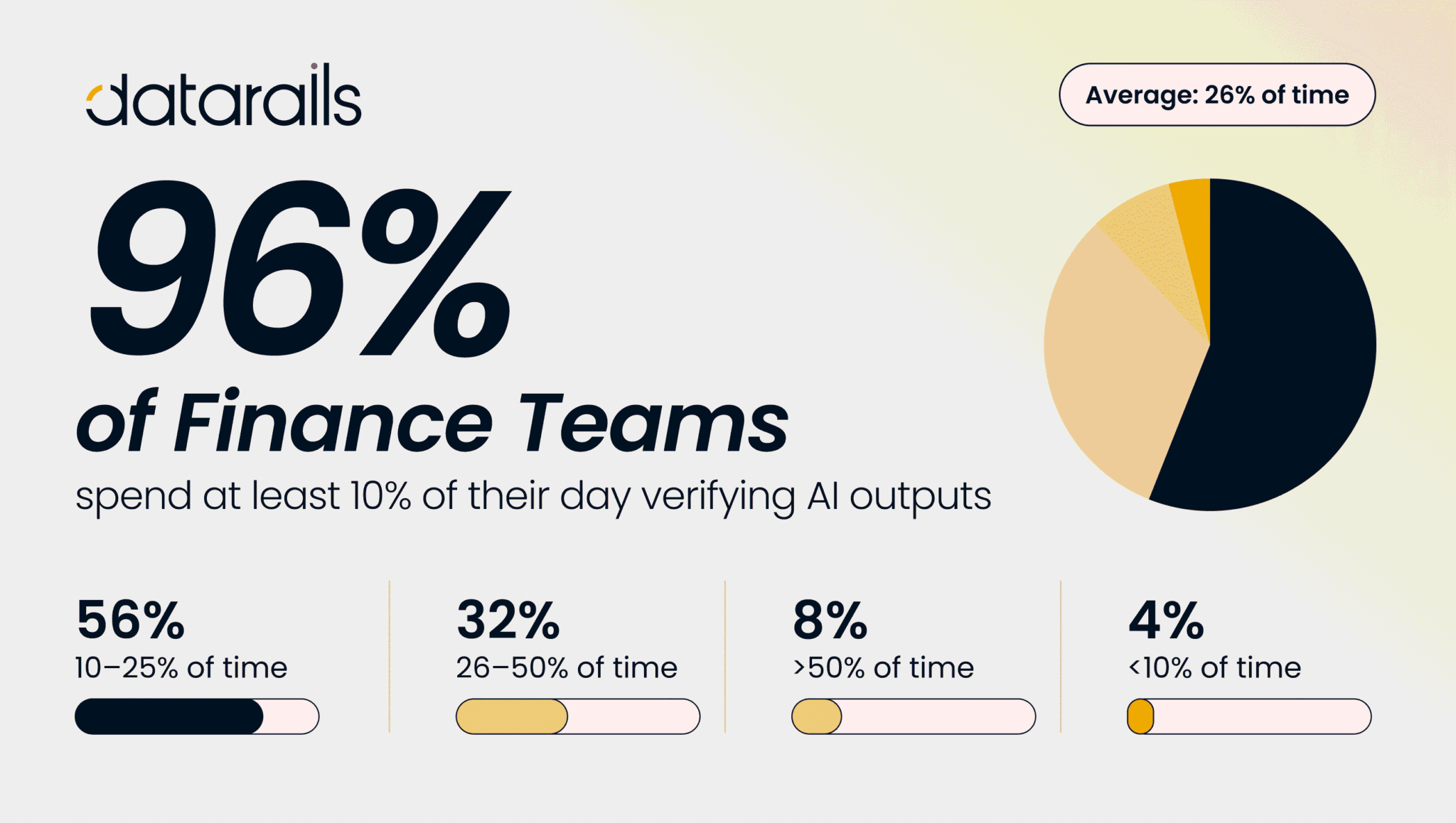
Click for Takeaways: AI and Data Management in Finance
- Finance teams are adopting AI faster than the data architecture beneath them can keep up; many now run AI tools across multiple use cases, and under the traditional model each new tool demands its own governed data connection.
- Traditional ERP integration (scheduled file extracts, custom APIs, and ETL pipelines) was built for a handful of downstream systems, and it breaks down when every new AI tool needs its own connection to build, govern, and maintain.
- Datarails FinanceOS addresses this at the architecture level: it integrates with 600+ data sources, consolidating everything into one fully governed, semantically structured financial data layer, then exposes it through a single MCP server that any compliant AI tool can query.
- Governance, access controls, and audit logging are applied once at the protocol level and extend to every tool, rather than being rebuilt — or quietly skipped — for each new addition.
- With 86% of finance teams still early in their AI rollout, the durable advantage comes not from having the most AI tools but from having the cleanest, best-governed data layer underneath them.
It started with one. A planning team piloted an AI assistant to speed up variance commentary. It worked, so another team added one for revenue forecasting. Someone in corporate finance connected Microsoft Copilot to the reporting layer. An FP&A analyst started using Claude for board narrative drafts. Six months later, the finance function has five AI tools in active use – and five separate data problems to solve.
This is the pattern playing out as AI in finance accelerates across every industry right now. The AI adoption curve is accelerating: more than half of CFOs are increasing their AI investment by over 15% this year, even as most concede they haven’t yet scaled it. What has not kept pace is the data architecture underneath it, the foundation that makes finance AI workflows trustworthy enough to scale..
Every new AI tool that needs access to financial data is, under a traditional integration model, a new integration to build, govern, and maintain. Multiply that by the number of tools a modern finance team is deploying, and the engineering backlog becomes unmanageable before the business value has had a chance to materialize.
There is better architecture. But to understand why it works, it helps to understand exactly why the traditional model breaks under this kind of pressure.
One Tool, One Integration, and Why That Math No Longer Works
Traditional ERP integration was designed for a world where FP&A systems had a small number of downstream connections to manage. The connections it produced came in three forms.
The first was file-based extraction: a scheduled job exports data from the ERP into a CSV or flat file, picked up by the downstream system on a defined schedule. It is the most common approach in mid-market environments and the most fragile. Schema changes in the ERP break the downstream mapping, and there is no feedback mechanism when the extraction fails silently.
The second was API integration: more reliable, but each connection is custom-built, and when the ERP vendor updates its API, the integration breaks until someone fixes it.
The third was a middleware or ETL pipeline sitting between the ERP and downstream systems, the most robust traditional approach, and also the most expensive to build and operate. In all three cases, the integration delivers data to a specific destination in a specific format for a specific purpose. When the destination changes or when a new consumer appears, the integration has to be extended or rebuilt.
That model was already expensive to maintain before AI entered the picture. NetSuite, SAP, and Oracle all update their APIs regularly, and every update has the potential to break the custom integrations built against them. In organizations running multiple ERPs (SAP at the group level, NetSuite at the subsidiary level) the integration surface was already multiplying faster than most IT teams could manage.
59% of finance functions now report using AI and since the leading tools each have their strengths and weaknesses, stacks of five or more LLMs are common. But when each one requires access to financial data, its own governed connection, and its own maintenance needs, the traditional integration model does not scale. The math simply does not work.
A Single Governed Interface for Every AI Tool
Datarails FinanceOS solves this at the architecture level rather than the integration level.
It connects to over 600 data sources and applies the kind of consolidation logic that purpose-built financial consolidation tools provide — making multi-entity financial data trustworthy before any AI tool ever touches it: intercompany eliminations, FX adjustments, allocations, and chart of accounts normalization across systems that use different schemas and different conventions. The result is a single, governed, semantically structured financial data layer.
That layer is then exposed through an MCP for finance — a protocol-level interface built on Model Context Protocol, Anthropic’s open standard that defines how any compliant AI tool queries structured data from any compliant source. Claude, ChatGPT, Microsoft Copilot, Gamma, Lovable – any MCP-compliant tool queries the same server using the same protocol.
A finance team running AI agents in finance does not build a new integration every time a new tool is added. It connects the new tool to the existing MCP server, which already has the governance, the access controls, and the audit logging built in.
One governed interface for every finance AI workflow. Any AI tool. No bespoke integration for each new addition.
One clarification worth making explicit: MCP does not replace the ERP. NetSuite continues to record transactions. SAP continues to run the financial close. Oracle continues to manage the consolidation. The connections between Datarails FinanceOS and those source systems still exist and still need to be maintained. What MCP eliminates is the need to build and maintain a separate integration for every AI tool that needs access to financial data on top of that. The ERP layer stays. The sprawl of bespoke AI connections does not.
Governance That Travels With the Data
The other problem the traditional model cannot solve is governance. Every custom integration built for an AI tool has its own governance logic (or more accurately, lacks consistent governance logic) applied at the destination after data has already been extracted. When a new AI tool is added, its governance is someone’s responsibility to configure separately. In practice, it frequently does not get configured at all until something surfaces a risk.
With the Datarails FinanceOS MCP server, governance is applied at the protocol level before any data is returned. When an AI tool sends a query, the server validates it against the access permissions of the user who initiated it. If that user cannot see executive compensation data, the AI cannot retrieve it. The query is logged, the data lineage is recorded, and every output is traceable back through the consolidation layer to the originating transaction in the source ERP.
The governance does not need to be rebuilt for each new AI tool. It applies universally, by design, to every finance AI workflow that queries through the MCP server.
The Right Foundation for What Finance AI Becomes Next
The finance teams building real competitive advantage from AI applications in finance right now are not the ones with the most tools. They are the ones with the cleanest data layer underneath those tools: Governed, consolidated, and structured in a way that makes AI outputs trustworthy enough to act on. With 86% of finance teams still in the early stages of AI adoption, the foundation is what separates the teams that scale AI from the ones that stall.
The number of AI tools asking for access to financial data will keep growing. When it comes to AI and data management in finance, the question is whether each new addition requires a new bespoke connection, or whether the architecture is built around getting finance data AI-ready from the start.
AI and Data Management in Finance FAQs
MCP for finance is an open standard, introduced in late 2024 and since adopted across the major AI providers, that defines how any compliant AI tool queries structured data from any compliant source. Rather than building a custom connection for each tool, you expose your financial data once through an MCP server, and every compliant tool queries it the same way.
No. MCP does not replace the ERP. NetSuite, SAP, or Oracle continue to record transactions, run the close, and manage consolidation exactly as before. The connections between those systems and Datarails FinanceOS still exist and still need to be maintained. What the finance operating system removes is the need to build and govern a separate integration for every new AI tool that wants access to financial data.
A direct tool-to-ERP connection only sees one system’s raw data, with no consolidation logic applied. FinanceOS first consolidates 600+ sources into a single governed layer — handling intercompany eliminations, FX adjustments, allocations, and chart-of-accounts normalization — so every AI tool queries trustworthy, consolidated numbers rather than raw extracts from one system.