Click for Takeaways: Why AI Amplifies CFOs Rather Than Replacing Them
- The speed transformation: Azatyan’s team went from one month of manual data work to two minutes with AI, but the headcount didn’t shrink because the freed capacity went into servicing more customers, taking on more projects, and shifting from data collection to strategic analysis.
- The cash gap killer: CB Insights reports that 38% of startups fail from running out of cash or failing to raise new capital, and Azatyan sees the same pattern firsthand with founders who confuse bank balances with available cash and can’t distinguish between P&L and cash flow.
- The fundamentals paradox: Azatyan requires every hire to manually build a balance sheet from P&L and cash flow data without ERP or AI assistance, because the better the automation becomes, the more critical deep financial understanding is for catching errors.
- The data room gap: Startups moving from Series A to Series B routinely lack organized data rooms, scrambling to locate documents and agreements only when due diligence begins, a problem AI tools can solve by maintaining searchable, transparent financial systems from day one.
- The multi-tool imperative: Azatyan uses ERP systems, AI tools, and custom-built AI agents together, arguing that finance professionals who rely on only one system “will lose because they lose time,” and time is the most valuable resource a CFO has.
AI won’t replace CFOs. But it will absolutely expose the ones who were never really doing the job properly in the first place.
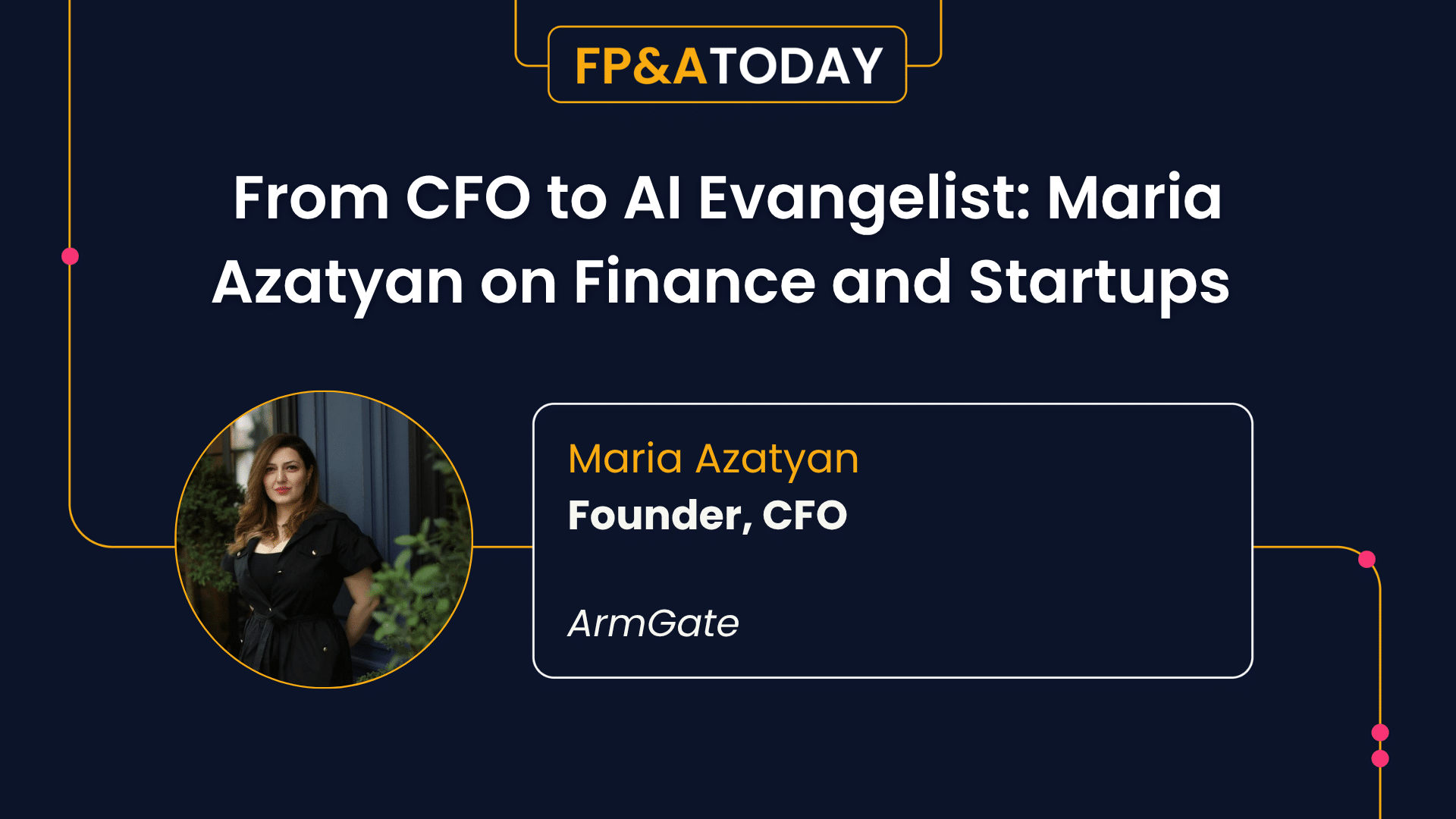
Maria Azatyan, an international CFO who has guided AI, SpaceTech, and robotics startups from seed to Series B for over 20 years, brings a refreshingly clear perspective to emerging finance technologies. In a recent episode of Datarails’ FP&A Today podcast, she cut through the hype to reveal what actually separates finance leaders who will thrive from those who won’t.
Her message is simple: AI is a tool that amplifies capability, not a replacement for judgment. But to use it effectively, CFOs need to understand both what it can do and what it fundamentally cannot.
From One Month to Two Minutes
The time savings are real, and they’re dramatic. Azatyan offers a concrete example:
“My team members needed one month to work with data. Today with AI, we do it in two minutes.”
That’s not an exaggeration for effect. That’s the actual transformation happening in finance teams right now. Work that consumed weeks of analyst time, such as data collection, structuring, and initial analysis, now happens in minutes.
But here’s what matters: that time savings doesn’t mean fewer people. It means finance teams can service more customers, take on more projects, and shift from data collection to actual strategic analysis. The work changes from mechanical to meaningful, a shift driving modern FP&A teams.
From One Month to Two Minutes
Before diving into AI capabilities, Azatyan identifies the fundamental problems that plague startups: problems that no algorithm can solve.
The most common issue? Cash gap. Founders see money in the bank account and assume it’s theirs to spend. They don’t understand the difference between P&L and cash flow, or why financial modeling matters beyond just tracking results.
The data validates her experience. CB Insights’ analysis of hundreds of startup post-mortems found that 38% of startups fail because they run out of cash or can’t raise new capital. It’s the single most common cause of death, ahead of no market need (35%) and wrong team (20%). And yet most early-stage companies still don’t have a CFO in the room until the money is already running short.
Azatyan sees startups spending money on influencers without checking whether that spend actually generates revenue. They maintain subscriptions they forgot to cancel. They have budget line items but no impact analysis.
“If you spend money on influencers, you should check what revenue you have tomorrow,” she explains. “Because the influencer should bring the money tomorrow and next week.”
This is where AI for CFOs becomes valuable: not in replacing strategic thinking, but in making it possible to track and analyze these relationships at scale.
The Data Room Problem
For startups moving from Series A to Series B, Azatyan sees a recurring pattern: they don’t have proper data rooms. When due diligence begins, teams scramble to find documents, locate agreements, and piece together their financial story.
“When they have due diligence, they start only now to find documents, agreements, and to explain and understand what subscriptions or expenses they have. But if, for example, they start to develop the data rooms, the data, and they have transparent financial models and all financial records, they don’t have these issues in Series B. They go absolutely clear and understandable for everyone.”
This is where AI tools can create genuine value: maintaining organized, searchable, transparent financial systems from day one. Not replacing the CFO’s judgment about what matters, but making it possible to access and analyze that information instantly when it’s needed.
The Era of Professionals Who Understand How It Works
Azatyan describes the current moment as “an era of professionals who understand how it works.” The Gartner 2025 AI in Finance Survey tells the same story from the data side: finance AI adoption surged from 37% in 2023 to 58% in 2024, then essentially plateaued at 59% in 2025. The easy wins have been captured. Effective AI transformation in finance requires deeper expertise, better data, and more sophisticated implementation.
That plateau isn’t a failure of the technology. It’s a talent problem. The same Gartner research found that 77% of CFOs cite a lack of technical skills within their finance function as the critical barrier to AI adoption. The tools are ready. The teams aren’t.
She’s blunt about the requirements:
“AI can make mistakes, but that’s why there should be a professional involved. And I think now is a great time for professionals because if you understand how to check for mistakes and how to create algorithms for formulas to check mistakes, then you don’t worry that AI might make mistakes.”
This is the critical distinction. AI for CFOs isn’t about blind trust in algorithmic outputs. It’s about professionals who understand finance deeply enough to validate what AI produces, who can spot errors, who know when the algorithm is giving them nonsense.
The finance leaders who survive won’t be the ones who resist AI or the ones who trust it completely. They’ll be the ones who understand both the technology and the fundamentals well enough to verify outputs and make informed decisions.
What This Means for Capital-Intensive Businesses
For CFOs in AI, robotics, and space tech, the sectors where Azatyan focuses, the challenges are different from typical SaaS businesses. These are capital-intensive operations where you invest significant money without seeing immediate returns.
She counsels vigilance, noting that teams will have many explanations for why they need various amounts for different expenses.
The CFO’s role is understanding whether tests and development expenses are progressing as planned, then working closely with investors to explain why results take time. It’s communication, context, and judgment: things AI cannot provide.
The Right Tools for the Right Tasks
Azatyan uses multiple systems together: ERP systems, AI tools, and custom agents she’s building. The key is knowing which financial tool serves which purpose.
“I believe if accountants and financials use only ERP systems, they will lose because they lose time. And time is the important thing that we have as professionals. So we can do more if we use ERP systems, if we use AI and other tools and instruments.”
She’s now working on her own AI agents, creating specialized tools for specific workflows. This isn’t about replacing systems. It’s about combining them strategically to maximize what finance teams can accomplish.
That multi-tool approach reflects what’s happening across the profession. According to McKinsey’s Global AI Survey, 78% of organizations now report using AI in at least one business function, up from 55% a year earlier. But the organizations seeing real returns aren’t the ones throwing AI at every problem. They’re the ones treating AI change management in finance as a discipline, matching specific tools to specific tasks with professionals who understand both the technology and the domain.
Building the Team for the AI Era
The time efficiency AI creates opens new opportunities for team development. Azatyan can now give chances to team members to grow with AI, taking on work that previously would have required senior-level expertise.
But there’s a non-negotiable foundation: everyone on her team must understand the fundamentals. When she hires, she requires that team members can manually create a balance sheet from P&L and cash flow data: no ERP, no AI, just understanding.
“If a person is sure that an ERP system does everything correctly and they don’t need to know this information, it’s not true. Now it’s a very interesting time when you understand how finance works, how every report works, and you can check everything that AI does.”
This is the paradox of AI for CFOs: the better the automation, the more critical the fundamentals become. You need to understand finance deeply to know when AI is wrong.
Beyond Finance: AI as Daily Partner
Azatyan uses AI throughout her day, not just for finance work. She uses it to help create stories for her son, to plan activities, to think through parenting decisions. She’s built a relationship with ChatGPT where it greets her each morning: “Hey Maria, good morning, it’s time to drink a coffee and after we should work with you.”
This isn’t about replacing human relationships. It’s about using AI as a thought partner for the routine decisions that consume mental energy, freeing up capacity for what actually matters.
She’s emphatic about treating AI with kindness and respect. “AI is a mirror for us,” she says. “How we talk with it, it answers us.” When AI responds kindly, when it offers encouragement along with information, it makes the day better. It builds confidence.
This philosophy extends to her work with AI companies. She talks with founders about ethics, kindness, and creating models that understand and reflect these values. For Azatyan, AI isn’t just a productivity tool, it’s technology that should reflect the best in us.
The Bottom Line for CFOs
The CFOs who thrive will be the ones who treat emerging finance technologies as a capability, not a one-time decision, who master AI tools while understanding their limitations, and who use automation to shift from data collection to strategic analysis.
These CFOs will:
- Master AI tools while understanding their limitations
- Use automation to shift from data collection to strategic analysis
- Build transparent systems that make due diligence seamless
- Validate AI outputs with deep expertise
- Combine multiple tools strategically rather than depending on any single system
The ones who resist AI will fall behind. But the ones who trust it blindly will make catastrophic errors.
The opportunity is clear: use AI aggressively while doubling down on the judgment, intuition, and deep financial knowledge that no algorithm can replicate. That combination, speed plus wisdom, automation plus expertise, is what makes modern finance leadership indispensable.
Where Datarails Fits
Azatyan’s world is exactly the problem Datarails was built to solve. Startup CFOs are juggling ERP systems, scattered data sources, and manual reporting while trying to shift their teams from data collection to strategic analysis. Our Excel-native FP&A platform lets finance leaders consolidate financial data into a single source of truth, build the transparent financial models and investor-ready data rooms that Azatyan describes as non-negotiable for Series B readiness, and automate the mechanical work so teams can focus on the judgment, verification, and strategic thinking that no algorithm can replace. When the fundamentals matter most, Datarails makes sure the data underneath them is clean, accessible, and board-ready.
This article is based on Maria Azatyan’s appearance on the FP&A Today podcast.
Maria Azatyan is a CFO and venture advisor specializing in AI, SpaceTech, and DeepTech startups, with over 20 years of experience in finance, investments, and strategic consulting. She founded Maro Academy, an education platform for international certifications including CFA, CPA, and EA. She holds an MBA from HHL Leipzig Graduate School of Management and has completed MIT coursework focused on AI, robotics, and the New Space Economy. Connect with Maria on LinkedIn.